RICHARD: You never went to college, let alone an Ivy League college.
Lorelai did go to college. She studied Business part-time at the community college in Hartford as a mature student. Presumably Richard means that she never went to college straight from school. It does sound as though he is saying Lorelai’s education just doesn’t count, which is pretty hurtful, considering how much work it took for her to graduate while working full time.
RICHARD: Oh, I told him all about you and your grades and how well you were doing at Chilton. Well, of course, he insisted on seeing you. He wouldn’t let me off the hook.
RORY: But I haven’t applied to Yale.
RICHARD: Oh, I told him that you weren’t finished deciding, that you were being very picky. I think that made him want you even more. They can be very competitive, these Ivy League schools. He’s expecting you at three. Oh, look, it’s three now. Well, we timed this perfectly now, didn’t we?
While showing them the Administration Building, it transpires that Richard’s real reason for bringing Rory to Yale is to get her an interview with the Dean of Admissions, who turns out to be a good friend of Richard’s (shades of Chilton, where Headmaster Charleston was a good friend of Richard and Emily’s).
Lorelai is outraged by Richard’s manipulation, but he has a point. Lorelai has got a bee in her bonnet about Rory going to Harvard and nowhere else, and this was the only way that Richard believed he could give his granddaughter a chance to go to Yale if she wanted to. As he points out, Ivy League colleges are very competitive, and it would be easier for Rory to get into Yale as a legacy, because her grandfather went to Yale.
Although Emily didn’t know what Richard planned to do, she does try to defend him from Lorelai. She points out that if Rory got accepted by Yale, it might make her more attractive to Harvard, which I don’t think Lorelai would have thought of by herself.
Charles Dickens made his first trip to the US in 1842, and did visit New Haven and Yale University, praising both. In 1868, after another trip, he described Hillhouse Avenue in New Haven as the most beautiful street in America. It’s possible he really did drop a pencil somewhere on campus!
Yale University does have a quill pen once owned by Charles Dickens [pictured], held at the Beinecke Rare Book and Manuscript Library at Yale University. Richard may have taken Rory to see it, inspiring Emily’s comment.
[The four of them are walking through the administration building]
RORY: Wow.
LORELAI: Lions and tigers and bears . . .
RORY: Oh my.
Lorelai and Rory are referencing the film, The Wizard of Oz, previously discussed, and a touchstone for the show.
In the film, Dorothy is walking through a dark forest with the Tin Man and the Scarecrow, and they become frightened by noises in the foliage. The Scarecrow wonders if there might be animals in the forest, and the Tin Man suggests there are lions and tigers and bears, which the others nervously repeat.
Dorothy gasps, “Lions and tigers and bears! Oh, my”. Pretty soon the three of them are skipping through the forest chanting, “Lions and tigers and bears, oh my”.
In fact, the very next creature they meet is a lion – the Cowardly Lion, who soon becomes their companion on the quest to see the Wizard of Oz.
Lorelai is suggesting that the administration building is intimidating, like the dark, scary forest, and that they need to keep their spirits up, like Dorothy did in the film. Like Dorothy, Rory will soon be confronted by a “scary” unexpected interview, although like the Lion, it won’t really hurt her.
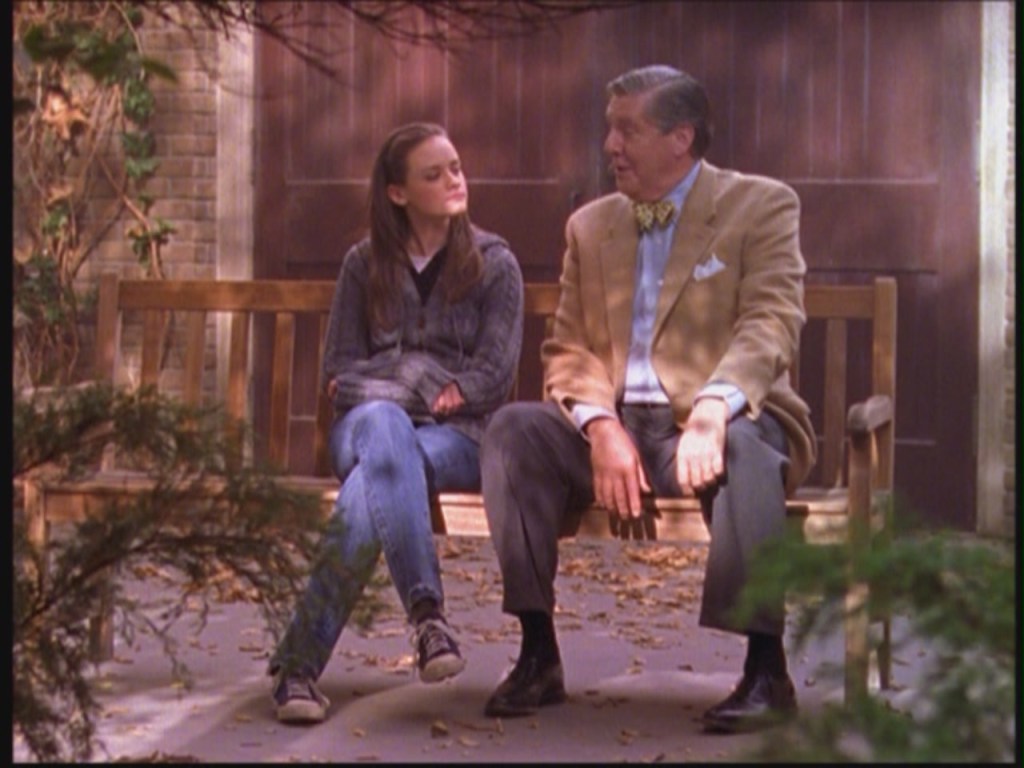
RICHARD: You know, one day, when your mother was ten years old, she ran into my office and she said, “I’m going to go to Yale, just like you.” She actually took my diploma out of my office and put it in her room. She wouldn’t give it back to me for about six months.
Rory learns from Richard that Lorelai’s original dream for college, was not Harvard, but Yale. This was when she was ten years old, and presumably before her teenage years drove a wedge between father and daughter.
Richard’s point could not be clearer – if Rory is hanging onto a dream of going to Harvard to fulfil what Lorelai wanted, then that wasn’t even Lorelai’s original plan. And if Lorelai changed her mind, then Rory can too.
RICHARD: See that? That is my favorite building in the whole school … Because that’s where the Timothy Dwight Dining Hall is.
This is the dining hall of Timothy Dwight College, a residential college at Yale University which opened in 1935. Presumably it was Richard’s old college. The dining room at the college is a replica of a New England town hall with maple tables and captain’s chairs. According to Richard, they serve a delicious pot roast (one of Rory’s favourite meals), although that no longer seems to be on the menu.
LORELAI: If I had a thumbtack, I could make a Scud missile.
Scud missile, one of a series of tactical ballistic missiles developed by the Soviet Union during the Cold War. It was exported widely to both Second and Third World countries. The term comes from the NATO reporting name attached to the missile by Western intelligence agencies. In use since the 1970s, they became familiar to the public in the West during the 1991 Persian Gulf War.
EMILY: And what do you intend to do with that paper clip? LORELAI: I intend to carve something really dirty into the bathroom door … What rhymes with Nantucket?
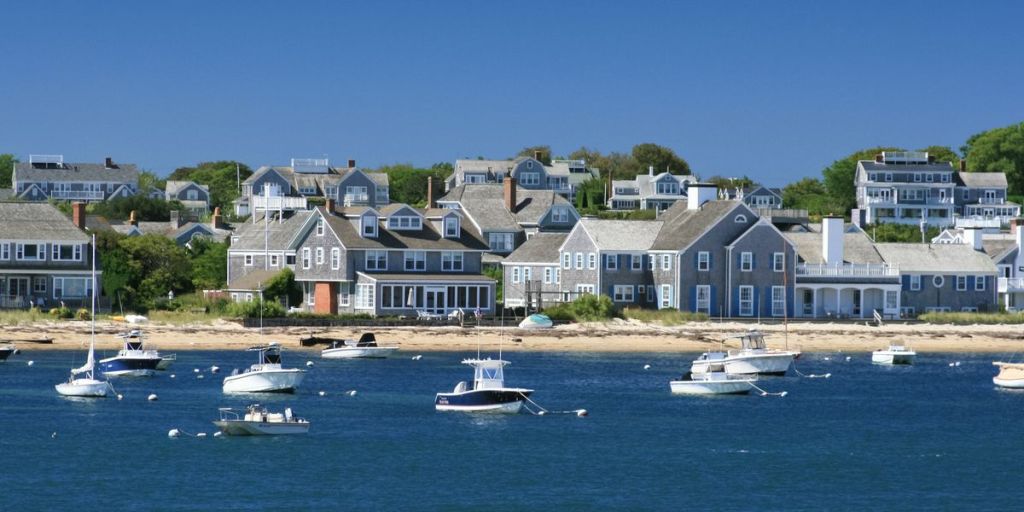
Nantucket, an island about 30 miles from Cape Cod in Massachusetts; the main town on the island is also called Nantucket. European settlement on the island began in the 17th century, and it was a major centre for the whaling industry by the 19th century – it features in Herman Melville’s novel, Moby Dick. Since the 1950s, it has been an upmarket summer colony and popular tourist destination.
The island features in a famous limerick which begins, “There once was a man from Nantucket …”. The original, written in 1902, is:
There once was a man from Nantucket Who kept all his cash in a bucket. But his daughter, named Nan, Ran away with a man And as for the bucket, Nantucket (“Nan took it”).
It spawned numerous sequels, many of them vulgar in nature, because the island’s name rhymes with “fuck it” and “suck it”. The earliest such example was published in 1927. It is a staple of American humour, with the name itself enough for listeners to understand the allusion, as in this scene.




 The Annotated Gilmore Girls