RICHARD: Well, I’m no Perry Como, but my shower hasn’t kicked me out yet.
Pierino “Perry” Como (1912-2001), singer, actor and television personality. During a career spanning more than half a century, he recorded primarily vocal pop and was renowned for the intimate, easy-listening genre. He sold millions of records and pioneered a weekly musical variety television show.
Como received five Emmys, a Christopher Award, and a Peabody Award. He received a Kennedy Center Honor in 1987 and was inducted into the Academy of Television Arts & Sciences Hall of Fame in 1990. Posthumously, he received the Grammy Lifetime Achievement Award in 2002 and was inducted into the Long Island Music Hall of Fame in 2006. He has the distinction of having three stars on the Hollywood Walk of Fame for his work in radio, television, and music.
RICHARD: I’m going to be going back there next week. There’s going to be a little reunion of the Whiffenpoofs … It’s an a cappella singing group I belonged to at Yale.
The Whiffenpoofs are a real a capella singing group at Yale University. Established in 1909, it is the oldest such group in the US. The line-up is completely replaced each year, and is always composed of rising seniors, who may take a year’s absence in order to go on tour nationally and internationally. Cole Porter is their most famous alumnus.
LORELAI: Mom, you know, if you’re not a little nicer to your help, you might find yourself in a Frank Lloyd Wright situation … Mrs. Wright apparently had this major problem with her help. She was very rough on them and they totally hated her. So this guy who had worked for her forever, he had finally had enough … Anyhow, Mrs. Wright invites this whole posse of people over for dinner and they’re all sitting around eating, and Mr. Disgruntled Servant Guy goes outside and locks all the doors and windows and douses the whole house in gasoline and sets the place on fire … So the house is on fire, and people are freaking out, so they run to the doors but the doors are locked, so a few of them try to get out through the windows, but Mr. Angry-Puss is standing outside with an ax hacking them to death and so they all died.
Lorelai refers to the famous architect Frank Lloyd Wright (1867-1959). It’s often been speculated that he was one of the inspirations for the character of Howard Roark in Ayn Rand’s novel, The Fountainhead.
Although Lorelai typically gets her facts a little mangled, the seemingly outrageous story she relates about him is essentially true. The woman involved wasn’t Wright’s wife, but the woman he had left his wife for and was living with in a domestic partnership that was considered scandalous at the time.
Her name was Mary “Mamah” Borthwick, a translator who had left her husband and children to be with Wright in 1909, living together since 1911 (after her divorce came through), in a house Wright built for Mamah in Spring Green, Wisconsin, called Taliesin (“shining brow” in Welsh).
In 1914, their recently-hired servant Julian Carlton, a man from Barbados who was mentally unstable, set fire to their house and murdered seven people with an axe as they fled the burning structure. The dead included Mamah Borthwick, her two visiting children, aged 8 and 12, a gardener, a draftsman, a workman, and the son of Wright’s carpenter. Carlton attempted suicide straight after the attack, and starved himself to death in jail despite receiving medical attention.
Julian Carlton never did give a motive for his actions, but there’s some evidence that he had disputes with the workmen, and that he knew he was about to lose his job. There’s no evidence that it had anything to do with Mamah Borthwick herself, and the victims, apart from Borthwick and her children, were not dinner guests, but workmen employed by Frank Lloyd Wright.
The devastated Frank Lloyd Wright rebuilt the house in Mamah’s honour, but it burned down again in 1925 after being hit with a lightning storm. It was rebuilt again, and this third version of Taliesin is now open for tours and events.
EMILY: Liliana will be right out with the sand dabs.
Sand dabs are a variety of flatfish native to the oceans around the Americas. The most common in the US is the Pacific sand dab, which is caught in California and the Pacific North West, and is a rather expensive delicacy of the San Francisco Bay area (it feels like this is the sand dab the writers of the show would be familiar with!).
Sand dabs can be grilled, pan-fried, or roasted. They are said to be an acquired taste, which might explain why Lorelai seems to have been less than impressed with her experience eating one.
RORY: Think about something else … Something disgusting that will take your appetite away.
LORELAI: Ari Fleischer?
RICHARD: Ari Fleischer is our nation’s mouthpiece, young lady.
Lawrence Ari Fleischer (born 1960), media consultant and political aide who served as the press secretary for President George W. Bush from 2000 to 2003. He was a prominent advocate for the Iraq War.
There seems to be a bit of a pattern of Lorelai skipping lunch on Fridays, perhaps because she knows she’ll be getting a good dinner at her parents’ that evening. As a result, she turns up to dinner hungry and cranky, and ready for a dramatic fight every week! Of course, it’s possible Lorelai often skips lunch on weekdays, due to her busy schedule at the inn.
EMILY: Really, Lorelai, you can’t wait ten minutes for another salad? The situation’s that dire?
LORELAI: Four salads ago, no, not dire. Right now it’s ‘your money for nothing and your chicks for free.’
Lorelai refers to the song “Money For Nothing” by English rock band Dire Straits – so she’s saying that they are now in “dire straits” due to waiting for their food for so long. The lyrics don’t have the exact line that Lorelai says, but it’s pretty close. There are numerous repeated lines about getting your money for nothing and chicks for free, in slightly different iterations.
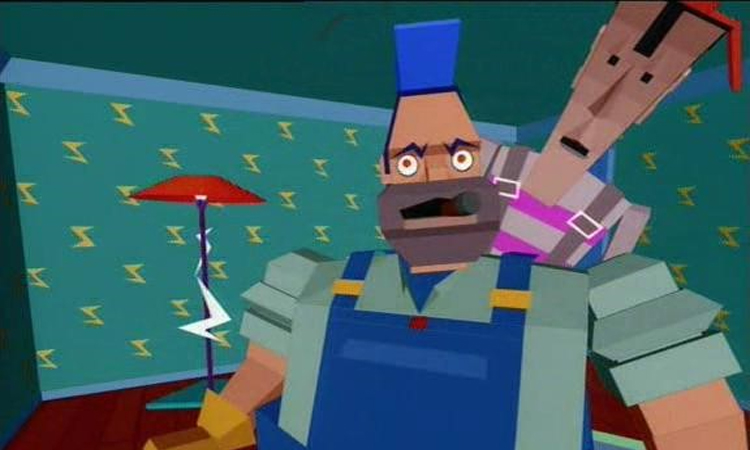
“Money for Nothing”, with backing lyrics by Sting, was released as a single from the band’s 1985 album, Brothers in Arms. It’s memorable for it’s groundbreaking animated music video, and repeated refrain of I want my MTV. It was Dire Straits’ most successful single, reaching #1 in the US and Canada, and #4 in the band’s native UK.
In July 1985, Dire Straits and Sting performed it at Live Aid. It won a Grammy, and two MTV Music Video Awards in 1986, and in 1987 was chosen as the first video to be played on MTV Europe.
LORELAI: You know, Mom, in Europe, they eat the salad last and the main course first.
I’m not sure how many European countries this rule supposedly applies to, but in France and Italy at least, it is customary to eat the salad between the main course and the dessert, as a palate cleanser (it’s probably falling out of favour, like a lot of customs). Lorelai’s idea is actually pretty practical!
LORELAI: You know what, I’ve spent a lot of time and energy fighting the whole Jess thing. Rory’s made her choice, I want her to be happy. I’m just hoping for the best at this point.
LUKE: Very romantic.
LORELAI: Says the man who yelled “Finally!” at the end of Love Story.
The ending of Love Story is that the female lead, a very young woman, dies of a terminal illness. So Luke was shouting out in relief that she was finally dead. A bit of sly black comedy.








 The Annotated Gilmore Girls