Hirschfeld

LORELAI: Why’d you get new menus?
LUKE: It was time.
LORELAI: But I had made little doodles with my name hidden in them on each one of the old ones just like Hirschfeld.

Albert “Al” Hirschfeld (1903-2003), caricaturist best known for his black and white portraits of celebrities and Broadway stars, in a career spanning nearly eight decades.

Hirschfeld had a daughter named Nina, born in 1945. Hirschfeld is known for hiding Nina’s name, written in capital letters (“NINA”), in most of the drawings he produced after her birth. The name would appear in a sleeve, in a hairdo, or somewhere in the background. The number of NINAs concealed is shown by the number written to the right of his signature. Generally, if no number is to be found, either NINA appears once, or the drawing was completed before she was born. Originally done to amuse his friends, the public quickly noticed and became obsessed with this little gimmick, sending angry letters when he tried stopping it.

Al Hirschfeld had died not long before this episode aired, so this mention feels like a little tribute to him.

Picasso

MRS. VAN WYCK: Then Picasso is obscene … It has six breasts.
TRIX: You cannot be sure if those are breasts. They could be cannons. He was quite obsessed with the Spanish Civil War for awhile.

Pablo Picasso (1881-1973), Spanish painter, sculptor, printmaker, ceramicist and theatre designer who spent most of his adult life in France. One of the most influential artists of the 20th century, he is known for co-founding the Cubist movement, the invention of constructed sculpture, the co-invention of collage, and for the wide variety of styles that he helped develop and explore.

Picasso painted a number of female nudes that Mrs Van Wyck might be looking at. Nude Woman With Necklace is one possibility, as at my first glance, I also was unsure how many breasts the figure has. On closer examination, some of them are her stomach and thighs. Remember that Mrs Van Wyck is peering at a tiny piece of transparent celluloid to view the painting.

One of Picasso’s most famous works is Guernica, a dramatic portrayal of the bombing of the Basque town of Guernica by German forces during the Spanish Civil War.

Family Portrait

The episode ends with a close up of the painting that holds pride of place in the Gilmore mansion – a family portrait over the mantlepiece. It is a young Lorelai with her parents, aged perhaps twelve or so, and it is a picture of the Gilmores before Lorelai became a rebellious teenager, and before their family was torn apart in circumstances that have never quite healed. It is a very poignant moment.

Collage

RORY: Can we not say the word college for at least forty-eight hours? …

LORELAI: How ’bout collage, can we say collage? ‘Cause it sounds the same but it’s actually very different.

Collage (from the French meaning “stick together”) is an art technique which involves assembling paper, photographs, ribbons, paint, and/or found objcts and gluing them to paper or canvas. The technique goes back to ancient China, around 200 BC, but made a dramatic reappearance in the early 20th century as a form of modern art.

The words college and collage don’t actually sound the same, although there is some similarity.

[Collage shown is an untitled work by German Dadaist artist Kurt Schwitter]

Louvre

RICHARD: Yale has one of the finest collections of British art in the world.

LORELAI: Louvre, schmouvre.

The Louvre is a historic landmark in Paris, and the world’s most visited museum. It is home to some of the world’s best known art pieces, including the Mona Lisa, and the Venus de Milo. Housed in the Louvre Palace, originally built in the 12th century under Philip II, the museum first opened in 1793, and contains more than 380 000 objects and more than 35 000 artworks.

Collection of British Art

RORY: Grandpa, that art gallery was amazing. Thank you.

RICHARD: Yale has one of the finest collections of British art in the world.

Richard refers to the Yale Center for British Art, which houses the largest and most comprehensive collection of British art outside the UK. The collection of paintings, sculpture, drawings, prints, rare books, and manuscripts reflects the development of British art and culture from the Elizabethan period onward.

It was established in 1966 by a gift from philanthropist and Yale alumnus Paul Mellon, together with an endowment for operations of the centre, and funds for a building to house the works of art. It is across the street from the Yale University Art Gallery [pictured], and no doubt Richard has taken Rory there as well – this could well be the amazing art gallery she speaks of.

The Yale University Art Gallery is the oldest university art museum in the Western Hemisphere. It houses an encyclopedic collection of art in several interconnected buildings on Yale’s campus. It was founded in 1832, after patriot artist John Trumbull donated more than 100 paintings of the American Revolutionary War.

It turns out that the art gallery at Yale was one of Richard’s favourite places to bring girls on dates, in order to impress them with his knowledge of art.

Quilting Convention, Cartwheels

LORELAI: Well, the quilting convention is sitting down to tea.

MICHEL: Uh, I’m doing internal cartwheels.

Quilting is the process of sewing different pieces of fabric together to form a multilayered quilt, which may be simple in design or a complex piece of art. There are numerous quilting societies in the US, and the inn is currently hosting a quilting convention.

Cartwheels [pictured] are an acrobatic maneuver commonly performed in gymnastics, as well as cheerleading and certain types of dance, including classical Indian dance. It is performed by bringing the hands to the floor one at a time while the body inverts. The legs travel over the body trunk while one or both hands are on the floor, and then the feet return to the floor one at a time, ending with the athlete standing upright. The phrase “performing cartwheels” is sometimes used metaphorically to mean that someone is exuberantly happy and excited. Compare when Lorelai said she was mentally doing a Jig.

Tiki Bar

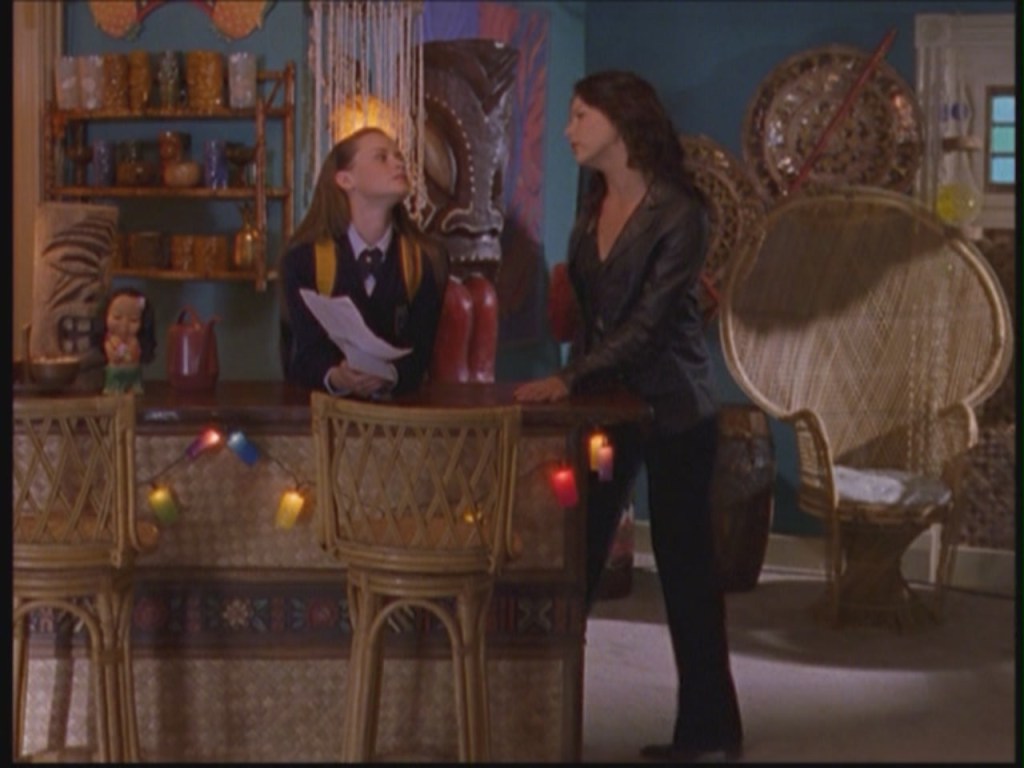
RORY: Hey, how come we don’t have a tiki bar?

Once inside Dwight’s home, which Lorelai has done her best to turn into a place of imagined horrors, the Gilmore girls naturally love it at once. It has the same kitschy taste that they like, and I think they appreciate that Dwight has decorated the house completely for his own comfort and amusement, a design aesthetic that is in harmony with Lorelai and Rory’s own.

Dwight’s home bar is a tiki bar – that is, a bar inspired by tiki culture décor. Tiki culture is an American movement inspired by a romanticised view of tropical island cultures, mostly Polynesian, catering to American views of the South Pacific. The name comes from Tiki, the Māori name for the first human, often represented in the form of a pendant and frequently appropriated by Europeans as a commercialised good luck charm.

Although tiki bars are generally of broadly South Pacific influence, they tend to serve cocktails from the Caribbean. Because of its colonial nostalgia, and the simplistic view of the Pacific taken by the aesthetic, Tiki culture has been perceived as controversial, culturally insensitive, or racist.

Tiki culture became fashionable during the 1930s as a Hollywood-style image of a leisurely, exotic island lifestyle. It had an explosion of popularity after World War II, as American servicemen returned from tours of duty in the South Pacific, often with souvenirs. It began to decline in the late 1970s but there was a revival in the late 1990s and early twenty-first century, so Dwight is surprisingly on trend in owning a tiki bar.

Cameos, Cod liver oil

EMILY: And what is wrong with that name [Society Matron’s League], Lorelai?

LORELAI: Nothing, it just sounds so serious. Brings to mind a room full of old ladies wearing black dresses and cameos and pushing spoonfuls of cod liver oil on the kids.

A cameo [pictured] refers to a piece of jewellery, usually a brooch, featuring a raised relief image, ususally of a face in classical style, against a contrasting background. They were very popular in the 19th century.

Cod liver oil is a dietary supplement made from the liver of cod fish. Like other fish oils, it contains omega-3 fatty acids, and the vitamins A and D. Historically, it was given to children because Vitamin D helps to prevent rickets.

Oddly, Lorelai does not say that she is smirking at the name of the Society Matron’s League because she knows of it from I Love Lucy, one of her favourite TV shows!

Sardi’s

DEBBIE: Well, I felt obligated to tell the other moms about your little performance at school before they heard about it elsewhere.

LORELAI: Really, ’cause usually I like to meet up at Sardi’s after a performance, wait for the reviews. I hope The Times liked me.

Sardi’s, continental restaurant in the theatre district of Manhattan in New York City. It was founded by Vincent Sardi Sr and his wife Jenny Pallera, and first opened in 1927. It is known for the caricatures of Broadway celebrities on its walls, of which there are over a thousand. Sardi died in 1969, and the restaurant declined in the 1980s, being sold in 1986. After closing temporarily in 1990, it reopened with new staff.

The restaurant is considered an institution in Broadway theatre. It’s known as a place to gather before and after the theatre hangout, as well as a location for opening night parties, and was where the idea of the Tony Award was devised. Lorelai sarcastically puts herself in the role of an actor waiting at Sardi’s for the reviews of their performance in the New York Times.