RORY: She made you apply to every one [of the colleges]?
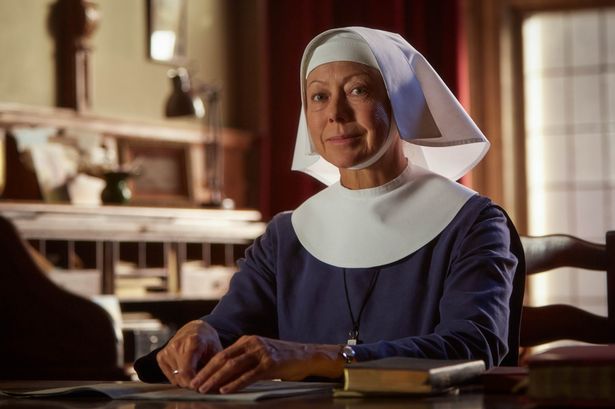
LANE: And measured my head for a wimple.
Wimple, a medieval form of female headcovering, formed of a large piece of cloth worn draped around the neck and chin, covering the top of the head. Its use developed in early medieval Europe; in medieval Christianity it was unseemly for a married woman to show her hair. Today a plain wimple is worn by the nuns of certain orders who retain a traditional habit.
Once again, the show (or Lane?) somehow conflates Mrs Kim’s Seventh Day Adventism with Catholicism, something that seems to happen a lot.
CAROL: If you were to tell either of my siblings that there was another life choice outside of the Ivy League, I think their khakis would wrinkle.
Khakis, another name for chinos, trousers made from a cotton twill (see Cotton Dockers). Developed in the mid-19th century for British and French military uniforms, it has since migrated into civilian wear. Trousers of such a fabric gained popularity in the US when Spanish–American War veterans returned from the Philippines with their twill military trousers. The fabric was originally made in khaki, and this is still the most popular colour.
LORELAI: You had these little OshKosh cords and they were way too big and once at the mall, they fell right down to your knees and I said, “Whoa, there, Droopy Drawers!”.
OshKosh B’gosh, children clothing company founded in Oshkosh, Wisconsin. It began in 1895 as the Grove Manufacturing Company by Frank E. Grove, J. Howard Jenkins, and James Clark. Grove was soon bought out and it was renamed Oshkosh Clothing and Manufacturing Company the next year. The B’gosh began being used in 1911, after the manager heard the tagline “Oshkosh b’gosh” in a vaudeville show; it formally became OshKosh B’gosh in 1937.
OshKosh are particularly known for their children’s bibbed overalls, sold since the early twentieth century as a way for parents to dress children like their fathers. They became popular in the 1960s, and since 1984, most of the company’s clothing line is for children. OshKosh have over 300 stores in the US, and are headquartered in Atlanta, Georgia. It’s now owned by Carter’s.
Baby Rory would have been wearing corduroy bibbed overalls from OshKosh [pictured].
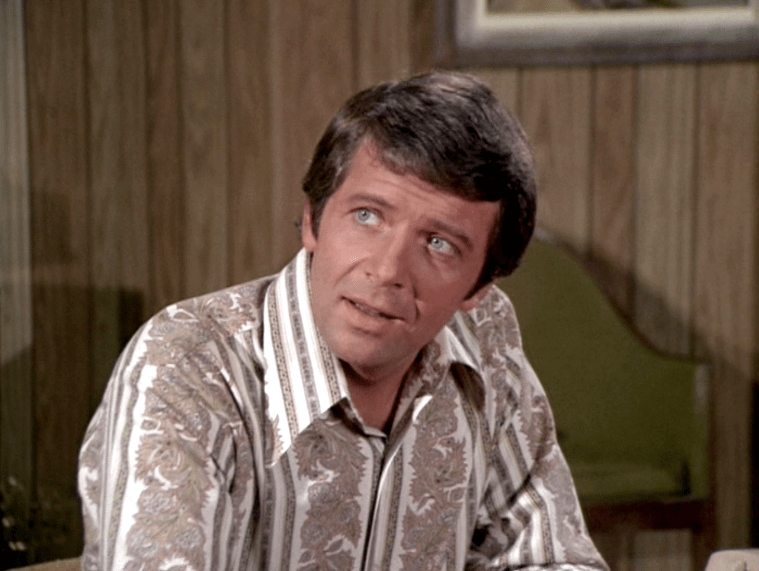
LORELAI: Are you sure that’s not just the sight of Robert Reed in the tight clown pants?
Robert Reed, born John Robert Rietz Jr (1932-1992), actor best known for playing father Mike Brady in The Brady Bunch, and its various specials and spin-offs. From the very beginning, Reed was unhappy with his role as Mike Brady, feeling that the show was far too silly for a serious classically-trained Shakespearean actor such as himself. Although he got on very well with the rest of the cast and behaved professionally at all times, he often argued with the creator and producer over the scripts (he was allowed to direct a few episodes to appease him). Despite this, he appeared in all the specials and spin-offs, and actually really loved doing The Brady Bunch Variety Hour, as it gave him the opportunity to sing, dance, and have fun.
LORELAI: So you’ve been just Nanooking it this whole time, just sending out for whale blubber and mukluks? [adjusts thermostat]
Nanook of the North [pictured], a 1922 silent film documentary/docudrama written, produced, and directed by Robert J. Flaherty. The film follows the struggles of an Inuk man named Nanook, his wife Nyla, and their family as they travel, trade and search for food in the Canadian Arctic. They are shown hunting a walrus, building an igloo, and going about their everyday tasks. Nanook and his family are portrayed as fearless heroes, enduring rigours beyond the comprehension of most Westerners.
The film has been criticised for fictionalising events and presenting them as reality. For example, “Nanook” was really named Allakariallak, and Nyla (aka Alice) was not his wife, but one of Flaherty’s common-law wives. The cast were scripted to behave in a more “authentic” Inuit way, such as using traditional hunting weapons rather than guns, and acting as if they had little knowledge of Western culture. Many things had to be staged, because of the difficulties of filming with one fixed camera in a harsh environment.
Nanook of the North was ground-breaking cinema, capturing authentic details of a culture that was then little known to outsiders, and filmed in a remote location. Hailed unanimously by critics, it was also a box-office success, and is still viewed as an enthralling documentary. As the first full-length feature documentary to achieve financial success, it paved the way for the entire genre. Nanook of the North was remastered and released on DVD in 1999, so Lorelai and Rory could have actually seen it.
Whale blubber is an important part of the traditional diet of Inuit people, valued for its high energy value, nutritional content, and availability. Mukluks are soft boots, traditionally made from caribou hide or sealskin, worn by the Indigenous people of the Arctic.



 The Annotated Gilmore Girls