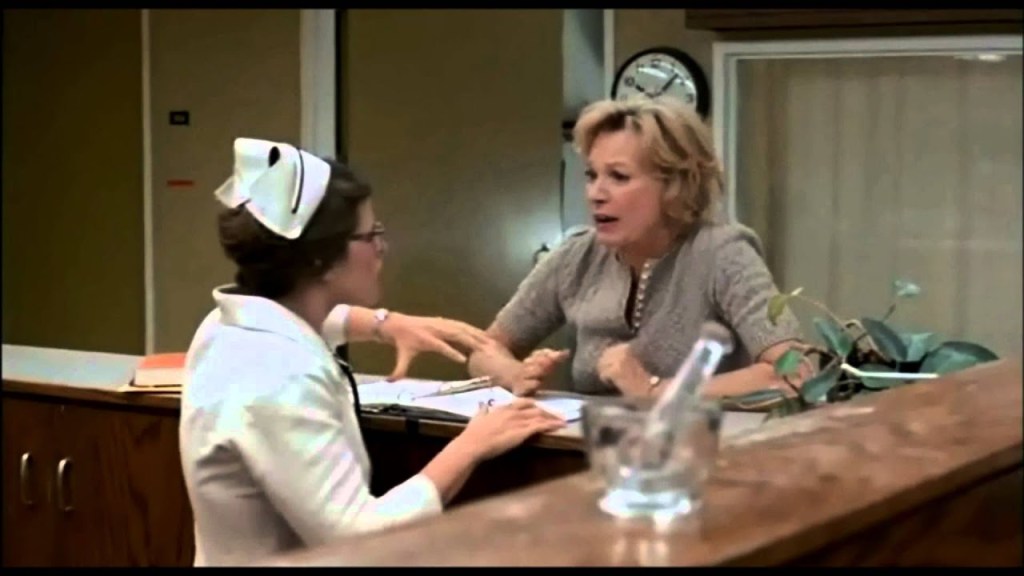
LORELAI: Hey, do you remember in Terms of Endearment, that scene where Shirley MacLaine is in the hospital and freaks out because they won’t give her daughter a shot? She got that from me and she toned it down a little.
Terms of Endearment, a 1983 family comedy-drama film directed, written and produced by James L. Brooks, and adapted from the 1975 novel of the same name by Larry McMurty. The film covers thirty years of the relationship between Aurora Greenway, played by Shirley MacLaine, and her daughter Emma, played by Debra Winger.
Terms of Endearment received critical acclaim and was the #2 film of 1983. It received five Academy Awards, including Best Picture, Best Director, and a Best Actress Award for Shirley MacLaine.
In the film, Aurora and Emma have a difficult but very close relationship. Emma is diagnosed with a terminal illness, and Aurora stays by Emma’s side throughout her treatment and hospitalisation, proving to be a fierce advocate on her behalf. There is a memorable scene where Aurora screams at a nurse, insisting that her daughter receive a shot (of pain relief) immediately when she felt they were being too slow to administer it.
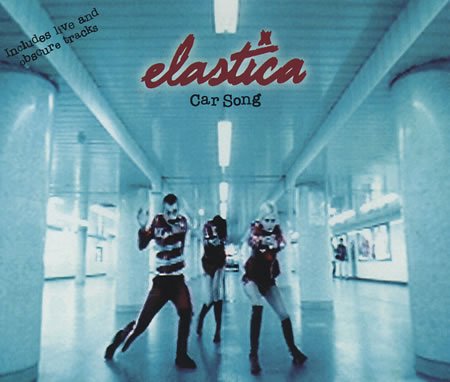
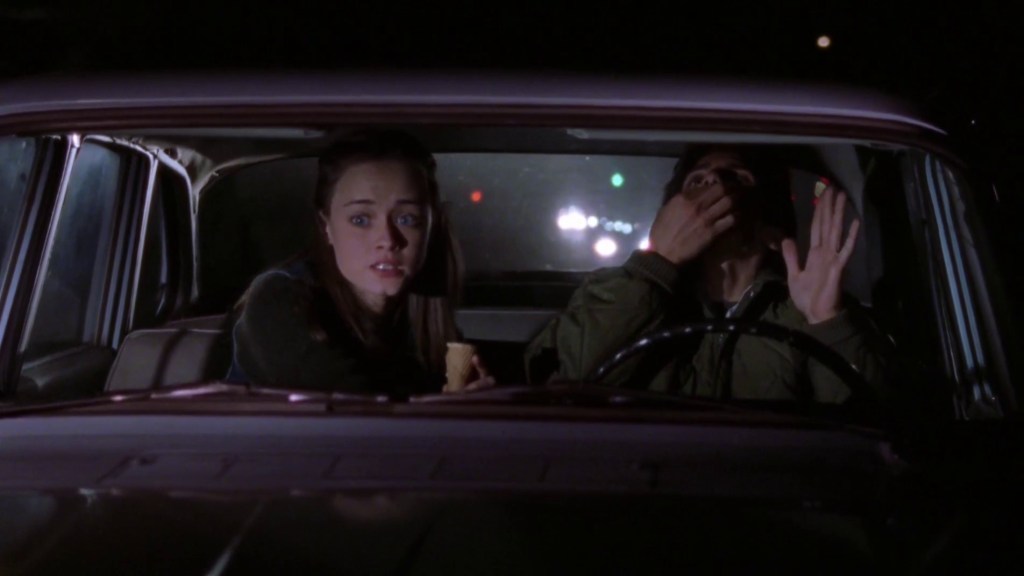
This song plays while Jess and Rory are in the car, driving back from buying ice cream cones (because Luke’s only serves ice cream in bowls, which doesn’t count).
“Car Song” is a 1995 song by Britpop group Elastica, written by Justine Frischmann, the band’s lead singer. From their self-titled debut album, it was only released as a single in North America and Australia in 1996, and went to #106 in Australia, while it charted on the US Alternative Songs Chart at at #33, and #14 on the Canadian Alternative Rock Chart. The song was well-reviewed, described as sexy and charming.
The song is about having sex in a car, to make it clear where Jess and Rory’s minds are going, and the subtext of them being in a car together. Although there’s no suggestion that they actually had sex in the car offscreen, or even kissed, their car trip is a symbolic lovemaking experience as it is so emotionally intimate. Compare it to the first time Rory was in the car with Dean, when she couldn’t even tell him how she felt, after dating for months.
Here we go again I’m riding in your car Let me count to ten ‘Cause it’s gone way too far Up my street to nowhere You know what detours are Here we go again And it’s gone way too far
The lyrics are a good description of what’s going on – they’ve taken a detour on a street to nowhere (driving aimlessly), and going around in circles (“here we go again”). And although they’ve gone nowhere much, they have “gone way too far” – because they should never have got in the car to begin with.
RORY: Do not give me that whole ‘I’m so misunderstood, Kurt Cobainy’ thing. You are way stronger than that and I don’t even wanna hear it. You have to go to college …
JESS: So, Courtney, what about you?
Kurt Cobain (1967-1994), singer, songwriter, and musician, frontman of the grunge rock band Nirvana, serving as the band’s lead vocalist, guitarist, and primary songwriter. Through his angst-fuelled songwriting and anti-establishment persona, Cobain’s compositions challenged the conventions of rock music. He was often heralded as a spokesman for Generation X and is considered one of the most influential musicians in the history of alternative rock.
Cobain struggled with depression, heroin addiction and the pressure of fame, and was found shot dead at the age of 27, apparently by his own hand. He was posthumously inducted into the Rock and Roll Hall of Fame, along with his fellow band members, in 2014.
Rory pretty much gives Jess the same talk that Lorelai did when he arrived in Stars Hollow – if anything, she is less sympathetic, telling him to quit the “misunderstood act”, and saying he is way too strong to be dragged down by his circumstances.
Jess is far more receptive to hearing this from Rory. He probably appreciates not being pitied, and likes the suggestion he is tough enough to survive anything. Rory may be the first person to openly tell Jess he can achieve anything he wants, and once again, she is very keen to urge a male love interest to attend college.
Note that as Rory casts Jess in the role of Kurt Cobain, he is equally quick to cast her as Kurt’s wife – an obvious suggestion that Jess considers her to be his “other half” that Rory surely cannot miss. As Kurt and Courtney were something of a doomed, destructive couple, it doesn’t feel like a good omen for Jess and Rory.
Could they have made this any more sexual? Even the choice to buy ice cream cones seems like a deliberately erotic choice.
Out the back window, you can see a set of traffic lights, and multiple cars behind them. I think they are still supposed to be driving around Stars Hollow, which only has one traffic light, on the main square, and almost no traffic. It really doesn’t look like Stars Hollow!
I can accept this scene as believable if Jess drove to a nearby larger town to buy ice cream cones and then back to cone-less Stars Hollow, but I’m not sure this is what the show actually wants us to think. My understanding is that Jess was just circling the main square.
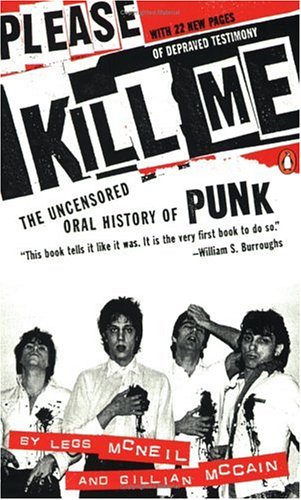
JESS: Have you ever read Please Kill Me? … Oral history of the punk movement. You’d like it – you can borrow it if you want.
Please Kill Me: The Uncensored Oral Historyof Punk by Legs McNeil and Gillian McCain, first published in 1996. It consists of interview with punk musicians, and spans the early period of punk in the US, from The Velvet Underground and The New York Dolls to Iggy Pop and The Ramones. The book became an instant hit, and is a cult classic.
Note that Jess suggests this “history” book as an alternative to reading about The Marshall Plan!
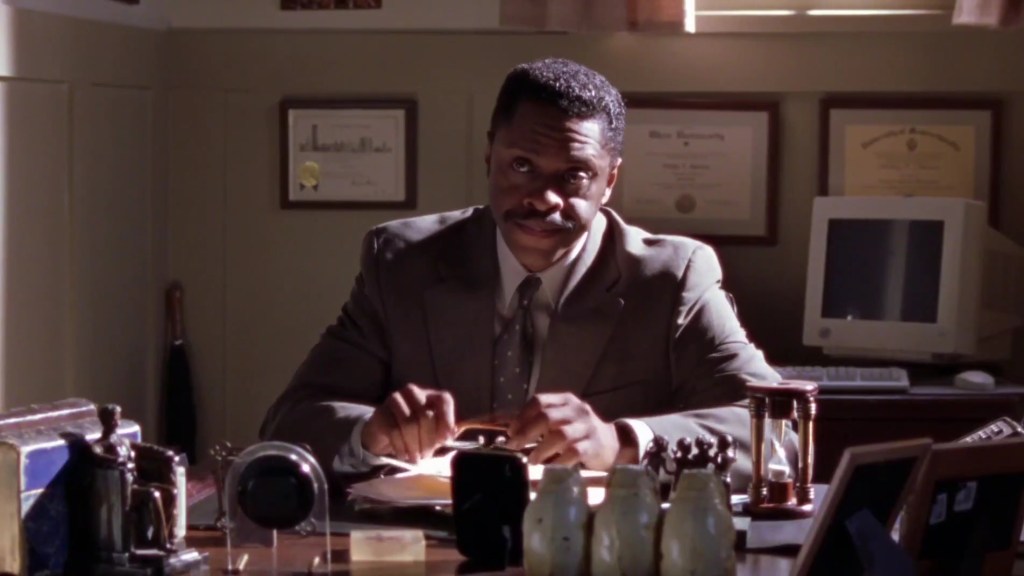
His attitude to teachers ranges from indifference to hostility
He shows no interest in school activities or fellow students
He stole all the baseballs
Principal Merton only tells Luke about all these issues one month before the end of semester! I don’t think it’s just Jess who’s been indifferent to his teachers – they sound like they’ve been indifferent to him as well. It’s almost as if the school has just been waiting for Jess to fail, rather than intervening to help or trying to engage with him – or talking to Luke about all these problems a lot earlier.
Schools really are quite useless in Gilmore Girls. Even if Jess was a model student for the next month, surely that wouldn’t be enough for him to pass, considering he’s had an entire year of doing nothing?
By the way, notice that Principal Merton’s observation that Jess isn’t interested in social activities or making friends at school is very similar to the criticism Mrs Verdinas had of Rory not socialising at Chilton. One might be failing while the other is maintaining a straight A average, but Rory and Jess have more in common academically than people think.
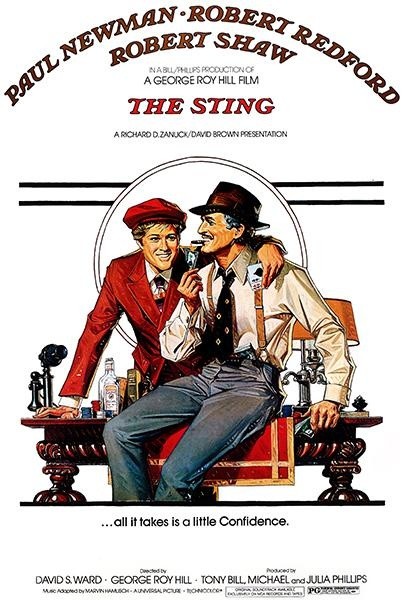
A 1973 caper film directed by George Roy Hill, involving two grifters, played by Paul Newman and Robert Redford, and their plan to con a mob boss, played by Robert Shaw. Set in 1936, it was inspired by real life cons perpetrated by brothers Fred and Charley Gondorff, as told in the 1940 non-fiction book, The Big Con by David Maurer. The Sting received rave reviews and was a box office smash, becoming the #2 film of the year. It won seven Academy Awards, including Best Picture and Best Director.
Rocky
A 1976 sports drama film, directed by John G. Avildsen, with screenplay by Sylvester Stallone, who also stars in the title role as Rocky Balboa. It’s a rags-to-to-riches tale of a working-class small-time boxer in the slums of Philadelphia who gets a shot at a world heavyweight championship. Made on a shoestring budget, it was a sleeper hit, becoming the #1 film of 1976. Critically acclaimed, it solidified Stallone’s career and led to him becoming a major movie star. It won three Academy Awards, including Best Picture, and is regarded as one of the greatest sports films ever made.
Crimes and Misdemeanours
A 1989 existential comedy-drama directed by Woody Allen, who also stars as Clifford Stern, a documentary filmmaker. The other main character is Judah Rosenthal, played by Martin Landau, who commits a very serious crime, and, stricken with guilt, turns to the religious teachings he had rejected. Cliff and Judah only meet once, at the end of the film, which has a philosophical message. A box-office flop, it was lauded by critics, and is regarded as one of Allen’s best films.
The Singing Detective
A 1986 BBC television serial drama, written by Dennis Potter, directed by Jon Amiel, and starring Michael Gambon. It is about a mystery writer, suffering writer’s block and ill in hospital, who enters a fantasy world involving his novel, The Singing Detective. Although ratings were modest, it was highly influential, and greatly praised in America, where it was later shown on PBS and won a Peabody Award. It is regarded as one of the greatest British TV programs ever made. Rory calls it a “mini-series”, but in fact it was six episodes – a normal run on British television.
Arthur
A 1981 comedy written and directed by Steve Gordon. It stars Dudley Moore as Arthur Bach, a drunken New York millionaire about to enter an arranged marriage with an heiress, but who falls for a working-class girl from Queens. The #4 film of 1981, Arthur was critically acclaimed, and considered one of the best films of the year. Its theme song, “Arthur’s Theme”, won an Academy Award for Best Original Song, and Sir John Gielgud won Best Supporting Actor for his role as Arthur’s valet.
Sophie’s Choice
A 1982 psychological drama film written and directed by Alan J. Pakula, adapted from the 1979 novel of the same name by William Styron. Set in 1947, it stars Meryl Streep as Sophie, a Polish immigrant with a dark secret from her past who shares a boarding house in Brooklyn with her lover, played by Kevin Kline, and a young writer, played by Peter MacNichol. It was a commercial and critical success, and Meryl Streep won the Academy Award for Best Actress for her role.
Cabin Boy
A 1994 fantasy comedy film directed by Adam Resnick and co-produced by Tim Burton. It stars comedian Chris Elliot, who co-wrote the screenplay with Resnick. Elliot’s character is a snobbish, unpleasant man who accidentally gets stuck aboard a boat out at sea, and goes on a fantastical voyage of self-discovery. The film received mixed reviews, and it is a matter of opinion whether it’s one of the worst films ever, an underrated work of comedic legend, or so bad that it’s good.
Desperately Seeking Susan
A 1985 comedy-drama film directed by Susan Seidelman, partly inspired by the 1974 French film Céline and Julie Go Boating. Set in New York City, it stars Rosanna Arquette as a bored housewife, who becomes involved with a bohemian drifter named Susan, played by Madonna in her first major screen role. The film was a commercial success, and received mostly positive reviews, with acclaim for both Arquette and Madonna. It’s considered one of the best films of the 1980s.
Fletch
A 1985 neo-noir comedy thriller film directed by Michael Ritchie, based on the 1974 novel Fletch by Gregory Mcdonald. It stars Chevy Chase as undercover reporter Irwin “Fletch” Fletcher who begins investigating a murder scheme that has unexpected links with the story he is working on. The film received positive reviews, and was a commercial success, performing very well on home media, and becoming a cult film.
Urban Cowboy
A 1980 romantic western film directed and co-written by James Bridges and Aaron Latham, adapted from an article of the same name Latham wrote for Esquire magazine. The story revolves around the love-hate relationship between a couple named Buford and Sissy, played by John Travolta and Debra Winger. Set in Pasadena, Texas, much of the action takes place in a honky-tonk bar playing country music. A critical and commercial success, the soundtrack was also a hit.
Lorelai and Rory managed to whittle their list of films down to a trim 75 possibilities!
TAYLOR: It is a fine, wholesome motion picture. Moving story, lovely scenes of nature.
The Yearling, 1946 dramatic family film directed by Clarence Brown, based on the 1938 novel of the same name by Marjorie Kinnan Rawlings. It stars Gregory Peck and Jane Wyman, and was filmed on location in the Ocala National Forest in Florida. The film is about a young boy, played by Claude Jarman Jr, who adopts a troublesome deer, the “yearling” of the title.
The Yearling was praised by critics as a heart-warming family film, and was the #9 film of the year at the box-office. However, high production costs meant that it didn’t actually make a big profit. It won three Academy Awards, including a Juvenile Award for Claude Jarman Jr. A television adaptation was released in 1994.
Note that we later learn in this episode that when Taylor says, “Moving story, lovely scenes of nature”, he is quoting from the description given in the film catalogue.
After Lorelai complains that Taylor has chosen The Yearling for the past three years for Movie Night in the Square, Taylor unexpectedly gives her the job of choosing the movie instead, saying she has never volunteered once to help with this event (which is surprising to learn, since Lorelai loves film, and volunteers for most community festivals).
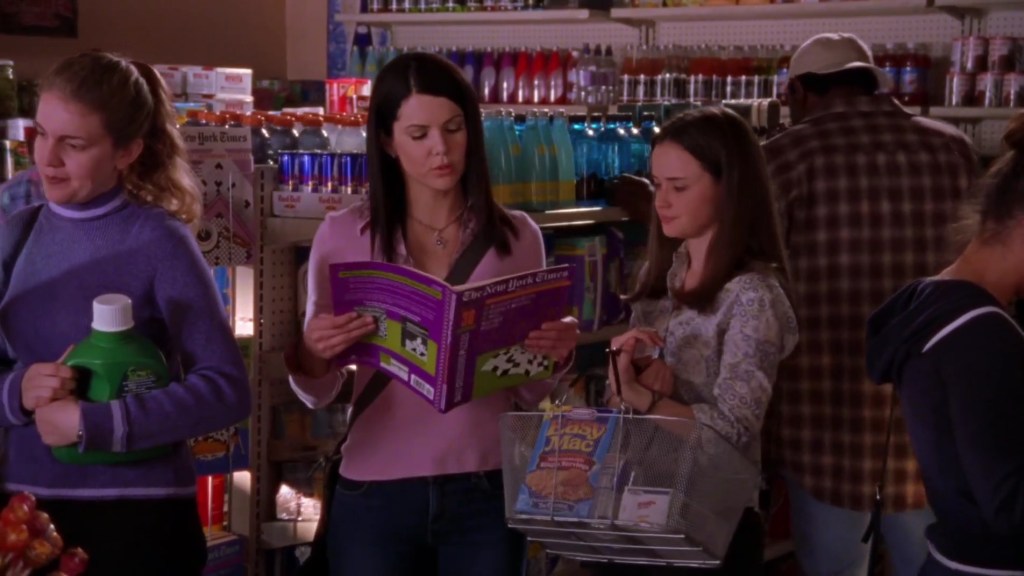
LORELAI: I hate crossword puzzles. They make me feel stupid.
An inside joke. Lauren Graham is very good at crossword puzzles, and would go through several a day on set while waiting for her turn.
Lorelai is looking at a New York Times puzzle book, and judging by the shopping basket Rory is carrying, they are having mac and cheese made from a packet, Twinkies, and a can of Red Bull for dinner that night.
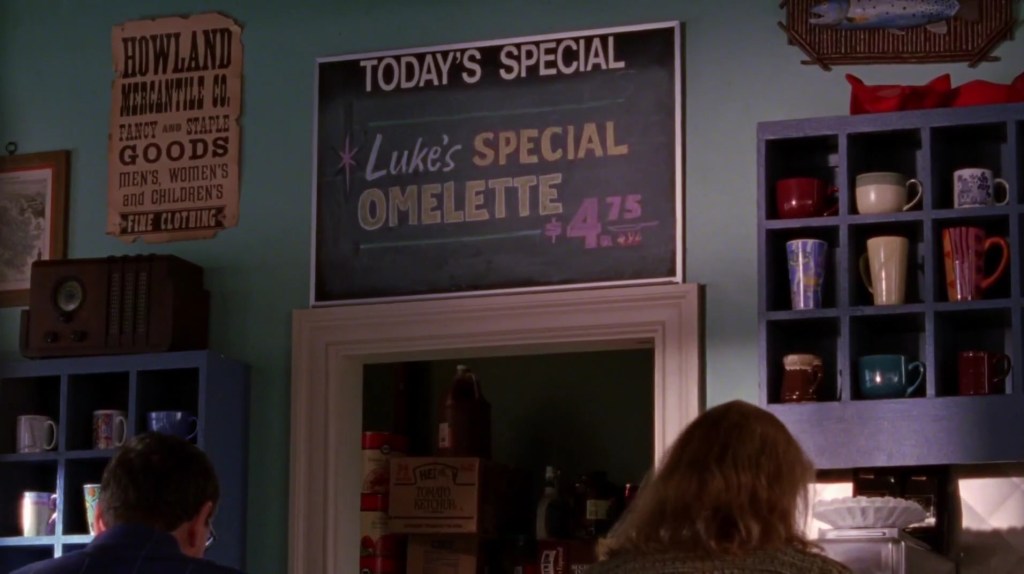
LORELAI: I know. Look how hard he worked on that sign and everything. Look at the handwriting, it’s so precise, so determined. It’s focused-Luke.
RORY: That’s Jess’ handwriting.
LORELAI: Really? How do you know Jess’ writing?
RORY: Oh, well, I lent him a book and he wrote some stuff in it.
Lorelai’s examination of Jess’ handwriting is a sign of how much more careful, focused, and determined Jess really is, deep down. That boy has hidden depths. Is it possible that it was Jess who convinced Luke to put a new special on the board – and if so, was it a tease for Rory, knowing that she usually orders French toast?
Lorelai also discovers that Rory can recognise Jess’ handwriting, and that’s because he wrote in her book – “vandalised it”, as Lorelai says. Rory is careful to say that she “lent” her book to Jess, not that he took it without asking, the very first moment he met her.
Note that the sign next to the chalkboard is for the Howland Mercantile Co., a reminder of Jess writing in the margins of Rory’s copy of Howl and Other Poems.
Surprisingly, Lorelai doesn’t seem to be able to tell Luke’s handwriting from Jess’, even though Luke writes on the chalkboard all the time. Unless Jess and Luke have the same handwriting?


 The Annotated Gilmore Girls