[Rory is studying on the couch as Lorelai walks into the room with two mugs]
LORELAI: Coffee and Ovaltine.
Ovaltine (originally Ovomaltine), a chocolate milk powder which can either be made into a hot or cold drink. It was developed in Switzerland in 1904, and quickly gained international appeal. By 1915 it was being manufactured in the US, among other countries. The drink is particularly popular in Britain, and the British version is also imported in the US.
It seems that Rory doesn’t have coffee before bed, the way Lorelai does. She may have trouble getting to sleep if she drinks coffee late at night, or the Ovaltine is a comforting childhood ritual.
Taylor says that if birds land on the street lights, he will put sharp metal spikes on top and turn them into shish kabobs.
Shish kabobs is the North American term for shish kebabs, skewered and grilled cubes of meat, traditionally lamb, found in Mediterranean cuisine and originating in the Middle East. In North America, the word kebab nearly always refers to a shish kebab. The word kebab comes from Arabic, and means “frying, burning”, while the shish part means “skewer, pointed stick”.
Quiche
Rory predicts that quiche will be served at Sherry’s baby shower.
Quiche is a French tart which is a pastry crust filled with savoury custard and pieces of cheese, meat, seafood, or vegetables. The word goes back to the 17th century in the Lorrain patois (quiche Lorraine, anyone?), but only to 1805 in French. It’s probably related to the German word for “cake, tart”. The basic premise of putting savoury custard into a pastry shell goes back to the 14th century in England, and the 13th century in Italy, so they are not uniquely French.
Mojito [pictured]
Maureen offers Lorelai a mojito at the baby shower, which she gratefully accepts.
Mojito is a traditional Cuban punch, made from white rum, sugar (or sugar cane juice), lime juice, soda water, and mint. It originated in Havana, but it’s origins are debatable – local South American Indians, Sir Francis Drake, and African slaves have all been given the credit for it. The name may come from mojo, meaning a spice made from mint, or from mojadito, the Spanish for “lightly wet”. It’s a popular drink for summer, but because it’s green, Sherry has it at her “green is the new pink” autumn baby shower.
Club Soda
Gail offers Rory a club soda at the baby shower.
Club soda is a manufactured carbonated water used as a drink mixer. English chemist Joseph Priestly discovered the method for making carbonated water in 1772, but commercial production was begun by Johann Jacob Schweppe, a Swiss jeweller and amateur chemist in 1783. It was first made commercially in the US by Benjamin Silliman, a Yale chemistry professor, who sold in New Haven, Connecticut. The original trademarked club soda was made by Cantrell and Cochrane in Ireland in 1877 – the “club” in the name refers to the Kildare Street Club in Dublin.
Horseradish
Susan guesses that horseradish is the smell in her diaper during a game at the baby shower.
Horseradish (Armoracia rusticana) is a root vegetable in the radish and mustard family, cultivated since antiquity for use as a spice and condiment. You may remember that Emily enjoys horseradish on her steak.
Jell-O
Babette thinks that the Town Loner mentioned the word “Jello-O” in his protest.
LORELAI: And I, in turn, chimed in with my story about getting sick on Andre Cold Duck in the back of Peter Cutler’s car in ninth grade.
Andre Cold Duck is a sparkling red wine, which is sweet with a fruity flavour. Made in the Sacramento area, it is marketed as “California champagne” and is very cheap. It was a go-to choice for high schoolers and college students in the 1980s due to its price and syrupy flavour, and at that time was supposedly the best-selling sparkling wine in the US. Its sickly sweet taste meant that it was common to throw up from drinking it, like Lorelai did, and the sugary overtones also meant a killer headache the next day if you overindulged. Beware of its properties if you want to try it out!
LORELAI: Yes, he sniffed, swirled, swished, and did every other pretentious and borderline-disgusting thing that you can do with a glass of wine in a public place, and he did it all while describing to me the vintage discrepancies and the wood they use for the barrels in Palermo and the grape crop projections for the following year.
Palermo is the capital of Sicily, an island region of Italy. Almost three thousand years old, it is rich in history and culture, and a popular tourist destination for its climate, music, nightlife, and cuisine. There are several vineyards and winemakers in the area.
A piña colada is a cocktail made with rum, pineapple juice, and coconut milk or cream, served either blended or shaken with ice. It may be garnished with a pineapple wedge, a maraschino cherry, or both. The cocktail originated in Puerto Rico, is its national drink, and its name means “strained pineapple” in Spanish. One story is that the cocktail was invented by Puerto Rican pirate, Roberto Confresi in the 19th century; the less exciting but more probable version is that it was invented in 1954 at the Caribe Hilton Hotel in Puerto Rico by bartender Ramón “Monchito” Marrero.
Lorelai refers to “Escape (The Piña Colada Song)”, written and recorded by British-American singer Rupert Holmes, released as a single from his 1979 album Partners in Crime. The song is about a man who is bored with his current relationship, and answers a lonely hearts advertisement in the newspaper which begins, “If you like piña coladas …”. When he meets up with the lady, it turns out to be his partner, who was equally bored in their relationship. They realise they had more in common than they realised, and their relationship is now reinvigorated. It was an international hit, and went to #1 in the US and Canada. Ironically, Rupert Holmes has never drunk a piña colada, and the original lyrics were, “If you like Humphrey Bogart”.
Lorelai gets the words slightly wrong. The lyrics are actually:
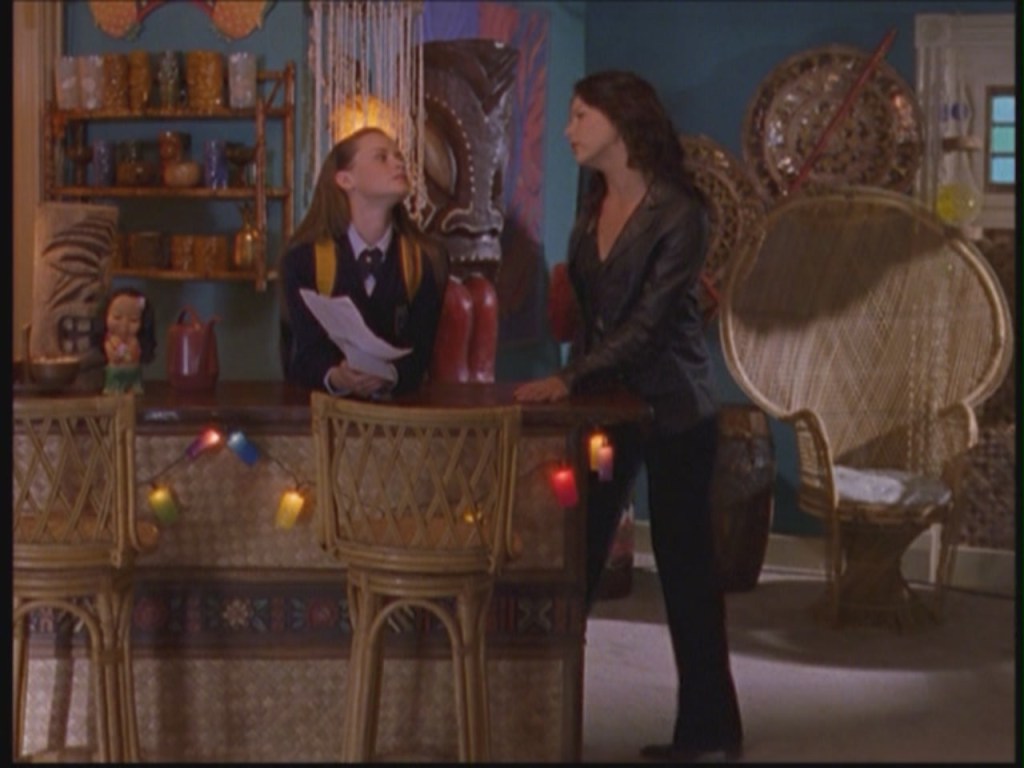
Once inside Dwight’s home, which Lorelai has done her best to turn into a place of imagined horrors, the Gilmore girls naturally love it at once. It has the same kitschy taste that they like, and I think they appreciate that Dwight has decorated the house completely for his own comfort and amusement, a design aesthetic that is in harmony with Lorelai and Rory’s own.
Dwight’s home bar is a tiki bar – that is, a bar inspired by tiki culture décor. Tiki culture is an American movement inspired by a romanticised view of tropical island cultures, mostly Polynesian, catering to American views of the South Pacific. The name comes from Tiki, the Māori name for the first human, often represented in the form of a pendant and frequently appropriated by Europeans as a commercialised good luck charm.
Although tiki bars are generally of broadly South Pacific influence, they tend to serve cocktails from the Caribbean. Because of its colonial nostalgia, and the simplistic view of the Pacific taken by the aesthetic, Tiki culture has been perceived as controversial, culturally insensitive, or racist.
Tiki culture became fashionable during the 1930s as a Hollywood-style image of a leisurely, exotic island lifestyle. It had an explosion of popularity after World War II, as American servicemen returned from tours of duty in the South Pacific, often with souvenirs. It began to decline in the late 1970s but there was a revival in the late 1990s and early twenty-first century, so Dwight is surprisingly on trend in owning a tiki bar.
[Lorelai walks up to the bar as a man is ordering a drink]
PEYTON: Can I get a Merlot, please?
Merlot, a deep purple-red wine made from the dark blue Merlot grape variety. The name is thought to be a diminutive of merle, the French word for “blackbird”. Merlot is one of the primary grapes used in Bordeaux wine, and it is the most widely planted grape in the Bordeaux wine regions.
Merlot is also one of the most popular red wine varieties around the world, and is produced internationally – in the US, California produces the most Merlot, after the “Merlot craze” of the 1990s, sparked by a 60 Minutes report on the low incidence of heart disease in France, which drinks a lot of red wine.
RORY: Oh, a girl told me once that if your scalp is hurting from bleach, drink a 7 Up. It’s something to do with the bubbles.
LANE: The Kim household does not have soft drinks.
RORY: Well, what do you got?
LANE: Something called Salad Water imported from Korea. Believe me, it’s nothing like 7 Up.
7 Up, a lemon-lime flavoured soft drink owned by Dr Pepper, and distributed by Pepsi. It was created by Charles Leiper Grigg in St Louis in 1929, two weeks before the Wall Street stock market crash of that year. Originally called Bib-Label Lithiated Lemon-Lime Soda, it contained lithium citrate, a mood stabiliser used to treat manic states and bipolar disorder. It became 7 Up in 1936, and nobody really knows why that name was chosen – some say that it refers to the seven original ingredients, some that it’s a coded reference to lithium, which has an atomic mass around 7.
7 Up won’t do anything to stop your scalp hurting after bleach (and if it’s the bubbles, wouldn’t any soft drink do the same thing?), but I’ve seen it recommended for stomach ache and the common cold, so there seems to be a lot of belief in it as a folk remedy. I suspect Rory is saying anything to distract Lane, and possibly hoping for a placebo effect.
Salad Water, or Water Salad [pictured], is water flavoured with green salad, produced by Coca-Cola in Japan. I’m not sure why the Kims have imported it from Korea when it’s a Japanese product – perhaps the Korean import-export company imports it from Japan, then exports it to the US.
DARREN: Do you know which French city famous for its water was the capital of collaborationist France?
LORELAI: Oh, me? Um, Evian, Perrier, uh, Le Crystal Geyser?
JENNIFER: Vichy.
Vichy is a city in central France on the river Allier, a spa town and resort famous for its warm mineral springs, the direct result of historical volcanic activity – although the volcanoes have been dormant for more than a century. During World War II, it was the seat of government for Vichy France from 1940 to 1942. Officially independent, Vichy France adopted a policy of collaboration with Nazi Germany.
Lorelai quickly says the first brands of mineral water she can think of. Evian has been bottling mineral water from Évian-les-Bains in the French Alps since 1829. Perrier bottles its carbonated mineral water from Vergèze in Southern France, beginning production in 1898. Crystal Geyser is actually an American company, founded in Calistoga, California in 1977.
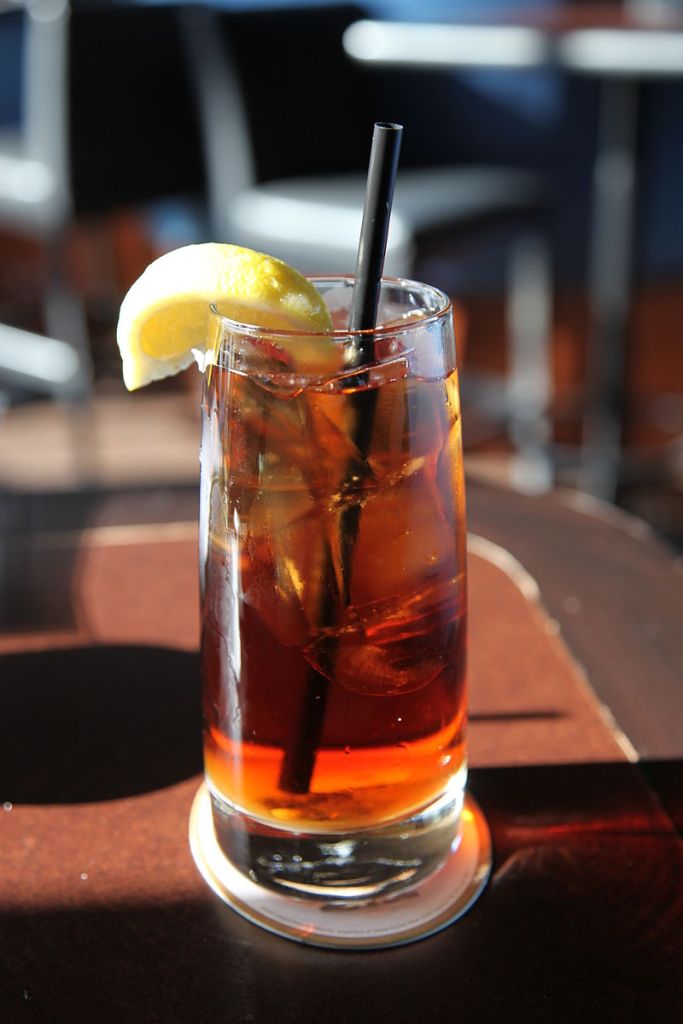
Iced tea, tea that has been chilled and often sweetened with sugar or syrup, usually served with ice cubes. In the US it is traditionally served with a slice of lemon as a garnish on the side of the glass. Iced tea began to appear in the US in the 1860s, and became increasingly popular after being served at the 1904 World’s Fair. Most tea in the US (85%) is drunk as iced tea, rather than a hot drink, and it is particularly associated with the Southern states of the US.




 The Annotated Gilmore Girls