School Pageant

RORY: I had a school thing once, and I wasn’t sure if Mom would want to go so I didn’t invite her. It was my kindergarten “Salute to Vegetables” pageant and I was broccoli and I did a tap dance with a guy that was playing beets and the entire number I was just thinking, “Mom’s not here” and it was my fault that she wasn’t there and, well, it was kind of a life lesson for me.

We already know that Rory studied ballet with Miss Patty when she was a little girl, but apparently she did tap dancing even in kindergarten! I’m guessing Miss Patty also taught tap to the kindergarten class. In A Year in the Life, Rory takes up tap dancing again as a way to relieve stress.

Rory’s little anecdote about the school pageant is actually one of the more plausible things we hear about her childhood. Most things make her seem either too old for her age or too young, but it’s perfectly believable that the thoughtful young child of a single, working mother who’s a maid at an inn would be hesitant at asking her mother to come to a school pageant.

Little Rory would know how hard Lorelai works and that there’s no other parent to fall back on if she’s unavailable. I can imagine her feeling that a school pageant isn’t important enough to pull Lorelai out of work for, yet missing her horribly when the moment arrives, and seeing all the other mothers there.

The fact that she blamed herself entirely for the situation shows that even as a young child, she was already placing herself as the responsible person in the relationship with her mother, and taking on the parental role.

Vassar

LORELAI: Rory, I was supposed to graduate from high school. Go to Vassar. Marry a Yale man.

Vassar, previously discussed.

We now discover that Richard and Emily wanted Lorelai to attend Vassar, a private liberal arts college. The beautiful campus, flexible curriculum, small class sizes, and strong encouragement to study abroad sound like things Lorelai would have actually enjoyed.

Vassar and Yale have a historic relationship, making marriage to someone from Yale seem an obvious choice (for people of Richard and Emily’s generation, when Vassar was a women’s college only, and when women had fewer career options).

“My stupid conservative high school”

RORY: You’ve never been a part of an actual graduation ceremony.

LORELAI: I know. That’s because my stupid conservative high school wouldn’t let me be in the ceremony and nurse you at the same time.

We discover here that Lorelai did not graduate from her private high school. Although she jokes they wouldn’t let her graduate while nursing a baby, most likely she was actually asked to leave once her pregnancy became obvious. Her former classmate Mitzi said she hadn’t seen Lorelai since “her seventh month”, suggesting that she didn’t return to school after the summer vacation of 1984.

“Community colleges have ceremonies”

RORY: Well, community colleges have ceremonies.

LORELAI: My community college doesn’t even have a lawn, they won’t necessarily have a ceremony.

Rory is correct: community colleges have graduation ceremonies, like any other college. You don’t need a lawn – they can be held in an auditorium, theatre, gym or even a separate hired venue.

The fact that Lorelai’s college isn’t having one, only her business class as a separate event, is obviously just to fit in with the restrictions of filming the episode.

Another Confusing Timeline

As with so many episodes written by Daniel Palladino, I cannot follow the timeline of this episode very easily. It opens early in the morning, and we know it’s a school day, because Rory is dressed in her Chilton uniform. Yes, she has to get a bus to school, and they can’t go to the diner, so it makes perfect sense for them to walk a long way for a friend to cook them breakfast! They really should have just made their own breakfast, for practical reasons.

However, the next few scenes have Rory dressed in her normal clothes and Lorelai isn’t at work, so that it seems to be the weekend. That implies they had breakfast at Sookie’s on a Friday morning, but the previous episode ended on Friday night. And they can’t have skipped a week, because Rory was meant to have her cast removed in two weeks, so it would have been gone by that time.

I think just as “PS I Lo … ” has two Thursdays in a row, there are two Fridays in a row as we transition from “Help Wanted” and “Lorelai’s Graduation Day”.

The timeline issue could have been fixed by simply making their breakfast on Saturday morning, which makes sense because they always eat out for breakfast on Saturday, and they would have plenty of time to walk to Sookie’s (and Lane would have the free time to practice drumming on pots and pans). It would even make it slightly more plausible that Jackson was sitting around in his PJs and not at work.

Possibly the problem isn’t the fault of the writer this time, but of the costume department, for putting Rory in a school uniform she shouldn’t have been wearing. The only way I can make sense of this is for Rory to have run out of clean clothes and forced to wear her uniform on a weekend – or she has some school activity that Saturday, like a debate, and is already dressed for it.

Woman Who Won the Lottery

LORELAI: I don’t know, didn’t they feed lead to our jumping frog or something?

RORY: Oh yeah, right after they stoned the woman who won the lottery.

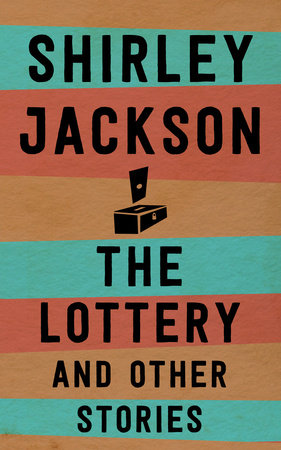
Rory references the 1948 short story, “The Lottery”, by Shirley Jackson. Set on a beautiful summer day in an idyllic New England village (based on Jackson’s own home of Bennington, Vermont), the story tells of an annual ritual known as “the lottery”, an old tradition carried into modern times, and seemingly practised to ensure a good harvest.

People draw slips of paper from a box, and a wife and mother named Tessie Hutchinson eventually “wins” by drawing the marked piece of paper. The entire village begins stoning her to death as she screams of the injustice of the lottery – an injustice that only bothers her when she is the scapegoat marked for death.

The story was first published on June 26 in The New Yorker, and proved so unsettling at the time that The New Yorker received a torrent of letters, the most mail they ever received about a story. Jackson herself received about 300 letters about the story that summer, much of it abusive or hate mail. (Some asked where they could go to watch the “the lottery” take place!).

Since then, “The Lottery” has been analysed in every possible literary and sociological way, its careful construction and symbolism noted, and its themes linked with everything from mob mentality, the military draft, and the death penalty. It is one of the most famous stories in American literature, often reprinted in anthologies and textbooks, and has been adapted for radio, television, film, graphic novel, and even (to Shirley Jackson’s bafflement) a ballet.

Apart from being a short story often read for high school English classes, this seems like a story Rory would enjoy. She has a taste for dark and “gloomy” themes, and is a fan of American Gothic. Like Tessie, Rory is from an idyllic New England town, and has been singled out for special treatment – but in her case, it’s to be loved and glorified by the town.

The story reminds us that even the most charming small towns have a dark side, and that includes Stars Hollow. Rory is no doubt thinking of Jess, vilified and forced to leave because of a minor car accident. (The name Jess even sounds a bit like Tessie).

Driver’s Ed

RORY: I can’t hold the wheel, you’re driving. The person who’s driving has to hold the wheel. That’s the first thing they teach you in Driver’s Ed.

Driver’s Education, a class or program, often organised by high schools, that helps give young people instruction in driving to help prepare them for their driver’s license test. The first Driver’s Education program in the US started in 1934, at a Pennsylvania high school.

Rory’s comment suggests that she took Driver’s Ed, possibly at Stars Hollow High, since she (impossibly) already has her license before she starts at Chilton.

The Marshall Plan

RORY: Explain to me the political ramifications of the Marshall Plan.

The Marshall Plan, officially the European Recovery Program or ERP, was an American initiative enacted in 1948 to provide foreign aid to Western Europe. The US transferred over $13 billion (equivalent to around $115 billion today) in economic recovery programs to Western European economies after the end of World War II.

The initiative was named after the US Secretary of State, George C. Marshall, and one of its main ramifications was to ensure greater geopolitical influence for the US in Western Europe. It has been argued that it marked the beginning of the Cold War, with the USSR refusing assistance, and determined to bolster its own influence in Europe. This was seen by the US as an act of hostility.

Jess’ History class is obviously studying the Post-War era.

“A mind is a terrible thing to waste”

JESS: Well, hurry – a mind is a terrible thing to waste.

A mind is a terrible thing to waste is the marketing slogan of the United Negro College Fund, adopted in 1972, and one of the most widely recognised advertising slogans in the US. Despite its name, the UNCF has scholarships open to people of all ethnic backgrounds, although the majority of recipients are African-American.

This is something said as a joke which is all too true. On some level, Jess must realise that he is letting his good mind go to waste, or that it is being wasted.

Schoolhouse Rock!

JESS: I just can’t wait for that learning to begin. Hey, are we gonna do some of those Schoolhouse Rock! songs?

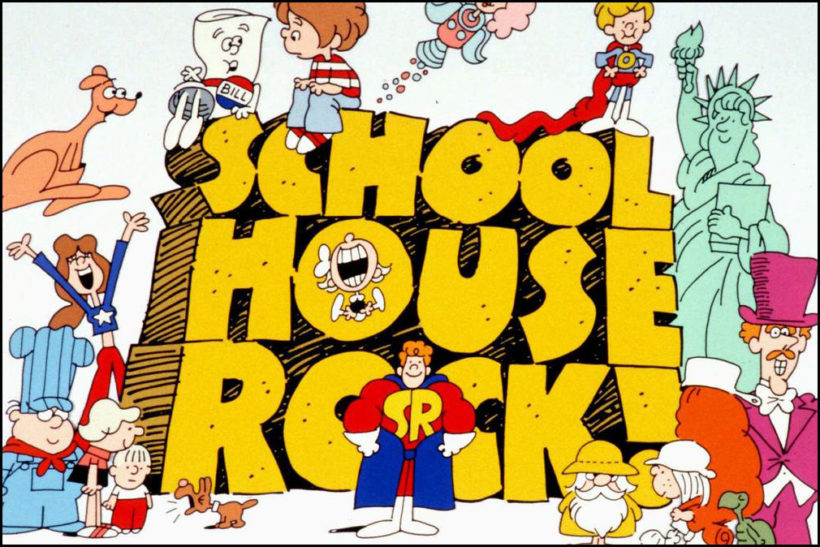
Schoolhouse Rock! is a series of short animated educational musical films that aired during Saturday morning children’s programs on the ABC network from 1973 to 1984, with a revival between 1993 and 1996 (when Rory and Jess were aged 9 to 12). Themes covered grammar, science, economics, history, mathematics, and civics. Soundtrack albums and songbooks were released as tie-ins.

Jess consistently equates formal education with something dated and childish, but I think he actually would learn better if the facts were presented as rock songs!