The Miracle Worker

LANE: Let me guess. You and Lorelai haven’t made up yet?
RORY: Nope. Things are still very Miracle Worker at my house.

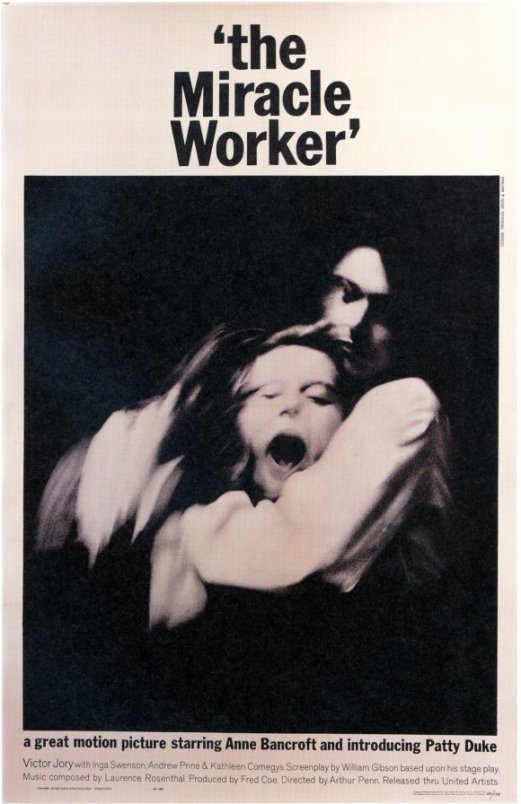
Most likely a reference to the 1962 biographical film The Miracle Worker, directed by Arthur Penn and based on the 1959 play of the same name by William Gibson (originally part of the 1957 television drama anthology Playhouse 90); Gibson wrote the screenplay for the movie.

The film is the story of Anne Sullivan (1866-1936), the sight-impaired teacher of Helen Keller (1880-1968), who had become both blind and deaf at a very early age. Anne was able to break through Helen’s almost total isolation from lack of language, allowing her to communicate with the world by spelling words into her hand and teaching her to read Braille.

Helen made remarkable progress at a school for the blind with Anne’s support, and went on to become the first blind person to earn a bachelor of arts degree, forging an inspirational career as an author, political activist, and lecturer.

William’s Gibson’s source for The Miracle Worker was Helen Keller’s 1902 autobiography, The Story of My Life, and the title comes from Mark Twain‘s description of Anne Sullivan as “a miracle worker”.

The Miracle Worker received rave reviews, and is still considered one of the most inspirational films ever made. Anne Bancroft, who played Anne Sullivan, won the Academy Award for Best Actress, while Patty Duke, who played Helen Keller, won the Academy Award for Best Supporting Actress (in the 1979 television remake, Patty Duke played Anne Sullivan).

Rory possibly means that she and her mother are still not talking, just as Helen Keller was not able to communicate until she was taught to by Anne Sullivan. She could also be referring to the famous fight scene in the movie, shown on the poster, where Anne Sullivan struggles physically with Helen Keller in an effort to make her eat politely at the breakfast table, to mean that she and Lorelai still fighting.

Double Indemnity

This is the movie that Lorelai and Emily watch on TV while Rory is at the dance. Double Indemnity is a 1944 film noir, directed by Billy Wilder, and based on James M. Cain’s 1943 novella of the same name; Raymond Chandler co-wrote the screenplay with Wilder. The original novella was partly based on a true story – a 1927 high-profile murder by a married woman and her lover, in which the criminals were soon arrested and convicted.

The film stars Fred MacMurray as an insurance agent, and Barbara Stanwyck as a flirtatious housewife who wants her husband dead so she can collect the insurance money. Unable to resist her charms, the insurance agent uses his knowledge to make her husband’s murder look like an accident, triggering the “double indemnity” clause so that she will receive double the amount.

Double Indemnity was an immediate hit on release, and had good reviews from critics. Its reputation has grown over the years, and it is now considered one of the greatest in the film noir genre, and is sometimes cited as the first film noir ever made.

Emily mentions that she loves Barbara Stanwyck’s husky voice, and Lorelai says Emily’s voice is somewhat like Stanwyck’s. Lorelai teases that Emily could have gotten Fred MacMurray to kill Richard if she’d really wanted to.

Although Emily usually gets annoyed with Lorelai’s constant jokes, for once she is able to accept the teasing with little complaint – perhaps because it is complimentary for a change.

The Outsiders

RORY: And these kids at my school – awful. Have you seen The Outsiders?
DEAN: Yeah, I have.
RORY: Just call me Ponyboy.

The Outsiders is a 1983 teen drama film directed by Francis Ford Coppola, adapted from the popular novel of the same name by S.E. Hinton. The movie looks at the conflict between the Greasers, tough working-class teens, and the Socs, a gang of wealthier kids.

The main protagonist is Ponyboy Curtis (C. Thomas Howell), who is one of the Greasers, but is good at school and loves literature; while hiding out after his friend Johnny killed a Soc to defend him, Ponyboy reads Gone With the Wind and recites Robert Frost’s poem Nothing Gold Can Stay.

Rory feels the social difference between she and her Chilton classmates very strongly, identifying herself with a teenager from the wrong side of the tracks, albeit one who loves reading.

It is worth noting that Rory doesn’t ask Dean if he’s read The Outsiders, even though it is a very well known book for teenagers, and often set as a school text. By now she may have got the idea that Dean isn’t much of a reader.

Either that, or Rory hasn’t read it herself, rejecting it as beneath her reading level, or something that is too typically teenage to bother with.

Saran Wrap

EMILY: “We’re in here?” That’s how you answer the door?
LORELAI: Well I was all out of Saran Wrap.
EMILY: I don’t even want to figure that one out.

Saran wrap is a brand of plastic wrap or clingfilm made for wrapping food; it is such a dominant brand that the brand name is often used for the item itself (like Kleenex).

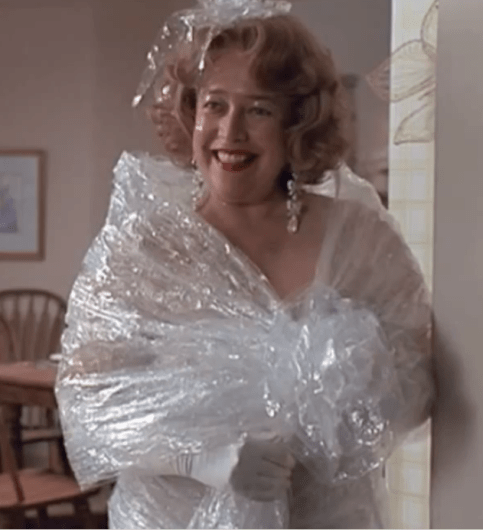
Lorelai’s comment to Emily is a probable reference to the 1991 comedy-drama film Fried Green Tomatoes, directed by Jon Avnet and based on the 1987 novel Fried Green Tomatoes at the Whistlestop Cafe by Fannie Flagg; Flagg was one of the screenwriters for the movie. The film did well at the box office and was generally well received by critics.

In one of the scenes, a character named Evelyn (Kathy Bates) tries to revive her marriage by greeting her husband at the door dressed only in Saran wrap. She got the idea from the best-selling 1973 self-help book The Total Woman by Marabel Morgan, the #1 non-fiction book of 1974.

Morgan, who gave out marriage advice grounded in evangelical Christianity with a distinct anti-feminist bias, suggested that women greet their husbands at the door wearing sexy outfits, with Saran wrap being one idea. (It doesn’t work for Evelyn and her husband).

You can see this as either a reference to the film or the book, but it seems far more likely that Lorelai saw Fried Green Tomatoes in the 1990s than that she has read the 1970s book (and if she did, it was probably after seeing the film).

The Group

This 1963 novel by Mary McCarthy is what Rory is reading while waiting in line to buy tickets to the winter formal. Tristan teases her for this by saying “how novel”.

The Group is about eight young women, educated and from wealthy backgrounds, and their lives after graduation during the 1930s. It explores the various issues they have to face, such as sexism, child-rearing, financial problems, family strife, and sexual relationships, mostly revolving around the men in their lives, whether husbands, lovers, fathers, or employers.

Striving for independence, they are hampered by an era where women are restricted in their options, and although the novel is not a feminist work, it casts a sharp eye on female lives and ideas, and shows how the personal is political. The novel is partly autobiographical and spent more than two years on the best-seller list when it was published.

Rory may have been drawn to the novel because it examines the choices of educated young women after graduation – especially because the women in “the group” are characterised as intellectuals sensitive to art and beauty, rather than politically aware or active. The literary one of the group, Libby MacAusland, and her subsequent disastrous career may have been of interest to Rory as well.

(Unexpected connection: Mary McCarthy is the sister of Kevin McCarthy, who starred in Invasion of the Body Snatchers).

Oscar Levant

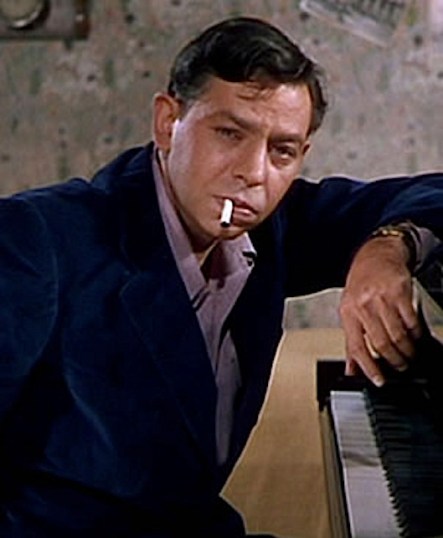
Lorelai jokingly tells Emily that if Rory grows up bitter and filled with regrets, she could become a crazy Oscar Levant type of celebrity.

Oscar Levant (1906-1972) was an American pianist, composer and comedian. A serious composer who wrote numerous film scores for Hollywood and appeared in several films as a pianist, he was famous for his eccentricity and acid wit. He was a panellist on radio and TV for many years, and was open about his many neuroses.

“Gentleman caller”

The Golden Girls

RORY: He’s my … gentleman caller.
LANE: Okay, Blanche.

Rory is referring to Tennessee William’s 1944 play The Glass Menagerie, where the mother Amanda, a faded Southern belle, is obsessed with finding a suitor, or “gentleman caller”, for her daughter Laura, who has crippling shyness.

I believe Lane’s response is likely a reference to the sitcom The Golden Girls, which originally aired from 1985 to 1992. It featured four older women sharing a house together in Miami, Florida; Blanche Devereaux (played by Rue McClanahan) was a slightly man-crazy Southern belle who’d grown up on a plantation. The character was inspired by Blanche DuBois in A Streetcar Named Desire, and Scarlett O’Hara in Gone With the Wind.

The Golden Girls was a ratings winner which received numerous awards, and is considered one of the best TV sitcoms of all time. It continues to gain new viewers in syndication, and has aged extremely well.

EDIT: Edited in response to reader Holly, who suggested it was more likely that Lane was referring to Blanche in The Golden Girls than to Blanche in A Streetcar Named Desire.

Sixteen Candles

LORELAI: However, not really, since you’ve never actually been to one you’re basing all your dance opinions on one midnight viewing of Sixteen Candles.

Sixteen Candles is a 1984 teen comedy film directed by John Hughes, starring Molly Ringwald. As earlier discussed, it is about a girl named Samantha “Sam”, whose family appear to have forgotten her sixteenth birthday. A significant portion of the film is set at a school dance, where a geeky younger student with a crush on Sam tries to take her knickers for a bet, while Sam pines for a boy named Jake. The film was a commercial success, and was well reviewed; it’s now regarded as one of the best films of 1984.

Lorelai must have taken Rory to see a midnight screening of the film at the Black-White-Read Bookstore, probably within the last year or two. Now that we know Rory has seen the film, it’s opens up the possibility that the Happy Birthday song from the film was actually playing in Rory’s head during the birthday invitation scene.

Sausalito

EMILY: If she doesn’t want to go it must be because of something you said.
LORELAI: Mom, I promise. All I ever said to her about dances is that you go, you dance, you have punch, you eat, you take a picture, and then you get auctioned off to a biker gang from Sausalito.

Sausalito is a town in the Bay Area of San Francisco, on the north side of Golden Gate Bridge. It’s big claim to fame is that it is “the dock of the bay” in the song by Otis Redding, who once lived there. It’s also mentioned in Jack Kerouac’s On the Road as being a little fishing village full of Italians.

Lorelai’s joking explanation for Rory’s fear of dances sounds suspiciously similar to the plot of the 1967 film The Born Losers, where teenage girls are kidnapped, raped, and beaten by the Born Losers motorcycle gang in a small Californian town. We learn later that it is one of Lorelai and Rory’s favourite films. The story was based on a real life incident in Monterey, California, involving the Hells Angels, which was the impetus for Hunter S. Thompson’s first book:  Hell’s Angels: The Strange and Terrible Saga of the Outlaw Motorcycle Gangs (1966). Could this have been the book that Dean lent to Rory?