Luke Freaks Out Over Breastfeeding

LUKE: Why, why do they do this? This is a public place, people are eating here … This cannot be sanitary … When did that become acceptable? In the old days, a woman would never consider doing that in public. They’d go find a barn or a cave or something. I mean, it’s indecent. This is a diner not a peep show!

Luke is horrified when a woman nurses her baby in the diner. I have trouble accepting this “caveman” version of Luke, when he was depicted as intelligent and progressive in Season 1 – sometimes it feels as if the show couldn’t decide whether Luke was smart or stupid, progressive or reactionary.

He did tell Lorelai that he didn’t like small children very much, especially their messy, sticky side, and perhaps this is why he is having problems with seeing a baby fed, but it ends up being a judgement on the mother for putting on a “peep show” – therefore sexualising her need to feed her child, which is pretty creepy of Luke.

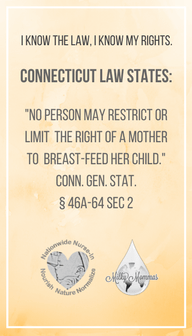
In Connecticut, women have been legally entitled to breastfeed in public since 1997, and it is prohibited for anyone to restrict or limit their right to do so. This includes restaurants and diners, so Luke has had five years to adjust to the law. As a responsible business owner, Luke would know of his legal obligations, and I don’t think he would behave like this, even if he did secretly feel a little uncomfortable.

As another mirroring scene, Jess is also shown being unable to handle seeing a woman breastfeed her baby. It’s not like this entire scene didn’t age well – it was outdated and unfunny at the time of first broadcast.
Schnitzel

LORELAI: And the rabbit says, ‘How about that schnitzel!’

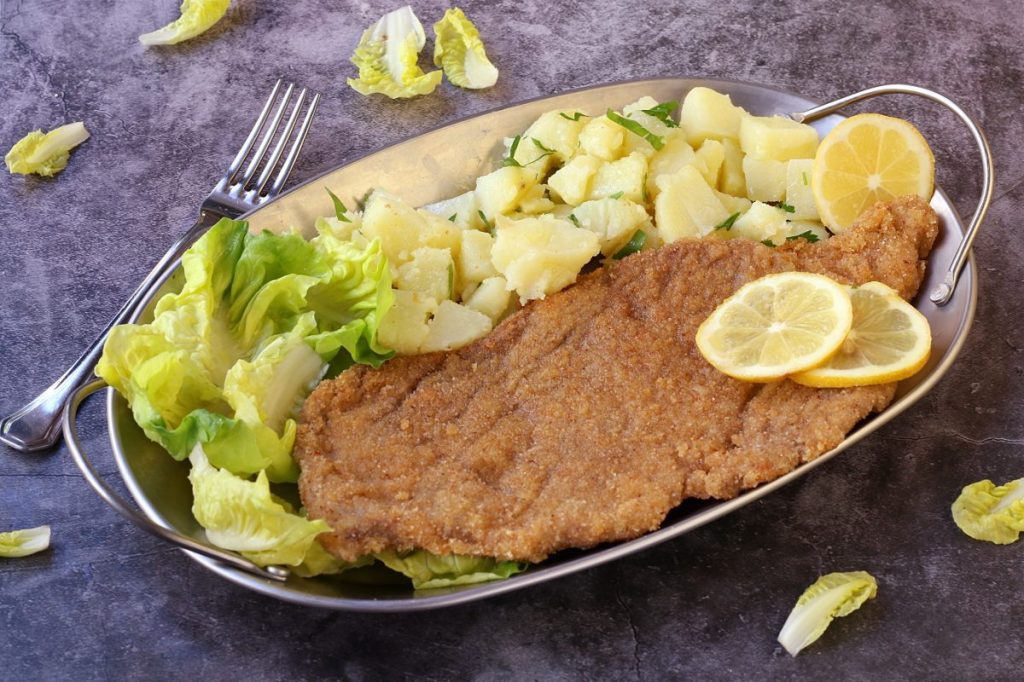
A schnitzel is a thin slice of meat that has been pounded into a flat shape using a meat tenderiser. It is usually breaded before being fried. The word is German, and means “slice” or “little slice”. Wiener schnitzel is a popular Viennese dish made of veal, traditionally garnished with a slice of lemon and served with potato salad or boiled potatoes with parsley and butter. It dates to the 19th century, and is one of the national dishes of Austria. There are numerous international versions of the dish.

The punchline to Lorelai’s alleged joke (Rory doesn’t think it is one) appears to be original.

Sardi’s

DEBBIE: Well, I felt obligated to tell the other moms about your little performance at school before they heard about it elsewhere.

LORELAI: Really, ’cause usually I like to meet up at Sardi’s after a performance, wait for the reviews. I hope The Times liked me.

Sardi’s, continental restaurant in the theatre district of Manhattan in New York City. It was founded by Vincent Sardi Sr and his wife Jenny Pallera, and first opened in 1927. It is known for the caricatures of Broadway celebrities on its walls, of which there are over a thousand. Sardi died in 1969, and the restaurant declined in the 1980s, being sold in 1986. After closing temporarily in 1990, it reopened with new staff.

The restaurant is considered an institution in Broadway theatre. It’s known as a place to gather before and after the theatre hangout, as well as a location for opening night parties, and was where the idea of the Tony Award was devised. Lorelai sarcastically puts herself in the role of an actor waiting at Sardi’s for the reviews of their performance in the New York Times.

Seventh Day Adventist Schools

RORY: Out of twenty-three schools, there wasn’t one that you might want to go to?

LANE: It depends on what I’m looking for. Of course, all the great Seventh Day Adventist schools were represented, with their ban on dancing, gum chewing and bowling.

There are twelve Seventh Day Adventist colleges and universities in the US, and one in Canada. The closest one to Connecticut is probably Washington Adventist University, in the suburbs of Washington DC. If Lane had to apply to all of them, that leaves at least ten more she applied to that weren’t Seventh Day Adventist.

Seventh Day Adventists really do disapprove of secular dancing, seeing it as worldly and immoral. Chewing gum isn’t forbidden, but it isn’t seen as part of a healthy diet, and some older Seventh Day Adventists prefer that gum not be chewed in public.

Back in the day, I think bowling was considered an unsuitable entertainment, along with anything else that was a competitive pastime, but these days it can seen as a wholesome activity, and there are even Seventh Day Adventist bowling teams.

Old Fashioned Drinks

While Luke is serving customers at the diner, Kirk and two young boys come in, ordering old fashioned soda shop drinks. It soon transpires they were sent by Taylor, making a point how necessary such a soda shop is, which Taylor wants to install in the space next to the diner, owned by Luke. Kirk already works for Taylor, and the two boys are presumably in his Boy Scout troop.

Egg Cream: Previously discussed.

Black Cow: Traditional name for a root beer float, which is root beer with vanilla ice cream. In some areas, the ice cream has to be chocolate in order to be called a black cow, and others say brown cow instead. (Root beer is a North American soft drink made using the root bark of the sassafras tree, or the sarsaparilla vine, Smilas ornata). Frank J. Wisner, owner of Colorado’s Cripple Creek Brewing, is credited with creating the first root beer float in 1893. The North American fast food chain A&W Restaurants are well known for their root beer floats.

Chocolate Phosphate: Traditional soda fountain drink, which is chocolate syrup and acid phosphate added to club soda. Acid phosphate is a mixture added to drinks which gives it a slightly tart flavour, and aids carbonation – a partially neutralised solution of diluted phosphoric acid made with salts of calcium, magnesium, and potassium. It’s recently come back into fashion as a mixer for soft drinks and cocktails.

Note also in this scene, references to ham on rye sandwiches and Coney island, previously discussed.

Snow Cones

JESS: It was hot. Two weeks ago there was a run on snow cones.

A snow cone is a dessert made of shaved or ground up ice, topped with a flavoured syrup, usually served in a paper cone or foam cup. Ice desserts began being made in the US in the mid-19th century, when ice became commercially available. By the late 19th century, theatres were selling them in the summer to keep patrons cool, and they were seen as an upper-class commodity. They became popular in the Great Depression and during World War II, as they had become so cheap almost anyone could afford one as a treat.

Luke’s Diner apparently has a machine that makes snow cones, at least during the summer months and for the tourist trade.

“I’ll have to call Paul Newman”

EMILY: How is your Caesar salad dressing prepared?

LUKE: I’ll have to call Paul Newman and ask him.

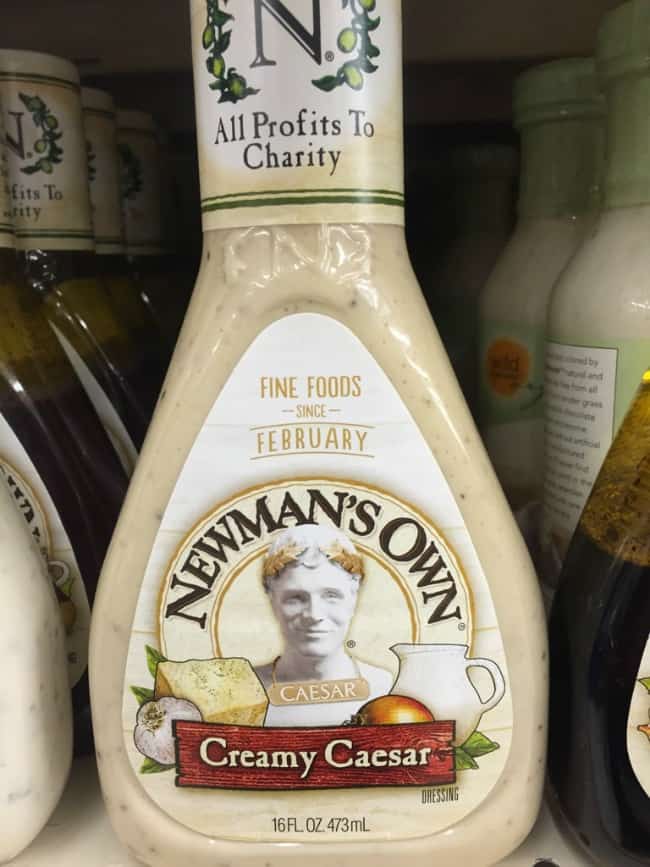
Luke is saying he doesn’t make his own salad dressing, he is using a bottle of Newman’s Own dressing, a brand of condiments and foods founded by Hollywood star Paul Newman and author A.E. Hotchner in 1982. The company, headquartered in Westport, Connecticut, donates 100% of its after-tax profits to the Newman’s Own Foundation, a private non-profit foundation which supports various charitable causes – one of them is the SeriousFun Children’s Network, residential summer camps for seriously ill children all over the world, which Newman co-founded in 1988.

Caesar Salad and Cobb Salad

Emily debates whether to order Caesar salad or Cobb salad for lunch at Luke’s diner.

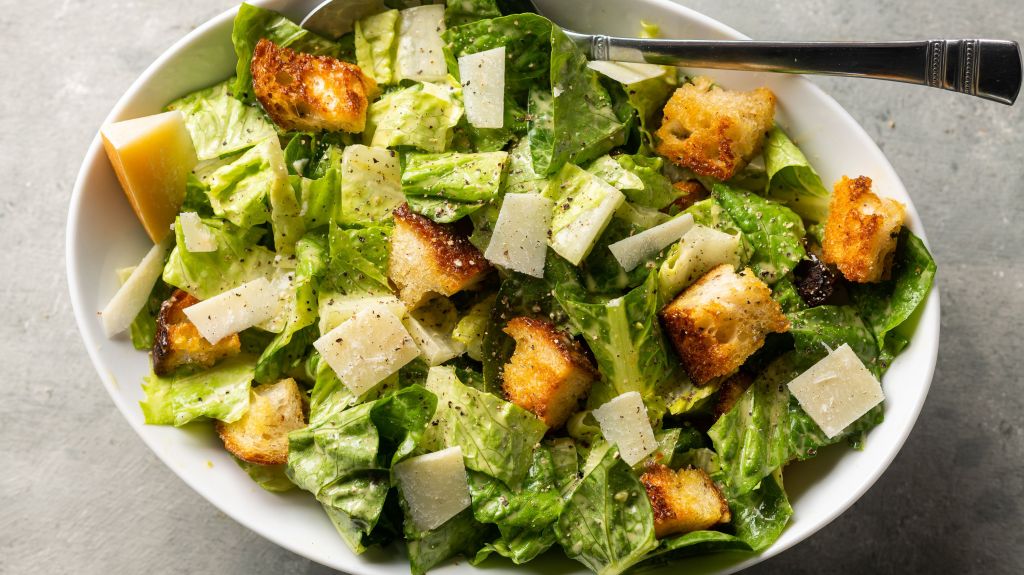
A classic Caesar salad [pictured] consists of whole leaves of romaine lettuce and croutons, dressed with lime juice, olive oil, coddled eggs, Worcestershire sauce, garlic, Dijon mustard, Parmesan cheese, and black pepper. Its creation is attributed to Caesar Cardini, an Italian immigrant who had restaurants in Mexico and the US. He is said to have invented the salad in 1924 at his restaurant Caesar’s in Tijuana, Mexico, when a busy Fourth of July left his kitchen depleted. He used what ingredients he had on hand, adding flair by tossing the salad at the table. In 1946, the salad was introduced to New York by Gilmore’s (!) Steak House, who added anchovies into the mix. Although Cardini disapproved, anchovies are now usually added. Lemon juice is also typically substituted for the lime juice.

Cobb salad is a classic American garden salad usually made from chopped salad greens, tomato, crisp bacon, fried chicken breast, hard-boiled eggs, avocado, chives, blue cheese, and red wine vinaigrette. The ingredients aren’t mixed together, but laid on the plate in neat rows. There are various stories as to how it was created, one being that it was invented in 1938 by Robert Cobb, the owner of the Brown Derby Restaurant in Hollywood, where it became a signature dish. The legend goes that Cobb hadn’t managed to eat until nearly midnight, and made the salad out of leftovers he found in the kitchen.

Coddled eggs are eggs that have been gently poached in a ramekin in a bain-marie, cooked just below boiling point. There is a risk of salmonella from eating them unless you are careful, hence Emily’s concern about ordering the Caesar salad. In the end, she orders the Cobb salad, where the eggs are hard boiled instead.

Note that Emily’s worry about the coddled eggs is basically the same conversation that Lorelai had with Sookie about mussels when they went out to dinner on their double date with Jackson and Rune. In both cases, Lorelai pleads with them to choose something else from the menu, in almost the same words.

Soup for Breakfast

LUKE: It’s the third day in a row you’ve ordered soup for breakfast.

Because she has a cold, Lorelai has ordered chicken noodle soup and mashed potato for breakfast at the diner. Mashed potato is soft and easy to eat, even with a sore throat, while chicken noodle soup is well known as a home remedy for colds, clearing nasal congestion and providing nutrition and hydration at the same time. I have never heard of anyone eating them for breakfast though, even when ill, and I would have thought it wasn’t a good idea to go out to breakfast when you have a cold, spreading your germs in a place where people eat.