MICHEL: My neighbor had this dog, a frisky little scamp that used to love to yap to his friends all night long. It was so cute. Then one day he disappeared. I told the police what I knew, but sadly the adorable little chatterbox was never found. It was tragic. LORELAI: You got rid of a dog? … MICHEL: I will gladly show you the transcript from the lawyer and the results of the lie detector test. LORELAI: You’re heinous. MICHEL: And very well rested.
Michel, the (unproven) dog killer! It is actually possible to beat a lie detector test, although quite difficult. Michel is obviously a very cool customer. It’s much easier to fail one while being innocent, due to anxiety. These false positives are why evidence from one is not admissible in a court of law in the US.
ANSWERING MACHINE: Ms. Gilmore, it’s Bob Merrimam, your mother’s lawyer. I’m calling about the little matter of this lawsuit she’s involved in. We’d like it if you could give a deposition . . .
The voice of Bob Merrimam is supplied by Seth MacFarlane, friend and colleague of Daniel Palladino from Family Guy. Seth MacFarlane had already had a role on Gilmore Girls.
Bob asks Lorelai to give a deposition in support of her mother’s case against Gerta, the unfairly dismissed German maid. This is where the episode title, “I Solemnly Swear” comes from, because that’s the beginning of the oath taken in legal contexts.
PARIS: Are the [votes] for Princess Diana’s butler jokes or real?
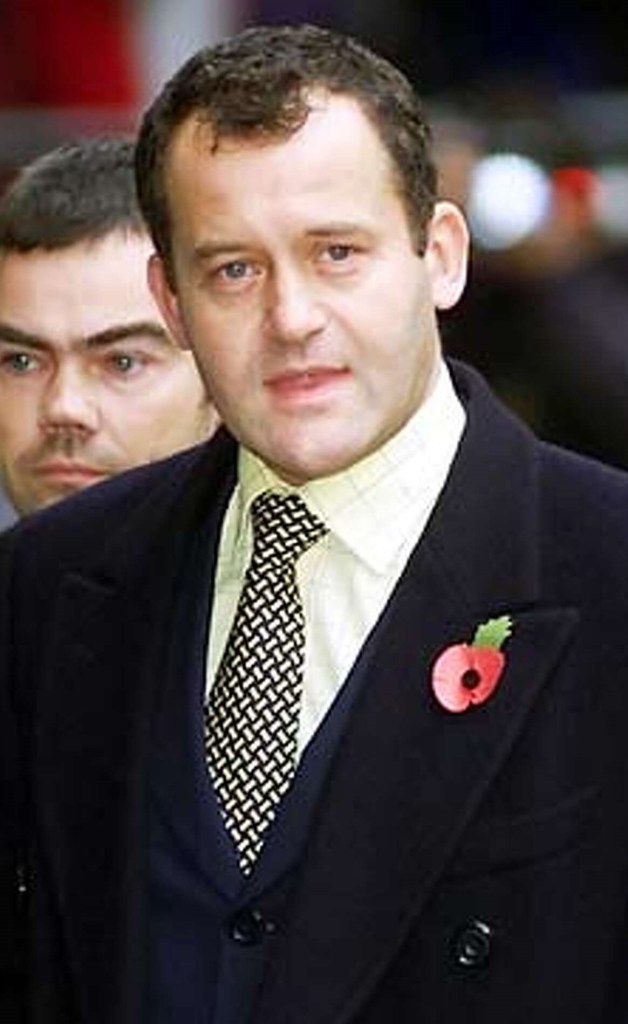
Paris refers to Paul Burrell (born 1958), English former servant of the British Royal Household, and Princess Diana‘s butler from 1987 until her death in 1997.
In 2003 he released a memoir called A Royal Duty, detailing his life as a royal servant, and in particular focusing on Princess Diana, who he claimed had called him “the only man she ever trusted”. Princess Diana’s sons, Princes William and Harry, accused Burrell of betraying their mother’s confidences, and called the book, “a cold and overt betrayal”.
The book didn’t come out until October, but pre-publicity probably went on for a long time before that, as reviewers called it “the long-awaited” memoir. Burrell had also been in the news in November 2002, in court for theft of Diana’s possessions. The case collapsed when he was granted immunity from prosecution by the Crown.
LOUISE: I’m having [Thanksgiving] dinner with my dad.
MADELINE: Isn’t he still in jail?
LOUISE: Yes, but his company donated some treadmills for the inmates so he swung a special trailer for dinner that they’re gonna set up for us in the parking lot. We have it for about two hours and then one of the Manson girls gets us.
In the episode “Back in the Saddle”, Louise mentioned that her father was due in court, on mysterious charges (she didn’t bother finding out what he had been arrested for). Now it’s seven months later, and Louise’s father is undertaking his sentence – for whatever it was. Madeline refers to it as “jail”, rather than “prison”, possibly suggesting a shorter, lighter sentence (although sometimes people use the word jail for both jail and prison, so that’s not certain at all).
It does sound as if Louise’s father is in a low or medium security facility, since he is permitted to spend his Thanksgiving dinner in a trailer in the parking lot with his daughter (and possibly other family members, it seems unlikely only Louise would go and see him). These trailers are a reward for good behaviour given to model prisoners, so Louise’s father is clearly well-behaved – even the donation of treadmills to the prison would not be enough on its own. Connecticut is one of only four states that allow extended visits like this (the others are California, New York, and Washington).
Louise says the trailer then goes to “one of the Manson girls”, referring to the female members of the Manson family who were convicted for their crimes. In real life, they were incarcerated in California, and in high security prisons, so this could not have really happened. (Squeaky Fromme was in a high security mental treatment facility in Texas).
Interestingly, there is a state prison in Cheshire, Connecticut called the Manson Youth Institution, for men under the age of 21. Louise can’t be referring to that either, as they are young men, not women, and they are not permitted visits such as she describes.
It is just possible that Louise’s father is being held at the federal correctional facility in Danbury, Connecticut [pictured], a medium and low security prison and satellite prison camp which has facilities for both male and female inmates – so if Louise’s dad’s trailer wasn’t going to a “Manson girl”, it could feasibly be going to a female prisoner, at least. The facility in Danbury has often featured in pop culture, including Orange is the New Black.
TAYLOR: Well, that’s not indicated here, but it doesn’t matter, because protesting is not allowed in the town square, period. It’s un-American.
LUKE: You mean like the Revolutionary War?
BABETTE: And Rosa Parks?
TAYLOR: That’s different. They were against the British and buses. No one likes the British or buses.
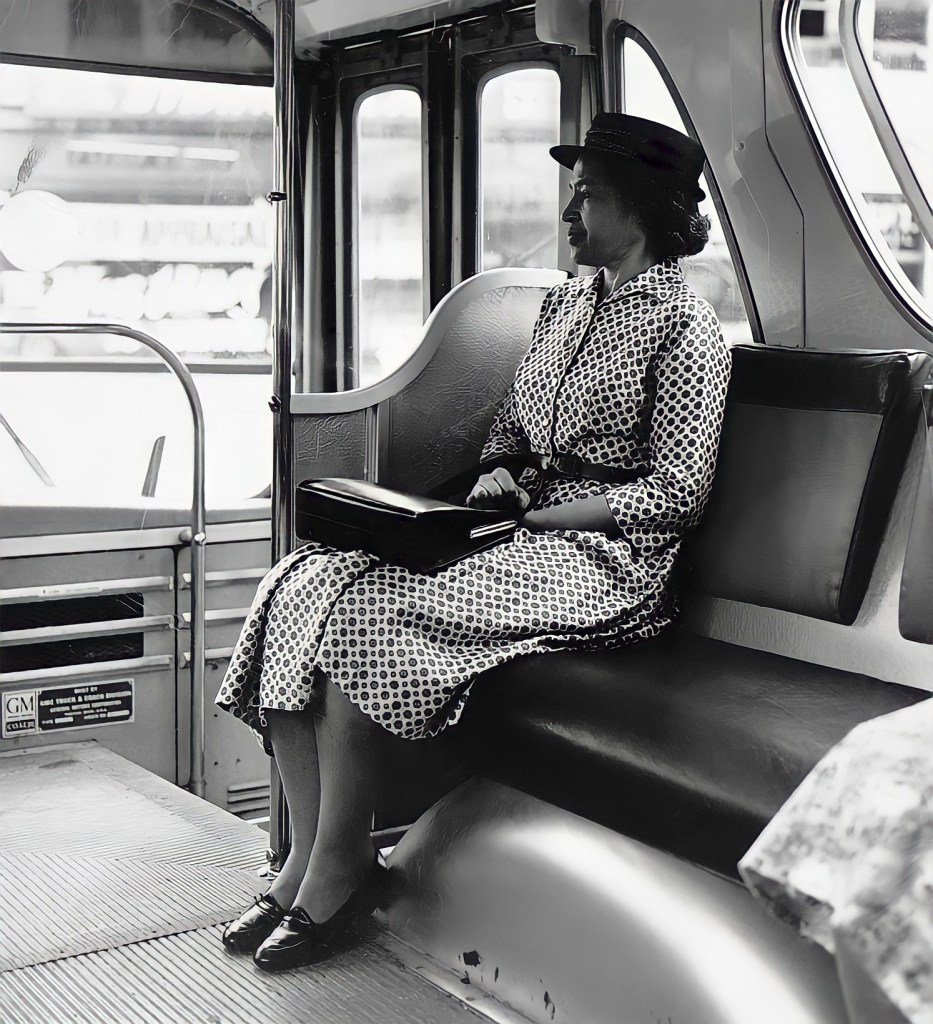
Rosa Parks (1913-2005), an activist in the civil rights movement best known for her pivotal role in the bus boycott in Montgomery, Alabama. In 1955, she refused a bus driver’s order that she vacate her row of seats in the “coloured” section of the bus to make way for white people, once the “white” section was full. Her act of civil disobedience helped inspire the black community to boycott the Montgomery bus company for over a year. In 1956, the courts decided that bus segregation was unconstitutional.
Rosa Parks became an international icon of resistance to segregation, and collaborated with civil rights leaders such as Edgar Nixon and Martin Luther King Jr. Although widely honored in later years, she also suffered for her act; she was fired from her job, and received death threats for years afterwards.
Rosa Parks received the NAACP’s Spingarn Medal, the Presidential Medal of Freedom, the Congressional Gold Medal, and a posthumous statue in the United States Capitol’s National Statuary Hall. Upon her death in 2005, she was the first woman to lie in honor in the Capitol Rotunda. California and Missouri commemorate Rosa Parks Day on her birthday, February 4, while Ohio, Oregon, and Texas commemorate the anniversary of her arrest, December 1.
Comically, Taylor thinks that Rosa Parks was protesting buses, which he appears to approve of! Is Taylor against public transport?
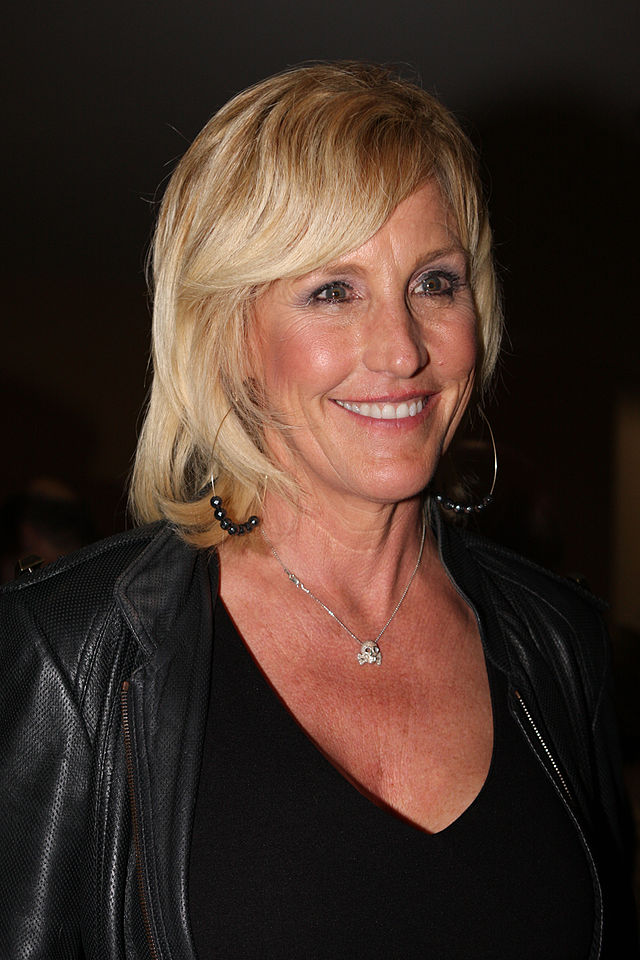
DORIS: How dare you sneak out like that, you sniveling little pond scum sample! I should call Erin Brockovich to bring a lawsuit against your parents, you steaming lump of toxic waste!
Erin Brockovich (born Erin Pattee in 1960), legal clerk, consumer advocate, and environmental activist who, despite her lack of education in the law, was instrumental in building a case against Pacific Gas & Electric Company (PG&E) involving groundwater contamination in a town in California with the help of attorney Ed Masry in 1993.
Their successful lawsuit was the subject of the Oscar-winning 2000 film, Erin Brockovich, starring Julia Robert and Albert Finney. Since then, Brockovich has become a media personality and legal consultant.
LUKE: Why, why do they do this? This is a public place, people are eating here … This cannot be sanitary … When did that become acceptable? In the old days, a woman would never consider doing that in public. They’d go find a barn or a cave or something. I mean, it’s indecent. This is a diner not a peep show!
Luke is horrified when a woman nurses her baby in the diner. I have trouble accepting this “caveman” version of Luke, when he was depicted as intelligent and progressive in Season 1 – sometimes it feels as if the show couldn’t decide whether Luke was smart or stupid, progressive or reactionary.
He did tell Lorelai that he didn’t like small children very much, especially their messy, sticky side, and perhaps this is why he is having problems with seeing a baby fed, but it ends up being a judgement on the mother for putting on a “peep show” – therefore sexualising her need to feed her child, which is pretty creepy of Luke.
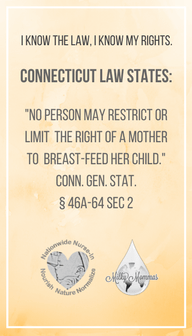
In Connecticut, women have been legally entitled to breastfeed in public since 1997, and it is prohibited for anyone to restrict or limit their right to do so. This includes restaurants and diners, so Luke has had five years to adjust to the law. As a responsible business owner, Luke would know of his legal obligations, and I don’t think he would behave like this, even if he did secretly feel a little uncomfortable.
As another mirroring scene, Jess is also shown being unable to handle seeing a woman breastfeed her baby. It’s not like this entire scene didn’t age well – it was outdated and unfunny at the time of first broadcast.
LANE: Good thinking. Hey, uh, isn’t it a drag that Jello Biafra isn’t singing for them anymore?
Dead Kennedys, punk rock band formed in San Francisco in 1978 with its classic line-up of Jello Biafra (lead singer), East Bay Ray (guitar), Klaus Fluoride (bass), and D.H. Peligro (drums). One of the defining hardcore punk bands, their lyrics were usually political in nature, satirising political figures, authority, popular culture, and punk itself. From 1978 to 1986 they attracted controversy for their provocative lyrics and artwork. They released four albums and one EP before disbanding acrimoniously in 1986.
Jello Biafra (born Eric Boucher in 1958), former lead singer and songwriter for the Dead Kennedys. In the mid-1980s, Biafra became an active campaigner against the Parents Music Resource Center, a committee formed in 1985 with the goal of increasing parental control over the access of children to music, via labelling music with Parental Advisory stickers. Biafra’s campaigning culminated in an obscenity trial between 1985 and 1986, which resulted in a hung jury.
In 2000, Biafra lost a legal case initiated by his former Dead Kennedys bandmates over songwriting credits and unpaid royalties. In 2001, the band reformed without Biafra. Although Dead Kennedys have continued to perform live over the years, they have not released any new material since the release of their fourth studio album, Bedtime for Democracy, in 1986.
[Picture shows Dead Kennedys in the early 1980s; Jello Biafra is second on the left]
LUKE: Taylor, no, no, no, no, and every day from now on ’til the end of my life, I am gonna come in here and say, “Taylor, no!” And when I die, I’m gonna have them freeze me next to Ted Williams, and when they find the cure to what I died of and they unfreeze me, my first words are gonna be, “How’s Ted?” followed closely by, “Taylor, no!”.
Theodore “Ted” Williams (1918-2002), professional baseball player and manager who played his entire career for the Boston Red Sox, from 1939-1960. Inducted into the Baseball Hall of Fame in 1966.
Ted Williams died in Florida of cardiac arrest at the age of 83 on July 5, 2002. Although his last will and testament asked that he be cremated and his ashes scattered in the Florida Keys, his son John-Henry and his younger daughter Claudia chose to have his remains cryonically frozen.
Ted’s elder daughter, Bobby-Jo Ferrell, brought a suit to have her father’s wishes recognised. John-Henry’s lawyers then produced a “pact” signed by Ted, John-Henry, and Claudia, agreeing that they would all be frozen, in the hopes of being together again one day. Ted’s signature was found to be genuine, and Bobby-Jo dropped the case due to lack of funds. Publicity from the case increased the number of enquiries to cryonics organisations.
Ted Williams’ biographer, Leigh Montville, claims that Williams’ signature on the pact was a practice autograph on a plain piece of paper, around which the family agreement was written. He had signed the pact Ted Williams, as he did for autographs, while legal documents were signed Theodore Williams.
John-Henry Williams unexpectedly died from acute leukaemia in 2004, and was also cryonically frozen by Alcor in fulfilment of the family agreement.
JESS: At that stupid summer insanity plea the town put on.
An insanity plea, otherwise known as a mental disorder defence, is an argument put forward during a criminal trial that the defendant is not guilty for their crimes due to a psychiatric disease at the time the crime was committed. Using this as a defence goes back in law to the very beginnings of recorded history, and although it’s popular in fiction, it’s rare in the US – used in about 1% of cases, and then, only successful about a quarter of the time. The person who succeeds in winning their case this way will usually have to undergo psychiatric treatment in an institution instead of a prison sentence, or as part of their prison sentence.




 The Annotated Gilmore Girls