Rebecca of Sunnybrook Farm

RORY: I guess the thought of just being nice to people never occurred to you, huh?

PARIS: See, that is exactly what I need from you, Rebecca of Sunnybrook Farm for the new millennium. Hey, wear some braids tomorrow with bows. I mean, hell, let’s sell it, sister!

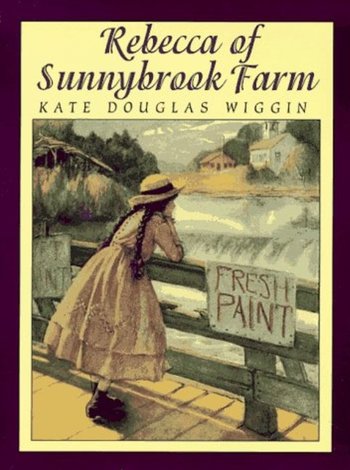
Rebecca of Sunnybrook Farm, a 1903 classic children’s book by Kate Douglas Wiggin. The main character is Rebecca Rowena Randall, an imaginative and charming little girl from a poor family, sent to live with her aunts, Miranda and Jane Sawyer, in the fictional village of Riverboro, Maine. Miranda is stern with Rebecca, while Jane is kindly and finds Rebecca’s lively nature refreshing. However, Aunt Miranda will eventually prove how much she values Rebecca.

Like Rory, Rebecca is a brunette from a small town, and eventually becomes a very good student, especially in English, as well as talented writer.

The book was turned into a stage play, and was made into a film three times, most notably in 1938, starring Shirley Temple. However, Paris seems to be describing the book rather than a film, as the films don’t show Rebecca with the braids and bows of the book, preferring curly-headed heroines.

Tough Love

DEAN: Why don’t we just bring [Lorelai] something out?

RORY: No. She and Luke have been in this fight for too long, she’s gotta do this.

DEAN: You’re cruel.

RORY: Tough love, baby.

Tough love is the act of treating a person harshly or sternly with the intent to help them in the long run. It is thought that the phrase originated with the 1968 book Tough Love by Christian community activist Bill Milliken, who worked with at-risk youth to keep them engaged with the education system.

Dean describing Rory as “cruel” seems quite apt, considering the dishonest basis of their relationship at this point.

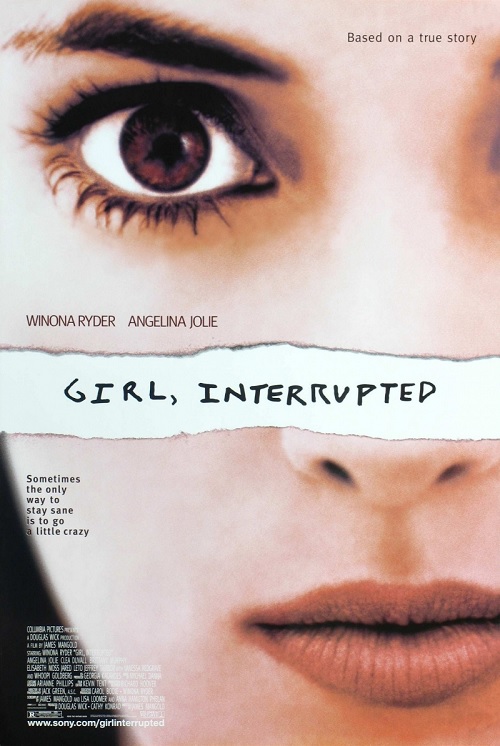
Girl, Interrupted

RORY: I’ll tell you what, Sookie. How about Lane and I come up with a few more suggestions for you? Still melodic, but not quite as Girl, Interrupted.

Girl, Interrupted, a 1999 psychological drama film directed by James Mangold, and based on the 1993 memoir of the same name by Susanna Kaysen. The memoir’s title comes from the Vermeer painting, Girl, Interrupted at Her Music. The film is set in New England in the 1960s, and follows a young woman, played by Winona Ryder, who spends 18 months in a psychiatric facility after a suicide attempt.

The film received only lukewarm reviews, with most of the praise for the performance of Angelina Jolie, who plays a sociopath. Jolie won the Academy Award for Best Supporting Actress. The author, Susanna Kaysen, didn’t like the film, accusing James Mangold of adding too many invented, melodramatic scenes. Mangold rewrote the story as a parallel to The Wizard of Oz.

It seems possible that Rory could have read the book, either before or after the film came out. Not only does she enjoy female memoir and autobiography, but Susanna Kaysen was admitted to the same private psychiatric hospital where Sylvia Plath and Anne Sexton were treated, as well as John Nash.

44th Street

TOURIST: Excuse me, I’m so sorry to bother you. Which way is 44th?

RORY: Oh, um, that way.

44th Street is two blocks north of the bus terminal, and Rory has sent the tourist south instead. As Jess says, they will hopefully soon notice that the street numbers are getting smaller rather than bigger, and turn around. (The tourist made a rookie mistake by not asking at least one other person for directions!).

44th Street is in the theatre district, with numerous hotels, clubs and restaurants the tourist may have been looking for. It’s also the site of The Algonquin Hotel, at 59 West 44th Street, so this minor interaction feels like a hidden homage to Dorothy Parker.

“The early bird”

MAN: Wow, you’re hours early.

LORELAI: Yeah, well, I just wanted to beat traffic and have time to get ready and relax, and also, I’ve heard the early bird gets the unwrinkled gowns without the mysterious stains in them.

Lorelai plays with the common English proverb, “The early bird catches the worm”, meaning that the first people to arrive are most likely to nab the best stuff, or that the earlier you begin a task, the more likely you are to succeed at it before others. It’s first found in a 17th century collection of proverbs, suggesting that it was already an old and well-known saying.

High Fidelity

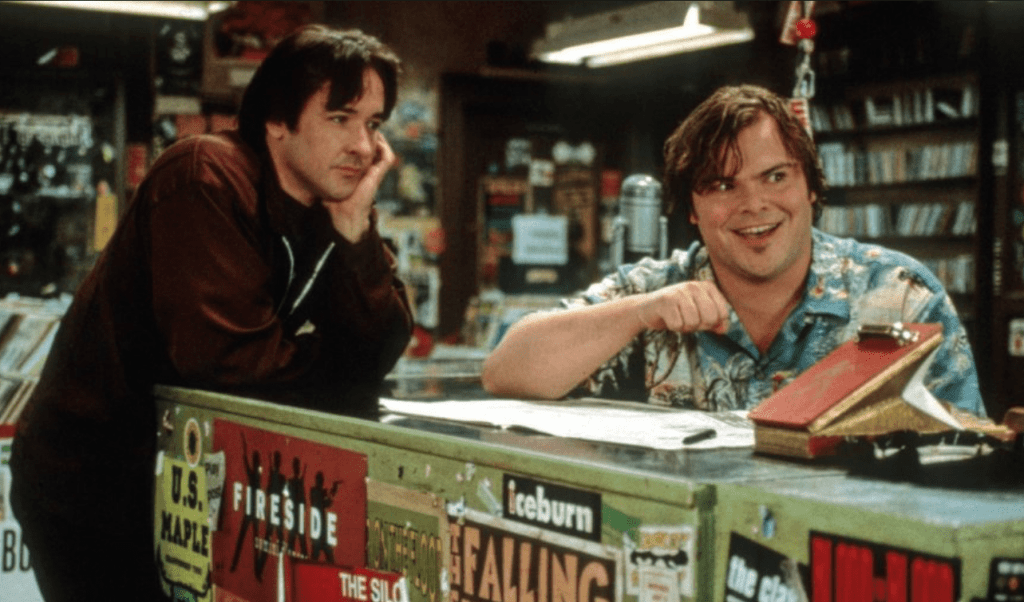
JESS: There’s a record store you should check out. It’s run by this insane freak who’s like a walking encyclopedia for every punk and garage-band record ever made. Catalog numbers . . . it’s crazy. The place is right out of High Fidelity.

High Fidelity, 2000 romantic comedy-drama film directed by Stephen Frears, based on the 1995 British novel of the same name by Nick Hornby, with the film’s action moved from London to Chicago, but otherwise faithful to the book.

The film stars John Cusack as a music-lover named Rob with little understanding of women who owns a record store called Championship Vinyl. He and his employees Dick and Barry (played by Todd Louiso and Jack Black), armed with an encyclopedic knowledge of music, compile “Top 5” lists for every occasion, and openly mock their customers’ tastes. Eventually, Rob is able to produce a mixtape to please his girlfriend, Laura (played by Iben Hjejle).

High Fidelity was a commercial and critical success, receiving praise for its witty dialogue, strong performances and solid soundtrack. It’s been voted one of the best romantic comedies, and one of the greatest films of all time. It was made into a 2020 television series.

It’s interesting that Jess compares the record store he is taking Rory to with one out of a romantic comedy – especially one where a smart but emotionally obtuse young man learns to express his feelings.

EDIT: Thank you to High Fidelity fan Alisa for supplying the correct name of the actress playing Laura.

The Electric Kool-Aid Acid Test

This is the book that Jess is reading in the park when Rory finds him. It’s a 1968 non-fiction book by Tom Wolfe, a popular example of the New Journalism literary style. It’s a firsthand account of the novelist Ken Kesey and his followers, called The Merry Pranksters, who travelled around the US in a colourfully painted school bus called Further, whose name was painted as the destination sign. The bus was driven by Neal Cassady, the inspiration for Dean Moriarty from Kerouac’s On the Road.

Kesey and his Pranksters became famous for their use of psychedelic drugs such as LSD (“acid”), often added to the drink Kool-Aid at Acid Test parties. Kesey becomes idolised as a hero of the countercultural movement, and almost a priest of a transcendent new religion or cult. He forms friendships with the Hell’s Angels, and crosses paths with other countercultural icons, such as The Grateful Dead and Allen Ginsberg, but is unsuccessful in his attempts to meet psychologist Timothy Leary, who worked with psychedelic drugs. The Pranksters meet Jack Kerouac, who finds them overwhelming and resents them, a symbol of the hippies overtaking the Beat generation as the new counterculture. Eventually, the law catches up with them.

The book received modest critical acclaim, and is regarded as a faithful and sober account of Kesey’s activities, although it has also received plenty of criticism for Wolfe’s idolisation of Kesey, and his glorification of rampant drug abuse. Kesey himself noted that Wolfe was only with him for three weeks, and used no recording devices at all, but provided a reasonably factual account.

This book makes perfect sense for Jess to read – an updated On the Road, with a similar vibe to Fear and Loathing in Las Vegas. It shows his interest in journalism as a literary art form.

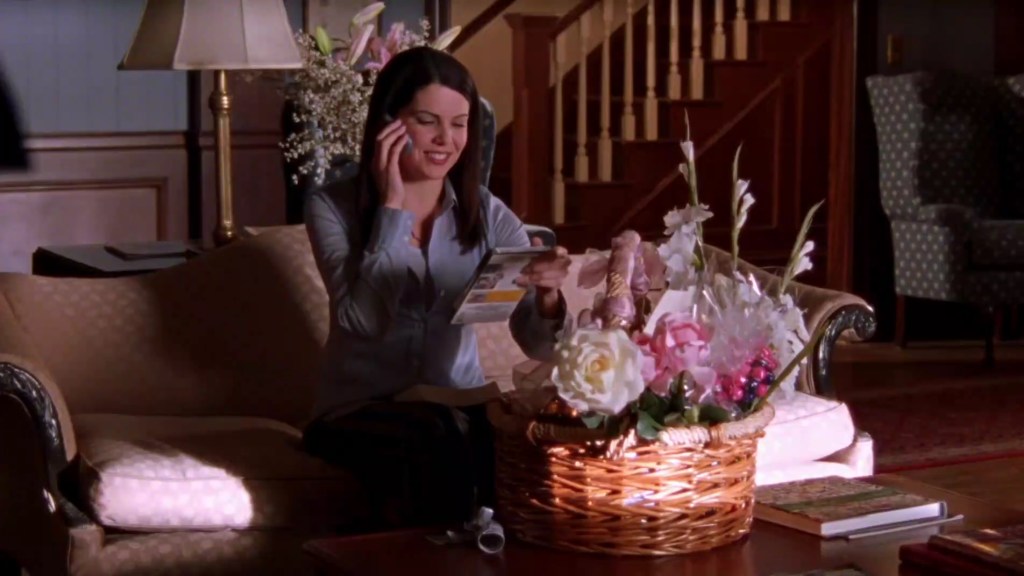
Christopher’s Gift Basket for Lorelai

Flowers

$25 savings bond

Youth Hostel card

What Color is Your Parachute?, by Richard Nelson Bolles (a classic guide for job-seekers)

The Graduate on DVD, the 1967 film starring Dustin Hoffman

The Portable Nietzsche, by Friedrich Nietzsche, translated by Walter Kauffman

Application to join the army

Disposable camera

Pearl necklace in a velvet box

They are all traditional graduation gifts, and/or joke gifts. The camera actually ends up becoming an essential item. Lorelai never seems to consider how Sherry would feel about her boyfriend sending another woman flowers and jewellery.

Zagat’s

RORY: I’ll look it up in Zagat’s.

The Zagat Survey, commonly known as Zagat, an organisation which collects and correlates the ratings of restaurants by diners, established by Tim and Nina Zagat in 1979. Their first guide was only for New York City, with reviews written by their friends; at its height in 2005, it covered 70 cities, based on the input of more than 250 000 people, rating not only restaurants, but also hotels, shopping, nightlife, zoos, museums, music, movies, theatres, golf courses, and airlines.

Zagat was published in a number of books and guides, and had a website you could subscribe to. Zagat was bought by Google in 2011 and is fully integrated into Google services such as Google Maps and Google + Local. Most of the staff were laid off, and production of Zagat in book form is looking “bleak”. They sold it to The Infatuation in 2019, with promises of a comeback, new website, and apps.

John Nash

RORY: That diploma hanging on the wall is going to make this all worthwhile, trust me.

LORELAI: I guess, unless I turn into John Nash and start drooling on people.

John Nash (1928-2015), mathematician who made fundamental contributions to game theory, differential geometry, and the study of partial differential equations. His theories are widely used in economics. Nash is the only person to win both the Abel Prize and the Nobel Memorial Prize in Economics Sciences.

In 1958, Nash began showing clear signs of mental illness and spent several years in psychiatric hospitals being treated for schizophrenia. His condition slowly improved in the 1970s, allowing him a return to academic work by the mid 1980s.

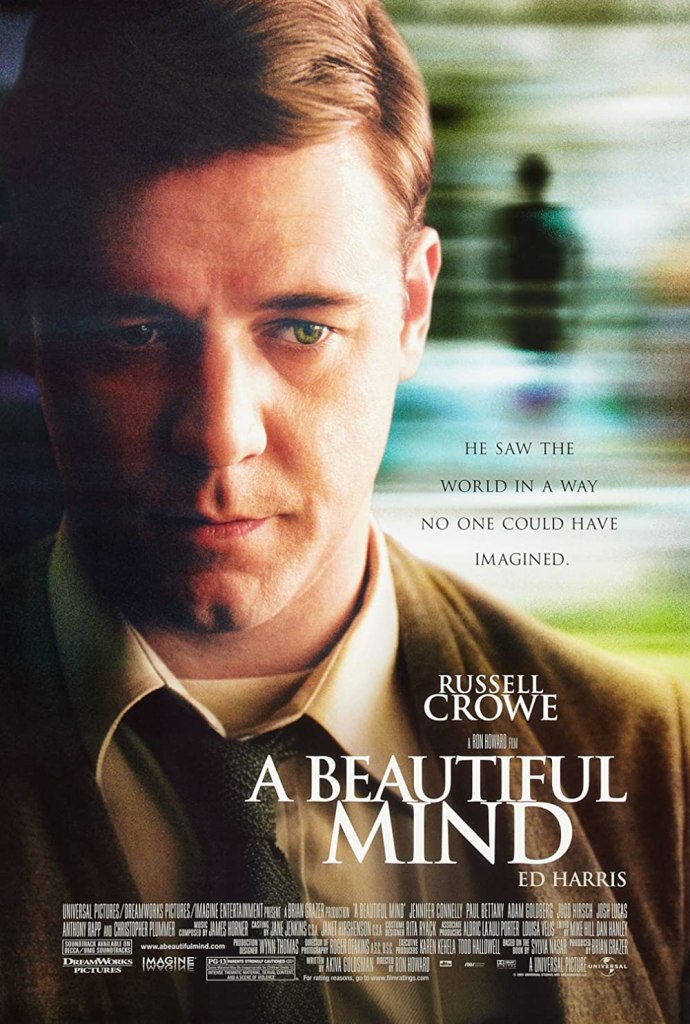
John Nash’s struggles with mental illness and his recovery were highlighted in the 2001 biographical film, A Beautiful Mind, directed by Ron Howard and based on the 1997 best-selling Pulitzer-winning biography of the same name by Sylvia Naser, with Russell Crowe starring as Nash. A Beautiful Mind was a commercial and critical success, winning four Academy Awards, including Best Picture and Best Director.