JESS: I can’t get into poetry. It’s kind of like, geez, just say it already, we’re dying here.
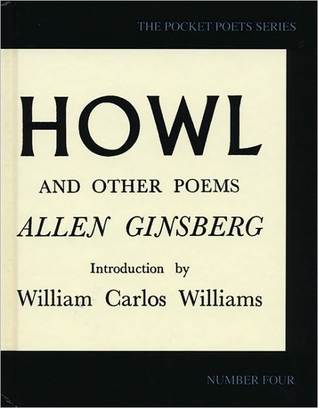
Jess has actually read Allen Ginsberg’s poem Howl more than forty times, so this “I’m too butch for poetry” is nothing but posturing. Maybe he’s trying provoke Rory into saying something, which would reveal to an outsider how they formed an intimate bond over her poetry book. If so, it doesn’t work.
But in what possible universe would Jane Austen have liked Charles Bukowski, as either a person or a writer? She lived in an era when it was deeply shocking, even violating, for a man to address a woman without an introduction – how would she have coped with Bukowski’s vivid description of his own penis and his offer of it to a female friend, with instructions as to its use?
Jess is saying that a nice, genteel girl like Rory can still appreciate a crude but intelligent bad boy like himself. Rory and Jess? For sure. Jane Austen and Bukowski? Not a chance.
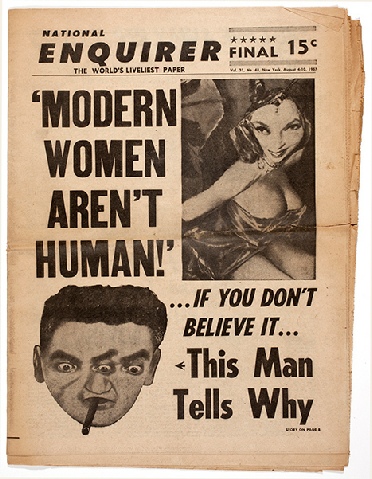
PARIS: [The Beats] believed in drugs, booze, and petty crime … That was not great writing. That was the National Enquirer of the fifties.
National Enquirer, tabloid newspaper founded in New York in 1926, known for its sensationalist reporting and flimsy journalistic ethics.
The National Enquirer already existed in the 1950s, so I’m not sure how The Beats are “the National Enquirer of the 1950s”. Surely the National Enquirer was the National Enquirer of the 1950s? For a supposedly smart character, Paris says some remarkably silly and ignorant things.
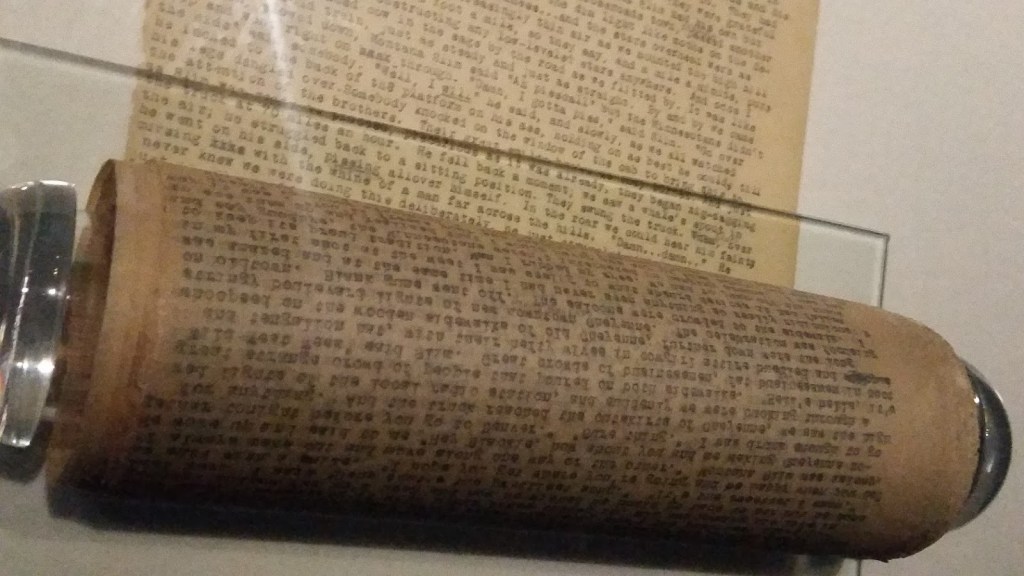
There is a myth that his novel On the Road was typed on one long free-form written scroll, without any editing. In fact, the experiences which inspired the novel were first written in a series of notebooks, and the early drafts were worked on for several years.
Dissatisfied with his progress, and impressed by a rambling 10 000-word missive from his pal (and muse) Neal Cassady, Kerouac then decided to write the novel as if it was a letter to a friend, with all the improvisational fluidity of jazz. The first draft was typed up in three weeks on a continuous 120-foot roll of tracing paper that he cut and taped together, single-spaced, and with no paragraph breaks.
In the following years, Kerouac continued to revise this manuscript, and the final published version was considerably shorter, with fictional names given to the real people he wrote about. In 2007, a slightly edited version of the original scroll was published, retaining the real names.
The original scroll was bought in 2001 for $2.43 million by American businessman Jim Irsay, and has been exhibited at various times in museums and libraries in the US, UK, Ireland, and France.
Paris’ comment is reminiscent of Truman Capote’s withering statement about Kerouac, and his supposed lack of editing: “That’s not writing. That’s typing”.
One of Rory’s tee shirts she discusses with Dean has Kafka Was Here written on it, a nod to one of her favourite authors. Two of her other tee-shirts with writing on them are Rock Star and Evil.
RORY: Actually, I was thinking of pulling kind of a hermit thing tonight.
DEAN: Why?
RORY: I don’t know. J.D. Salinger seems to dig it.
Jerome David “J.D.” Salinger (1919-2010), author of Catcher in the Rye and Franny and Zooey, both previously discussed. As his literary notability grew, Salinger gradually withdrew from public life.
The title for this episode comes from the phrase, “there’s the rub”, to mean that there is a problem or contradiction which is difficult or impossible to resolve. It’s also a pun, because Lorelai and Emily are going to a spa to receive massages, or to be “rubbed”.
The phrase is believed to have originated from the sport of lawn bowls, played since ancient times, and known in England since at least the 13th century. A ball (known as a bowl) is rolled toward a smaller stationary ball, called a jack. The object is to roll one’s bowls so that they come to rest nearer to the jack than those of an opponent. A rub is a flaw in the playing surface that interferes with the ball’s trajectory.
The saying was popularised by William Shakespeare’s Hamlet. In the soliloquy scene, as Hamlet is contemplating suicide, he says, “To sleep; perchance to dream: ay, there’s the rub: for in that sleep of death, what dreams may come?”.
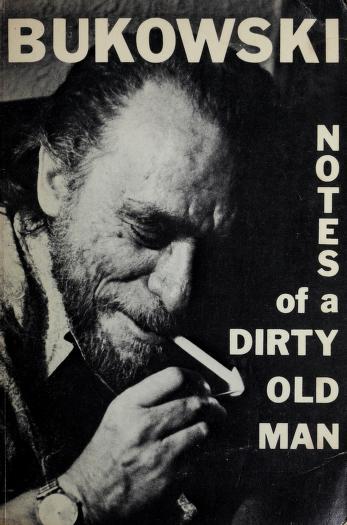
This is the book that Jess is reading on his bed when Luke comes in.
Notes of a Dirty Old Man is a 1969 book by Charles Bukowski, a collection of his newspaper columns for the underground Los Angeles newspaper, Open City. His articles showcased his trademark crude humour and attempts to provide a truthful viewpoint of events in his life. He writes openly about his alcoholism and hook-ups with prostitutes and married women.
Some of the quotes from the book sound like things that Jess could probably relate to:
The people walk with such an indifference I begin to hate them, but then again I’ve never really been fond of anything.
Is it possible to love a human being? Of course, especially if you don’t know them too well.
The people will always betray you. Never trust the people.
This kind of nihilistic self-hatred and detachment from others is heady stuff for a teenage boy who’s been kicked around, and I can imagine Jess reading this as a kind of wisdom needed to survive in the world.
Like Rory, Jess has a strong interest in journalism – but a very different type of journalism. Did he recommend this book to Rory? It seems likely. And likely that she would read it, too.
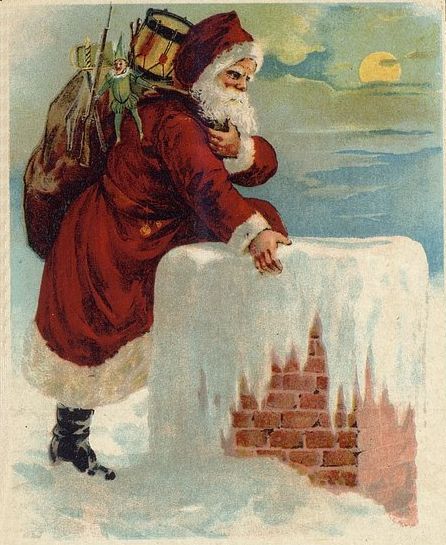
JESS: Actually, I came down the chimney and pulled a Santa Claus.
Jess refers to Santa Claus delivering gifts by coming down the chimney, a common tradition in many European countries. It probably pre-dates Christianity, as in Germanic legend, the Norse god Odin was said to bring gifts down the chimney at Yuletide, and in folklore elves and fairies brought gifts down the chimney to leave on the hearth. The fireside and hearth has been held sacred since ancient times, probably since humans began using fire.
Santa Claus coming down the chimney became part of American tradition upon the publication of the 1823 poem, A Visit from St. Nicholas, by Clement Clarke Moore, which begins, “’Twas the night before Christmas …”. Enormously popular, it had a massive effect on Christmas traditions in the US, many of which can be dated to the publication of the poem.
Jess is quick to counter Lorelai’s suggestion that he broke into their house to steal the bracelet by instead aligning himself with a benevolent figure who actually brings gifts, rather than steals them. Jess does the right thing in returning the bracelet as soon as he can, but gets nothing but grief for it.
EDIT: Edited to change a Jeff to a Jess, thank you to Carol Stamm for help in my battle with autocorrect. Otherwise we’d all be reading about Laurel Gilmore and her daughter Dory, in the little town of Tars Hello.




 The Annotated Gilmore Girls