“I paraphrased Proust”

RORY: Well, having company is about making sacrifices.

LORELAI: Martha Stewart?

RORY: I paraphrased Proust.

Martha Stewart, previously discussed.

Rory refers to Marcel Proust, previously discussed, the author of In Search of Lost Time, a novel in seven volumes.

I’m not sure which part of Proust Rory is paraphrasing from. There are so many times that the author reflects on sacrifices made for other people, and for the benefit of society that it is difficult to choose. However, this sentence from The Guermantes Way, Vol 3 of the novel, stood out for me as possibly reflecting Rory’s feelings:

The same familiar spirit represented to Mme. de Guermantes the social duties of duchesses, of the foremost among them, that was, who like herself were multi-millionaires, the sacrifice to boring tea, dinner and evening parties of hours in which she might have read interesting books, as unpleasant necessities like rain, which Mme. de Guermantes accepted, letting play on them her biting humour, but without seeking in any way to justify her acceptance of them.

Rory also submits to social duties she finds boring, in a way Lorelai doesn’t, but like Mme. de Guermantes, she would probably prefer to be reading “interesting books”, and uses her sense of humour as a coping mechanism to get through them.

That does sound a lot like Rory’s attitude, and if so, suggests she thinks of entertaining her father and his girlfriend as a boring necessity. A big change from the previous season, when she was so thrilled to see Christopher in Stars Hollow. Is it just Sherry making the difference, or is some of the gilt coming off Christopher already?

If this is the source, it means Rory has read at least the first three volumes of In Search of Lost Time.
New Belle and Sebastian Single

RORY: Lane, this is flat out stalking.
LANE: Look, I don’t have much time. I’ve already used up my five minutes of phone time so this is totally illicit, but I have to talk to you. There’s a new Belle and Sebastian single coming out today.

Belle and Sebastian, Scottish indie pop group formed in Glasgow in 1994 by Stuart Murdoch and Stuart David. After the limited release of their 1996 album Tigermilk , they recruited other musicians and singers. The band took their name from a short story Murdoch had written inspired by the television adaptation of the French novel Belle et Sébastien about a six-year-old boy and his dog.

Their 1996 album If You’re Feeling Sinister is widely considered the band’s masterpiece, while their 2000 album Fold Your Hands Child, You Walk Like a Peasant brought mainstream success in the UK.

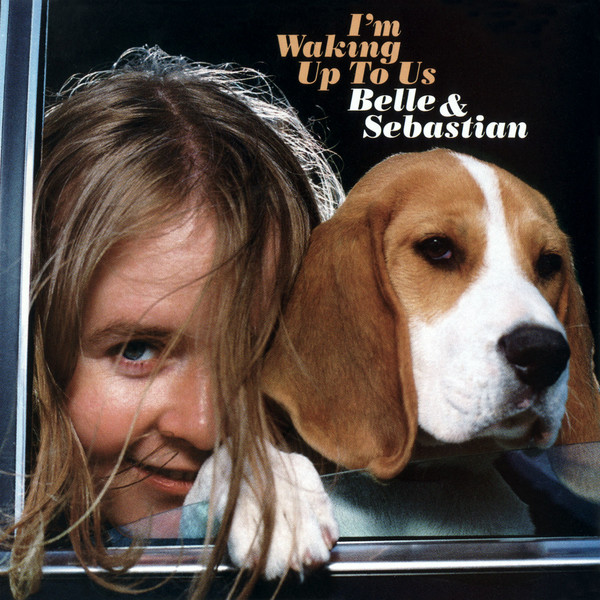
In fact, Belle and Sebastian didn’t release any new singles in 2002, although they brought out an album called Storytelling in June, the soundtrack to the 2001 film of the same name. Their most recent single was “I’m Waking Up to Us”, an EP put out on November 26 2001. It went to #39 in the UK and #22 in Scotland. It was #4 on the UK indie charts. I can only think this is the single Lane is referring to.

The song is about the break up of a relationship and the realisation that it would never have worked, which would fit in with Lane’s mood. Some of the lyrics include:

You know I love you here’s the irony
You’re going to walk away intact
I think you never liked me anyway …

I think I’m waking up to us
We’re a disaster
You don’t want to know me

Pinteresque

RORY: Sometimes I will add a dramatic pause to prove a point, undercutting my wpm.
PARIS: Let’s not harbor any Pinteresque fantasies here, Rory.

Paris is referring to playwright Harold Pinter (1930-2008), one of the most influential modern British dramatists, with a career spanning more than 50 years. His best known plays include The Birthday Party (1957), The Homecoming (1964), and The Betrayal (1978), each of which he adpated for the screen. He wrote several other screenplays, and directed or acted in radio, stage, television, and film productions of his own and others’ works. He received over 50 awards and honours, including the Nobel Prize for Literature in 2007.

To say that something is “Pinteresque” means that is characteristic of the dialogue in a Harold Pinter play, which (among other things) contains long, brooding pauses. “The Pinter pause” is considered a trademark of his style.

Psalm of the Day and Psalm 79

LANE: I only get five minutes a day of outside phone time but unlimited time to call the Psalm a Day line. A big ripoff, by the way, because Psalm 79 has been on there for three straight days. That’s not in keeping with what their name clearly implies, which is a new psalm per day, every day. Not the same tired one from the previous two days.

Mrs Kim has given Lane unlimited phone privileges to call the Psalm a Day Line, a number where you pay by the minute to hear a psalm each day – the same psalm being up all day.

Psalm 79 is identified in the Old Testament as “a psalm of Asaph”. Asaph was a member of the guild of musicians, and he may have either written, transcribed, or collected the psalms with his name attached, or they were produced by his guild, or written in a style he initiated.

Psalm 79 is a communal lament upon the destruction of Jerusalem, probably by the Babylonian army in 587 BC, and in particular the defilement of the Temple by allowing dead bodies to lie there, without burial.

The psalm expresses some sentiments pertinent to Lane’s situation, in particular asking how long God will remain angry at them and begging for mercy. It mentions hoping the groans of prisoners will help change God’s mind, just as Lane hopes her mother’s anger will eventually soften so that Lane can be released from her prison.

O God, the nations have invaded your inheritance;
they have defiled your holy temple,
they have reduced Jerusalem to rubble.

They have left the dead bodies of your servants
as food for the birds of the sky,
the flesh of your own people for the animals of the wild.
They have poured out blood like water
all around Jerusalem,
and there is no one to bury the dead.
We are objects of contempt to our neighbors,
of scorn and derision to those around us.

How long, Lord? Will you be angry forever?
How long will your jealousy burn like fire?
Pour out your wrath on the nations
that do not acknowledge you,
on the kingdoms
that do not call on your name;
for they have devoured Jacob
and devastated his homeland.

Do not hold against us the sins of past generations;
may your mercy come quickly to meet us,
for we are in desperate need.

Help us, God our Saviour,
for the glory of your name;
deliver us and forgive our sins
for your name’s sake.
Why should the nations say,
“Where is their God?”

Before our eyes, make known among the nations
that you avenge the outpoured blood of your servants.
May the groans of the prisoners come before you;
with your strong arm preserve those condemned to die.
Pay back into the laps of our neighbors seven times
the contempt they have hurled at you, Lord.

Then we your people, the sheep of your pasture,
will praise you forever;
from generation to generation
we will proclaim your praise.

“Music has charms to soothe the savage beast”

LORELAI: But my question is, how did that happen? How was it that suddenly everyone in the world was saying ‘music has charms to soothe the savage beast’ when it was written breast?

“Musick has Charms to sooth a savage Breast” is a famous quote from William Congreve’s 1697 play, The Mourning Bride, previously mentioned. It means that listening to music can help calm angry and upset emotions.

For some unknown reason, it became popularly misquoted as “Music has charms to soothe a savage beast”. It doesn’t even make sense – if you’re being attacked by a wild tiger, whistling show tunes won’t help in the slightest.

Rory Phones Jess

Rory got a pager message from Dean while she was at dinner, but instead of phoning him back right away, she called Lane’s house (Lane didn’t come to the phone). When she gets home, Lorelai goes for a shower, telling Rory to find a movie for them to watch. It was after 9 pm when they were at dinner, and they talked more and had a half hour drive home, so it must be around 10 pm by now, yet they’re planning to watch a movie as well!

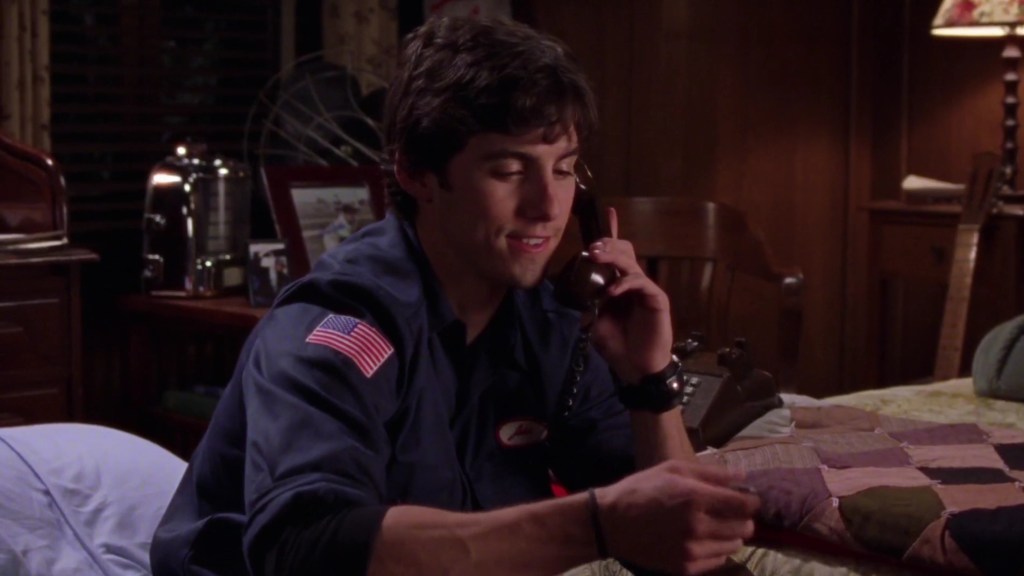
Instead of getting a movie, or phoning Dean back, Rory calls Jess. When we see him, he is reading The Fountainhead, as instructed by Rory. He is also playing with Rory’s bracelet, gazing at it softly with a misty smile. The phone call, ostensibly about literature, is very playful, and this episode marks the beginning of Jess and Rory’s mutual flirtation.

And Rory is still clearly very annoyed by Dean going to Lorelai when they had an issue in their relationship, because she isn’t returning his calls.

Lillian Hellman, The Children’s Hour, and Julia

RORY: You said you wanted to read The Children’s Hour.
LORELAI: I did?
RORY: The other night when we were watching Julia, and Jane Fonda was playing Lillian Hellman.

The Children’s Hour, 1934 play by Lillian Hellman. It is set in a girl’s boarding school run by two women, and when an angry student runs away, she tells her grandmother the women are having a lesbian affair to avoid being sent back. This false accusation destroys the women’s careers, relationships, and lives.

The play is based on an incident which occurred in Scotland in the 19th century, which Hellman read about in a 1930 true crime anthology called Bad Companions by William Roughead. The Children’s Hour was a financial and critical success, and was adapted into a film called These Three in 1936, then again under its original title in 1961; both versions were directed by William Wyler.

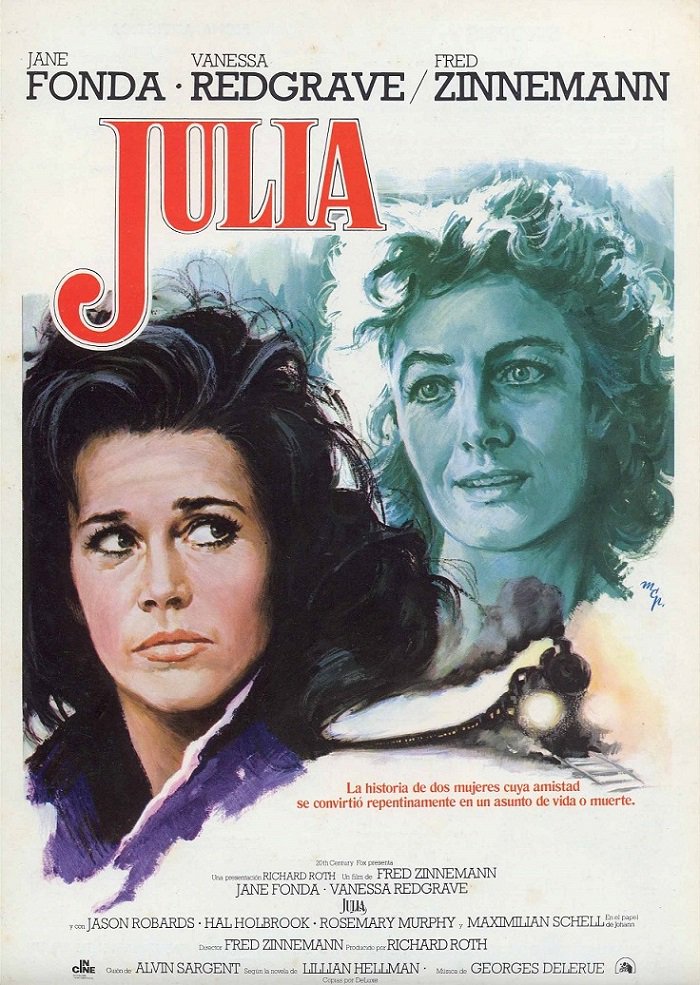
Julia, 1977 period drama film [pictured] directed by Fred Zinnemann, based on a chapter in 1973 Lillian Hellman’s controversial book Pentimento: A Book of Portraits. It is about Hellman’s alleged friendship with a woman named Julia, who fought against the Nazis prior to World War II. Jane Fonda plays Lillian Hellman, and Vanessa Redgrave is in the role of Julia. An image of the real Lillian Hellman is shown at the end.

Julia performed well at the box office and received generally positive reviews. However, it was felt, with good reason, that the supposedly true story must have been, at best, heavily fictionalised. At the time of her death, Lillian Hellman was still in the process of suing the writer Mary McCarthy for libel after she cast strong doubt on the story’s veracity.

In 1983, New York psychiatrist Muriel Gardiner claimed that she was the person the “Julia” character was based on. Lillian Hellman had never met Gardiner, but had heard about her through a mutual friend, so they couldn’t possibly have had the relationship or adventures together that Hellman had written about. This does seem the most likely explanation, however.

Muriel Gardiner wrote about her anti-Fascist activities in Vienna of the 1930s in a 1983 book, Code Name Mary: Memoirs of an American Woman in the Austrian Underground.

Ernest Hemingway

JESS: Okay, tomorrow I will try again, and you will . . .
RORY: Give the painful Ernest Hemingway another chance. Yes, I promise.
JESS: You know, Ernest only has lovely things to say about you.

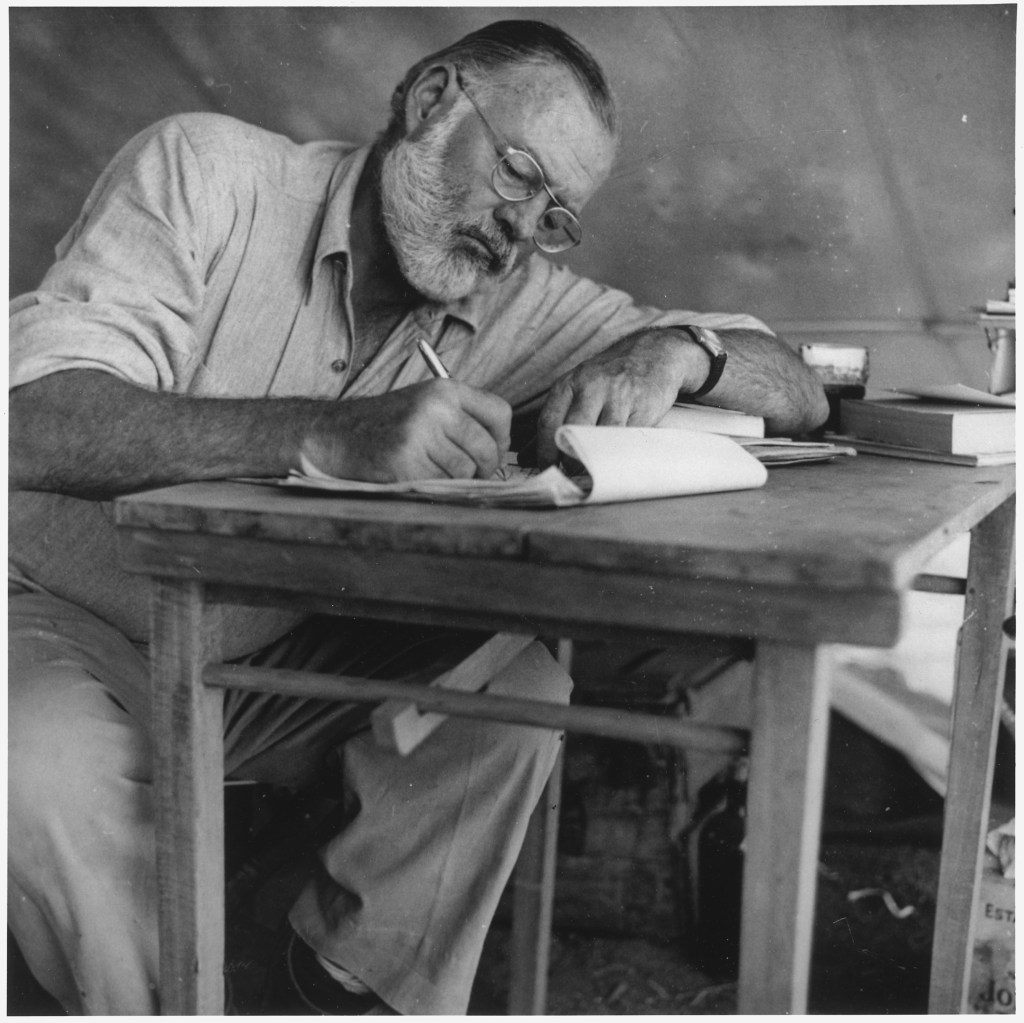
Ernest Hemingway (1899-1961), author, journalist, and sportsman. He is famous for his economical and understated style, which had a profound influence on 20th century fiction, while his public image and adventurous lifestyle brought many admirers. He produced most of his work during the 1920s to the 1950s, and was awarded the 1954 Nobel Prize for Literature. Many of his works are considered classics of American literature.

Hemingway’s hard, lean prose style and strongly masculinist ethos (to the point where it sometimes seems misogynistic) seem at odds with the more diffuse, subtle writing that Rory seems to appreciate. The irony is that Hemingway was a journalist, which helped to hone his spare writing style.

I’m not sure exactly what Jess means by “Ernest only has lovely things to say about you”, but in his works, brunettes are usually good, while blondes are bad (hm, rather like Gilmore Girls). Hemingway married four times times, three times to fellow journalists, as Rory plans to be.

The Fountainhead

RORY: Really? Try it. The Fountainhead is classic.
JESS: Yeah, but Ayn Rand is a political nut.
RORY: Yeah, but nobody could write a forty page monologue the way that she could.

The Fountainhead, 1943 novel by Russian-American author Ayn Rand, and her first literary success. The novel is about a ruggedly individualistic architect named Howard Roark, who battles against conventional standards and refuses to compromise his ideals. Rand said that Roark was the embodiment of her ideal man, and the novel reflects her views that the individual is more valuable than the collective.

Twelve publishers rejected the manuscript before Bobbs-Merrill took a chance on it, and contemporary reviews were mixed. However, it gained a following by word of mouth, and eventually became a bestseller. It has had a lasting influence, especially among architects, business people, conservatives, and libertarians. It was adapted into film in 1949, and turned into a stage play in 2014.

We here learn that Rory attempted to read The Fountainhead when she was ten, without success, but tried again when she was fifteen and liked it. Jess is taken aback by her recommending a text beloved of right-wing libertarians and “political nuts”, but Rory says she enjoys it as a piece of literature. The Fountainhead is absolutely full of characters having lengthy monologues where they clearly explain their philosophies, plans, and ideals.

The character of Howard Roark (allegedly based on architect Frank Lloyd-Wright) is a brooding man of few words, rather like Jess. Could Rory be recommending the book to Jess for that reason, to let him know that she likes a book where the protagonist is like Jess? A literary flirtation, like Jess annotating her copy of Howl?

Jess’ later career has a few things in common with Roark – neither of them graduate because they can’t be fettered by a conventional curriculum, both believe themselves to be misunderstood, both would prefer to take any paying job rather than compromise their creative integrity, and both become successful in their chosen fields.

More eye-raising is the character of Dominique, Roark’s love interest, and said to be his perfect match. Their first sexual encounter is so rough that Dominique describes it as a “rape”, and yet comes back for more, again and again. It’s a risque (or even plain risky) thing for a teenage girl to recommend to a boy she likes, and if this is a flirtation-by-literature, Rory seems to have suggested that Jess make things physical, even without her explicit consent.