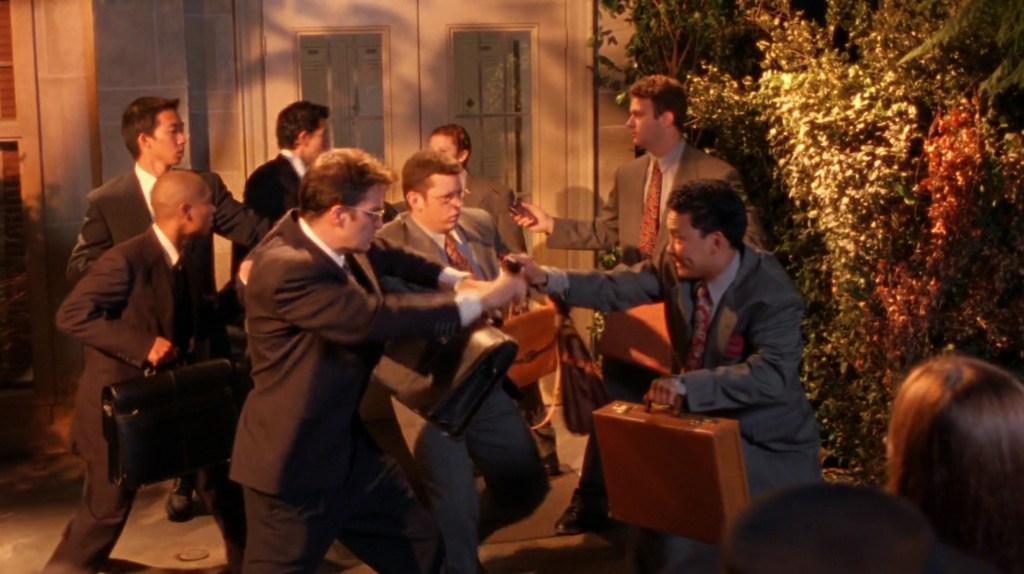
LORELAI: They’re here. RORY: Who? LORELAI: The Joy-less Luck Club.
Lorelai references the 1993 drama film, The Joy Luck Club, directed by Wayne Wang, and based on the 1989 novel of the same name by Amy Tan, who co-wrote the screenplay. The film is about a group of older Chinese-American women in San Francisco, all with adult daughters, who meet regularly to play mah-jong. The stories they tell each other reveals their hidden pasts, and how their family dynamics have been shaped by the interplay of Chinese and American culture.
The film was financially successful, and praised by critics for its diverse and nuanced portrayals of the experiences of Chinese-American women. It was only the second Hollywood film to have an all-Asian main cast; the first was Flower Drum Song, in 1961.
SOOKIE: No! It tastes too twentieth century guys. It’s gotta shout Washington Irving, not Irving my accountant.
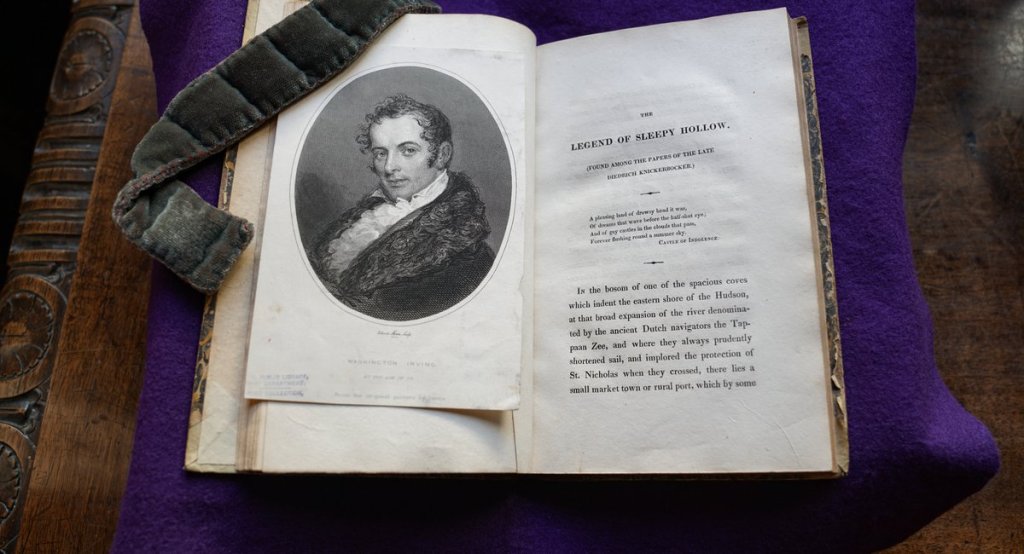
Washington Irving (1783-1859), American author most famous for his stories “Rip van Winkle” and “The Legend of Sleepy Hollow”, both of which appear in his collection, The Sketchbook of Geoffrey Crayon, Gent., previously mentioned as the source of the Bracebridge Dinner.
The Bracebridge Dinner at the Ahwahnee Hotel is in fact quite contemporary, and doesn’t shout Washington Irving either. Sookie may be too stressed to remember that she is actually living and cooking in the twenty-first century.
PARIS: Well, my parents are out of town, so my Portuguese nanny will make dinner and then I’ll either get back to reading The Iliad or we’ll play Monopoly. I crush her every time.
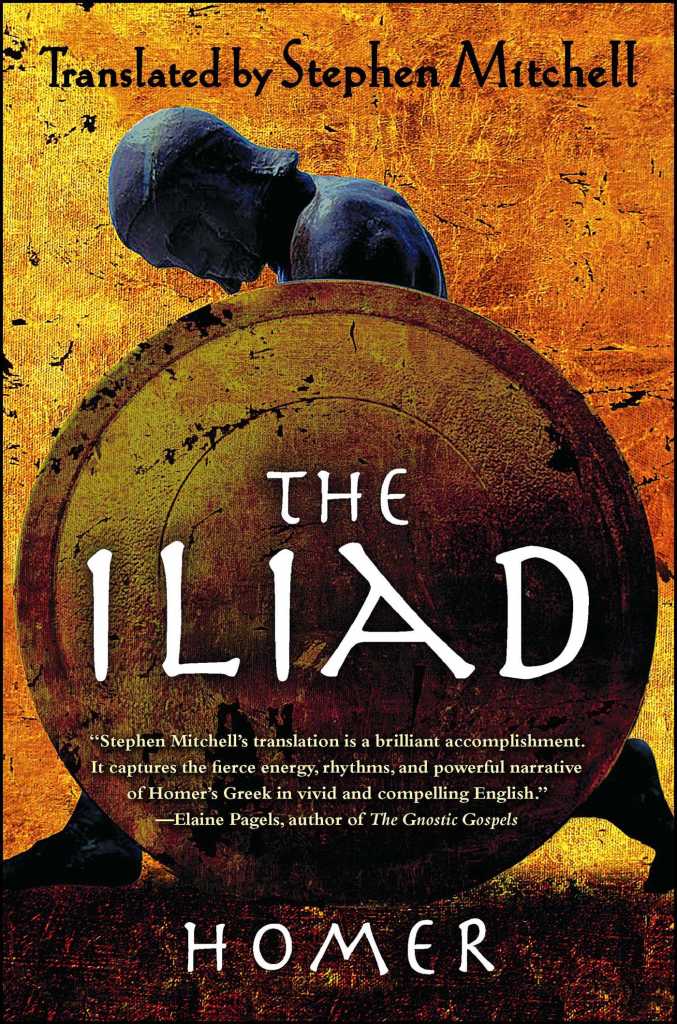
The Iliad, an ancient Greek epic poem, attributed to Homer, and usually dated to around the 8th century BC. The poem is set during the final weeks of the Trojan War, but contains so many allusions to past and future events that by the end it has told the entire story.
Monopoly, a board game where players roll dice to move around the board while buying and trading property. First published by Parker Brothers in 1935, and based on the 1903 The Landlord’s Game created by Lizzie Magie, it is one of the most well-known board games in the world.
Paris’ parents have gone away just as Paris goes on her break from school. It’s almost as if they’re trying to get away from her; they’re certainly not including her in their plans … no wonder the poor kid needs a nanny.
SOOKIE: Oh, that makes me so mad. And so sad. I’m smad!
Smad is a portmanteau word that Sookie invents – that is, a word combining two or more words. Examples would be motel, brunch, smog, spork, sitcom, romcom, dramedy, mockumentary, cosplay, bromance, himbo, Bollywood, chillax, hangry, email, podcast, fanzine, infomercial, emoticon, and chocoholic.
Portmanteau words are a feature of Lewis Carroll’s Alice Through the Looking Glass, previously mentioned. In fact, it was Carroll who invented the term “portmanteau word”. A portmanteau is an old-fashioned suitcase that has two parts hinged together [pictured], just as a portmanteau word has two words hinged together.
SOOKIE: We are crazy for doing this. LORELAI: We’re beyond crazy. We are ‘Anne Heche speaking her secret language to God and looking for the spaceship in Fresno’ crazy. SOOKIE: Oh Quiness, Nakka dune notta.
LORELAI: Il el nostra doska don.
Anne Heche (born 1969), actress, director, and screenwriter. First became known as a soap opera actress, before gaining mainstream recognition in the late 1990s in films such as Donnie Brasco (1997) and Six Days, Seven Nights (1998). She was also famous for her high-profile three-year relationship with comedian Ellen De Generes, who came out to the press shortly after she and Anne began dating.
On August 19 2000, the day after her relationship with Ellen ended, Anne drove from Los Angeles to Cantua Creek, near Fresno, parking her vehicle on a roadside. She walked for more than a mile through the desert wearing shorts and a bra before knocking on a stranger’s door and asking for a shower. As she seemed reluctant to leave, the homeowner called the sheriff’s department. When deputies arrived, Heche told them that she was God, and would take everyone up to Heaven in a spaceship (she later said she had taken ecstasy). She was admitted to a psychiatric unit in Fresno, and released after a few hours.
While promoting her 2001 memoir, Call Me Crazy, Anne told interviewers that she had been mentally ill for the first thirty-one years of her life due to horrific sexual abuse by her father (a closeted gay man who died of AIDS when Anne was thirteen), which began when she was only a baby. Her surviving family strongly reject those claims, although even without that, her childhood doesn’t sound like a picnic.
Anne said that she created a fantasy world called The Fourth Dimension and had an alter ego named Celestia who was the daughter and reincarnation of God, spoke her own language, had special powers, and was in contact with extraterrestrials. It seems likely Lorelai read Call Me Crazy, as it is the sort of camp celebrity memoir she could not resist (like Mommie Dearest and Tears and Laughter), although all the information could be gleaned from the press at the time.
Anne Heche stated that she had no further mental health issues after the episode at Cantua Creek, and she has gone on to have a successful career in film and television.
Sookie’s statement means, “Oh God, I cannot do this” in Anne Heche’s invented language. Lorelai replies, “It’s too scary for me now”, in the same language. Anne said this when she believed God wanted her to heal a friend’s injured ankle, however she says she did go on to heal her friend through laying on of hands. Anne shared this information, including the example of her language, with Barbara Walters on 20/20 in early September 2001.
Like Lorelai and Sookie, and many others at the time, Amy Sherman-Palladino mocked Anne Heche mercilessly after going public. Their tone was completely mainstream for the time.
UPDATE: Anne Heche passed away after a car accident on August 12 2022, under the influence of narcotics.
LORELAI: For the Bracebridge Dinner. JACKSON: Geez, you guys are going crazy with this dinner. SOOKIE: Jackson, I told you, this dinner is not just about food. We are recreating an authentic 19th century meal. LORELAI: The servers are all gonna be in period clothing, they’re gonna speak period English. Here, look at the costumes.
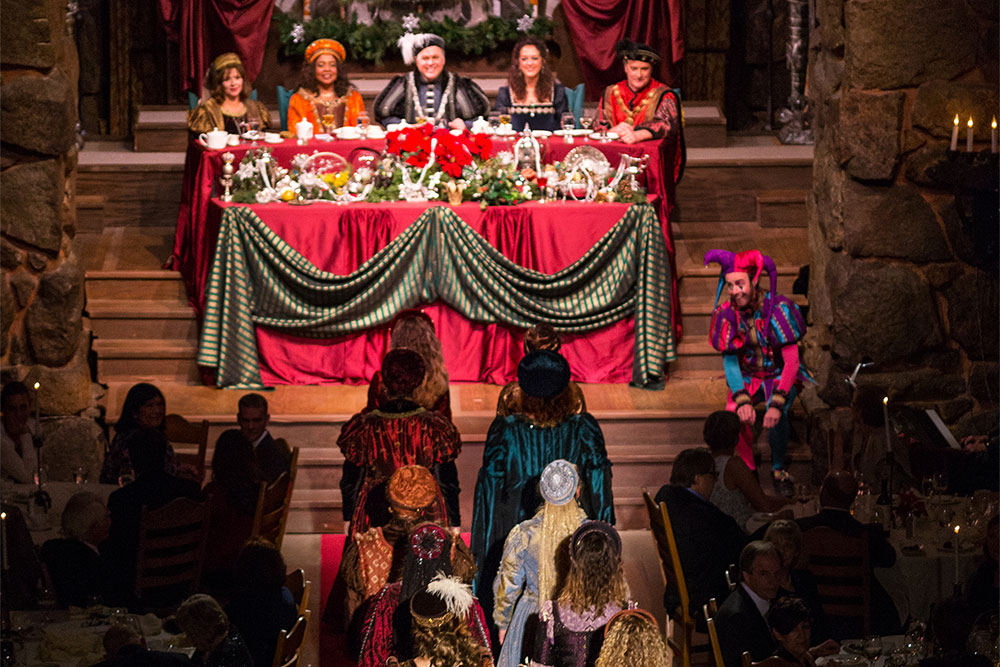
The Bracebridge Dinner is an annual tradition which has been held at the Ahwahnee Hotel in Yosemite National Park, California since 1927, when the hotel opened. The interior of the Ahwahnee was an inspiration for the hotel in Stanley Kubrick’s film, The Shining – a hint as to how Lorelai may have become interested in holding her own Bracebridge Dinner.
The Bracebridge Dinner is a seven-course formal gathering held in the Grand Dining Room and presented as a feast given by a Renaissance-era lord. It was inspired by the fictional Squire Bracebridge’s Yule celebration in a story from the 1820 work, The Sketch Book of Geoffrey Crayon, Gent., by American author Washington Irving. Music and theatrical performances based on Irving’s story accompany the introduction of each course.
Tickets to the Bracebridge Dinner cost around $400 and are generally difficult to obtain, sometimes being awarded in a lottery system. In 1992, there were 60 000 applicants for the 1650 seats available. This could be the reason why the Trelling Paper Company from Chicago have decided to hold their own Bracebridge Dinner at the Independence Inn.
Sookie says they will be serving an authentic 19th century meal, but in fact it is a Renaissance-themed meal. There’s not that much authentic about the dinner really, however I’m pretty sure the 19th century one wasn’t either. It’s a bit of fun and frolic, not a history lesson.
[Paris comes back dressed as Romeo] PARIS: What are you standing there for? Let’s go. You better start sucking on an Altoid.
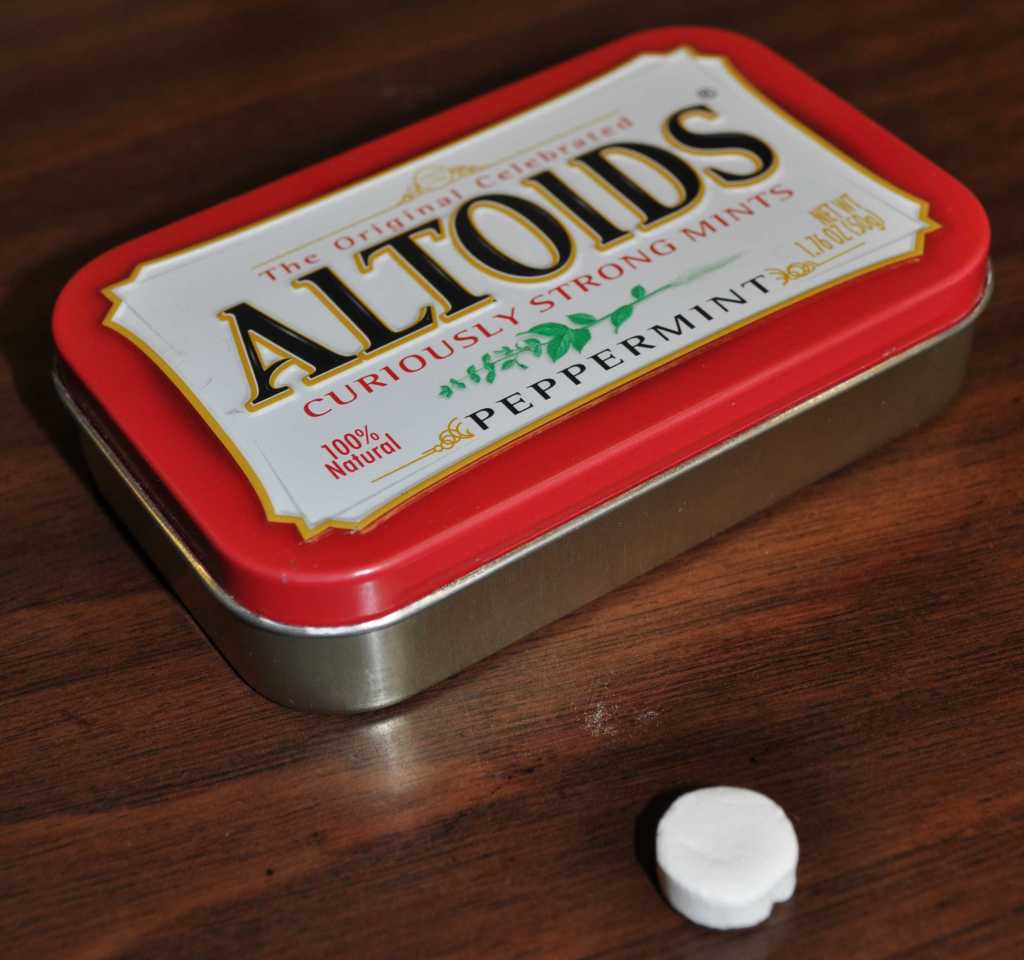
Altoids are a brand of mints sold in metal tins. Created by the London business Smith & Company in the late 18th century, they became part of the Chicago-based firm Callard & Bowser in the 19th century. Their advertising slogan is “The Original Celebrated Curiously Strong Mints”. They are less widely available in the UK than in the US, although Marks & Spencer has an almost identical product called Curiously Strong Mints.
Why Rory had to suck on a breath mint when Paris didn’t even kiss her, I don’t know. Paris is very keen on hygiene though, and perhaps she wasn’t convinced Rory was clean enough.
(There is an odd sort of logic to Paris taking over as Romeo, because in Romeo and Juliet, Juliet was meant to marry Count Paris).
[Lane watches Henry in Act 3, interpreted as businessmen with cell phones] HENRY: I am hurt. A plague on both your houses! Oh, I am sped. What, is he gone and hath nothing?
Henry’s speech is from Act 3, Scene 1 of Romeo and Juliet. He is playing Mercutio, a close friend of Romeo, and a relative of Count Paris, who Juliet is betrothed to. It is he who persuades Romeo to attend the Capulet’s party where he meets Juliet and falls in love with her.
Something of a wild party animal, Mercutio is lively and witty, making him a memorable scene stealer in the play. Romeo refuses to duel with Juliet’s cousin Tybalt, as he now sees Tybalt as one of his kin, through his secret marriage to Juliet.
Mercutio is incensed at the dishonourable way Romeo has refused to fight, and duels Tybalt himself, getting stabbed to death for his troubles. As he dies, he furiously denounces both the Montagues and the Capulets, crying, “A plague on both your houses!”.
A grief-stricken Romeo kills Tybalt to avenge his dearest friend, leading to him being banished from the city, and setting the tragic portion of the play in motion.
BOY: Ooh, ooh. He jests at scars that never felt a wound. But, soft! What light through yonder window breaks? It is the east, and Juliet is the sun.
The quote is from Act 2, Scene 1 of Romeo and Juliet, the famous “balcony scene” where Romeo hides in the orchard after the Capulet’s party where he met Juliet, then sees her leaning out of her window. He compares her beauty to that of the sun, moon, and stars.
TRISTAN: You don’t want me to tell Dean that we kissed. RORY: By George, I think he’s got it.
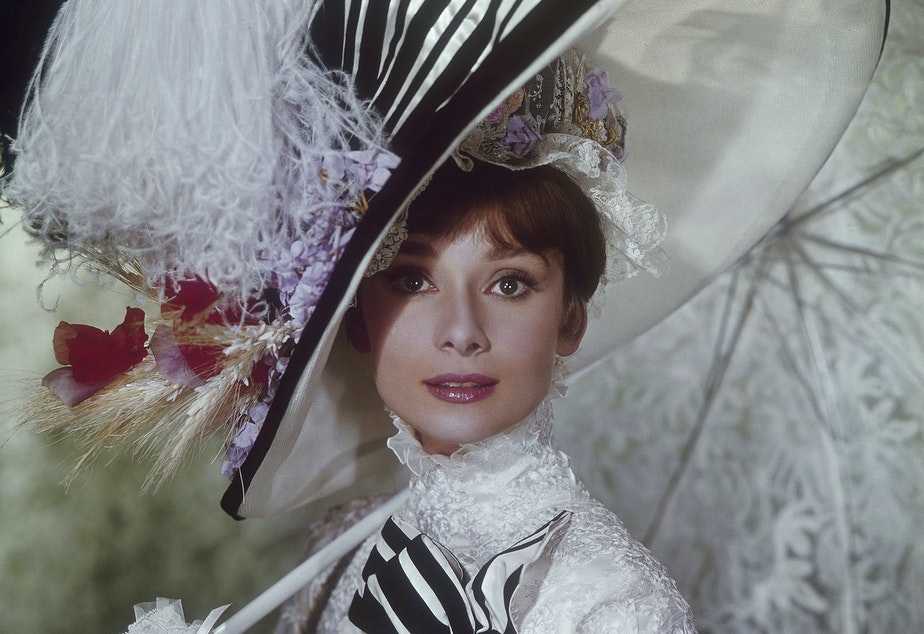
Rory is referencing the 1964 musical comedy-drama film My Fair Lady, adapted from the 1956 Lerner and Loewe stage musical of the same name, which was based on George Bernard Shaw’s 1913 play, Pygmalion.
In the film, phonetics professor Henry Higgins (Rex Harrison), has a bet that he can teach a Cockney flower girl named Eliza Doolittle (Audrey Hepburn) to speak with an upper-class accent. At first she makes no progress, but one day has a sudden breakthrough, leading Higgins to exclaim delightedly, “By George, I think she’s got it”.
My Fair Lady was a critical and commercial success, becoming the #1 film of 1964, and won eight Academy Awards, including Best Picture, Best Actor, and Best Director (for George Cukor). It is considered one of the greatest musicals, and one of the great films of all time.




 The Annotated Gilmore Girls