RORY: The Compact Oxford English Dictionary! CHRISTOPHER: I promised you I’d get it. I’m just sorry it took so long. RORY: That’s okay. CHRISTOPHER: On the bright side, this is the new edition. If I’d gotten you the old one, you wouldn’t have the word ‘jiggy’ in it. RORY: Thank you. I love it, I’m gonna go look things up right now. CHRISTOPHER: Wait, wait. [hands her magnifying glass]
The Compact Oxford English Dictionary, previously discussed as Rory’s dream book, which Christopher couldn’t buy her six months ago because his credit card was declined.
This time he is able to buy her the 2001 edition, which contains the American slang word “jiggy”. The Oxford English Dictionary defines it as “Excitedly energetic or uninhibited, often in a sexual manner; to get jiggy: to engage in sexual activity”.
The Compact Oxford English Dictionary has such fine print that it comes with its own reading glass.
LORELAI: And uh, you’ll need shoes, hose, gloves, some mice, a dog, a pumpkin.
Lorelai is referencing Cinderella, previously discussed. Cinderella’s fairy godmother turned a pumpkin into a coach, and a dog and some mice into attendants so that she could go to the ball in style.
It’s interesting that the last time Lorelai compared Rory’s situation to Cinderella was for her sixteenth birthday party, organised by Emily. This is another formal, dressy occasion they are going to for Emily’s sake, where Rory will be primped and put on display for Hartford society. For both events, Lorelai did her best to help Rory, even though she didn’t fully approve.
Lorelai is casting herself in the role of the fairy godmother, who is going to help Rory transform into a fairy tale princess for one night.
Founded in 1982, it provides clothing, games, and deliveries directly to hospitalised children through a network of more than 700 children’s hospitals and medical centres in the US, Canada, the UK, and Australia.
Emily has been the co-chair on its board for the past eight years, which seems unlikely – the foundation’s headquarters are in Los Angeles, it doesn’t have co-chairs, and its board is made up people with high profiles in medicine, finance, and media. I think we are meant to assume this is a (fictional) local fundraising branch for Hartford.
The Black and White Ball is their main fundraising event. This is a masquerade ball in which everyone is dressed in either black or white. They are intended to be extremely glamorous and exclusive events, with high ticket prices.
Hartford Zoological Silent Auction
A fictional organisation of which Emily is a board member. Hartford doesn’t actually have a zoo. The nearest Zoological Society is in Bridgeport, Connecticut, to support Beardsley’s Zoo.
A silent auction is one where bidders write their bids down on a sheet of paper, with the highest bid winning. They are common at charity events.
The Mark Twain House Restoration Fund
The Mark Twain House is a museum in Hartford, once the home of the author of Huckleberry Finn. Restoration began on the house in 1963, and its fundraising arm is the Friends of the Mark Twain House and Museum. They’ve been fundraising since 1954. This must be the organisation that has Emily as a board member, and is holding the charity luncheon Emily has been forced to turn down.
Harriet Beecher Stowe Literacy Auction
Harriet Beecher Stowe (1811-1896) was an American author and abolitionist, best known for her 1852 anti-slavery novel, Uncle Tom’s Cabin. The Harriet Beecher Stowe House & Center is in Hartford, next door to the Mark Twain House and Museum. Emily seems to be on the board of both these museums.
Emily’s strong community involvement, which is the major part of her social life, is very much like Lorelai’s enthusiastic support of every festival and celebration in Stars Hollow, right down to a cat’s wake. The apple didn’t fall far from the tree in this case.
Oliver Twist, or the Parish Boy’s Progress, is a 1838 novel by English author Charles Dickens. The titular protagonist is a poor orphan boy who is born in a workhouse and apprenticed to an undertaker. He escapes to London, where he meets the “Artful Dodger”, a boy who belongs to a gang of juvenile pickpockets. It’s an unromantic portrayal of criminals and their sordid lives, and exposes the cruel treatment of orphans in the 19th century.
Rory jokingly refers to Jess as the Artful Dodger, a boy thief who is known for his great skill and cunning as a pickpocket. It’s something of both an insult and a compliment. More interestingly, the Artful Dodger attempts to seduce the innocent Oliver into a life of crime, as if Rory instinctively sees Jess as a corrupting influence.
Rory is not only teasing Jess, she is setting him a little test. Does he only read the Beat poets, or is he also familiar with classic novels? You know, proper literature, as studied at school? Jess passes the test with flying colours, and Rory beams, as if she has found a kindred spirit.
The book which Jess secretly took from Rory’s bookshelves, even though she had earlier offered to lend it to him.
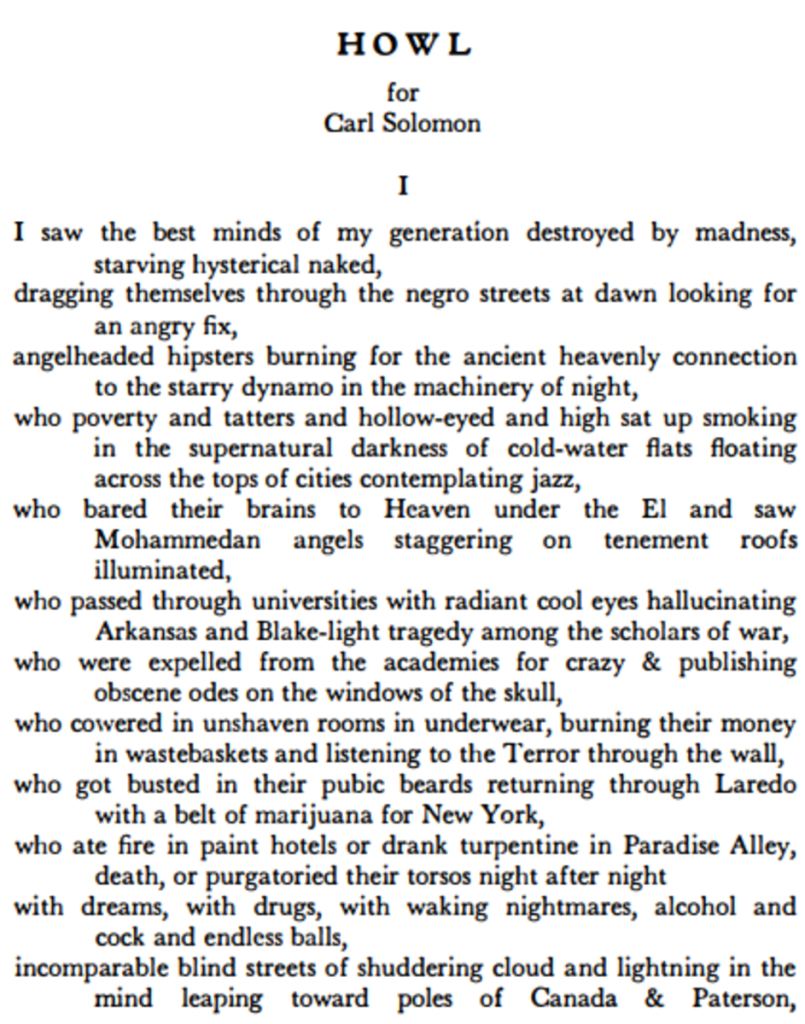
It’s a poetry collection by American Beat poet Allen Ginsberg, first published in 1956. It contains his most famous poem, “Howl”, a biographical poem originally inspired by a terrifying peyote vision. The publisher of the book, Lawrence Ferlinghetti, another Beat poet, was subsequently arrested and charged with obscenity, but found not guilty at his 1957 trial.
Jess now reveals that even though he said he didn’t read “much”, he has read Howl and OtherPoems about forty times. He smoothly implies that “much” is a relative term, after all.
He has also written notes in the margin for Rory to read. The viewer will now either a) be horrified that he took her book without asking and defaced it, or b) sigh over the fact that he took the opportunity to bond with Rory over literature, sharing his innermost thoughts. It is definitely intended as an intimate, seductive move.
It’s interesting to wonder what thoughts Jess had about “Howl”. It’s an intense poem about madness, rebellion, drug-taking, and sex, which could lead to some interesting observations. If Jess knew a lot about the Beats, he might also be able to pick out those parts of the poem which were taken from real life experiences.
Then again, much of the poem is set in New York, and possibly Jess simply compared his own experiences in the locations mentioned. I can definitely imagine Jess taking a day or a weekend to visit all the places around New York in the poem.
When Rory is interviewing Max, this book is on the desk between them, in a pile of other books that includes Anna Karenina, previously discussed.
The Brothers Karamazov is a 1880 novel by Russian novelist Fyodor Dostoevsky about the sons of a buffoon named Fyodor Karamazov; he has three sons from two marriages, and it is rumoured that his servant is actually an illegitimate son. Fyodor takes no interest in his sons, who are raised apart from each other and their father. A passionate philosophical novel, it delves deeply into questions of God, free will, morality, faith doubt, and reason, involving a plot about patricide. It is acclaimed as one of the great works of modern literature, and has influenced many great authors and thinkers. It was Einstein’s favourite novel, Freud considered it the greatest work of literature, while Franz Kafka felt indebted to it as a influence on his own work.
We know that Russian literature is the first component of the English Literature course in the sophomore year at Chilton, and this must be on the curriculum. On Rory’s first day at Chilton, the teacher talked about how they had studied Dostoevsky the week before. We can feel pretty confident that Rory would have read this novel in her efforts to catch up with her schoolmates, and it may have helped give her an interest in the works of Kafka.
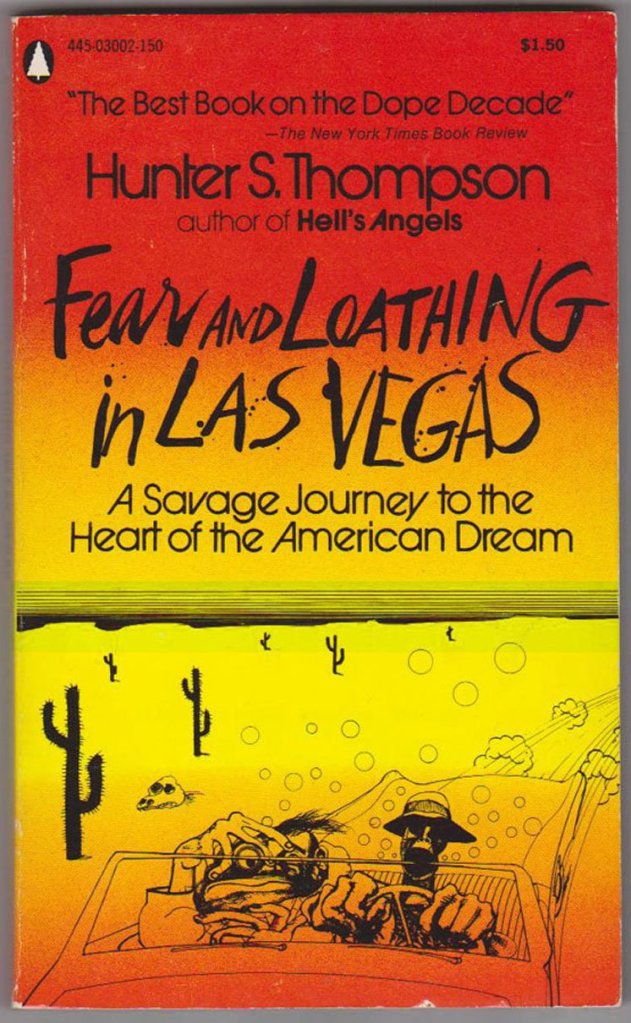
This 1972 novel by American author Hunter S. Thompson is one of the books that Jess brought to Stars Hollow with him, seen strewn around the bedroom he shares with Luke.
The book is autobiographical, based on two trips to Las Vegas Hunter S. Thompson took with attorney and political activist Oscar Zeta Acosta (called Dr. Gonzo in the novel) in 1971. In the novel, the characters descend on Las Vegas to chase the American dream in a drug-induced haze, ruminating on the failure of the 1960s counterculture. First published in Rolling Stone, the book is Thompson’s most famous work, and his subjective blend of fact and fiction became known as “gonzo” journalism.
It’s notable that this is another autobiographical novel about travel and the American dream that Jess has brought with him, and the “fear and loathing” a comment about how he feels being dumped on a relative in a small town. Which is interesting, because it means Jess not only hates Stars Hollow, he’s scared by it, and a lot of his sneering and posturing are an attempt to disguise that.
I think we’re meant to be impressed that Jess is reading a book by a journalist, as if to say, “Jess is not only smart and enjoys reading, like Rory, but he’s interested in journalism, like Rory”. Unfortunately the writers already made Dean a fan of Hunter S. Thompson (back in the days when Dean read books and understood films), and he introduced Rory to Thompson. This undercuts Jess’ intellectual status quite a lot, although it does show he and Dean may be more alike than it appears at first sight.
This is the book that Rory reads while she thinks she’s waiting for The Franklin meeting to start.
Dawn Powell (1896-1965) was an award-winning American novelist, playwright, screenwriter, and short story writer. Known for her acid-tongued prose, her work was highly praised, and Powell was a friend and colleague to many of the leading lights of the New York literary scene. She fell into obscurity, but interest in her was revived in 1987 when Gore Vidal praised her in an editorial in The New York Review of Books. This selection of her letters was edited by Tim Page, and published in 1999.
Jess is carrying this 1957 book by American Beat writer Jack Kerouac, previously discussed, when he leaves the diner. It looks as if Jess might be looking for a quiet spot to read, just as Rory likes to do.
It immediately establishes Jess as a reader, something which will surely pique Rory’s interest, as she was always trying to get Dean to enjoy great literature (with unsatisfying results). It is also an obvious symbol of Jess’ journey to small town America, and possibly a foreshadowing that Jess does not intend to stick around.
LORELAI: Luke, um, that’s not a bed, that’s a raft, which is fine if you’re gonna build a moat around the diner but … LUKE: It’s fine. LORELAI: Luke, the kid needs a bed. If you want to get him something inflatable, make it a blonde.
Lorelai is humorously referring to inflatable sex dolls. She also refers to the blow-up mattress as a “raft”, which feels like another subtle nod to Huckleberry Finn.
During the show, the (dark-haired) showrunners had a habit of making blonde women the butt of their jokes, and blonde characters were usually shallow, stupid, spiteful, or all three. There’s a slight suggestion here that blonde women are little more than sex dolls (otherwise, why does the sex doll have to be blonde? They could have any colour hair).






 The Annotated Gilmore Girls