Miss September and Johnny Depp

LORELAI: And he’s staring at her like she’s Miss September, and she’s looking at him like he’s Johnny Depp, and I was just babbling like a moron. What is wrong with me?!

American men’s magazine Playboy features a nude or semi-nude centrefold model as their Playmate of the Month, with each one known as Miss January, Miss February, and so on.

John “Johnny” Depp II (born 1963) is an American actor, producer, and musician. He rose to prominence in the police show 21 Jump Street, airing from 1987 to 1991, where he became a popular teen idol. Depp played the title role in the dark fantasy Edward Scissorhands (1990), which established him as a major film star, and gained critical praise for his performances in films such as What’s Eating Gilbert Grape (1993), Ed Wood (1994), and Donnie Brasco ( 1997). He is regarded as one of the biggest stars in Hollywood.

Elizabeth Barrett Browning

SUMMER: So, meet me after biology?
TRISTAN: And if I don’t?
SUMMER: You will.
TRISTAN: Oh, yes I will. Ah. To be young and in love.
PARIS: What a shame Elizabeth Barrett Browning wasn’t here to witness this. She’d put her head through a wall.

Elizabeth Barrett Browning (1806-1861) was an English poet, very popular in the Victorian era and a great influence on American poet Emily Dickinson. Her first volume of poetry, Poems, was published in 1840 to immediate success.

Paris may be unfavourably comparing Tristan and Summer’s conversation with Barrett Browning’s famous love poem Sonnet 43 which begins, “How do I love thee? Let me count the ways”. It was published in her 1850 collection Sonnets from the Portuguese.

“Funny, funny girl”

LORELAI: Okay. I need a pan.
RORY: And a fire extinguisher.
LORELAI: Funny, funny girl.

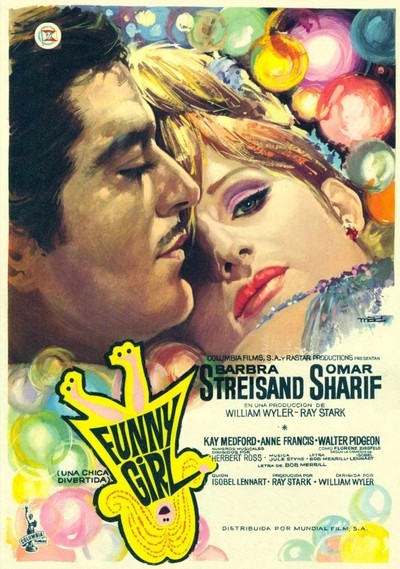
Lorelai may be alluding to the 1968 biographical musical film Funny Girl, directed by William Wyler and based on the 1963 stage musical of the same name with book by Isobel Lennart, music by Jule Styne, and lyrics by Bob Merrill.

Funny Girl stars Lorelai’s favourite actress Barbara Streisand, reprising her Broadway role to portray actress and comedian Fanny Brice (1891-1951), a star of vaudeville, film, radio, and television who rose to fame as a Ziegfield Follies girl in the 1920s.

Funny Girl was the #2 film of 1968, and acclaimed by critics; Streisand won a Best Actress Award for her role in the film at the Academy Awards. Regarded as one of the best musical films of all time, it is notable for being the first film where a Jewish woman is portrayed as smart, funny, talented, and beautiful.

We later learn that Funny Girl is Lorelai’s favourite film.

“Relocated to a plastic bubble”

DEAN: Well, what if it’s for a really special occasion?
RORY: Well, that special occasion better include my being relocated to a plastic bubble if my grandmother’s gonna let me out of dinner.

Rory is referring to the disease severe combined immunodeficiency, a rare genetic disorder where the sufferer remains extremely vulnerable to infectious disease due to having an immune system so compromised it is effectively absent. It is sometimes called “bubble boy disease”, because high-profile patients became known for living in sterile environments.

The disease became well known after the 1976 television film The Boy in the Plastic Bubble, directed by Randal Kleiser, and with John Travolta in the title role. The film was inspired by the real-life cases of David Vetter (1971-1984) and Ted DeVita (1962-1980); DeVita actually had severe aplastic anemia, which is able to be better treated now.

Although the movie wasn’t shown on television during Rory’s childhood, bootleg copies were widely available on video, and Lorelai may have obtained one.

Tito Puente

MISS PATTY: Who wants to hear about the time I danced in a cage for Tito Puente?
KIDS: [raising hands] Me!
MISS PATTY: It was the summer of ’66 …

Ernesto “Tito” Puente (1923-2000) was an American singer, songwriter, big band leader, percussionist, and music producer. He is best known for his mambo, cha-cha-cha, and Latin jazz compositions, produced over a fifty year career, several of which were used in films. He was sometimes known as “The Musical Pope” and “The King of Latin Music”, and was at the peak of his popularity in the 1950s. He was posthumously awarded a Grammy Lifetime Achievement Award in 2003.

It is unclear where Miss Patty may have danced for Tito Puente. He was a fixture at the Palladium Ballroom in New York, a centre for Afro-Caribbean dance music, but that had just closed down, in May 1966. Maybe she means the spring of 1966?

Tony Randall

CHRISTOPHER: Rory might be my only child.
LORELAI: That’s not true. If Tony Randall can crank one out in his seventies you have decades left to spawn.

Tony Randall, born Aryeh Rosenberg (1920-2004) was an American actor, director, and producer. He is best known for playing the role of Felix Unger in the television sitcom The Odd Couple, earlier discussed.

In 1995 Randall, then a widower aged 75, married Heather Harlan, a 25-year-old who had worked as an intern on one of his theatre productions. The couple had a daughter and son named Julia and Jefferson, so he actually fathered two children in his seventies. Tony and Heather Randall remained married until his death.

Christopher is being overly dramatic when he says he may have lost the chance to father more children, as he’s only in his early thirties. In fact he does go on to have another daughter in a future season.

Charlie Manson

CHRISTOPHER: I want to marry you …
LORELAI: You are out of your mind. You are completely insane. You have flipped your lid. Charlie Manson is freaked out by you right now!

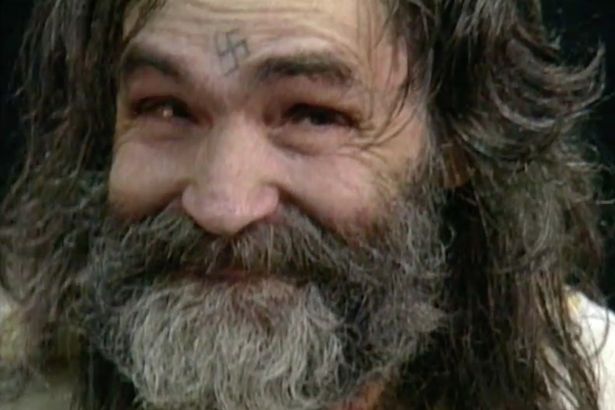
Charles Manson (1934-2017) was an American criminal and cult leader, earlier alluded to as the head of the notorious Manson Family. His followers committed a series of murders in 1969 under his instructions.

Obsessed with The Beatles, Manson believed their song Helter Skelter was a warning of an apocalyptic war between whites and blacks, and that the Manson Family were being instructed to preserve the worthy from the impending disaster. By committing the murders, his followers would help precipitate the race war, and also control it, allowing them to escape from harm.

In 1971 he was convicted of murder and conspiracy to commit murder. Originally sentenced to death, his sentence was commuted to life imprisonment, which he served in California State Prison.

Lorelai believes Manson was mentally ill, and the prison system agreed. He was diagnosed with schizophrenia and paranoid delusions, had no remorse for any of his crimes, or apparent understanding of their magnitude, with highly controlling behaviour, and an exceptionally callous disregard for human suffering.

President Bush

LORELAI: I hate President Bush … He’s stupid and his face is too tiny for his head and I just want to toss him out.

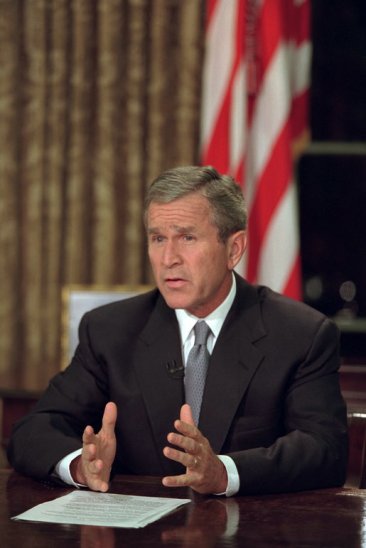
Lorelai is talking about George W. Bush (born 1946), who had been elected President of the United States in November 2000, and sworn in on January 20 2001, less than two months previously from Lorelai’s perspective. He is the son of George H.W. Bush, who was US President from 1989 to 1993. Like so many famous people referenced in the show, George W. Bush has a Connecticut connection, being born in New Haven: he also attended both Yale and Harvard.

Lorelai’s perception of George W. Bush as “stupid” was one shared by many people, due to his frequent lapses of grammar, mangled sentences, and baffling statements. Polls showed that American voters saw him as having a low intelligence. Historians rate his presidency quite poorly, although his popularity has picked up since he left office in 2009.

It was rare for Gilmore Girls to stray far into politics, so this was an unusual moment which identified Lorelai as a Democrat. She was clearly desperate to get attention away from Rory, and her plan worked. Impulsive as ever, Lorelai didn’t stop to think whether her comment was going to make the evening easier. It didn’t help things.

Chuck Berry

RICHARD: I’m a Chuck Berry man myself.
LORELAI: … Chuck Berry?
RICHARD: Yes, Chuck Berry. He was all the rage when I was in school.
LORELAI: So we’re talking pre-My Ding-a-ling?

Charles “Chuck” Berry (1926-2017) was an American singer, songwriter, and musician who was one of the pioneers of rock and roll, most famous for 1950s songs such as Maybellene, Roll Over Beethoven, Rock and Roll Music, and Johnny B. Goode. Chuck Berry was one of the first musicians to be inducted into the Rock and Roll Hall of Fame when it opened in 1986, with his lyric structures, guitar riffs, and showmanship seen as laying the groundwork for modern rock and roll. He won the Grammy Lifetime Achievement Award in 1984, and is regarded as one of the greatest rock musicians of all time.

My Ding-a-ling is a novelty song that was first written written and recorded by Dave Bartholomew in 1952, and covered by Chuck Berry in 1972. The song is about a child’s toy covered in silver bells – the “ding-a-ling” – which is constantly held and played with, but the song uses double entendre as most of the lyrics would still make sense if the “ding-a-ling” was actually a penis. It was Chuck Berry’s only single to get to #1.

Richard says he became of a fan of Chuck Berry because his songs were popular when he was at school: Richard would have been aged 12-15 when Berry became famous in the 1950s. Richard being a fan of Chuck Berry continued to be a feature of the the show throughout its run.

Christopher’s Alleged Doppelgangers

JACKSON: Boy I gotta tell you, did they get your description wrong.
CHRISTOPHER: Really?
JACKSON: Oh yeah, much more George Clooney than Brad Pitt. Hey Andrew.
ANDREW: Yup.
JACKSON: Don’t you think he’s much more George Clooney than Brad Pitt?
ANDREW: I’m going with the Billy Crudup comparison myself.

George Clooney (born 1961) is an American award-winning actor, director, producer, screenwriter, activist, businessman, and philanthropist. He made his television debut in 1978, and found fame on the medical drama ER from 1994 to 1999. During this time he took major roles in films such as Batman and Robin (1997) and Out of Sight (1998). In 1999 he had the lead role in Three Kings, a satire about the Gulf War. Clooney is generally seen as one of the handsomest men in Hollywood.

Brad Pitt (born William Bradley Pitt in 1963) is a multi award-winning actor and producer. He first gained recognition as a cowboy hitchhiker in Thelma & Louise (1991), and had leading roles in A River Runs Through It (1992), Legends of the Fall (1994), and Interview with the Vampire (1994). He received critical acclaim for Seven (1995), and Twelve Monkeys (1995), and starred in the cult film Fight Club (1999). At the peak of his career, he was seen as one of the sexiest men in Hollywood.

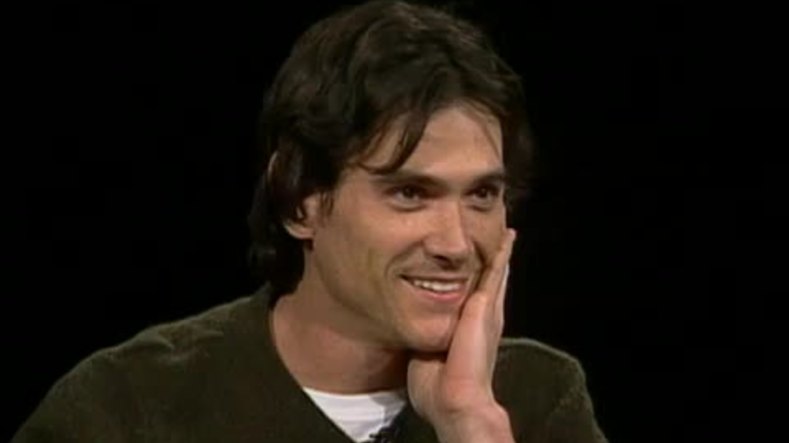
William “Billy” Crudup (born 1968) [pictured] is an American actor with extensive experience on the stage, mostly on Broadway. He has had supporting roles in films such as Sleepers (1996), and Almost Famous (2000). He gained financial success narrating the “Priceless” campaign for MasterCard from 1998 to 2005. Unless it’s cut very short or slicked back, Crudup has wavy hair, which may have reminded Andrew of Christopher’s locks; he’s also from a similar upper-middle class background to Christopher, who is identified as looking as if he comes from “money”.

Which of these actors Christopher most looks like is a matter of opinion. To me he doesn’t strongly resemble any of them, but presume that the Stars Hollow townsfolk are referring to different types of masculine good looks – handsome sophisticate, sexy charmer, or preppy hipster. Christopher apparently has elements of all these in his appearance.