Pose Naked on the Cover of Rolling Stone

[Rory, Lane and Lorelai are walking through Stars Hollow. They cross a street]

LANE: Are you serious? …We can really rehearse in your garage?

LORELAI: In exchange for the promise that you never pose naked on the cover of Rolling Stone no matter how much trouble your career is in.

Rolling Stone magazine has quite a tradition of musicians and actors posing nude or semi-clad on their cover. A few examples are John Lennon and Yoko Ono in 1968, Madonna in 1991, The Red Hot Chili Peppers in 1992, and Blind Melon in 1993. Most recently from the perspective of this episode, Christina Aguilera had appeared nude on the cover in November 2002.

In this episode, Lane’s problems finding a rehearsal space for the band are solved when Lorelai generously allows them to rehearse in her garage. Given how noisy bands can be while rehearsing, this is an extremely kind offer on Lorelai’s part.

“Andrew Jackson, not Alfred E. Neuman”

LUKE: And he paid cash? … Did you make sure Andrew Jackson was on the bills, not Alfred E. Neuman or someone?

Andrew Jackson, previously discussed. Former president Andrew Jackson is on the US $20 bill.

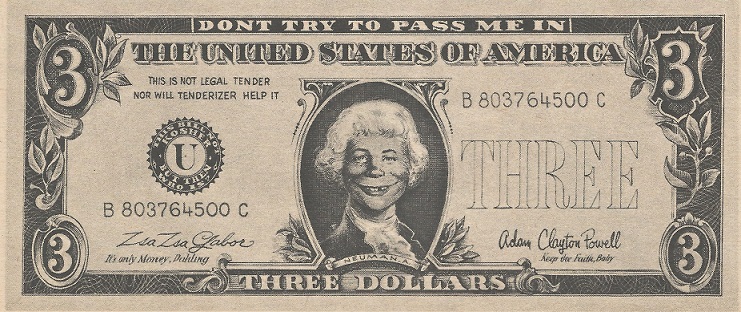
Alfred E. Neuman, the fictitious mascot and cover boy of the humour magazine Mad. The image had been used since the 19th century in advertising, and for Roosevelt’s political campaign in the 1930s. Mad magazine claimed the image in 1954, and named him “Alfred E. Neuman” in 1956. Since his debut, he has appeared on all but a handful of the magazine’s covers.

In 1967, the magazine published pictures of joke coins and a three dollar bill with Alfred E. Neuman’s face on it. Despite being an obvious satire on coin collecting, some readers cut the notes out of the magazine and were able to use them in Las Vegas money-changing machines, leading to federal authorities moving to stamp out this counterfeit operation.

Mad magazine went on to publish fake Monopoly money, and smaller versions of the three dollar bill which were given out as novelties at trade shows and conventions.

We Owe You Nothing

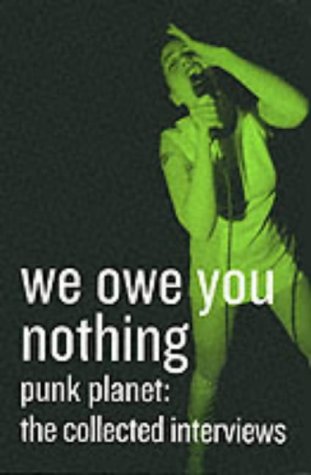
When Luke gets home, he finds Jess reading this book.

We Owe You Nothing: Punk Planet – The Collected Interviews is edited by Daniel Sinker, and was published in 2001. It’s a collection of interviews from Punk Planet zine, which we already know Jess is a fan of, and a nice bit of continuity. There are interviews with people such as Jello Biafra, Kathleen Hanna, Henry Rollins, Ian MacKaye from Fugazi, and Noam Chomsky.

Sardi’s

DEBBIE: Well, I felt obligated to tell the other moms about your little performance at school before they heard about it elsewhere.

LORELAI: Really, ’cause usually I like to meet up at Sardi’s after a performance, wait for the reviews. I hope The Times liked me.

Sardi’s, continental restaurant in the theatre district of Manhattan in New York City. It was founded by Vincent Sardi Sr and his wife Jenny Pallera, and first opened in 1927. It is known for the caricatures of Broadway celebrities on its walls, of which there are over a thousand. Sardi died in 1969, and the restaurant declined in the 1980s, being sold in 1986. After closing temporarily in 1990, it reopened with new staff.

The restaurant is considered an institution in Broadway theatre. It’s known as a place to gather before and after the theatre hangout, as well as a location for opening night parties, and was where the idea of the Tony Award was devised. Lorelai sarcastically puts herself in the role of an actor waiting at Sardi’s for the reviews of their performance in the New York Times.

Maxim

LANE: This is the most radical thing a Kim has done since my cousin Nam got caught reading Maxim at summer camp.

Maxim, a men’s magazine launched in the UK by Felix Dennis in 1995, but based in New York City since 1997. It’s known for its photographs of prominent singers, actors, and female models. It has been criticised for its sexual objectification of women, and publishes a Hot 100 List – in 2002, #1 was actress Jennifer Garner, the first time someone had debuted in the top spot.

Nam is a very popular Korean boy’s name, which means “south”.

The Brat Pack

EMILY: And now it’s the in thing for young Hollywood celebrities to go to universities. What do they call themselves, the Brat Pack?

LORELAI: About a hundred years ago.

The Brat Pack, a nickname given to a group of young actors who frequently appeared together in teen coming-of-age films in the 1980s. It was first mentioned in a 1985 New York magazine article, used to describe Emilio Estevez, Rob Lowe, Judd Nelson, and most of the cast of The Outsiders. Later on, the definition (somehow?) seems to have narrowed to refer to those actors who starred in The Breakfast Club and/or St Elmo’s Fire. But there is no set definition of who was in the Brat Pack and who wasn’t.

The label brought negative attention to the actors, who hated it, and they stopped socialising together. It certainly was not something they called themselves, but an unwanted label foisted upon them. The journalist who coined the expression later admitted he shouldn’t have done it.

The name “Brat Pack” was coined in imitation of the “Rat Pack”, an informal group of A-List show business friends in the 1940s and ’50s, centred on Frank Sinatra, Dean Martin, and Sammy Davis Jr. It is important to note that the Rat Pack is what the group called themselves, the Brat Pack was a name created by the media.

Holmes & Yoyo, Hee Haw Honeys

RORY: I know, [The Brady Bunch Hour‘s] on my top fifty best.

LORELAI: Yeah, right after Holmes & Yoyo and Hee Haw Honeys.

Holmes & Yoyo [pictured], comedy TV series that aired during the 1976-1977 season. The series follows police detective Alexander Holmes (played by Richard B. Shull), and his partner Gregory “Yoyo” Yoyonovich (played by John Schuck), who he discovers to be an android crime-fighting machine, designed as a secret weapon by the police department. Many of the gags involved Yoyo’s constant malfunctions. The series performed poorly and was cancelled after eleven episodes, the final two being shown during the summer. It was #33 on TV Guide‘s worst shows of all time list.

Hee Haw Honeys, a short-lived spin-off from variety show Hee Haw, previously discussed, which aired during the 1978-1979 season. It starred Kathie Lee Johnson (later Gifford) and members of the Hee Haw cast as a family who owned a truck stop restaurant where guest country artists would perform their latest hits. It was #10 on TV Guide‘s worst shows of all time list.

TV Guide

RORY: Did you see that TV Guide had this on their list of the worst fifty shows of all time?

TV Guide Maagazine, a bi-weekly magazine containing the TV schedules, as well as television news, celebrity interviews and gossip, film reviews, and crossword puzzles. It was founded by Lee Wagner of MacFadden Publications, and first printed in 1948 as the The TeleVision Guide, only for the New York area. It began printing nationally as TV Guide in 1953. Since 2015, it’s been owned by NTVB Media.

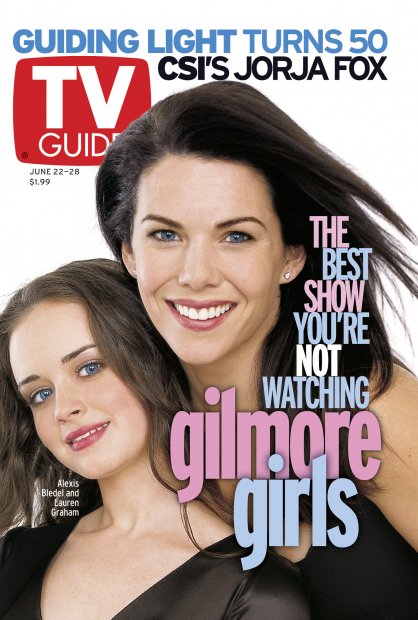
Gilmore Girls had featured in TV Guide in June 2002, with Lauren Graham and Alexis Bledel on the cover, so this feels like a definite shout-out to the publication. As a self-deprecatory inside joke, Lorelai and Rory proceed to criticise the magazine’s opinions of TV shows, since TV Guide had just raved about Gilmore Girls.