Pastorella Theatre

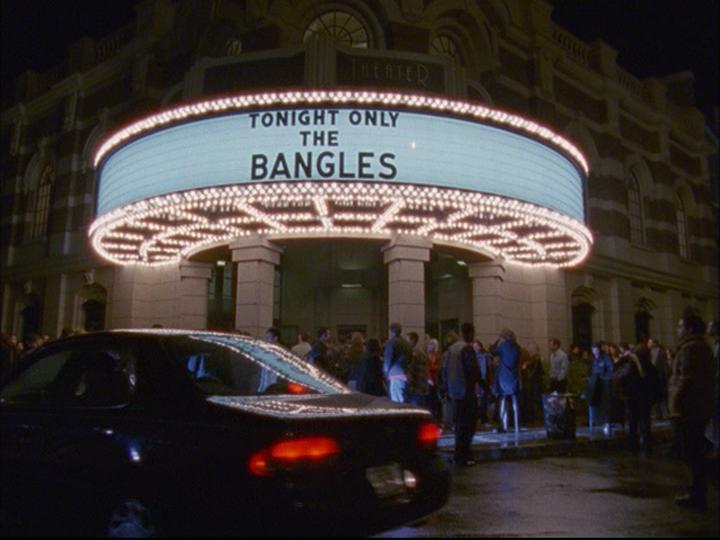
The Bangles concert takes place at the Pastorella Theatre in New York City, a fictional entertainment venue. In Italian, pastorela means “shepherdess”, and a pastorella can mean any musical or literary work with a pastoral theme, a church composition for the Christmas season, or a medieval poem or song involving love for a shepherdess. The Pastorella Theatre therefore has a name connected with music.

In real life, The Bangles appeared at the Irving Plaza at 17 Irving Place in Union Square, Manhattan when they played in New York during their reunion tour; the date was October 2 2000. For the concert venue in this episode, the exterior shots are from the Warner Bros. Theater in Burbank, while the interior shots are from The Wilshire Ebell Theatre in Los Angeles.

The Bangles in Concert

The main event of the episode kicks off when Sookie receives four tickets to see The Bangles in concert that Saturday as a gift from a delighted wedding client named Mr. Birnbaum, and gives them to Lorelai. Sookie says that Lorelai requested them, so perhaps Mr. Birnbaum, who owned a ticket agency, asked Sookie which show she would like to attend, and she asked for The Bangles on behalf of Lorelai.

The Bangles broke up in 1989 and went on hiatus. They drifted back together in 1998, and officially re-formed in 1999 to record a song called Go Get the Girl (written by band members Susanna Hoffs and Debbi Peterson) for the soundtrack to Austin Powers: The Spy Who Shagged Me. Susanna Hoffs is married to Jay Roach, the film’s director.

In 2000 The Bangles did a reunion tour, and that same year was inducted into the Vocal Group Hall of Fame. In real life, Lorelai could not have seen The Bangles in concert in February 2001 as they were not touring then, but working on their next album.

“You break, you buy”

MRS. KIM: You break, you buy!

This is of dubious legality. In the US, sometimes a customer would have to pay at least partially for an item they broke negligently or on purpose, but US law is so complex that it is hard to say what would actually occur if it went to court. In this case, Kim’s Antiques is so cluttered that the customer could easily have argued that the Kims themselves were responsible for the breakage.

Convent in Siberia

RORY: Your mom’s really mad huh?
LANE: The words “convent” and “Siberia” were both used several times and at least once as a combo.

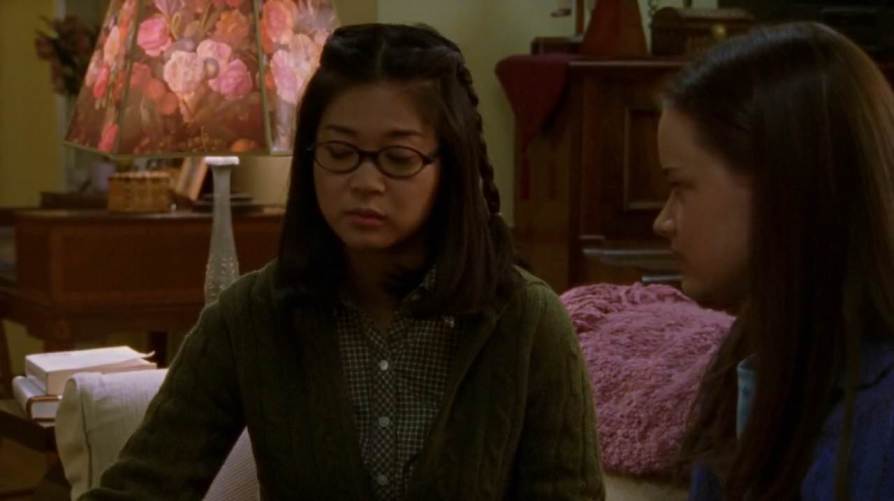
It’s not clear why Mrs. Kim, a practicing and devout Seventh Day Adventist, would send her daughter to a convent, which are generally Catholic, Anglican, or Orthodox. I’m guessing either Lane is exaggerating, or Mrs. Kim was babbling threatening nonsense in a terrified (and terrifying) rage.

However, if Mrs. Kim was determined to send Lane to a convent in Siberia, there is a small one in the city of Omsk, Siberia – the Beatas Olimpia y Laurencia. It is highly unlikely that they would accept Lane though.

Fugazi

LANE: Wh-what kind of music do you like?
TODD: I don’t know – whatever.
LANE: Fugazi?
TODD: What?
LANE: The band on your shirt.
TODD: Oh. Huh, pretty cool picture.
LANE: You don’t know what’s on your shirt?
TODD: It’s my sister’s.

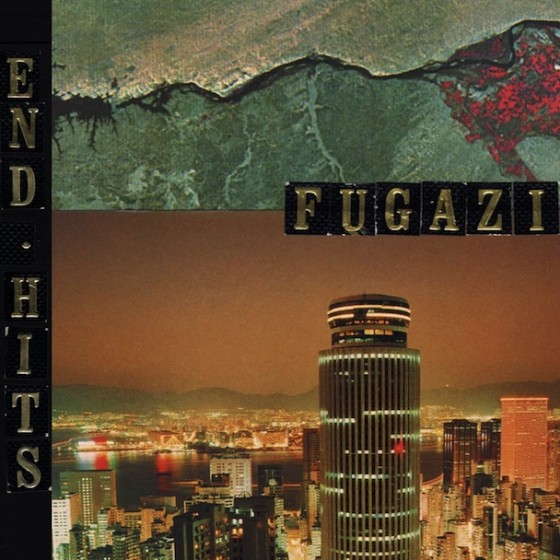
Fugazi is an American punk rock band formed in 1987, consisting of Ian MacKaye, Guy Picciotto, Joe Lally, and Brendan Canty. Their first album was released in 1990, and their most recent album from Lane’s perspective is End Hits (1998), which looks to be featured on the tee shirt Todd is wearing. The band has been on hiatus since 2003.

Fugazi are famous for not selling or licensing merchandising, creating an enormous market for bootleg tee-shirts. Presumably Lane knows that the shirt Todd is wearing is unofficial, but can’t see the point of discussing it with him.

Tall Lorelai

RUNE: That’s Lorelai?
JACKSON: Yes.
RUNE: Did you see how tall she is?

Lauren Graham (Lorelai) is 1.75 m tall (just under 5 foot 7 and a half inches), while Max Perlich (Rune) is 1.62 m tall (around 5 foot 3). There’s a height difference in Lorelai’s favour – somewhat increased by heels – but Rune ridiculously compares her to a basketball player, an East German maid, and a freak of “bearded lady” proportions.

(The East German comment refers to the decades-long systematic doping of East German athletes with steroids and testosterone for the purposes of cheating, leading to some impressively large and strong athletes. The program ended in 1989 with the fall of communism, but unfortunately the men and women involved – some of whom were only eight years old at the time – are still experiencing physical and mental health disorders because of the doping. Lorelai is in the right age bracket to be an East German maid who was doped as an athlete in the 1980s:  picture shows 1980s East German athlete Marita Koch, who holds the world record for the 400 m, partly due to steroid use).

Lorelai rarely has any trouble attracting men, so having a date openly and constantly insult her physical appearance must be a bizarre experience for her.

Alaska and Hawaii

LORELAI: Maybe you could do them [the Baked Alaskas] in the actual shape of Alaska.
SOOKIE: Interesting.
LORELAI: Or you could do little baked Alaskas and Hawaiis.
SOOKIE: Because they joined the union last.

It would be very difficult to make Baked Alaska in the shape of Alaska and Hawaii as Alaska has a multitude of islands around its coastline, and Hawaii is a group of islands. I’m sure it can be done, with some artistic licence. Lorelai is joking though.

Alaska was purchased by America from Russia in 1867, and became a US territory in 1912. It was admitted as the 49th state of the US in January 1959.

The Kingdom of Hawaii was overthrown during a coup d’état in 1893, and the country was annexed by the US in 1898, becoming one of its territories. In August 1959 Hawaii was admitted to the union, becoming the 50th state of the US.

Hawaii is the state where Lauren Graham (who plays Lorelai Gilmore) was born, which might be why it is mentioned here. It also happens to be where Keiko Agena (Lane Kim) was born.

“Necesito las hojas grandes”

Sookie says this phrase to one of her kitchen assistants; it means “I need the large sheets of paper” in Spanish. She is making meringue, and needs the sheets of baking paper to line the baking tray.

The Spanish-speaking kitchen staff at the inn isn’t very realistic, as the Hispanic population in rural Connecticut isn’t that big, and the majority of Hispanics in Connecticut are American-born and would already speak English. It’s more in keeping with California, where Gilmore Girls was made, which has a Hispanic population of around 39% with a high rate of immigration from Latin America.

Church

LANE: And then I was thinking that this date could maybe happen this weekend.
RORY: Huh.
LANE: Sunday preferably.
RORY: Well –
LANE: After church.

Lane makes it sound as if the date will be the evening after church on Sunday, but as a Seventh Day Adventist she would attend church on Saturday. She must mean the date will be on the day after church – at least that’s the only way her statement makes any sense.

Yoko Ono

LANE: A very misunderstood artist and the Beatles would’ve broken up anyways.
RORY: Have you shared this theory with anyone?
LANE: I know it, Yoko knows it, Sean knows it. Julian’s still in denial but what can you do?

Yoko Ono (born 1933) is a Japanese artist, singer, songwriter, peace activist, performance artist, and film-maker. She is famous for being the second wife of British singer-songwriter John Lennon, one of the Beatles. They met in 1966 and began a relationship while John was still married to his first wife, Cynthia, and were married in 1969.

The Beatles disbanded in 1970, and it is common to blame Yoko Ono as one of the primary causes of the band’s break up. Lennon and Ono spent all their time together, even when The Beatles were recording, which went against the band’s unspoken agreement not to allow wives or girlfriends into the studio. Ono frequently made comments and suggestions on the recording process, encouraged by Lennon, but to the other band members’ irritation.

However, The Beatles had experienced a number of stresses, including the death of their manager Brian Epstein in 1967, and the rise of George Harrison as a composer in his own right, with each member of the band beginning to have solo projects of their own. Although Ono placed further pressure on the band and contributed to feelings of ill-will, Lane is correct that The Beatles would have broken up anyway.

Sean Lennon (born 1975) is the son of John Lennon and Yoko Ono, while Julian Lennon (born 1963) is the son of Lennon and his first wife Cynthia. One reason why Lane says Julian might be “in denial” is that Julian was excluded from his father’s will, with the majority of the estate going to Ono; Julian sued the estate and in 1996 reportedly accepted a settlement of £20 million.

Despite the many factors working against their relationship, Julian is said to be on polite terms with Yoko Ono, and gets on very well with Sean. I’m not sure Julian has ever expressed an opinion on whether Ono broke up The Beatles (and by this stage, probably doesn’t care anyway).

Yoko Ono made several albums in collaboration with John Lennon, while also releasing solo albums – her solo debut album was in 1970. Although critics dismissed her work for many years, in November 2001 she brought out a concept album which was critically acclaimed, so Lane (and the show) was slightly ahead of the trends by recognising her as a misunderstood genius.

Once again, Lane demonstrates a sympathy for creative artists of Asian heritage. Perhaps she can picture herself as another Yoko Ono, bringing out avant-garde pop music with a feminist slant to it.