Halloween and Trick-or-Treating

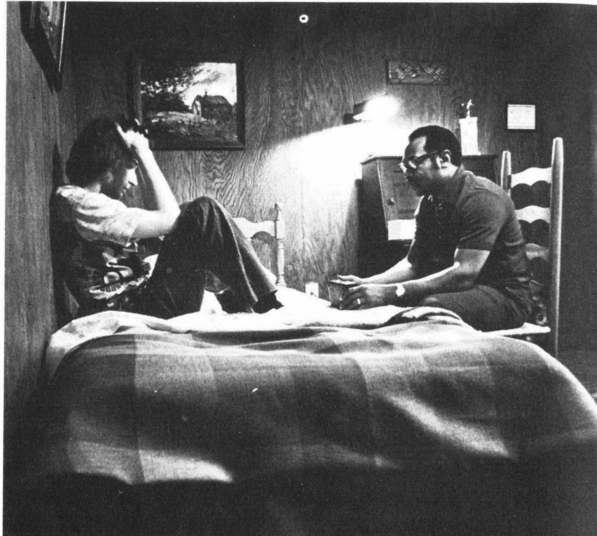
CY: So, like I say, it’s Halloween, right, and we’re lucky Louie doesn’t have razor wire around his yard, you know how he is. So finally one of the neighborhood kids, he gets all courageous and he goes sauntering up to the door and he goes ‘trick or treat!’.

Halloween is a contraction of All Hallows Evening, the night before All Hallows Day, which is November 1 (so Halloween is October 31). Alluded to several times already in the show as an important date on the calendar, it is a day for remembering the dead with a Christian name but with probable pagan roots.

Halloween customs were brought to North America in the 19th century by Scottish and Irish immigrants. In return, the American influence on Halloween has spread around the world in the 20th and 21st centuries.

Trick-or-treating is a Halloween tradition where children dress in costumes and travel from house to house, asking for treats, with the phrase, “Trick or treat?”. The “trick” is a threat, usually idle, to commit some small act of mischief on the homeowner should no treat be provided.

The custom goes back to at least the 16th century in Scotland and Ireland, where it was called guising. In America, trick-or-treating has been a tradition since the 1920s; the earliest known example is from Canada in 1911.

It is apt that one of the last things that happen in this episode is a memory shared of Louie’s behaviour on Halloween, since it is day for the remembrance and honour given to the dead.

Louie’s Funeral

Luke brought Louie home to be buried in Stars Hollow, next to his brother William, and this scene is set in Stars Hollow cemetery (it may be behind the church, and only seems to be a short walk from the centre of town, which is unusual for a cemetery, although not unheard of).

The minister conducting the ceremony is identified as Reverend Hackett in the credits (played by Brian McDonald). I’m not sure whether he and Reverend Nichols are both ministers in Stars Hollow, but of different religions, or if Rev. Hackett is a junior minister of some kind. Nor can I tell you if Rev. Hackett is the church minister who plays handball, although he looks young and fit enough for that to be believable. It’s all quite confusing.

The Romanovs

EMILY: I’ll see you for dinner tonight, Lorelai. And Luke, I’m sure I’ll see you again soon. What do you think of the Romanovs?

LUKE: They probably had it coming.

EMILY: A match made in heaven.

The House of Romanov, the reigning imperial family of Russia from 1613 to 1917. They became prominent after the first Tsar of Russia, Ivan the Terrible, married Anastasia Romanova, the first Tsarina. It is from Anastasia’s name that the family became known as the Romanovs.

The abdication of Tsar Nicholas II during the Russian Revolution on 15 March 1917 ended 304 years of Romanov rule and paved the way for the formation of the Russian Republic. In July 1918, Bolshevik officials executed Nicholas and his family.

Although Lorelai refers to their murder as “the firing squad”, they were shot and bayoneted, then the bodies taken to the forest to be stripped, buried, then mutilated with grenades to prevent identification. This is what Luke thinks they “probably had coming”.

The Romanov burial site was discovered in 1979 by an amateur sleuth, but not officially confirmed by Russia until 1989. The remains were identified by forensic and DNA analysis, assisted by British experts, and in 1998 the remains were re-interred in a state funeral in the Peter and Paul Cathedral in St Petersburg. In 2000, Nicholas II was canonised as a saint by the Russian Orthodox Church.

After the assassination of Nicholas and his family, the remaining 47 members of the Romanov family went into exile abroad, still claiming the former Russian throne. Since 1991, the line of succession has been in dispute.

[Picture shows Nicholas II of Russia with his wife Alexandra (Alix of Hesse), his son Alexei, and four daughters Olga, Tatiana, Maria, and Anastasia].

EDIT: A date edited with the kind assistance of reader Omar.

The Wedding Company’s Former Clients

SOOKIE: Oh, it’s this company’s sample place setting. Emily set me up with them. They did Celine Dion’s wedding, and Steven Spielberg’s daughter’s Jack Russell Terrier’s Bark Mitzvah.

Celine Dion, previously discussed. She married her manager, Canadian music producer René Angélil, in 1994 [pictured]; they first met in 1980, when Dion was 12 and Angélil was 38. They remained married until Angélil’s death in 2016.

Steven Spielberg (born 1946), film director, previously mentioned. He is one of the most commercially successful directors of all time. He has four daughters (Jessica, Sasha, Destry, and Mikaela), but I can find no reference to any of them having a Bark Mitzvah for a Jack Russell – although the Spielberg family does seem very attached to their pet dogs, so it’s not wildly unbelievable.

A Bark Mitzvah is a fun coming-of-age celebration for pet dogs with Jewish owners, held as a joke counterpart to the Bar Mitzvah, previously discussed. The first one was held in 1958, and although some rabbis find the idea offensive, they continue to be popular.

Jehovah’s Coffee Girl

LUKE: Not everybody likes it that strong.

LORELAI: Well, then I shall convert them. I am the Jehovah’s coffee girl.

Jehovah’s Witnesses is a non-mainstream Christian denomination which emerged from the Bible Study Movement founded in the 1870s by Charles Taze Russell; after his death, a breakaway group headed by Joseph Franklin Rutherford took control and chose the name Jehovah’s Witnesses in 1931.

Jehovah’s Witnesses are probably best known for their door-to-door preaching, distributing evangelical literature. Lorelai sees herself as similarly working to convert people to strong coffee.

Cult Deprogrammers

LORELAI: I’m gonna have to be deprogrammed by cult deprogrammers to get that Tuesday out of my brain.

Cult deprogramming claims to assist people who have been “brainwashed” by new religious movements. Deprogramming was introduced in the 1970s by a high school dropout named Ted Patrick, who, despite having no qualifications or training, convinced people that he could rescue their loved ones from organisations and groups for $10 000. He had experience, having already removed his own son from the Children of God.

Essentially, deprogramming involves abducting the new convert, isolating him, physically restraining him and hitting him with a barrage of continuous arguments and attacks against his new religion, threatening to hold him forever until he agrees to leave it. Ted Patrick was tried and convicted of multiple felonies, such as kidnapping and unlawful imprisonment.

There is no evidence that deprogramming works – in fact, there is a higher rate of success from people naturally getting bored and dropping out of religious movements than there is from deprogramming. Members of the Church of Unification were particularly targeted by deprogramming efforts in the 1980s.

[Picture shows Ted Patrick trying to deprogram a young member of the Children of God].

Moonies

EMILY: I love it here.

LORELAI: Hm. Careful Mom, that’s how they get you in the Moonies.

The Unification Church of the United States, a religious movement which began in the 1950s and ’60s when missionaries from Japan and South Korea were sent to the US by the church’s founder and leader, Sun Myung Moon (1920-2012). It expanded in the 1970s when Moon moved to the US.

“Moonies” soon became slang for a member of the church, and although members of the church were quick to accept it and even wear it as a badge of honour, today most church members believe that’s offensive and derogatory.

The church has attracted a lot of criticism and controversy, with people often feeling their family members had been “brainwashed” into joining it. One of their techniques is “love bombing” where a new recruit is bombarded with affection, gifts, and promises of friendship. Lorelai is humorously suggesting the spa is doing the same thing to them by offering them perks like free cucumber water.

Franny and Zooey

LORELAI: Did you get lost?
JESS: No, I was looking at Rory’s books … I wanted to see if she had Franny and Zooey. She does.

Franny and Zooey by J.D. Salinger, comprising his 1955 short story, “Franny”, and his 1957 novella, Zooey, both originally published in The New Yorker. The collection was published in 1961.

The book focuses on Frances (“Franny”) and her brother Zachary (“Zooey”), the youngest members of the Glass family, who frequently appeared in Salinger’s short stories. They were a large family of highly precocious children , the offspring of two vaudeville performers in New York City, the father an Australian Jew, the mother Irish. The Glass children all get college educations by winning a radio quiz show.

Both stories reflect Salinger’s interest in Eastern mysticism, particularly Zen Buddhism and Hindu Advaita Vedanta, as well as Eastern Orthodox Christian spirituality. Franny and Zooey was very popular, spending 26 weeks at the top of the New York Times Fiction Best-Seller’s List, but received mixed reviews from critics.

The book was a strong influence on the 2001 film, The Royal Tenebaums, which had only been out a few months before this episode aired.

Jess seems to have been careful to choose a non-romantic book, as Franny and Zooey are siblings who talk about philosophy together. Perhaps he is trying to tell Lorelai that he and Rory have an intellectual brother-sister relationship. (Later on, they do end up related to each other).

Franny does have a boyfriend in the book, but they don’t have much in common, and he doesn’t seem capable of understanding her (the boyfriend is named Lane!). When Franny is at a particularly low point, Zooey is able to get through to her by secretly talking to her on the telephone, and giving her some words of wisdom. When the phone call ends, Franny lies on the bed and smiles.

This might be a hint of what Rory and Jess’ nascent relationship is like. Unsatisfied with her boyfriend, Rory is enjoying her secret phone calls with Jess, which are on a different level to the conversations she has with Dean, and leave her smiling at the end. Although all this is offscreen and never directly referred to, we can see that their friendship has progressed and grown closer, and chances are they have continued talking on the phone in secret.

Vanity Fair

LORELAI: And one leg suddenly feels shorter than the other.
RORY: This is gonna be the Vanity Fair paper cut incident all over again, isn’t it?

Vanity Fair is a monthly magazine of fashion, popular culture, and current affairs, published by Condé Nast. It was first a society magazine published from 1913 to 1936, after which it merged with Vogue. The title was revived in 1983.

The magazine’s title ultimately comes a location in John Bunyan’s 1678 allegorical religious novel, The Pilgrim’s Progress. In the story, Vanity Fair is a decadent city built by Beelzebub where every worldly pleasure that a person could want, delight in, and lust after is sold daily. It appears attractive, but in reality is a dreadful place. It was used as a title of a satirical novel by William Makepeace Thackeray in 1848.