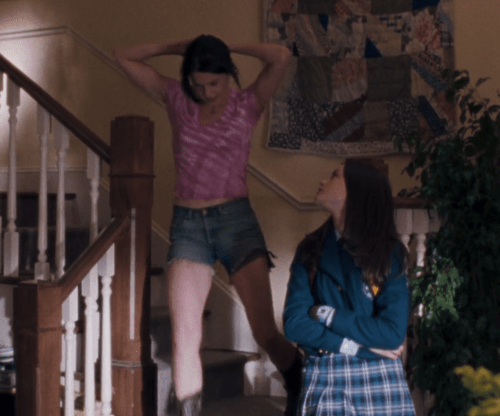
“I don’t have any clean clothes”

Being woken up at 7:10 am instead of 5:45 am sends Lorelai intoa panic. We learn that all her nice clothes are at the drycleaners, and she was planning to pick them up and get dressed in her blue suit with the flippy skirt before she took Rory to school. She fumbles through a drawer, then in the next scene she is hurrying downstairs dressed in cut off denim shorts, a pink tie-dyed tee-shirt, and cowboy boots – apparently the only clean clothes she has to wear.

The trouble is that she opens the closet and we see clothes hanging up in there. Maybe they’re not great clothes, but most of them would be better than going to Rory’s school dressed in denim cut-offs and boots. For that matter, why does she need to wear boots? You don’t send shoes to a dry-cleaner, so she should still have normal shoes to wear. And what time did she plan on going to the dry-cleaner anyway – Rory’s school day starts at around 8 am and it’s a half hour drive, so does the dry-cleaner in Stars Hollow open around 6.30 am?

It’s hard not to reach the conclusion that Lorelai had a very specific outfit in mind – the blue suit with the flippy skirt – and since she isn’t able to wear it due to her own poor time-management skills, is determined to wear something completely unsuitable in a fit of pique.

“We never fight”

Lorelai

SOOKIE: It was a fight. Mothers and daughters fight.
LORELAI: No, we don’t fight. We never fight.

During the course of the show, Lorelai and Rory had their fair share of fights and arguments, during which the normally meek Rory could be shockingly rude and hurtful to her mother. If Lorelai is to be believed, they never had a single fight until Rory was a few weeks shy of her sixteenth birthday, which would mean that they lived in harmony until Rory began gaining some independence for herself. It’s telling that Rory forming an identity for herself apart from Lorelai is the beginning of their various quarrels.

Of course, Lorelai may be just conveniently forgetting all the fights they had before this one.

Rory’s Locker Books

When Rory is cleaning out her locker at Stars Hollow High, the viewer can identify at least three of the books she has piled up in there.

One is The Second Sex by French philosopher Simone Beauvoir, a 1949 work which is a seminal text in modern feminism. The book speaks frankly about teenage girls and their sexuality, which could be important information for Rory. It is also very critical of marriage as an oppressive instution which leads women into domestic and emotional slavery: does this have any effect on Rory’s understanding of relationships? The book does seem to have informed Lorelai’s views, who is committment-shy, not interested in cooking and housework, and highly focused on her career. We may wonder if Rory borrowed the book from her mother: especially as the book discusses the difficulties of mother-daughter relationships.

Another is Mistress of Mellyn, a 1960 Gothic romance by popular British novelist Victoria Holt (pen name of Eleanor Hibbert). Set in Cornwall in the 19th century, a young governess finds romance with her employer, but there is some mystery over the fate of his first wife which the girl investigates. The book has a similar plot and themes to classics such as Jane Eyre by Charlotte Bronte, The Woman in White by Wilkie Collins, and Rebecca by Daphne Du Maurier. This literary romance became an immediate bestseller upon publication. Could this choice of novel show Rory’s desire for romance?

You might be able to spot Chikara!: A Sweeping Novel of Japan and America by American author Robert Skimin, published in 1984 – the year that Rory was born. It’s an epic historical saga about a Japanese-American family, covering the years from the early twentieth century to the 1980s. It may be telling that the book involves multiple generations, and a man’s search for power for himself and his sons – but in the end it is his granddaughter who triumphs.

If nothing else, the books demonstrate the wide range of Rory’s reading.

Chilton Preparatory Academy

The exclusive co-ed private school in Hartford to which Rory gains a late acceptance, kicking off the events of the entire Gilmore Girls series. It is loosely based on Choate Rosemary Hall, a private boarding school in the town of Wallingford, Connecticut.

The name Chilton may have been inspired (in universe) by Mary Chilton (1607-1679), a Pilgrim who came to America from England on the Mayflower, giving the name a historical connection; Mary Chilton was an ancestor of George Bush and George Bush Jr. According to legend, Mary was the first passenger to step ashore at Plymouth in 1620, excitedly jumping out of the boat and wading out to Plymouth Rock. It seems like a name suitable for daring young girls willing to leap into a new world.

For the 2017-18 academic year, Choate’s tuition fees for a day (non-boarding) student were $44 400. However, they have a generous financial aid package which would mean that someone in Lorelai’s situation would have their tuition fees heavily subsidised. You can also pay by the month with no interest, and unlike Chilton, there is only a small enrolment fee.

It is unclear why Chilton never offered any similar financial aid to Rory – perhaps because she was a late acceptance. For the purpose of the plot it was necessary for Lorelai to be desperate for money, or Gilmore Girls could never have happened. So Chilton had to be a price-gouging school with massive enrolment fees, no financial aid, no payment plans, and no up-front information about their fees for parents (Lorelai is apparently disconcerted to learn Chilton costs anything at all).

Exterior scenes at Chilton were filmed at Greystone Mansion in Beverly Hills, California; this 1920s Tudor-style mansion is in a public park owned by the City of Beverly Hills, and is a popular place for film and TV locations.

Mr. Kim

RORY: When are you going to let your parents know that you listen to the evil rock music? You’re an American teenager, for God’s sake.

Lane has two parents, but her father is never seen during the course of the original show, even at major family events. It is never explained where he is, and Keiko Agena, who played Lane, never asked Amy Sherman-Palladino where Mr. Kim was. Keiko herself felt that he had to travel a lot, and that it might have something to do his religion, such as missionary work of some kind. Perhaps he was always out buying new stock for the antique store. A Year in the Life provides a brief glimpse of Mr. Kim, confirming once and for all that he does exist.