“I can’t believe I ate the whole thing”

[Jackson moans]

LORELAI: Now say, “I can’t believe I ate the whole thing”.

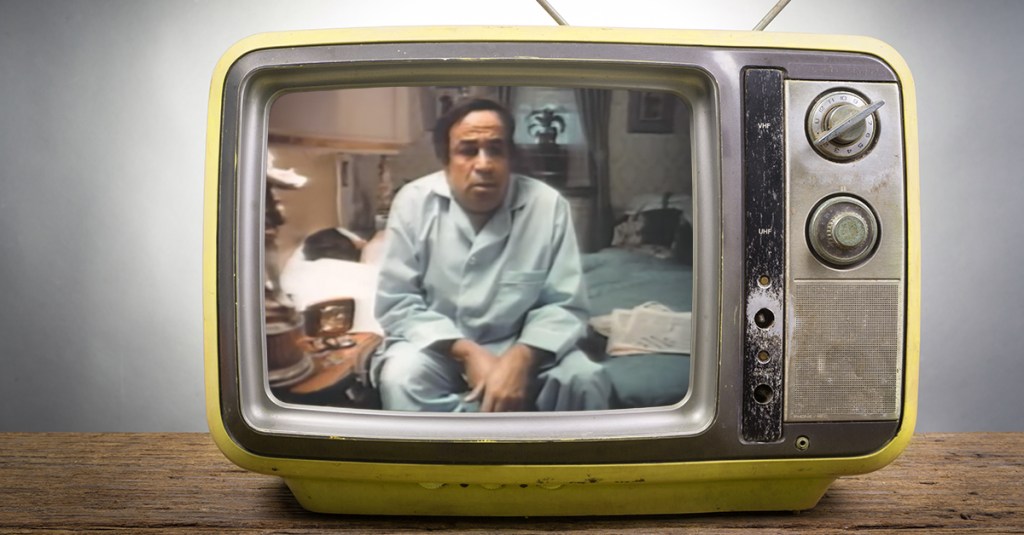
A reference to a 1970 Alka-Seltzer commercial, shown on television. It shows a newly-wed couple (played by Alice Playten and Terry Kiser) in the bedroom where the wife has served her husband a giant dumpling. The husband says, “I can’t believe I ate the whole thing!”, which becomes the commercial’s tagline. He quickly and secretly takes some Alka-Seltzer antacids so his wife won’t know how indigestible her cooking is.

The commercial was created by Howie Cohen, who was inspired by a real life incident where he ate everything he was given at a photo shoot out of politeness. When he said to his wife, “I can’t believe I ate the whole thing”, she replied, “There’s your next Alka-Seltzer commercial”.

The commercial won a CLIO Award, and its tagline quickly became a popular catchphrase.

One of Terry Kiser’s acting roles was playing comedian Vic Hitler in the television series Hill Street Blues. Vic was known as “Vic the Narcoleptic Comic”, which seems a bit similar to Jackson being “Narcoleptic Nate”. Lorelai nicknamed Dean “Narcolepsy Boy” after he fell asleep with Rory at Miss Patty’s, so it seems like an insult she likes to dish out.
Michael Landon

LANE: [runs up behind them] Hey, wait, stop!

LORELAI: Oh look, it’s Michael Landon.

Michael Landon, born Eugene Orowitz (1936-1991), actor and filmmaker best known for his roles in the television series Bonanza (1959-1973), Little House on the Prairie (1974-1982), and Highway to Heaven (1984-1989).

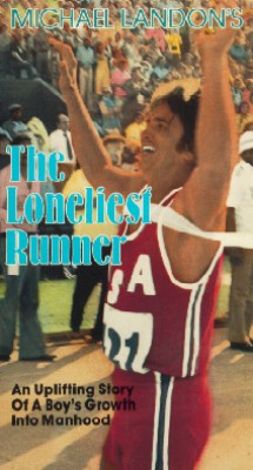
Michael Landon made an autobiographical television film in 1976, called The Loneliest Runner. The story is about a teenage boy named John Curtis, based on Landon himself, who still wets his bed. His mother publicises his problem by hanging the stained sheets from his bedroom window for all to see.

Every day, John runs home from school to take the sheets down before his friends see them. He starts running with the junior track team to channel his anger and forget the shame and hurt of his dysfunctional family life. Ten years later, he is a gold-medal winning Olympic champion, who credits his mother for his athletic success. Landon plays the adult Curtis himself.

Like John Curtis, Michael Landon wet the bed until he was 14, and his mother Peggy hung the sheets out to shame him. He had Olympic ambitions as a javelin-thrower, but a shoulder injury ended his athletic career, which propelled him into acting.

His unauthorised 19991 biography by Aileen Joyce, Michael Landon: His Triumph and Tragedy, relates that the bedwetting was brought on by the stress of having a suicidal mother. As a child, Michael Landon had to save his mother from drowning herself during a beach vacation.

Woman Who Won the Lottery

LORELAI: I don’t know, didn’t they feed lead to our jumping frog or something?

RORY: Oh yeah, right after they stoned the woman who won the lottery.

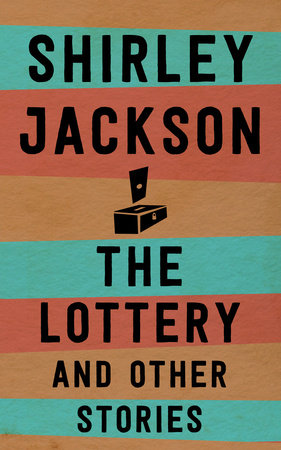
Rory references the 1948 short story, “The Lottery”, by Shirley Jackson. Set on a beautiful summer day in an idyllic New England village (based on Jackson’s own home of Bennington, Vermont), the story tells of an annual ritual known as “the lottery”, an old tradition carried into modern times, and seemingly practised to ensure a good harvest.

People draw slips of paper from a box, and a wife and mother named Tessie Hutchinson eventually “wins” by drawing the marked piece of paper. The entire village begins stoning her to death as she screams of the injustice of the lottery – an injustice that only bothers her when she is the scapegoat marked for death.

The story was first published on June 26 in The New Yorker, and proved so unsettling at the time that The New Yorker received a torrent of letters, the most mail they ever received about a story. Jackson herself received about 300 letters about the story that summer, much of it abusive or hate mail. (Some asked where they could go to watch the “the lottery” take place!).

Since then, “The Lottery” has been analysed in every possible literary and sociological way, its careful construction and symbolism noted, and its themes linked with everything from mob mentality, the military draft, and the death penalty. It is one of the most famous stories in American literature, often reprinted in anthologies and textbooks, and has been adapted for radio, television, film, graphic novel, and even (to Shirley Jackson’s bafflement) a ballet.

Apart from being a short story often read for high school English classes, this seems like a story Rory would enjoy. She has a taste for dark and “gloomy” themes, and is a fan of American Gothic. Like Tessie, Rory is from an idyllic New England town, and has been singled out for special treatment – but in her case, it’s to be loved and glorified by the town.

The story reminds us that even the most charming small towns have a dark side, and that includes Stars Hollow. Rory is no doubt thinking of Jess, vilified and forced to leave because of a minor car accident. (The name Jess even sounds a bit like Tessie).

Tonto

RORY: My feet are sore.

LORELAI: Hey, Tonto, when did you become older than me?

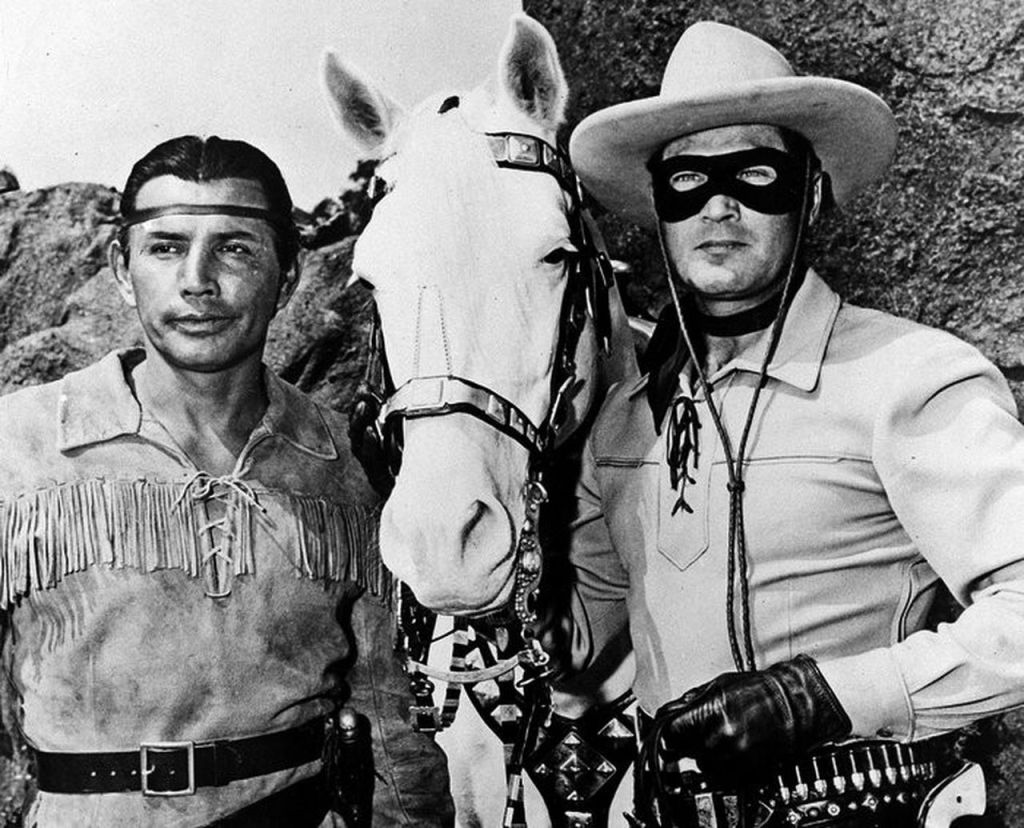
Tonto is the Native American companion of The Lone Ranger, crime-fighting fictional characters from the American Old West created by George W. Trendle and Francis “Fran” Striker. They first made their appearance in 1933 on The Lone Ranger radio show, but proved so popular they appeared in several other media – perhaps most memorably in The Lone Ranger television series (1949-1957), with Jay Silverheels in the role of Tonto [pictured].

The portrayal of Tonto is often seen as degrading to Native Americans, as Tonto spoke in pidgin English. From the 1980s onward, Tonto was articulate in English, and tended to be witty, outspoken, and sarcastic toward The Lone Ranger.

Lorelai addresses Rory as her loyal sidekick, like Tonto. In the radio series, Tonto was actually quite elderly, and it was only when they moved into films that he began to be portrayed as a handsome young warrior.

“Tiny fellow on that M*A*S*H* program”

RICHARD: Hm, maybe we should start a tab with them so we don’t have to pay cash everyday.

LORELAI: Already done.

RICHARD: Amazing. You’re like the tiny fellow on that M*A*S*H* program, always anticipating.

M*A*S*H* (an acronym for Mobile Army Surgical Hospital), a war comedy-drama television series set during the Korean War in the early 1950s which aired from 1972 to 1983. It was adapted from the 1970 film of the same name, which in turn was based on the novel MASH: The Story of Three Doctors by Richard Hooker, based on the author’s own experiences as a doctor in a field hospital in Korea.

Richard refers to the character Corporal Walter “Radar” O’Reilly on the TV sitcom M*A*S*H*, portrayed by Gary Burghoff. He seems to have extra-sensory perception, appearing at his commander’s side, with whatever paperwork is required, before being called, and finishing his sentences before the officer is anywhere near the end of them. Young and naïve, Radar tends to look up to his superiors as father figures, something Richard would probably like from Lorelai.

Although M*A*S*H* took a while to find its feet, by its second season it was one of the top 10 programs of the year, and stayed in the top 20 for the rest of its run. Becoming an allegory for the Vietnam War, it is considered one of the greatest TV shows of all time, and is still broadcast in syndication.

Drum Set

SOPHIE: That’s a DW drum set with Zildjian cymbals.

This is the drum set that Lane tries out. DW stands for Drum Workshop, a drum kit manufacturing business in Oxnard, California, founded in 1972 by music teacher Don Lombardi and his student, John Good. Although Lombardi had only intended the drum-making to help cover the costs of running a music teaching studio, demand was so great that it soon became his primary business.

Famous drummers who use DW drum kits include Chad Smith from the Red Hot Chili Peppers, Dave Grohl from Nirvana and Foo Fighters, Scott Travis from Judas Priest, and Nick Mason from Pink Floyd.

The Avedis Zildjian Company, or Zildjian, is the largest cymbal and drumstick maker in the world. It was founded in Constantinople by Avedis Zildjian, an Armenian metalsmith and alchemist, in 1623, making it one of the oldest musical instrument manufacturers in the world. Avedis Zildjian made his first cymbals in 1618 while working for the Sultan of the Ottoman Empire.

The family eventually emigrated to the US, setting up business in Quincy, Massachusetts in 1929. Business began booming in 1964, after Ringo Starr used Zildjian cymbals during The Beatles‘ famous appearance on The Ed Sullivan Show.

At one point, more drummers used Zildjian products than any other brand, and the list of famous customers is extremely long, but does include (besides Ringo Starr), Taylor Hawkins from Foo Fighters, Charlie Watts from The Rolling Stones, Lars Ulrich from Metallica, and Phil Selway from Radiohead.

A DW drum set with Zildjian cymbals like the one Lane tries out would cost at least $1500 today.

Sal Mineo and Chachi

TAYLOR: Rory, you don’t have to explain a thing to me. I know that there is absolutely no way that you would be involved in something like that if it weren’t for that Sal Mineo wannabe, believe me. Chachi, and Chachi alone, will be held responsible for that incident, okay?

Salvatore “Sal” Mineo (1939-1976) [pictured], actor, singer, and director. He is best known for his role of John “Plato” Crawford, in the 1955 film Rebel Without a Cause, previously discussed. Like Jess, Plato was abandoned by his father and is neglected by his mother, and although treated as a juvenile delinquent, is a sad, lonely boy, desperate for love and affection, and the target of bullies. Plato has a tragic ending, perhaps a bit of wish fulfilment from Taylor.

The role of Plato was played as if the character was a gay teenager in love with James Dean’s character, Jim – the original script even had them sharing a kiss – and Plato is commonly identified as the first gay teen in cinema. Sal Mineo was himself openly bisexual, and unfortunately, like his character, Sal Mineo’s life had a violent ending, as he was murdered in an apparent random mugging.

One fan theory, possibly controversial, suggests that Jess too may be gay or bisexual, and that this is a hint of it – although there’s nothing to disprove that, it seems more likely that Taylor is simply clueless about gay subtext in films.

Chachi, character from television sitcoms Happy Days and Joanie Loves Chachi, previously discussed.

Hit Parade

RICHARD: Done. Now, what else is on the hit parade?

A hit parade is a ranked list of the most popular recordings at a given point in time, usually determined by either sales or airplay. Billboard magazine published its first hit parade on January 4 1936.

It’s possible that Richard is specifically thinking of the radio and television music program Your Hit Parade, broadcast from 1935 to 1953 on radio, and from 1950 to 1959 on television. Each Saturday evening, the program would play the most popular and bestselling songs of the week. It was invariably referred to, incorrectly, as The Hit Parade.

“Hold an envelope up to your head”

RICHARD: No, no, they’ve already hung up. [phone stops ringing]

LORELAI: Okay, next time hold an envelope up to your head before you do that.

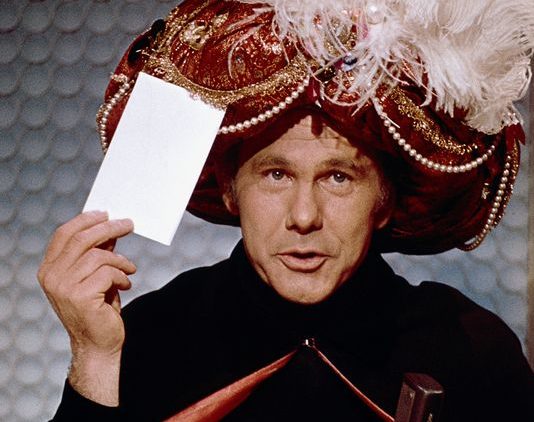
Lorelai refers to Carnac the Magnificent, a comedy role played by Johnny Carson on The Tonight Show Starring Johnny Carson, previously discussed. Carnac the Magnificent, dressed in a feathered turban and a cape, was a “mystic from the East”. When a sealed envelope with an unseen question was placed against his forehead, he would pretend to psychically give the question to that answer.

The humour would come from an unexpected question which followed a seemingly straightforward answer. For example, Carnac would give the answer, “Sis boom bah”, and the question would be, “Describe the sound made when a sheep explodes”.