Navy Shower

RICHARD: I’ll be right back.

LORELAI: Right back, Dad, like right back. In fact, change on the way upstairs. And make it a Navy shower – quick soap, quick rinse and no excessive posing!

A Navy shower is a method of showering that saves water and energy by turning off the water while lathering, and then turning the water back on to rinse off. The total running time of this kind of shower can last less than two minutes. Navy showers originated on naval ships, where supplies of fresh water were often scarce.

In US naval parlance, the opposite of a Navy shower is a Hollywood shower, which is a long shower that uses up a lot of water – I think this is what Lorelai is referring to when she says “no excessive posing” (like a movie star posing for photographs).

Most likely, Lorelai talks about a Navy shower because Gomer Pyle, previously mentioned in this episode, became the star of his own show, Gomer Pyle, U.S.M.C., which ran from 1964 to 1969. In this spin-off sit-com, the good-hearted Gomer Pyle joins the Marines, where he exasperates his drill sergeant with his frequent mistakes and misunderstandings.
Gomer

EMILY: Stop!

LORELAI: Gomer said!

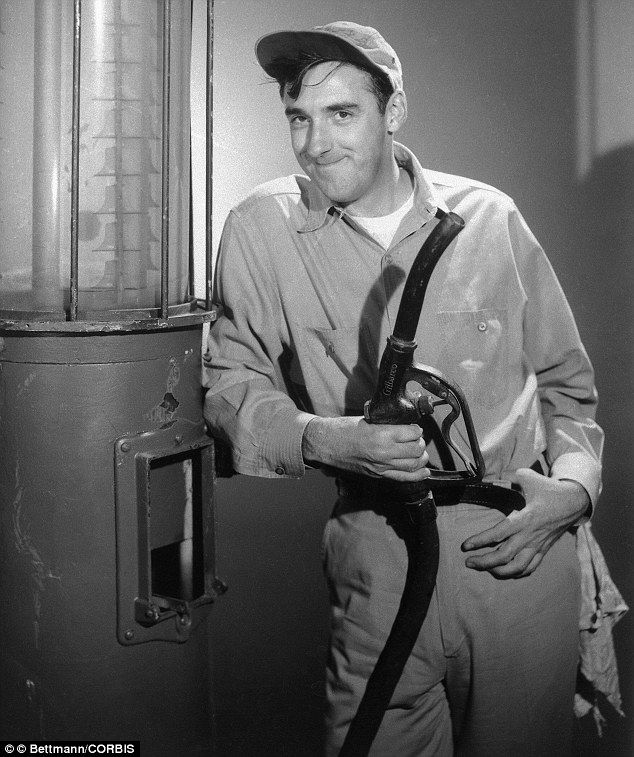
Lorelai is referring to Gomer Pyle, a character from The Andy Griffith Show, played by Jim Nabors. Gomer was the slow-witted, naïve mechanic who worked at the local filling station; at first very ignorant about cars, his knowledge increased until he was quite competent.

Lorelai calls Richard “Gomer” because he’s dressed in overalls and doing a mechanic’s work on his car.

Charlie Rose

MISS PATTY: Transcript?

LORELAI: Yeah, Taylor, this isn’t Charlie Rose.

Charlie Rose, television interview and talk show, hosted by journalist Charles “Charlie” Rose (born 1942). Rose interviewed thinkers, writers, athletes, politicians, entertainers, business people, leaders, scientists, and fellow journalists. It was broadcast on PBS from 1991 to 2017, only coming to an end when Rose was accused of sexual harassment. The show was then replaced by one hosted by Christiane Amanpour. Transcripts of the show were made available online after broadcast, and in fact many of them still are.

Mac and Tosh

LORELAI: We certainly are entertaining, Mac.

RORY: Indubitably, Tosh.

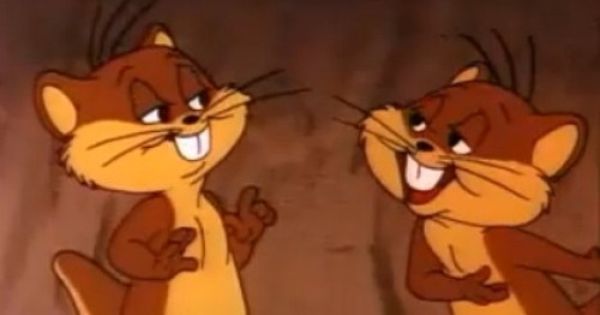
Mac and Tosh are the names of the two Goofy Gophers in the Warner Bros cartoons, created by Bob Clampett, and originally appearing in the 1947 short film The Goofy Gophers. The cartoon features the two gophers making frequent raids on a vegetable garden while tormenting the guard dog. They both speak in high-pitched stereotypical upper-class British accents.

They may have been intended as a spoof on the Disney chipmunk characters, Chip ‘n’ Dale, and their mannerisms and speech were patterned after the 1900s comic strip characters Alphonse and Gaston, drawn by pioneering cartoonist Frederick Burr Opper, where the jokes came from the ridiculous over-politeness of the French characters as they got on with each task. Another suggestion is that they were influenced by the British film Great Expectations, based on the Dickens novel, which was released in 1946, the year before the Goofy Gophers were created.

The pair’s dialogue is peppered with such over-politeness as “Indubitably!”, “You first, my dear,” and, “But, no, no, no. It must be you who goes first!”. They also tend to quote Shakespeare and use humorously long words.

The gophers only received names in a 1961 episode of the TV show, The Bugs Bunny Show – an obvious pun on the word mackintosh, meaning a raincoat.

Corky’s Country Cavalcade

RORY: What are you doing here anyhow? This is a town meeting for people who participate in and care about the town.

JESS: Well, Corky’s Country Cavalcade on public access was pre-empted, so I thought I’d check out the next best thing.

Corky’s Country Cavalcade, a fictional rural television program Jess has sarcastically invented to suggest that the town meeting is the closest real world parallel. Coming to a town meeting might mean that Jess does feel more connected to Stars Hollow since Rory has nagged him into helping out at the diner more at a time of family crisis, or that he wants to lend Luke some support. Or he might just want another chance to see Rory … his expression says he does. (Remember when Dean turned up to a town meeting just to see Rory?).

In North America, pre-empted is used in broadcasting to mean that a regular scheduled program has been interrupted or replaced.

The Final Days of Dick Nixon

RORY: Taylor’s wigging.

LORELAI: I know. He’s been sitting there like the final days of Dick Nixon for almost an hour.

Richard Nixon (1913-1994), 37th President of the US from 1969 to 1974. The Watergate Affair, the name used to describe the secret and illegal activities undertaken by members of the Nixon administration, was brought to light by reporters Carl Bernstein and Bob Woodward in The Washington Post in 1972.

Nixon had hoped to weather the storm by refusing to leave, but impeachment hearings against him opened in May 1974. With loss of political support, and the near-certainty he would be impeached and removed from office, Nixon resigned on August 9 1974.

Lorelai may be specifically referring to the 1976 non-fiction book, The Final Days, by Carl Bernstein and Bob Woodward, describing the last months of Richard Nixon’s presidency. It was a major commercial success, and was made into a television movie of the same name in 1989, with Lane Smith as Richard Nixon.

David and Lisa

TAYLOR: Let go of me!

TROUBADOUR #2: Don’t like to be touched, that’s cool. Got a little David and Lisa thing happening?

David and Lisa, 1962 drama film directed by Frank Perry. It is based on the second story in the 1961 novella Lisa and David by a psychiatrist named Theodore Isaac Rubin; the screenplay is written by Rubin’s wife, Eleanor Katz. The story is about a bright young man named David (played by Keir Dullea) who cannot bear to be touched; while in a mental health treatment facility, he befriends a girl named Lisa (played by Janet Margolin) who has a split personality.

David and Lisa received positive reviews from critics. It was made into a stage play in 1967, and into a television film in 1998, produced by Oprah Winfrey.

David and Lisa is one of the DVDs we can see at Stars Hollow Video in “Richard in Stars Hollow”.

Note the implication from the Second Town Troubadour/Second Market Guy that Taylor must have serious mental health problems if he doesn’t want to be hugged. It’s just the start of the trolling that Taylor is about to be subjected to!

Jeannie and Major Healey

JESS: I’m in the middle of something.

RORY: Just assume that Jeannie’s gonna get Major Healey out of whatever scrape he’s in.

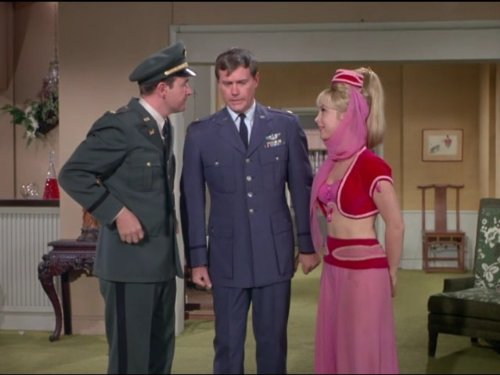
As the theme music playing tells us, Jess is watching I Dream of Jeannie, a fantasy sitcom created by Sidney Sheldon, starring Barbara Eden as a 2000-year-old genie named Jeannie, and Larry Hagman as Major Tony Nelson, the astronaut she falls in love with. Bill Daily played Tony’s best friend, Major Roger Healey, who was girl-crazy and often entered into get-rich-quick schemes, requiring Jeannie’s assistance to sort everything out. The show was originally broadcast from 1965 to 1970, but but often shown in reruns.

I Dream of Jeannie was created as a deliberate rival to Bewitched, both having pretty blonde magical beings as the focus of the show. It is amusing that Jess apparently prefers I Dream of Jeannie, while Lorelai seems to be a fan of Bewitched.

The classic theme music which you hear Jess listening to was composed by Hugo Montenegro with lyrics by Buddy Kaye. It replaced the original Season 1 theme music, a jazz waltz composed by Richard Weiss. Carole King and Gerry Goffin wrote a theme for the show, but it was never used.

(The show is set in Florida, the same place Louie retired to).

Taylorville

LUKE: He’s systematically buying up the town. He’s gonna turn it into Taylorville where everyone’ll wear cardigans and have the same grass height.

A possible allusion to The Andy Griffith Show, previously discussed. It is set in the small town of Mayberry (one of the models for Stars Hollow). One episode of The Andy Griffith Show explained that Mayberry was almost named Taylortown in honour of Colonel Taylor, an early settler. Andy Griffith’s character himself is named Andy Taylor.

There is a real-life Taylorville in Illinois, a city of around 11 000 people. (In the US, the designation of “city” does not seem to be dependent on achieving a minimum population size; Taylorville is barely bigger than “small town” Stars Hollow).