Twenty Questions

LUKE: So you get unpacked?
JESS: Yup.
LUKE: Get enough space in the closet?
JESS: Plenty.
LUKE: You hungry?
JESS: Eighteen.
LUKE: What?

JESS: Just counting how many questions ’til we hit twenty.

Jess is referring to Twenty Questions, an American parlour game originating in the 19th century. One person chooses a particular object or subject, but keeps it a secret. Players take turns asking them questions about it, which can only be answered by “yes”, “no”, and “maybe”. Winning the game involves correctly guessing the answer within twenty questions – if not, the answerer wins the game. Twenty Questions has been made into several successful radio and television quiz shows.

Of course, Luke isn’t trying to guess anything, just asking if Jess has everything he needs, but Jess is clearly not in the mood.

“New dodo on the Regis show”

RORY: What’s [Jess] like?
LORELAI: Well, he’s not gonna be subbing for the new dodo on the Regis show any time soon, let’s put it like that.

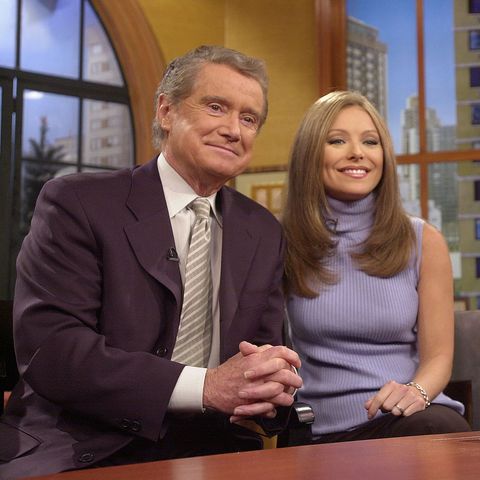
A reference to the talk show hosted by Regis Philbin, previously discussed. His co-host since 1988 was Kathie Lee Gifford, when it was called Live! With Regis and Kathy Lee. After Gifford’s last show in 2000, Regis spent six months auditioning possible co-hosts live on air. In February 2001, he chose dancer and actress Kelly Ripa, and the show’s name was changed to Live! With Regis and Kelly.

Kelly Ripa seems to be “the new dodo” (the new idiot) Lorelai is referring to. She’d been co-host for nearly seven months at this point, but I guess that’s still new for someone who is used to Kathy Lee Gifford.

“Subbing” is short for “substituting, so Lorelai is saying that Jess isn’t suitable to fill in for a talk show host (i.e., he isn’t chatty).

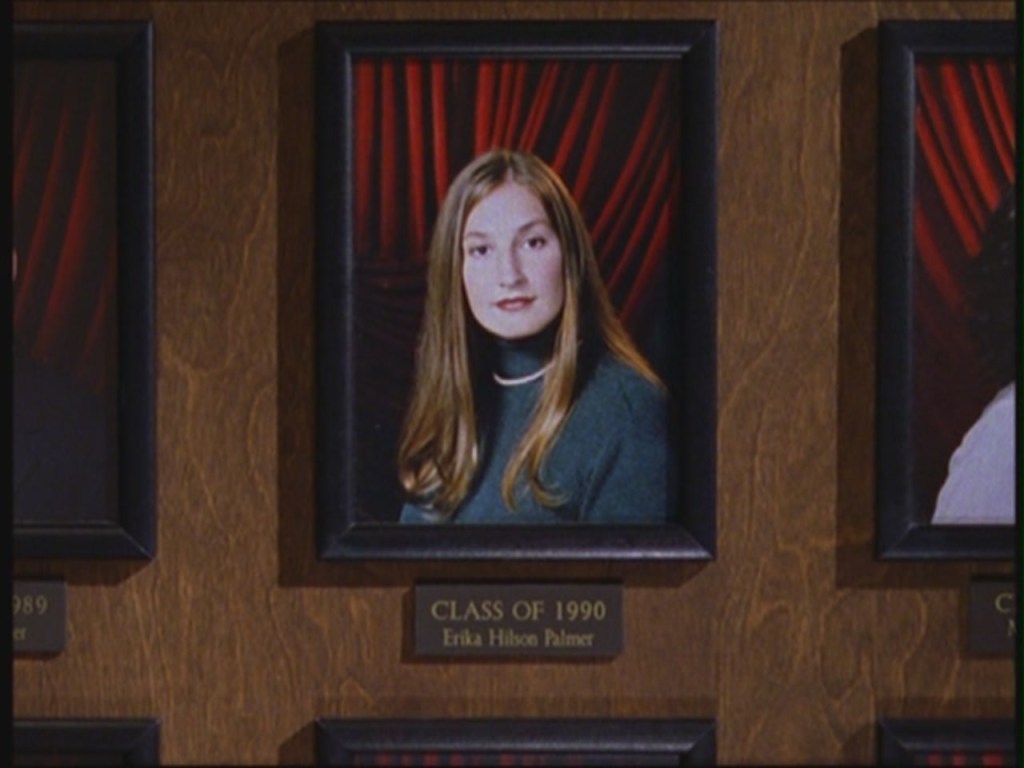
Erika Hilson Palmer

On her way back from going to the toilet, Lorelai has a poignant moment looking at a display of past valedictorians, and makes a point of gazing longingly at Erika Hilson Palmer, the valedictorian for 1990. This is the year that Lorelai would have graduated from university if she’d gone straight from high school instead of having Rory, and it’s a reminder that Harvard was her dream first, and that she seems to have had high ambitions for herself.

In real life, Harvard University does not have class valedictorians.

Reader Sazz has noted that the surname Palmer seems like a nod to Twin Peaks, the television  show directed by Amy Sherman Palladino’s idol, David Lynch (mentioned a short time earlier in this very episode). Twin Peaks centres around solving the mystery of teenage Laura Palmer’s death.

Happy Days and the Valley Girl Song

LORELAI (to two girls in the dormitories): Oh, cool. We’re just kinda hanging out between classes. We got Chef next. So, we’ll probably see you at the Phi Alpha Beta thing tomorrow, right?
GIRL 1: Maybe.
LORELAI: Yeah, I know, we’re not sure either. They can be so totally lame. Gag me.
GIRL 1: Yeah. See ya. [Students leave]
RORY: You do realize that all of your college kid jargon comes from Happy Days and the Valley Girl song?

Happy Days, previously mentioned, is an American sitcom that presented an idealised portrait of Midwestern life in the 1950s and ’60s. It starred Ron Howard as innocent teenager Richie Cunningham, and Henry Winkler as his friend Arthur “Fonzie” Fonzarelli, a cool biker and high-school dropout. Aired between 1974 and 1984, it became one of the biggest hits in television history, and was the #1 TV program in 1976-77. It turned Henry Winkler into a major star, and Fonzie into one of the most merchandised characters of the 1970s. It also spawned a number of spin-offs, including Joanie Loves Chachi, previously discussed. Happy Days is still on American television in reruns.

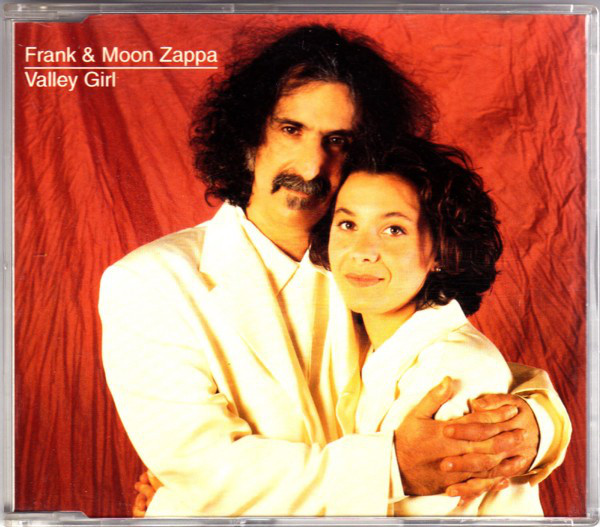
Valley Girl is a 1982 song by Frank Zappa and his daughter Moon Zappa, then aged 14. The song consists of Frank playing riffs on the guitar while Moon performs the lyrics in “Valspeak”, the slang and intonations of the teenage girls of the era from the San Fernando Valley. The song went to #32, and was Zappa’s only Top 40 single. Although intended as a savage parody, the song popularised the Valley Girl stereotype, and led to an increase in Valspeak. The fad directly inspired the 1983 Nicolas Cage movie Valley Girl.

Lorelai’s “They [frat parties] can be so totally lame. Gag me”, is pure Valspeak.

Ginchy!

STUDENT: Okay. So I’ll see you in class. And maybe at that Phi Kap party tonight?
LORELAI: Ginchy!
STUDENT: Cool. Bye.

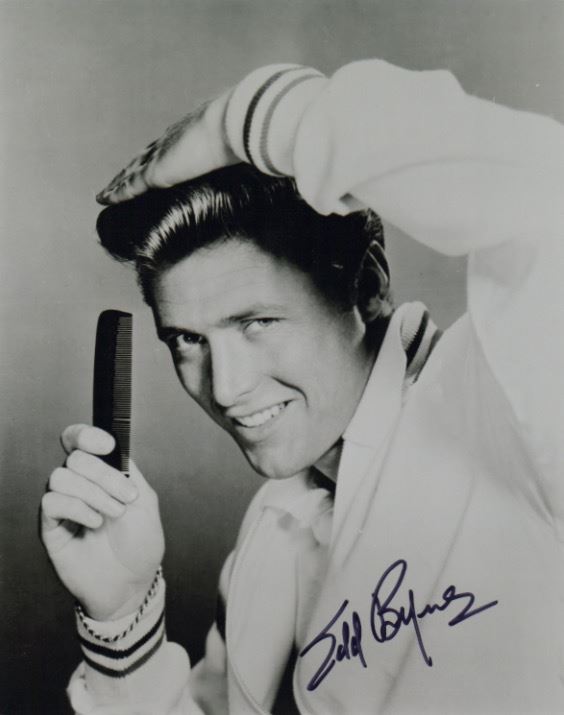
Ginchy is dated teen slang meaning “cool, neat, sexy”. The word was popularised by “Kookie” Kookson, played by Edd Byrnes, in the hit private detective television series 77 Sunset Strip, which aired from 1958 to 1964. Kookie, who was a wisecracking, hair-combing hipster and assistant to the detectives, is an obvious forerunner to the character of Arthur “The Fonz” Fonzarelli on Happy Days.

The word ginchy is 1930s slang related to ginch, meaning an attractive woman.

Past Graduates of Harvard

LORELAI: Past graduates. Henry James … isn’t that a beer?
RORY: And a novelist. Go on.
LORELAI: John Adams. That’s a beer!
RORY: Our second president. He’s very in right now.
LORELAI: W.E.B. Du Bois, Yo-Yo Ma. Oh cool! Fred Gwynne.
RORY: Who?
LORELAI: Herman Munster. Now I’m impressed.

Henry James (1943-1916), earlier mentioned, was an American-born British author, often considered one of the greatest novelists of all time. He is best known for his novels and stories depicting interactions between Americans, English people, and Continental Europeans, such The Portrait of a Lady, and The Ambassadors. Henry James’ style closely examines the psychology of his characters in an ambiguous or contradictory way. There is no beer named Henry James that I know of. Henry James attended Harvard Law School in 1862, but soon discovered he had no interest in law, and pursued a literary career instead, so he isn’t actually a graduate.

John Adams (1735-1826) was an American statesman and Founding Father of the United States who served as the Vice-President of the US, and as the second President of the US from 1797 to 1801. Adams tended to be a rather obscure president for many years, with many Americans knowing nothing about him, until the publication of his biography John Adams by popular American historian David McCullough in May 2001. It was very favourably received, and brought about a resurgence in Adams’ reputation. Rory seems to be referring to this book by saying Adams “is very in right now”, and has almost certainly read it. There is actually a beer named John Adams. John Adams entered Harvard in 1751, graduating in 1755 with a Bachelor of Arts degree.

William Edward Burghardt “W.E.B.” Du Bois (1868-1963) was an American sociologist, historian, civil rights activist, and writer. He was one of the founders of the National Association for the Advancement of Colored People in 1909, and was the leader of the Niagara Movement who worked for equal rights for blacks. A prolific author, Du Bois’ 1903 essay collection The Souls of Black Folk was a seminal work in African-American literature, and his 1935 Black Reconstruction in America was his greatest work. The Civil Rights Act, embodying many of the reforms for which Du Bois had campaigned, was enacted the year after his death. W.E.B. Du Bois attended Harvard from 1888 to 1890, where he received his second bachelor’s degree, graduating cum laude.

Yo-Yo Ma (born 1955) is a French-born American cellist. A child prodigy, he has performed as a soloist with orchestras around the world, recorded more than 90 albums, and received 18 Grammy Awards. He has received several prestigious awards, including the Presidential Medal of Freedom in 2011. Yo-Yo Ma received his bachelor’s degree from Harvard in 1976, and in 1991 Harvard awarded him an honorary doctorate.

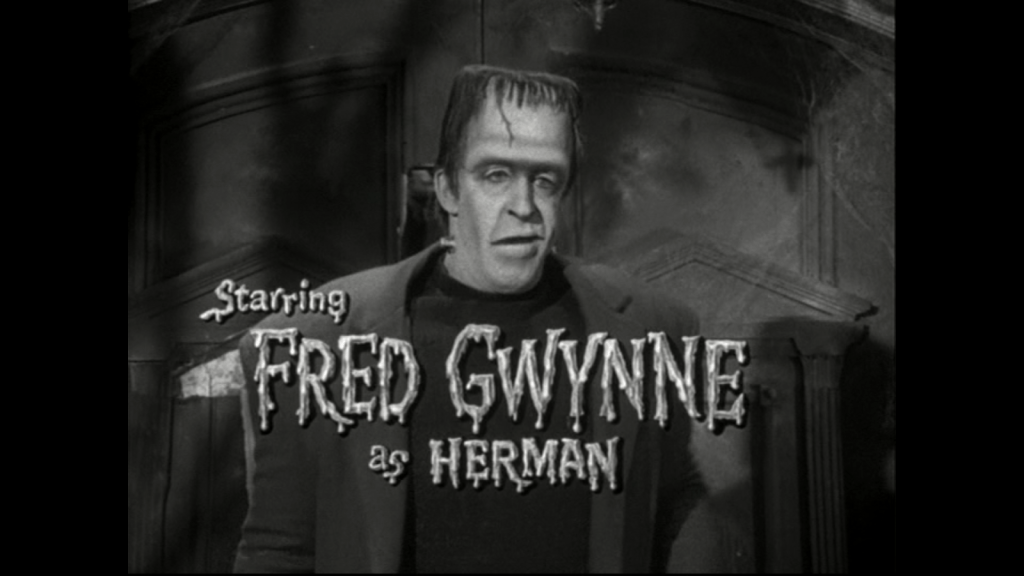
Frederick “Fred” Gwynne (1926-1993) was an American actor, singer, artist, and author, best-known for his roles in 1960s sitcoms such as The Munsters, where he played Herman Munster, who resembled Frankenstein’s monster. He also sang professionally, painted, and was a successful children’s author. Fred Gwynne graduated from Harvard in 1951, and was highly involved in Harvard life, including as a member of the Hasty Pudding Theatricals.
 

David Lynch

LORELAI: We are not gonna have this fight in a flowery bedroom with dentists singing Gypsys, Tramps and Thieves [sic] in the background. It’s too David Lynch!

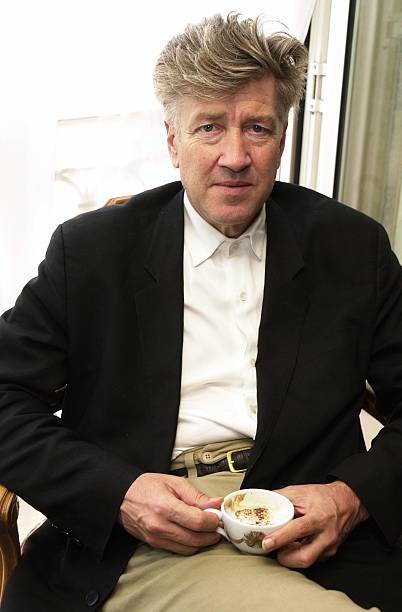
David Lynch (born 1946) is an American film maker, musician, actor, and artist. His first feature-length work was the surrealist horror film Eraserhead (1977), which became a cult classic, and he gained mainstream success with the biographical film The Elephant Man (1980), previously mentioned. The science-fiction epic Dune (1984) was a failure, while his mystery film Blue Velvet (1987) was controversial upon release, but now regarded as one of the greatest films of its era.

He is well known for his mystery horror television series Twin Peaks (1990-1991), which was a smash hit around the world, quickly gained a cult following, and caused him to be labelled the “first popular Surrealist”. He also directed Wild at Heart, earlier mentioned as a film Nicolas Cage starred in.

It becomes apparent during the show that Lorelai is a David Lynch fan.

Behind the Music

LORELAI: You know, if I was in a rock band touring and stuff, I’d make the bus driver stop at every Haden’s Nut House we pass.
RORY: Wow, your Behind the Music is gonna be really wild.

Behind the Music is a documentary music television series. Each episode, a particular band or musical artist is profiled and interviewed. The show has been broadcast since 1997.

Perfect Situation for a Fool

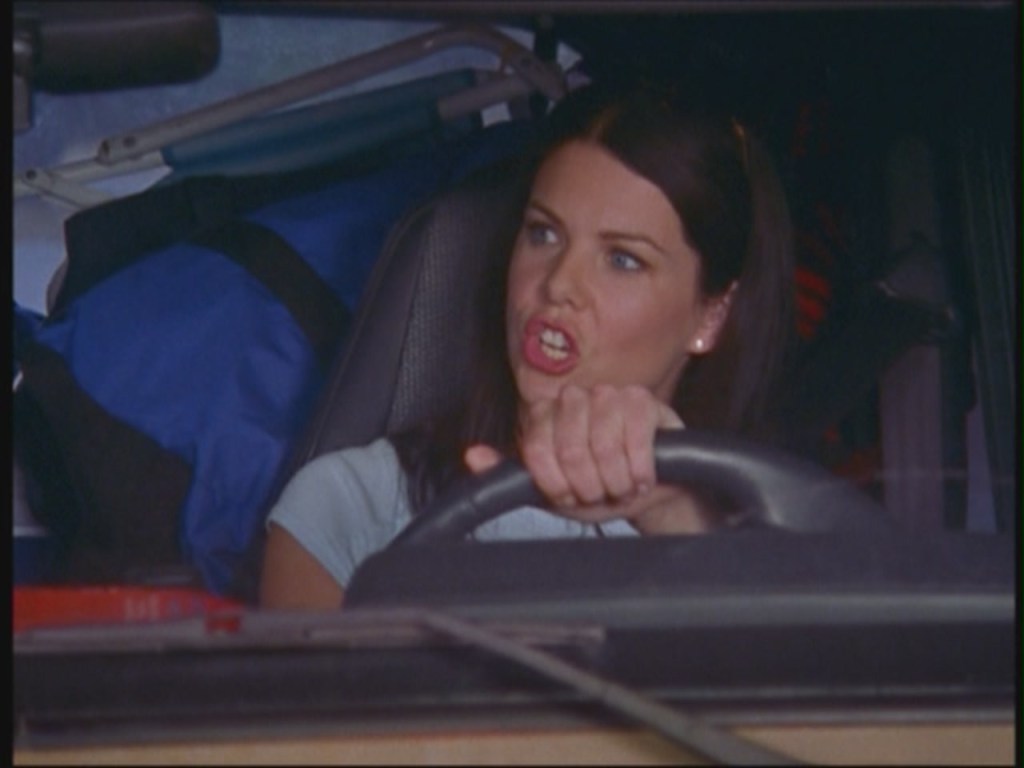
A small part of this country song written by Jai Josefs and Roy Brown and sung by George Highfill plays on the radio before Lorelai switches stations. It seems to have been written as music for film and television, and has been included on the soundtracks of other shows, including Supernatural.

Rather unbelievably, there is nothing on New England radio except country music and Christian rock – they are driving through Massachusetts, not Alabama!