DEAN: You know, when all this happened with you and me and Rory, I figured I’d just stay out of everyone’s way, that that would be easiest. But now, I’m looking at you and I’m thinking, I’m gonna run from him? The Glad Man.
I think Dean is referring to “The Man from Glad”, a mascot for the Glad Products Company, which specialises in trash bags – as a dig at Jess for taking out the garbage. The mascot is a white-haired man in a white suit who arrives to save housewives from domestic challenges, with the help of spy paraphernalia, as a nod to The Man From U.N.C.L.E.
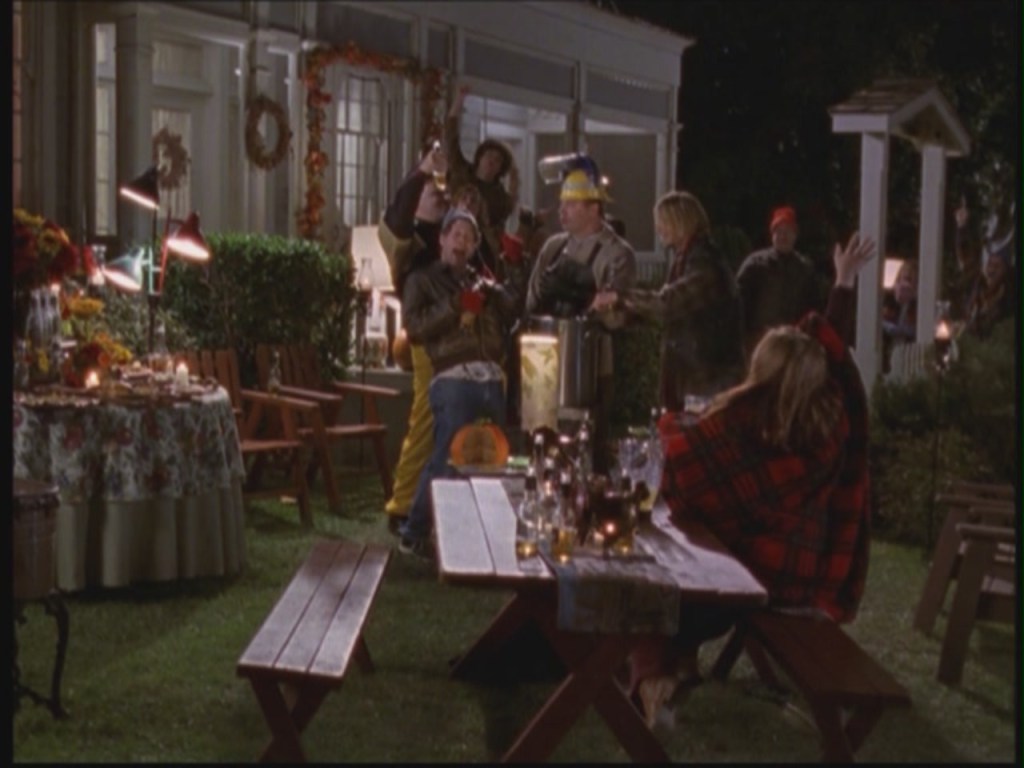
Jackson’s relatives are played by Sean Everett, Danny Buday, Kristin Caruso, Lynne Garbet, Monty Bane, John Jabaley, and DeVera (Dee) Marcus.
Most of them have only had limited acting experience, with the first two having more experience working in the props department or as a writer or producer for film and TV. John Jabaley had previously had roles on Buffy the Vampire Slayer and Firefly. Dee Marcus had previously had roles onWho’s the Boss?, Full House, and The Larry Sanders Show.
RICHARD: And this is our international contingent, Claude and Monique Clemenceau. They’re just in from France.
The Clemenceaus have been given the same surname as Georges Clemenceau (1841-1929), Prime Minister of France from 1906-1909, and again from 1917-1920, leading France through the end of World War I.
It is surely not a coincidence that Georges Clemenceau has a Connecticut connection. He fled France in 1865 due to involvement in radical politics during the regime of Napoleon III. He ended up teaching at a girl’s school in Stamford, Connecticut, where he fell in love with one of his students, Mary Plummer (1849-1922). They married in 1869 and moved to France a year later. They separated in 1876 and divorced in 1891, after which Clemenceau had Mary sent back to the US. From his time in the US, Clemenceau developed a strong faith in American democratic ideals.
Georges Clemenceau was a friend, biographer, and supporter of the famous French artist Claude Monet. Given Claude’s first name, this also does not seem like a coincidence. Notice that the name Monique sounds similar to Monet, as if both French guests have been named after the painter.
Claude is played by Michael des Barres, an English marquis, actor and rock singer. He played Murdoc in the original Macgyver and had a lead role in the show’s reboot, and replaced Robert Palmer in the band The Power Station, fronting the band at the 1985 Live Aid concert. He has had roles in numerous TV series and some films, including To Sir With Love, Pink Cadillac, and Mulholland Drive. A long-term campaigner against drug abuse, he is currently a radio host for Sirius XM.
Monique is played by Lydie Denier, a French-American model, singer, and actress. She has appeared in a few films and a number of TV programs, including General Hospital, Melrose Place, and Spin City.
RICHARD: These are our guests, Natalie and Douglas Swope.
EMILY: You two have met.
LORELAI: Yes, at the auction.
NATALIE: Good to see you again.
The show seems to have committed to the new timeline where Lorelai and Natalie Swope first met at the auction in “Eight O’clock at the Oasis”, supposedly about six weeks previously. However, when Natalie was visiting Emily in “Presenting Lorelai Gilmore”, she asked after Lorelai, who she remembered very well even though she hadn’t seen her since before she had Rory (as Lorelai is said to have attended the Christmas party at Richard and Emily’s every year, this in itself doesn’t seem very likely – did Natalie never attend one of the parties?).
We meet Natalie’s husband, Douglas, in this episode. Again, surely he and Lorelai would have met in the original timeline, but obviously not in this one, as he wasn’t at the auction. Douglas is played by John Aniston, the father of Jennifer Aniston. He had roles on the soap opera Search for Tomorrow, and The West Wing, as well as a long-term connection with Days of Our Lives.
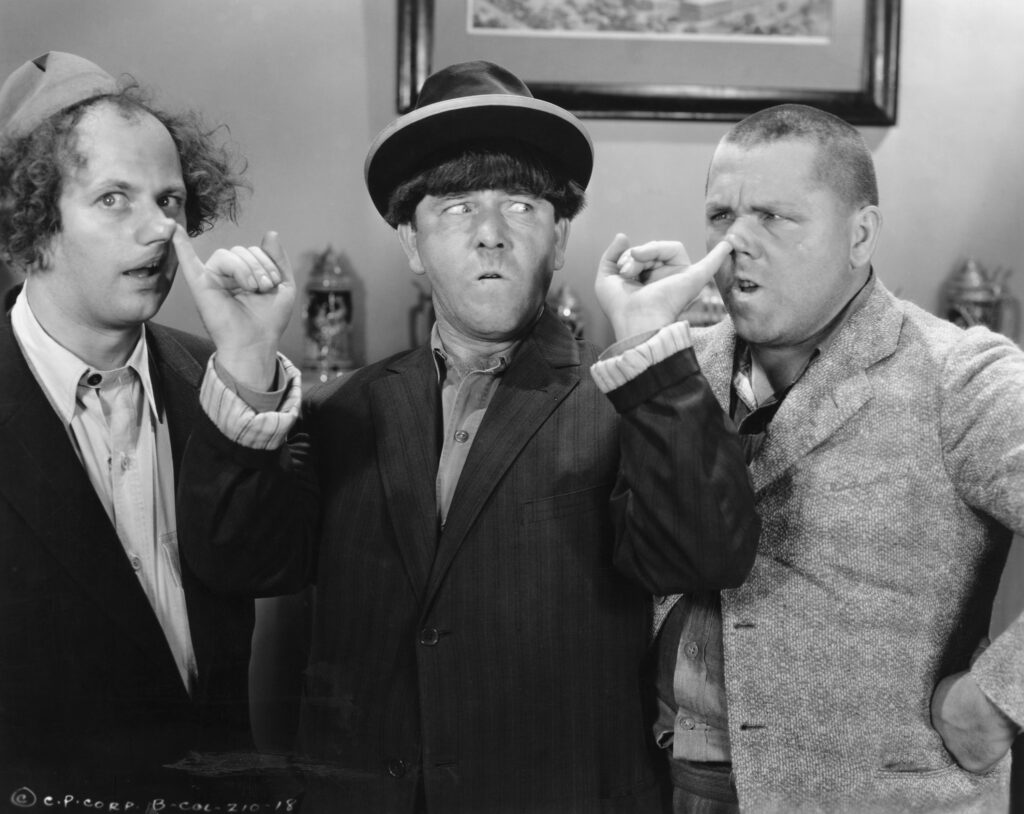
JESS: Yeah, or we can wear Three Stooges masks all the time, that way no one will know who we are.
RORY: I can be Curly.
JESS: I’ll be Moe.
The Three Stooges was an American vaudeville comedy team active from 1922 until 1970, best remembered for their 190 short films. Their hallmark styles were physical farce and slapstick. Although six actors played the Three Stooges, the classic line up was Moe Howard (played by Moses Horwitz), Larry Fine (played by Louis Feinberg), and Curly Howard (played by Jerome Horwitz). Their peak popularity was from 1934 to 1946, but television syndication made them one of the most popular comedy acts of the early 1960s.
Rory was proud to be seen with Dean, and kiss him in public. Now her relationship with Jess begins with her hiding their relationship away as if it is something shameful. It doesn’t feel as if the relationship is getting off to a very healthy start.
LOUISE: I’m having [Thanksgiving] dinner with my dad.
MADELINE: Isn’t he still in jail?
LOUISE: Yes, but his company donated some treadmills for the inmates so he swung a special trailer for dinner that they’re gonna set up for us in the parking lot. We have it for about two hours and then one of the Manson girls gets us.
In the episode “Back in the Saddle”, Louise mentioned that her father was due in court, on mysterious charges (she didn’t bother finding out what he had been arrested for). Now it’s seven months later, and Louise’s father is undertaking his sentence – for whatever it was. Madeline refers to it as “jail”, rather than “prison”, possibly suggesting a shorter, lighter sentence (although sometimes people use the word jail for both jail and prison, so that’s not certain at all).
It does sound as if Louise’s father is in a low or medium security facility, since he is permitted to spend his Thanksgiving dinner in a trailer in the parking lot with his daughter (and possibly other family members, it seems unlikely only Louise would go and see him). These trailers are a reward for good behaviour given to model prisoners, so Louise’s father is clearly well-behaved – even the donation of treadmills to the prison would not be enough on its own. Connecticut is one of only four states that allow extended visits like this (the others are California, New York, and Washington).
Louise says the trailer then goes to “one of the Manson girls”, referring to the female members of the Manson family who were convicted for their crimes. In real life, they were incarcerated in California, and in high security prisons, so this could not have really happened. (Squeaky Fromme was in a high security mental treatment facility in Texas).
Interestingly, there is a state prison in Cheshire, Connecticut called the Manson Youth Institution, for men under the age of 21. Louise can’t be referring to that either, as they are young men, not women, and they are not permitted visits such as she describes.
It is just possible that Louise’s father is being held at the federal correctional facility in Danbury, Connecticut [pictured], a medium and low security prison and satellite prison camp which has facilities for both male and female inmates – so if Louise’s dad’s trailer wasn’t going to a “Manson girl”, it could feasibly be going to a female prisoner, at least. The facility in Danbury has often featured in pop culture, including Orange is the New Black.
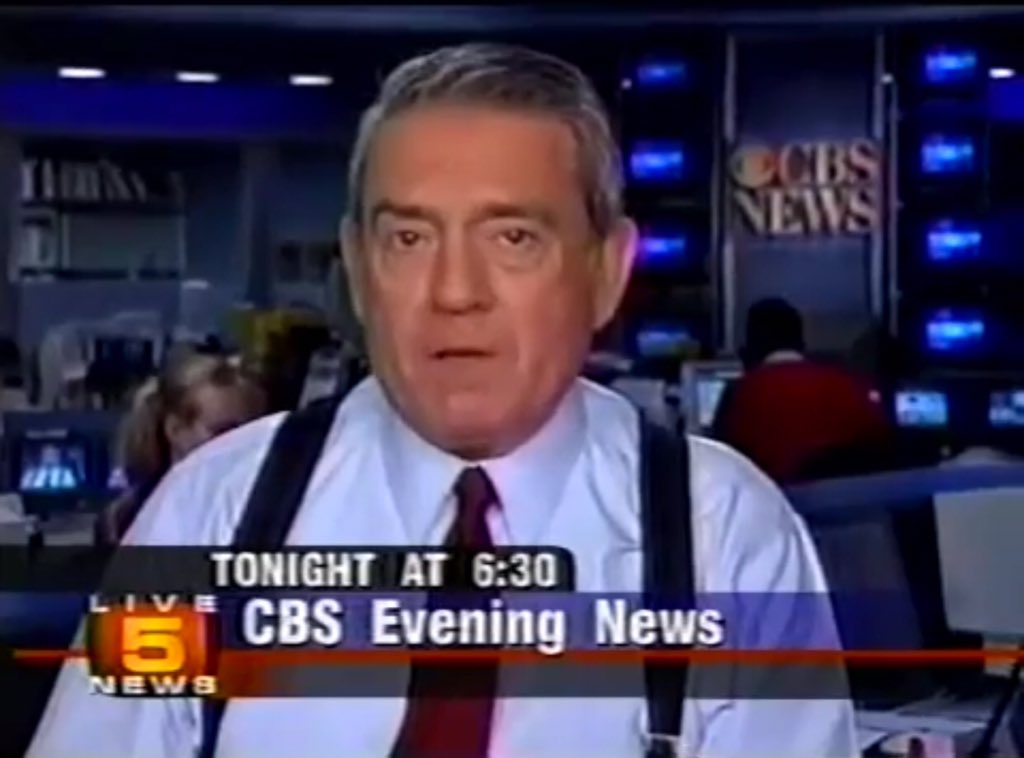
SOOKIE: They still say, ‘And now the CBS Evening News with Dan Rather.’ You see? Dan is still associated with it even though he’s off snorkeling or something, just like I’m gonna be associated with the dinner because Bob is substituting for Sookie.
Daniel “Dan” Rather (born 1931), journalist, commentator, and former national evening news anchor. Rather became a national name after his reporting saved thousands of lives during Hurricane Carla in 1961, creating the first radar weather report, and helping to initiate the successful evacuation of 350,000 people.
Rather reported on some of the most significant events of the modern age, such as the fall of the Berlin Wall, the Gulf war, 9/11, the second Iraq war, and the war on terror. He famously reported from Dallas at the time of John F. Kennedy’s assassination. He was promoted at CBS News, where he served as White House correspondent beginning in 1964. He covered the presidency of Richard Nixon, including the Watergate scandal, and the president’s resignation.
In 1981, Rather was promoted to news anchor for the CBS Evening News, a role he occupied for 24 years. Along with Peter Jennings at ABC News and Tom Brokaw at NBC News, he was one of the “Big Three” nightly news anchors from the 1980s through the early 2000s. He frequently contributed to CBS’s weekly news magazine, 60 Minutes.
After a 2005 controversy over fabricated documents, he was fired in 2006. He now has a news program on cable television, a Youtube channel, and a Substack newsletter.
It’s lucky that Jess decided to kiss Rory rather than light his cigarette, because it is dangerous to smoke near gas pumps, because of the flammable gasoline fumes in the air. The risk is low, but most gas stations have a policy not to allow smoking, in order to reduce the risk even further. (Does this underline what a “bad boy” Jess is, or suggest that he never intended to light the cigarette?).
Note that Jess is still carrying cigarettes around, even though Luke told him to give up smoking more than a year ago, at the start of Season 2. This scene strongly implies that he never gave up – he pats his pockets as if searching for a lighter.
It is also possible to read the scene as Jess using the cigarettes as props to look cool when Rory shows up, or as Jess being a reformed smoker who is tempted to begin again, or testing his own resolve.
HARRIS: It was a pleasure to meet you. I’ll read that book you recommended.
RORY: And don’t be fooled by the Oprah seal on the cover, it’s actually very good.
Rory refers to Oprah’s Book Club, a segment on the Oprah Winfrey Show, which highlighted books selected by the host, Oprah Winfrey. It ran from 1996 until 2011 (with a hiatus in 2002), and in that time it recommended 70 books. Because of the book club’s popularity, previously obscure works could become bestsellers, making an Oprah’s Book Club seal on the cover a highly influential piece of marketing.
Rory does not tell Richard (or the viewer) which book she recommended to the Dean of Admissions. However, due to the aforesaid hiatus, Oprah’s Book Club only recommended two works in 2002. My guess is that Rory recommended Sula, a 1973 novel by Toni Morrison, and her second published work.
The novel is set in the 1920s and ’30s in a fictional small town in Ohio (a favourite setting for Dawn Powell stories, one of Rory’s most admired authors). It is about two black girls named Nel and Sula who are close friends, but who take different paths in life (rather like Rory and Lane). While Nel chooses marriage, motherhood, and the close bonds of the town’s black community, Sula goes to college, lives in the city, and defies conventional sexual morality, bringing down condemnation from the town’s community.
It feels like a book which Rory would be interested in, and would also think suitable to recommend to a Dean, since it is by a Nobel Prize winning author, and the plot involves college and female education.
EMILY: Richard Gilmore, you are going to give these girls the wrong impression.
RORY: What impression is that, Grandma?
LORELAI: That you were the Helena Bonham Carter of the society set?
Helena Bonham Carter (born 1966), English actress. She rose to fame in 1985 film A Room With a View, and became a favourite choice for playing a virginal “English rose” in period dramas – something she was uncomfortable with. Bonham Carter gained worldwide recognition in the 2000s, and has had many major roles, including awards for biographical film and TV The King’s Speech, Enid, and The Crown.
Lorelai is referring to the fact that in 1994, Helena Bonham Carter began an affair with fellow actor Kenneth Branagh while they were filming Mary Shelley’s Frankenstein, even though Branagh was married to actress Emma Thompson at the time (they married in 1989).
Branagh and Thompson divorced in 1995, and Bonham Carter and Branagh broke up in 1999. They have all made peace with one another now, and the three of them had major roles in the Harry Potter film series. Helena Bonham Carter married director Tim Burton in 2001, the year before this episode aired. They divorced in 2014.
Amy Sherman-Palladino seems to have modelled her image very heavily on Helena Bonham Carter, who is known for her eccentric fashion and dark aesthetic, and for playing quirky female roles. I’d imagine she would be one of Sherman-Palladino’s favourite actresses, as well as her style icon.






 The Annotated Gilmore Girls