
RORY: Bye.
DARREN: Au revoir.
Au revoir, a French phrase common in English, meaning, “goodbye until we meet again”. It literally means, “until the re-seeing”.
Footnotes to the TV series
RORY: Bye.
DARREN: Au revoir.
Au revoir, a French phrase common in English, meaning, “goodbye until we meet again”. It literally means, “until the re-seeing”.
JENNIFER: Follow up ?
DARREN: And then we’ll go round-robin.
A round-robin tournament is one in which each contestant meets with every other contestant, usually in turn. It’s usually the fairest way of deciding an overall winner, but can be very lengthy. They are common in team sports – Darren’s love of sports might have prompted this idea. The word robin in this context is a corruption of the French word ruban, meaning “ribbon”.
Oddly, Marie (played by Anita Finlay, who, like her onscreen husband and children, had also been on Judging Amy) is never shown taking part in the quizzes or being expected to, as if her role is simply to bring out iced tea and say Darren is brilliant. It doesn’t seem very likely – surely Marie is also a college graduate? Perhaps we just never see her have her turn, and she takes her part during the round-robin tournament.
Lorelai looks very unhappy to be roped into the round-robin tournament. Jennifer looks like Christmas has come early, and Jack looks like he’s forcing himself to smile. I get the feeling he’s not quite as into the competitive quizzes as Jennifer. He doesn’t seem to be as good at them.

DARREN: Anyone know the artistic movement Matisse championed and referred to as the Wild Beasts?
JENNIFER: Oh, Fauvism!
Fauvism is the artistic style of les Fauves (“the wild beasts”), a group of early twentieth century modern artists whose works emphasised seemingly wild brush strokes and strong colours. Henri Matisse was one of the leaders of the movement.
[Picture is The Red Room by Henri Matisse, 1908].
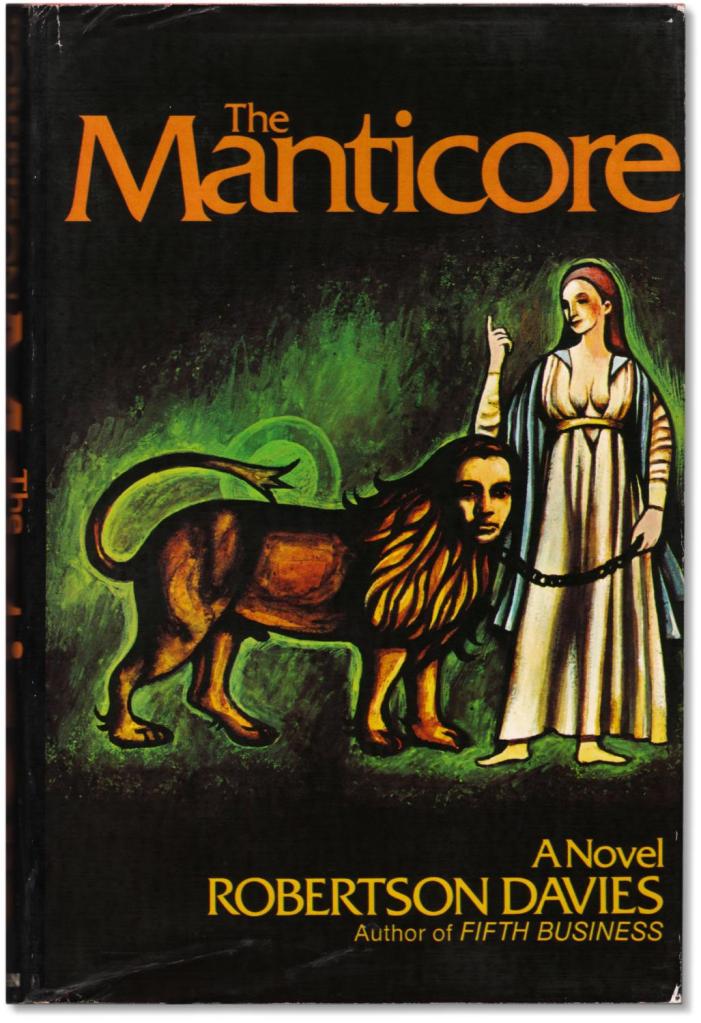
DARREN: Open question – which mythological figure has the head of a man, the body of a lion, and the tail of a scorpion? Here’s a hint – it’s also the title of a novel by Robertson Davies.
RORY: Oh, manticore.
The manticore is a Persian mythological creature with a human head, body of a lion, and a tail of venomous spines – some depict it as like porcupine quills, while others give it a scorpion tail, as Darren says. There are some accounts that the spines can be shot like arrows, making the manticore a lethal predator. It devours its prey whole, using its triple rows of teeth, leaving no traces of its victim behind. Its name comes from the Persian for “man eater”.
The Manticore is a 1972 novel by Canadian author Robertson Davies. It is the second volume in his Deptford Trilogy, three interrelated works set in the fictional town of Deptford, Ontario. The plot of The Manticore revolves around themes of Jungian psychology and psychoanalysis, and the journey towards becoming fully human.
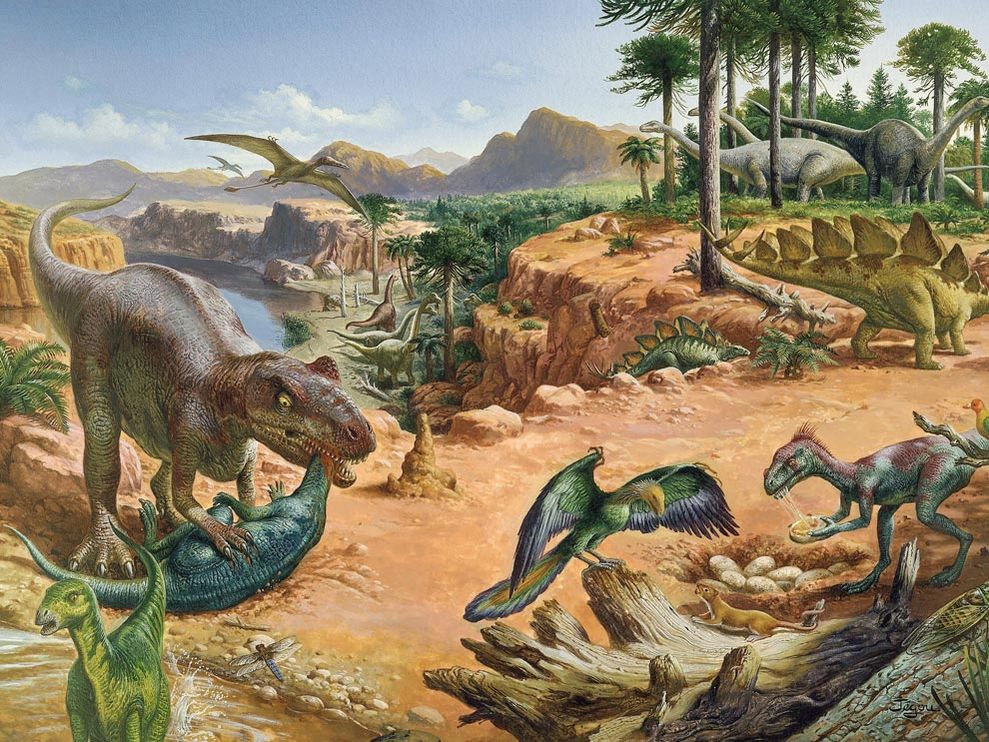
DARREN: Jennifer, can you give me the three sub-classes of the Mesozoic Era?
JENNIFER: Triassic, Jurassic, and Cretaceous … Follow-up – what preceded the Mesozoic Era?
DARREN: Paleozoic.
The Mesozoic Era is the second-last era of Earth’s geological history, lasting from 252 to 66 million years ago, and comprising the Triassic, Jurassic, and Cretaceous periods. It is sometimes called the Age of Reptiles of the Age of Conifers, and is characterised by the dominance of dinosaurs, an abundance of conifers and ferns, a hot greenhouse climate, and the tectonic breakup of the supercontinent Pangaea. The name Mesozoic means “middle life” in ancient Greek.
The Paleozoic Era came before the Mesozoic Era, the earliest of the three eras of geological history, with a name meaning “ancient life”. It was a time of dramatic geological, climatic, and evolutionary change, seeing an explosion of new species emerging, and life beginning in the ocean, but transitioning to the land.

DARREN: So, Lorelai, what’s your alma mater?
Alma mater, a Latin phrase used to identify a school, college, or university that one has attended or graduated from. It literally means “nourishing mother”, as if the student has gained intellectual nourishment from their school. It is related to the word alumnus, previously discussed – alumnus literally means “one who is nourished”.
The Latin phrase was originally a title for mother goddesses such as Ceres and Cybele, later given as a title to the Virgin Mary. It was first used academically in the English-speaking world in 1600, referring to Cambridge University, as part of the emblem for Cambridge University Press. You can see in the picture it was portrayed quite literally, with milk pouring out from the breasts of Cambridge – the milk of knowledge, I suppose.
DARREN: Putting us out? Today you are the Springsteen family’s raison d’être.
Raison d’être: French expression commonly used in English, meaning “reason for being”. Darren is saying that just for today, his family only exist to get to know Rory and assist her.
Darren Springsteen is portrayed by Granville Van Deusen, who, amongst other roles, played Keith Dennison on soap opera The Young and the Restless from 1997 to 2001.

RORY: Ish Kabibble.
Ish Kabibble, born Merwyn Bogue (1908-1994), comedian and cornet player. He appeared in ten films between 1939 and 1950, and although his stage persona was a gangly goofball, he was also a notable cornet player. He performed with bandleader Kay Kyser, and was the manager for the Kay Kyser Orchestra. After the band broke up in 1950, he worked as a solo act until 1961, when he became a real estate agent. He has become an icon of American comedy, often referenced in popular culture.
His stage name came from the lyrics to one of his comic songs, “Isch ga-bibble.” It’s a mock-Yiddish expression, supposedly meaning, “I should worry?”. In fact, it isn’t Yiddish at all, although there’s a Yiddish phrase nisht gefidlt meaning “it doesn’t matter to me,” from which the term “isch ga-bibble” may have been derived.
I’m not sure if Rory is simply answering one name from Jewish culture with another, or if she is literally saying, “I’m not worried”, or “It doesn’t matter right now”.

LORELAI: So, alumna is a girl graduate … And alumnus is a man … And plural is alumni.
RORY: Right, and that can be girls and guys.
A quick run-down on the correct usage of the Latin word alumnus – all terms used more commonly in the US than in other countries.
An alumnus is a man who has graduated from a particular institution, such as “a Harvard alumnus”, while a woman in the same position is an alumna. The plural is alumni, which can be either a group of male graduates, or a group of both males and females. The plural of only female graduates is alumnae. There is also alum – which is a gender neutral term that doesn’t get used as much, but may become more common in the future.

LUKE: Do they let kids drink coffee before school?
RORY: Why, do you think it might lead to harder stuff? Lattes, cappuccinos . . .
Latte [pictured]: Caffè latte, shortened to latte in English. Coffee style from Italy made with espresso and steamed milk; the Italian word literally means “coffee and milk”. Part of European cuisine since the 17th century, the word caffè e latte was first used in English by American writer William Dean Howells in 1867, after a visit to Italy. The “latte” as an American-style coffee drink is said to have been “invented” in Berkeley in the 1950s and popularised in Seattle in the 1980s.
Cappuccino: Previously mentioned as a favourite of Rory and Lorelai. Espresso-based coffee drink prepared with steamed milk foam; typically smaller than a latte with a thicker layer of foam. The name comes from the Capuchin friars of the Catholic church – their habits are the colour of cappuccinos. The drink appears to be Viennese in origin, dating to the 18th century, and spreading through Europe from the port city of Trieste. It doesn’t seem to have been taken up in Italy until the 1930s, but it was through Italian-American neighbourhoods that it was spread in the US. It only seems to have become popularised there in the 1990s.
 The Annotated Gilmore Girls