PARIS: [on phone] Hola, es Paris. Voy a comer la cena de cas de Rory. Hay mucho mac and cheese!
Paris’ nanny is Portuguese, yet Paris speaks Spanish to her here (is Nanny bilingual? Why can’t she speak English?).
She says, “Hi, it’s Paris. I’m going to eat dinner at Rory’s house. There’s a lot of mac and cheese!”.
She doesn’t translate “mac and cheese” into Spanish, which would be macarrones con queso. Probably because American mac and cheese feels like a completely different dish to what a Spanish-speaker would be expecting, unless she couldn’t think of the right word for it.
We open with the diner in disarray, because Luke’s apartment that he bought in the previous episode is still under construction. In real life, it usually takes months for the sale of a property to go through so you can begin work on it, but this is television, and Luke is already in the middle of renovations.
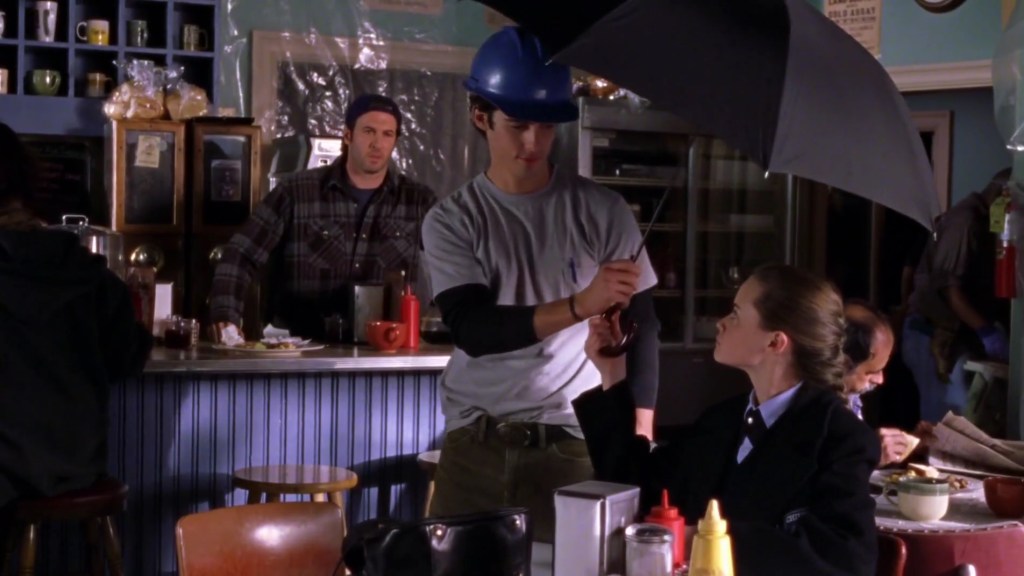
Jess, wearing a construction helmet, chivalrously brings Rory an umbrella to shield her from the mess. Although Luke gets cranky about Jess making fun of the situation, the umbrella saves Rory from being hit by debris just a minute or so later.
This is the first official sighting of Tom the Contractor, although it is the same actor (Biff Yeager) who played Tom who was the foreman at Rebuilding Together in Hartford where Rory did volunteer work. They have the same name and personality, and obviously look the same, so it seems perfectly possible that they are actually the same character. This is never confirmed, however.
It’s not clear how much time has passed since the previous episode, but Luke complains to Tom about the renovation taking another week, and in 2002 Easter was at the end of March, so perhaps three weeks have gone by and it’s now early April (Thursday 4th April). I won’t be able to keep blog entries in step with events in the show, or I will run out of time. Time gets very stretchy in the last few episodes of the season!
LORELAI: So, are you a healthy eater like Luke? JESS: No. No one’s a healthy eater like Luke. Euell Gibbons wasn’t a healthy eater like Luke … Many parts of a pine tree are edible.
Euell Gibbons (1911-1975), outdoorsman and early health food advocate. He promoted eating wild food during the 1960s, having begun foraging for food as a teenager to supplement the family diet. His books on wild food were instant successes, and he became a celebrity, appearing on TV shows such as The Sonny & Cher Comedy Hour, and The Carol Burnett Show, often good-naturedly sending himself up by pretending to eat wooden plaques and so on.
A 1974 television commercial for Grape-Nuts cereal featured Gibbons asking viewers “Ever eat a pine tree? Many parts are edible.” While he recommended eating Grape Nuts over eating pine trees (Grape Nuts’ taste “reminds me of wild hickory nuts”), the quote caught the public’s imagination and fuelled his celebrity status.
How Jess knows about Euell Gibbons and the advertisement, which was broadcast ten years before Jess was born, is a mystery. Teenagers seem to have an amazing knowledge of 1960s and 1970s pop culture in the Gilmore Girls world.
DEAN: You go look at the astronomy section, we’ll go see Lord of the Rings, and on the way home we’ll rent Autumn in New York and mock it for the rest of the afternoon.
Autumn in New York is a 2000 romantic drama directed by Joan Chen, and starring Richard Gere as a middle-aged womaniser who falls in love with a sweet young woman who is terminally ill, played by Winona Ryder.
The film received negative reviews, being judged as sappy with no chemistry between the two romantic leads, although Chen’s direction did receive some praise. It was nonetheless a success at the box office. The film was released on DVD in January 2001.
Although I think Rory would mock the film roundly, it has enough parallels with her relationship with Jess to also be uncomfortable viewing for her. The main characters share a love of poetry, just as she and Jess share an interest in literature, and there are references to Rory’s favourite poets, Emily Dickinson, Dorothy Parker, and Edna St. Vincent Millay.
There is a major plot point in the film where the young woman takes her lover’s watch as a keepsake, telling him she will return it when he no longer notices it is gone. This is quite similar to Jess taking Rory’s bracelet, and returning it – except he will return it when Rory notices it is missing.
Dean has proposed what sounds like an exhaustingly lengthy afternoon: hours looking at books, a three hour movie at the cinema, and then a 90 minute video “for the rest of the afternoon”. Just how long is this afternoon? It’s early spring, it gets dark early!
Dean’s plan apparently comes to nothing when he notices that Rory isn’t wearing her bracelet. Instead of simply telling him the truth, that she didn’t notice it had fallen off, she tells him a silly lie about having a rash on her wrist, possibly caused by her Spanish mid-terms (!), and needing to temporarily remove the bracelet.
Even though this version of events wouldn’t stop Rory watching movies, she instead spends the afternoon searching the entire town for her bracelet. Again, it would have made more sense for her to have been honest, said that she lost the bracelet somewhere (for all she and Dean know, it fell off that very day), and needs to look for it.
It’s never said how she managed to cancel all her plans to spend the day with Dean to look for her bracelet without confessing it was lost, or raising his suspicions.
Rory buys several books at the fundraiser, but only a couple of the titles are visible. Gypsy the mechanic is volunteering her time to work at the fundraiser, and she points Rory to the astronomy section, as if Rory has an interest in this area, and Gypsy somehow knows about it. Both quite surprising things to learn! The Buy a Book Fundraiser is held outside the library, and may be raising funds for new books.
Inherit the Wind
A 1955 play by Jerome Lawrence and Robert E. Lee, fictionalising the events of the Scopes “Monkey” Trial. This was a legal trial in July 1925 where schoolteacher John Scopes was taken to court by the state of Tennessee for teaching human evolution. There was intense media scrutiny of the case, with publicity given to the high-profile lawyers who had taken the case. The prosecution had former Secretary of State, William Jennings Bryan, while Clarence Darrow defended Scopes – the same lawyer who had defended child murders Leopold and Loeb, previously discussed. Scopes was fined $100, but the case was overturned on a technicality. The case was seen as both a theological contest, and a test as to whether teachers could teach modern science in schools.
The play gives everyone involved in the Scopes Trial different names, and substantially alters numerous events. It is not meant to be a historical account, and is a means to discuss the McCarthy trials of the 1950s, where left-wing individuals were persecuted as Communist sympathisers, under a regime of political repression and a fear-mongering campaign.
Rory might be particularly interested in the play because of the focus it places on the media, with reporter E.K. Hornbeck covering the case for a fictional Baltimore newspaper. He is based on journalist and author H.L. Mencken, previously discussed as one of Rory’s heroes, who gained attention for his satirical reporting on the Scopes Trial for the Baltimore Morning Herald.
Inherit the Wind premiered in Dallas in 1955 to rave reviews, and opened on Broadway a few months later with Paul Muni, Ed Begley, and Tony Randall in the cast. It’s been revived on Broadway in 1996 and in 2007, as well as in Philadelphia, London, Italy, and India.
It was adapted into film in 1960, directed by Stanley Kramer, and with Spencer Tracey starring as the defence lawyer, Dick York as the schoolteacher, and Gene Kelly as the Baltimore journalist. It received excellent reviews and won awards at the Berlin Film Festival. It’s also been made for television in 1966, 1988, and in 1999 (starring George C. Scott, Jack Lemmon, and Beau Bridges). It seems likely that Rory watched the most recent version on television.
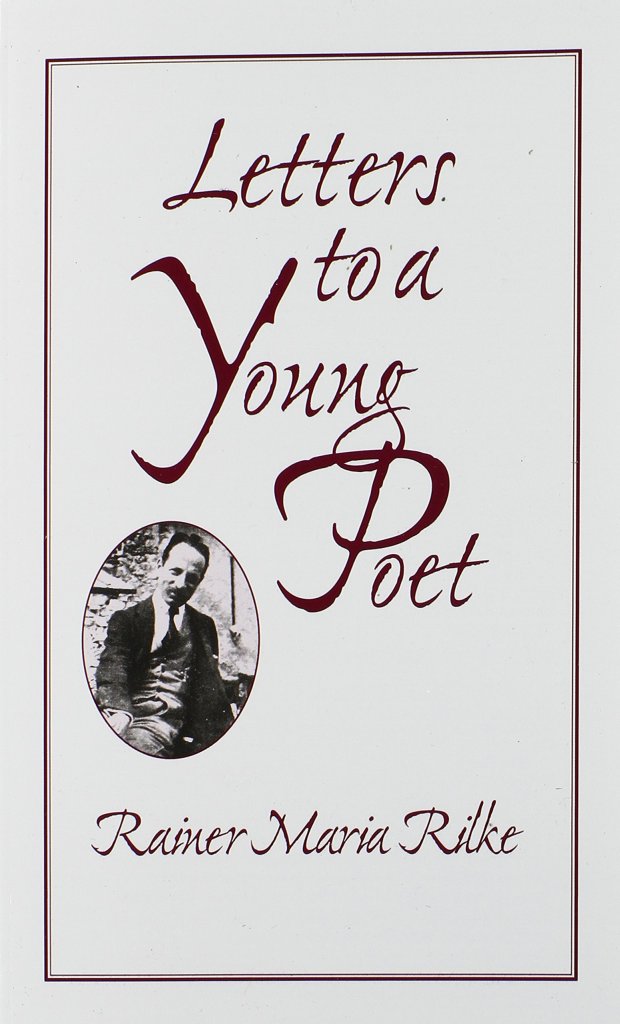
Letters to a Young Poet
A 1929 collection of ten letters written by the Bohemian-Austrian poet Rainer Maria Rilke, to a young officer cadet named Franz Xaver Kappus at the Theresian Military Academy in Wiener Neustadt, Austria between 1902 and 1908.
Kappus had written to Rilke, seeking advice on the quality of his poetry, to help him choose between a literary career, or one as an officer in the Austro-Hungarian Army. Kappus had been reading Rilke’s poetry when he discovered that Rilke had earlier studied at the academy’s lower school in St. Pölten, and decided to write to him for advice.
Rilke gave Kappus very little criticism or suggestions on improving his writing, and said that nobody could advise him or make life decisions for him. Over the course of ten letters, he instead provided essays on how a poet should feel and seek truth in experiencing the world around him. They offer insights into Rilke’s poetic ideas and themes, and his work processes.
Kappus did meet Rilke at least once, and despite his concerns about pursuing a military career, he continued his studies and served for 15 years as an army officer. During the course of his life, he worked as a journalist and reporter, and wrote poems, stories, novels, and screenplays. However, he never achieved lasting fame.
This is a book which features a future journalist – but one who yearns to become a poet. Is it a sign that Rory secretly wishes she could become a creative writer instead? Is she hoping that being successful in journalism will help her become a published author (it’s definitely a help in getting novels published, or at least considered). Is it even a hint that she will become a writer in the future, as she does in A Year in the Life, but is not destined to become famous from her writing? (Most published writers, even quite successful ones, don’t get famous, after all).
And is this correspondence between a poet and a student at a military academy meant to suggest that Rory is still thinking of Tristan, who went away to military school? Are she and Tristan actually writing to each other, or is the show leaving the door open for Tristan to possibly return in a future season, since they didn’t know how long One Tree Hill was going to last?
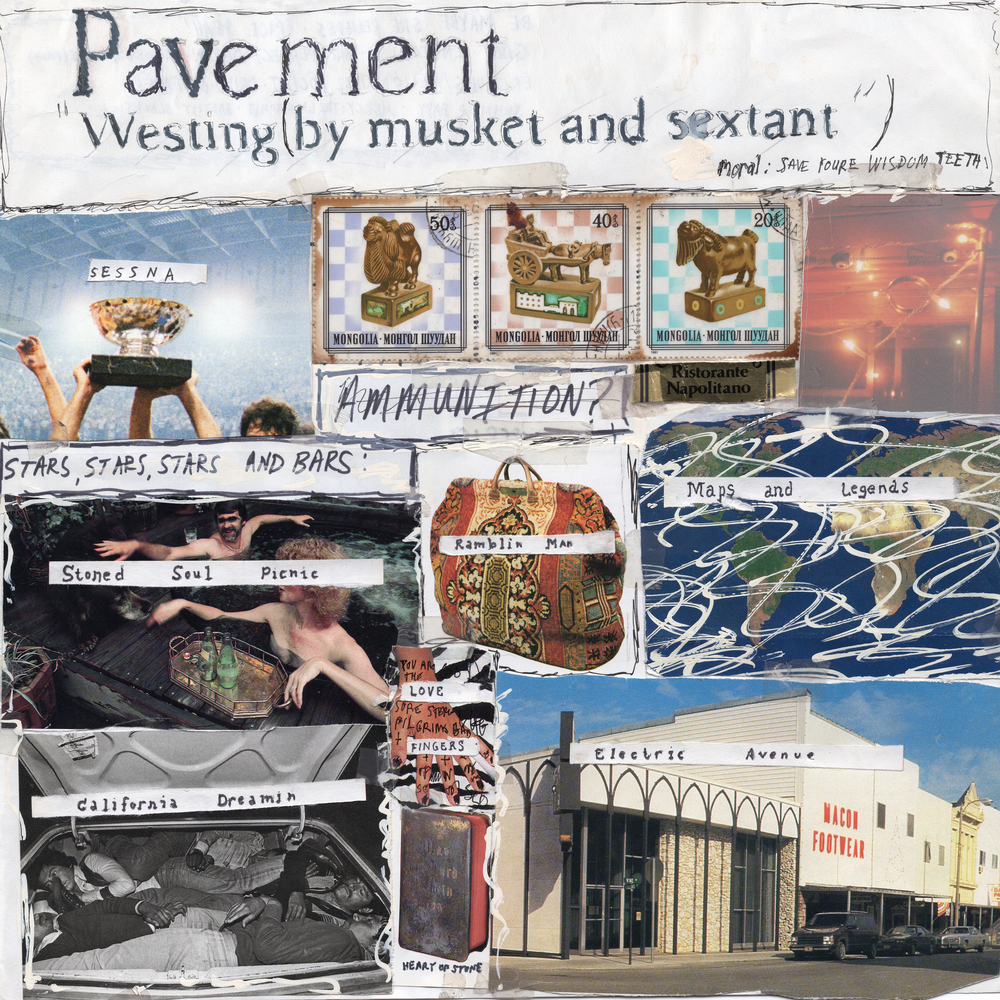
This is the music that Jess is sleeping to when Luke wakes him up. Price Yeah!, is by the American indie rock band Pavement, first released on their EP Slay Tracks: 1933-1969 in 1989. The EP was self-recorded, and is experimental hard-core punk.
The band were partly inspired by their home town of Stockton, California, a place they considered flat and boring that they wanted to escape from – something that Jess can probably relate to.
Being an extremely limited release, copies of this EP quickly became collector’s items selling for hundreds of dollars. Jess is most likely listening to Westing (By Mustang and Sextant), a compilation of Pavement’s early EP’s and singles which was released in 1993.
The song begins:
Just cause I’m fakin’ Doesn’t mean I’m wrong Cause I bought my price, yeah, No I got it at cost
And there’s the things I know Wrote them down on your nib Just remember turning It’s a rapid affair
Jess knows that he is faking it – but is he faking by hiding his true level of misery from Luke and the town, or is he faking by pretending to be less interested in Rory than he makes out? He’s aware of the price he is paying, but considers it worthwhile. The “rapid affair” may allude to how quickly he fell for Rory, and the things he wrote down to the annotations he made in Rory’s book.
Jess says he needs loud music on in order to sleep. Possibly he got into that habit needing to block out the sound of his mother partying or entertaining guests. Or even the sound of Liz having sex or fighting with her companion of the moment. Or they just lived in an apartment block where there was a lot of noise from other people, and little insulation against it.
Either way, it’s a sign that he didn’t have the best environment growing up. Unless he simply hasn’t adjusted to the quietness of the country after living in New York?
If Jess always needs loud music in order to sleep, how on earth has poor Luke been able to get any sleep? For that matter, why is he surprised to learn about it now? Has he just been gritting his teeth for six months and working long days on little sleep, and this is the final straw? And why haven’t any of their neighbours complained?
Rory has co-opted Kirk and Michel to help her with the CD drop off to Lane. While Kirk distracts Mrs Kim with idle chit-chat, it is Michel’s task to jog past, secretly slipping the CD into Lane’s bag. Unfortunately, Rory forgot to tell Michel about the revised time, so the poor man was left to jog around the square for an hour waiting for Lane to show up. He is understandably miffed.
Roping Kirk into a zany scheme is a natural choice, but it’s a surprise that Michel, who can barely be bothered doing his actual job some days, is apparently willing to help Rory and Lane out like this in his free time. Perhaps he always goes jogging on Saturday morning anyway, but even so he stuck it out for over an hour until everyone else arrived. Lord knows how Rory managed to persuade him.
I feel as if the writer, Daniel Palladino, was almost forced to choose Michel as the only person in Stars Hollow who is young and fit enough to be credibly kept jogging for an hour. It’s interesting that Rory never considers asking her boyfriend Dean to be involved. Maybe he works on Saturday morning.
If this scene does connect with the Elton John song “Rocket Man“, then Michel is in the role of the “rocket man” who is “lonely out in space on such a timeless flight”, and “burning up his fuse out here alone”. And as he feared, “I think it’s gonna be a long, long time”!!!!!
RICHARD: Uh, what does [Sherry] do? Does she work? CHRISTOPHER: Uh, she’s the East Coast sales rep for L’Oreal Cosmetics.
L’Oreal is a French beauty product company headquartered in Clichy, France, with a registered office in Paris. It is the largest cosmetics company in the world. It was founded in 1919 by chemist Eugène Schueller.
The US headquarters of L’Oreal are in New York City, but they certainly employ sales reps in Boston. Christopher says Sherry is the sales rep for the East Coast, as if they have only one! I’m pretty sure Sherry is only a sales rep for L’Oreal. Christopher loves to talk everything about himself up.
This does bring into question whether this business trip is really for Christopher, or was it for Sherry’s work? It seems like it’s actually her job that would involve travel, not his. Bearing in mind his comment about eating at White Castle (which is in New York), it could be that they were in New York for Sherry’s business, then decided to spend the weekend in Connecticut to see Rory. In which case, they could be staying as close as Woodbury, making their travel time to Stars Hollow even more achievable.
EMILY: So how long have you been with this woman? CHRISTOPHER: Eight months.
Christopher has supposedly been going out with Sherry since July 2001. Something he didn’t bother sharing with Lorelai and Rory until nearly three months later – and only then because they contacted him. Without Lorelai calling him, would Christopher have remained in contact with them at all, or disappeared to Boston to lead a new life with Sherry?
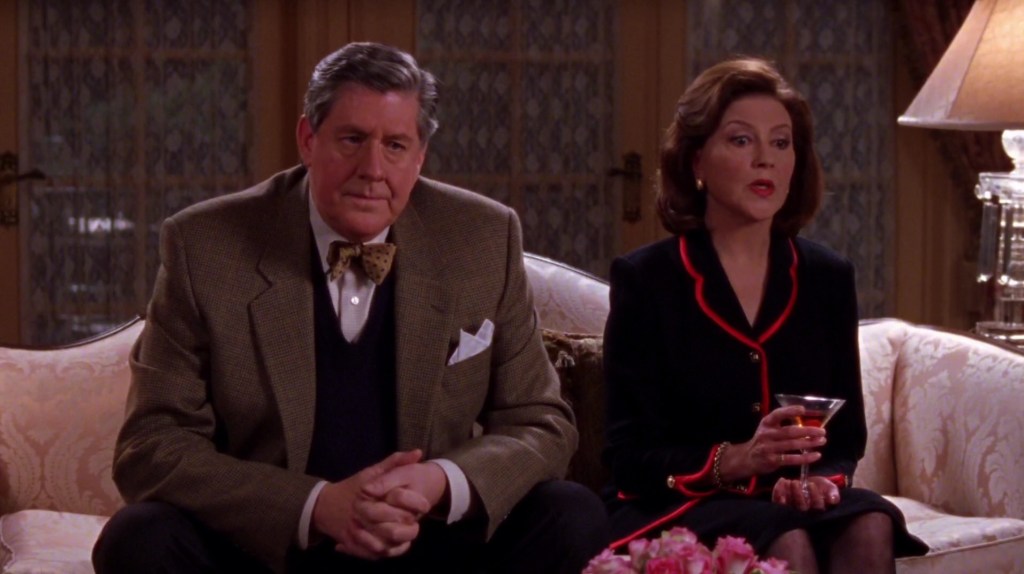
RICHARD: Uh, you wanna narrow that [drink order] down for me? LORELAI: Hooch is hooch, Dad.
Hooch is old-fashioned American slang for hard liquor, which became common during the 1920s and the Prohibition era. It originated in the 19th century, and comes from the Hoochino Indians of Alaska. One small tribe, who called themselves the Hutsnuwu, had a reputation of brewing their own illicit alcohol which was extremely potent (presumably the information on making spirits was taught to them by Europeans, but nobody knows for sure).





 The Annotated Gilmore Girls