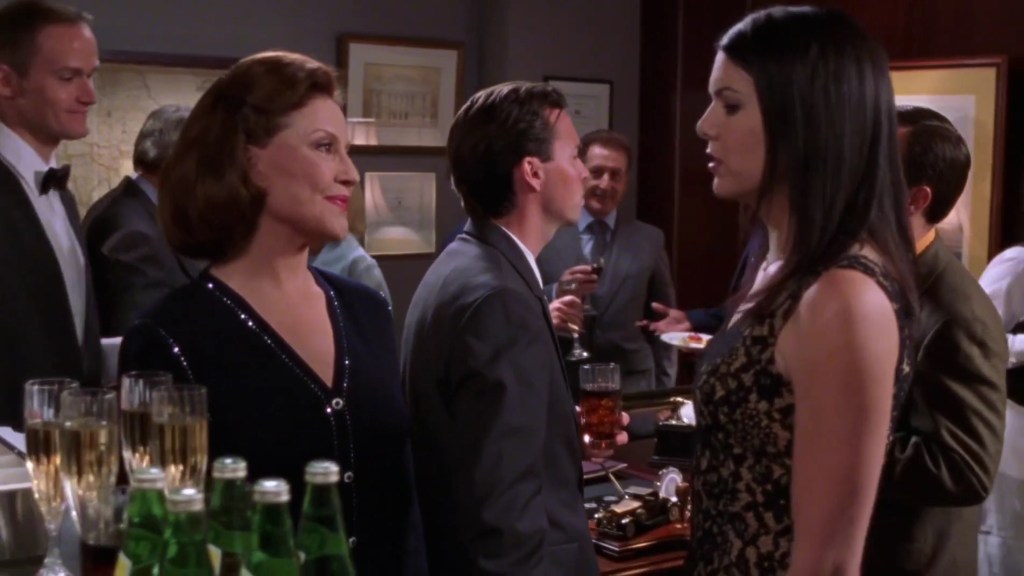
EMILY: I scaled back a lot. I cut two appetizers, I canceled the champagne fountain, and I reduced the catering staff to six servers, not counting the pointman.
Technically a pointman is the head of a military patrol, or in the US, the word is used to mean the person who is at the forefront of a particular endeavour. I think Emily just means the pointman is the person who is coordinating the party and giving the servers instructions, solving any little problem that might come up.
LORELAI: Well, you scheduled this beer bash during rush hour.
A beer bash is slang for an informal party, often organised in the context of a university or office social event. It seems to be used particularly in Commonwealth countries like Canada, and doesn’t appear to be common in the US. Emily doesn’t rise to the bait of having her corporate event described as a “bash”.
Rush hour, the name given to the time of day when traffic is heaviest, the times of day when most people are going to or from work. Unlike its name, it usually lasts more than an hour, and far from rushing, traffic is generally slow.
LORELAI: So you’ve been just Nanooking it this whole time, just sending out for whale blubber and mukluks? [adjusts thermostat]
Nanook of the North [pictured], a 1922 silent film documentary/docudrama written, produced, and directed by Robert J. Flaherty. The film follows the struggles of an Inuk man named Nanook, his wife Nyla, and their family as they travel, trade and search for food in the Canadian Arctic. They are shown hunting a walrus, building an igloo, and going about their everyday tasks. Nanook and his family are portrayed as fearless heroes, enduring rigours beyond the comprehension of most Westerners.
The film has been criticised for fictionalising events and presenting them as reality. For example, “Nanook” was really named Allakariallak, and Nyla (aka Alice) was not his wife, but one of Flaherty’s common-law wives. The cast were scripted to behave in a more “authentic” Inuit way, such as using traditional hunting weapons rather than guns, and acting as if they had little knowledge of Western culture. Many things had to be staged, because of the difficulties of filming with one fixed camera in a harsh environment.
Nanook of the North was ground-breaking cinema, capturing authentic details of a culture that was then little known to outsiders, and filmed in a remote location. Hailed unanimously by critics, it was also a box-office success, and is still viewed as an enthralling documentary. As the first full-length feature documentary to achieve financial success, it paved the way for the entire genre. Nanook of the North was remastered and released on DVD in 1999, so Lorelai and Rory could have actually seen it.
Whale blubber is an important part of the traditional diet of Inuit people, valued for its high energy value, nutritional content, and availability. Mukluks are soft boots, traditionally made from caribou hide or sealskin, worn by the Indigenous people of the Arctic.
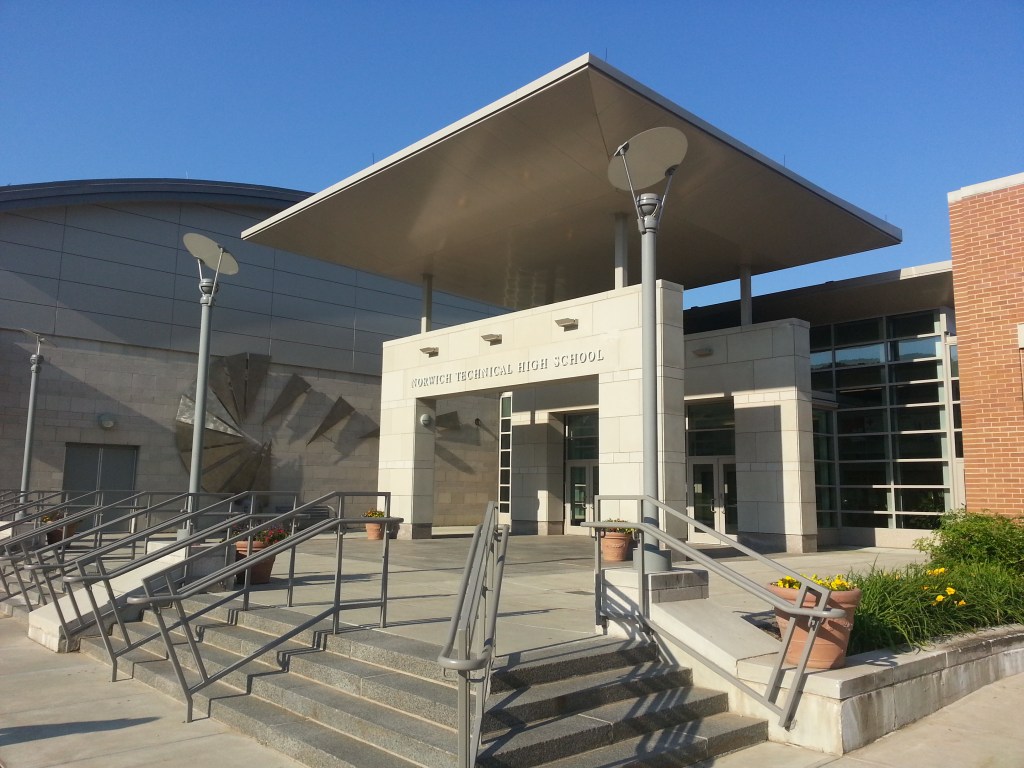
LUKE: Me? Oh, no, I’m not the one you want helping him. I went to this school – I’m sure there’s still a note stuffed in there about me with the words ‘trade school’ stamped in really big letters.
Trade school is a term in the US for a vocational college, technical school, or technical college, offering training in skills for specific job or career. In the US, they are government owned or supported, and require two years of study to fulfil requirements; they can sometimes replace the final two years of schooling. The number of such trade schools is declining significantly, but even so Luke would have had the choice of more than a dozen trade schools in Connecticut if he had wanted to attend one.
PARIS: I’m sorry, group leader, could you ask the Pigeon sisters if there is a point to this opus?
The Pigeon sisters are characters from the film The Odd Couple, previously mentioned. They are English sisters named Cecily and Gwendolyn Pigeon who live in the same building as Felix and Oscar. They were played by cousins Monica Evans and Carole Shelley in the original Broadway play, the film, and the 1970 sit-com, although their roles were gradually phased out in the television show.
The Pigeon sisters are friendly, flirtatious, ditzy, and as their name suggests, slightly bird-brained, rather like Louise and Madeline. Paris has no problem tearing down her friends in public; no wonder that Rory isn’t sure whether Paris is her friend or not.
An opus is an artistic work, especially one on a grand scale.
PARIS: Well, she’s all we’ve got so you need to do whatever it takes to make it happen, otherwise maybe you shouldn’t be the group leader.
LOUISE: A coup d’état, how exciting.
A coup d’état (French for “blow of state”), is the sudden violent overthrow of an existing government by a rival faction in an illegal seizure of power.
LUKE: So I got a Yellow Pages and I found the Big and Tall Casket Shop in Hartford.
The Yellow Pages are phone books which are for businesses, as opposed to the residential White Pages. They were originally printed on yellow paper, and came about in 1883 in Cheyenne, Wyoming, when a printer ran out of white paper and had to use yellow instead. The name and concept are now used globally.
In real life, Hartford does not have a Big and Tall Casket Shop, although it is certainly possible to order extra-large caskets for large people (or medium size people who want to be buried with all their worldly goods).
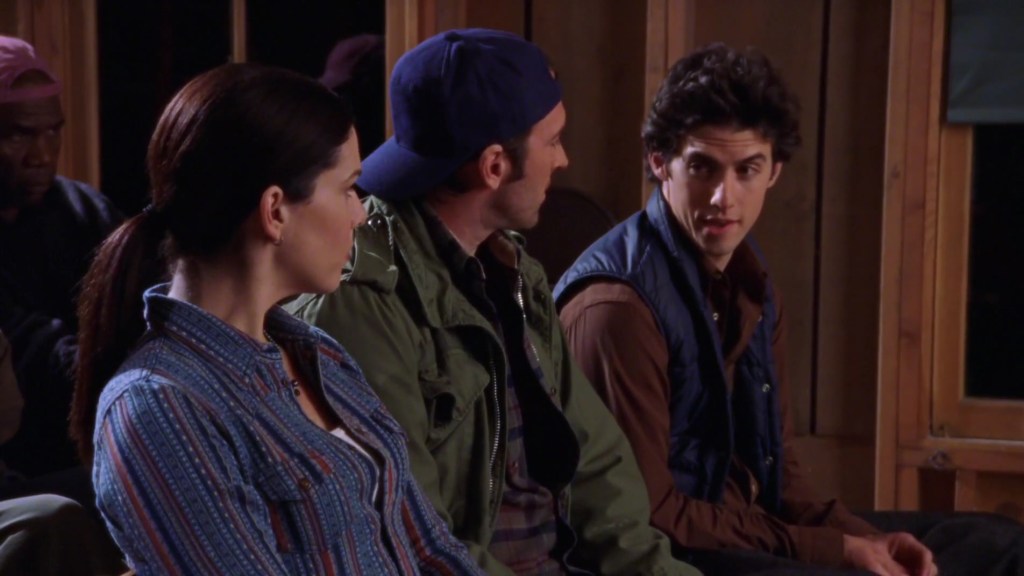
RORY: What are you doing here anyhow? This is a town meeting for people who participate in and care about the town.
JESS: Well, Corky’s Country Cavalcade on public access was pre-empted, so I thought I’d check out the next best thing.
Corky’s Country Cavalcade, a fictional rural television program Jess has sarcastically invented to suggest that the town meeting is the closest real world parallel. Coming to a town meeting might mean that Jess does feel more connected to Stars Hollow since Rory has nagged him into helping out at the diner more at a time of family crisis, or that he wants to lend Luke some support. Or he might just want another chance to see Rory … his expression says he does. (Remember when Dean turned up to a town meeting just to see Rory?).
In North America, pre-empted is used in broadcasting to mean that a regular scheduled program has been interrupted or replaced.
TAYLOR: Well, FYI Van Halen hair, I’m plenty busy.
Van Halen, rock band formed in Pasadena, California in 1973, with a classic line-up of brothers Eddie and Alex Van Halen and lead singer David Lee Roth. Credited with restoring hard rock to the forefront of the contemporary music scene, they were known for their energetic live shows, and the virtuoso lead guitar of Eddie Van Halen. Their 1978 self-titled debut album went straight into the Top 20 and sold over 10 million copies in the US. By the early 1980s they were one of the most successful rock acts of their day, although only one of their singles, “Jump”, went to #1, in 1983.
The band members of Van Halen had long hair during the 1980s, with David Lee Roth’s golden mane to the forefront.
TAYLOR: That’s Babette with an armload of rutabagas.
Rutabaga (Brassica napus) is the common US term for the winter root vegetable which is often called a swede in much of England, Australia, and New Zealand, a neep in Scotland, or a turnip in some parts of England, Ireland, and Canada. In some parts of the US, this vegetable may be known as a Swedish turnip or a yellow turnip.
Rutabagas are believed to have originated in Scandinavia or Russia, and were introduced to Britain in the late 18th century, coming to North America in the early 19th century. They aren’t widely eaten in the US, but may be found in stews and casseroles, or served mashed with carrots. They are often found in the New England boiled dinner, a traditional meal of corned beef with cabbage and root vegetables.






 The Annotated Gilmore Girls