The Fight Between Paris and Rory

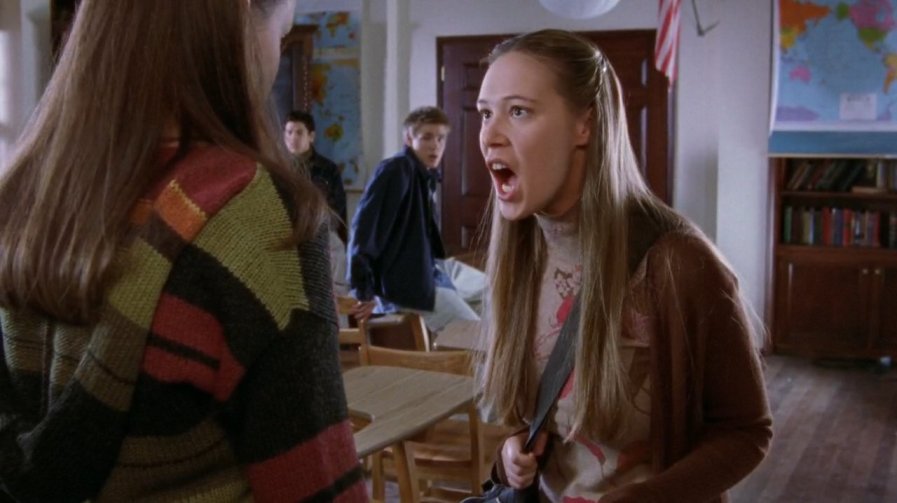
Paris finds out that not only does Tristan not want to date her again, even though their evening together seemed to go fairly well, but that it was Rory’s idea that he ask her out. She immediately throws a fit, accusing Rory of giving Paris her “cast offs”, so she’s obviously been quite aware of Tristan’s attraction to Rory.

Whenever Paris and Rory seemed to be becoming friends, something would happen to ruin it. Of course Rory could never do anything to hurt Paris, and would instantly forgive her whenever she hurt Rory, so the only way it could happen was for Paris to behave in a completely insane way, where she got angry over almost nothing, and would hold a grudge about it for an inordinate time.

“Let them eat cake”

PARIS: God, this is so weird. I can’t stop smiling.
RORY: Good, then it’s a good time to talk about our over-taxed peasants.
PARIS: Oh, let them eat cake.

Paris is referring to Marie Antoinette, the wife of King Louis XVI, and the last queen of France before the French Revolution.

“Let them eat cake” is a phrase popularly ascribed to Marie Antoinette upon being told the peasants were starving and had no bread to eat. The phrase supposedly demonstrates either an indifference to their plight, or a complete lack of understanding of it. It doesn’t fit with what we know of Marie Antoinette, who was quite concerned with the poor, and donated generously to charitable causes.

She almost certainly did not say it. It comes from Jean-Jacques Rousseau’s Confessions (1782), where he mentions a “great princess” who once said it. Not only does he not name the princess, but that part of his autobiography covers the years when Marie Antoinette would have been a little girl in Austria. He may have invented the anecdote entirely.

“Women shouldn’t drive”

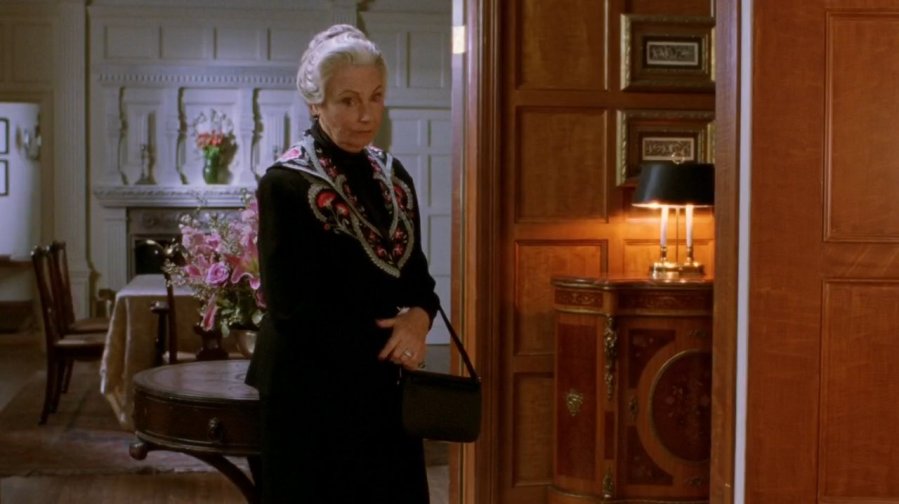
TRIX: I’ve ordered a car; women shouldn’t drive. Are you ready? [heads for the door]

Trix told Lorelai that she approved of her working, which she thought was good for a woman. However, she apparently doesn’t think women should drive. I guess they should only get jobs on a public transport route, or within walking distance.

It’s also not clear why Trix needed to order a car – in Love and War and Snow, Emily sent their chauffeur (?) Lance to pick Rory up from school. Did they sack Lance, or is Sunday his day off?

Whore of Babylon

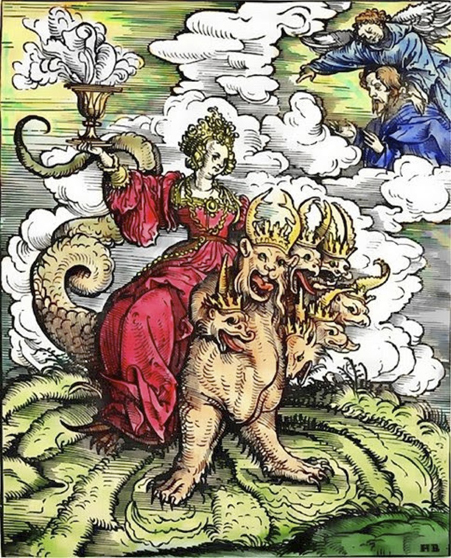
EMILY: I don’t care if she [Trix] demeans me and looks down on me. I don’t care if she thinks I’ve tarnished the Gilmore name. I don’t care if she thinks I’m the Whore of Babylon.

The Whore of Babylon is is a mythological female figure mentioned in the book of Revelations in the Bible. Her full name is given as Mystery, Babylon the Great, the Mother of Harlots and Abominations of the Earth. This is handily written on her forehead, presumably in fairly small writing so it can all fit.

This “great whore” is described as lavishly dressed, drinking the blood of saints and martyrs in a jewelled cup, and sitting on a scarlet beast of blasphemy, with seven heads and ten horns. Revelations explains that the seven heads mean seven mountains and seven kings, while the ten horns are ten further kings who will receive power for a short time, while the woman stands for a great city which reigns over the kings of the earth.

The Great Beast is regarded as the Antichrist, and the Whore of Babylon is usually taken by biblical scholars to mean Rome, or the Roman Empire, with the seven mountains the seven hills of Rome. Many modern scholars point out that the Great Whore is more likely to be Jerusalem, which also sits on seven hills. The seventeen kings are quite unidentifiable in either case.

Although Emily takes the Whore of Babylon to be a sexual figure, which is the way most people probably understand it, the frank sensuality of the image is symbolic of blasphemy and pagan idolatry – the Bible often talks about “whoring after idols” when it means that people are chasing after false gods. (In other words, they are being unfaithful to God and their religion, like a bride cheating on her husband).

Gaslight

LORELAI: Hey – [looks at Sookie’s watch] Aw! No! I’ve got to go home.
SOOKIE: Why? What are you doing?
LORELAI: I have to change, and go to tea with Gran and the cast of Gaslight.

Gaslight is a 1944 mystery thriller film directed by George Cukor, and adapted from the successful 1938 play Gas Light by British dramatist Patrick Hamilton.

Set mostly in Edwardian London, the film is about a woman named Paula (Ingrid Bergman) whose husband Gregory (Charles Boyer) tries to convince her that she is going insane as part of a fiendish criminal scheme: one of his methods is to contintually turn down the gas lighting in the house and tell her that only she can see it flickering.

Because of the film, the term gaslighting now refers to a form of psychological abuse where the abuser gradually manipulates the victim into doubting their own sanity, thus making them more dependent on the abuser. Lorelai is saying that’s exactly what her mother is doing to her.

Gaslight was the #13 film of 1944 and well-received by critics. It won two Academy Awards, including a Best Actress for Ingrid Bergman.

According to the town clock they walk past, it is around 11.35 am when Lorelai and Sookie leave the flower shop. Lorelai seems to need an inordinate amount of time to get changed so she can be in Hartford for afternoon tea, which is usually somewhere between 4 and 6 pm.

“That annoying Cranberries song”

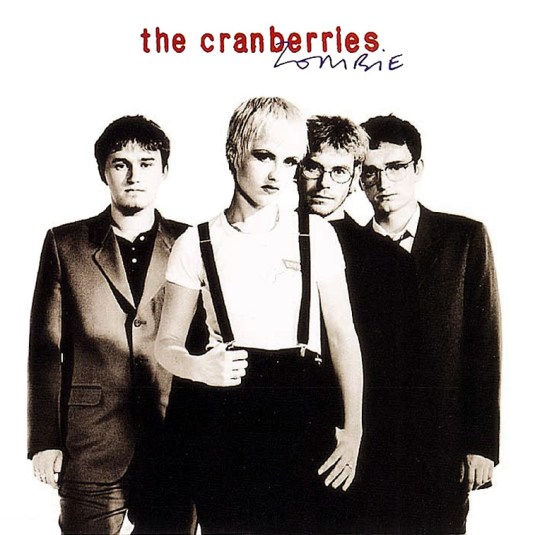
LORELAI: No, I mean – God I know this is crazy. I have my mother’s voice stuck in my head. It’s like that annoying Cranberries song.

Lorelai is probably referring to the 1994 protest song Zombie by Irish rock band The Cranberries. Written by vocalist Dolores O’Riordan, it is about the 1993 IRA bombings in England which killed two young children. Released as the lead single from their album No Need to Argue, it went to #32 in the US and #1 on the alternative charts, #3 in Ireland, and #14 in the UK. It went to #1 in several countries, including France, Germany, Denmark, and Australia.

Many people seem to hold Lorelai’s opinion that the song is “annoying” and an earworm that can easily get stuck in your head – the refrain keeps repeating, “in your head, in your head …”, which probably doesn’t help matters.

The song was re-released in an acoustic version in 2017 on their album Something Else, and still sold well, especially as a digital download. The music video for the original is one of the most popular on YouTube, so there must still be a lot of affection for it.

Since Dolores O’Riordan unexpectedly died in January this year at the age of 46, people have probably been a bit kinder toward the song.

“Faster than seventeen?”

LORELAI: It’s just that – you know, it’s about the freedom. I mean if I had access to all that money as a kid I would have left the house so fast.
SOOKIE: Faster than seventeen?

In fact we learn in the next season that Lorelai was actually eighteen when she left home in 1986. Originally the show seems to have decided it would happen in 1985, when she was seventeen and Rory almost one.

The Elephant Man

SOOKIE: She’s [Rory] like the most unmaterialistic kid in the world.
LORELAI: No, it’s not about what she would buy. I don’t care if she buys a house, or a boat, or The Elephant Man’s bones.

Joseph Merrick, often incorrectly called John Merrick (1862-1890) was an English man with severe facial and physical deformities who was exhibited at freak shows as “The Elephant Man”. He then went to live at London Hospital and became well known in society, even being visited by royalty. It is not known from which medical condition Merrick suffered, and DNA tests have been inconclusive.

His life story was depicted in a 1979 Tony Award-winning stage play, The Elephant Man, by Bernard Pomerance, and David Lynch did a film version in 1980, starring John Hurt in the title role.

In 1987, Michael Jackson, who had apparently related to Joseph Merrick after seeing the film The Elephant Man, reportedly offered the London Hospital one million dollars for Merrick’s bones, but the hospital refused to sell them. It seems to have been a story fabricated by Jackson himself to add to his “Wacko Jacko” persona. For some time, rumours persisted that Jackson actually owned the bones.

Cabaret

SOOKIE: Call her now. Ooh, page her, or page her and have her call my cell phone, and we can sing the money song from Cabaret. You be Liza, I’ll be Joel.

Cabaret is a 1972 musical drama film directed by Bob Fosse, and loosely based on the 1966 Broadway musical Cabaret by John Kander and Fred Ebb; this was adapted from the 1951 play I Am a Camera by John Van Drouten, and the 1939 memoir The Berlin Stories by Christopher Isherwood, which the play was based on.

Set in Berlin during the Weimar Republic of 1931, the film is about a young American named Sally Bowles (Liza Minnelli), and her bohemian life as a cabaret dancer at the Kit Kat Club. The musical shows the growing rise of the Nazi Party, as the club at first harrasses the National Socialists and then eventually allows them to dominate the audience.

The “money song” from the film is Money, Money, containing the refrain, “Money makes the world go round”. It’s sung by Liza Minelli and Joel Grey, who plays the Master of Ceremonies at the club, and acts as the storyteller of the film.

Cabaret was an immediate box office smash, and received rave reviews from critics as a completely different kind of musical – cynical, kinky, political, and bleak. It was the #7 film of 1972 and received eight Academy Awards, including Best Director, Best Actress for Liza Minelli, and Best Supporting Actor for Joel Grey. It holds the record for the most number of Oscars won by a film that did not win Best Picture. Cabaret is regarded as one of the best musical films of all time, and it turned Liza Minelli into a gay icon.

Cabaret was first released on DVD in 1998, so Lorelai and Sookie might have rented it quite recently.
“Those toasters”

LORELAI: She was asleep when I got home.
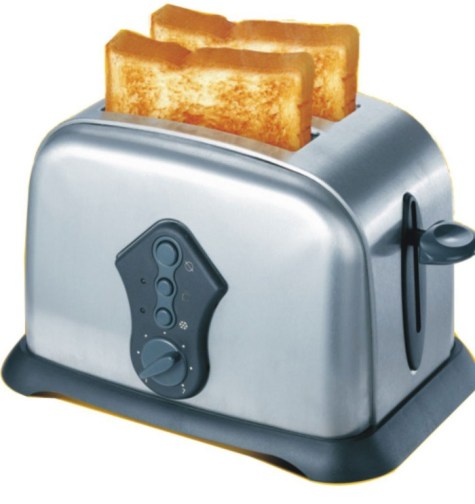
SOOKIE: Hi, for that much money you wake her up! You hire a singing telegram! Women jump out of cakes! People dress up like bankers and dance around with those toasters!

Decades ago, American banks would routinely give customers a free toaster or other small appliance when they opened a new account. It doesn’t happen any more, and was basically due to outdated regulations rather than any great generosity, but the free toaster has remained in pop culture as a humorous relic.