Luke’s Uncle Louie has died shortly before this episode opens, at the age of 85. Louie was the brother of Luke’s father, William Danes, and lived in Stars Hollow until he retired and moved to Florida. This episode focuses on Luke’s efforts to organise Louie’s funeral.
(The episode never says this, but it seems possible that Luke was given the name Lucas because it sounds similar to his uncle’s name of Louis).
LORELAI: Oh, no, it’s kind of slow here. So slow, in fact, that Michel and I were about to get the tetherball out.
Tetherball is a playground game where two players use their hands to hit a volleyball tethered to a metal pole by a rope. The game ends when one player manages to wind the ball all the way around the pole so that it is stopped by the rope. It must not bounce. An early variation was described in 1909, and the game was especially popular in the 1970s.
LORELAI: I’m gonna have to be deprogrammed by cult deprogrammers to get that Tuesday out of my brain.
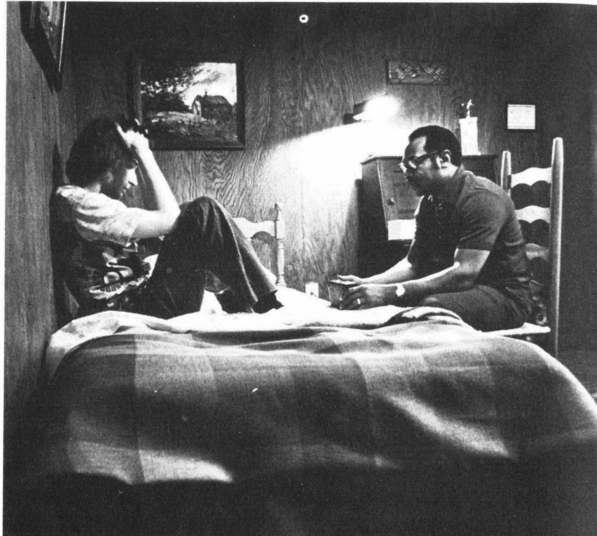
Cult deprogramming claims to assist people who have been “brainwashed” by new religious movements. Deprogramming was introduced in the 1970s by a high school dropout named Ted Patrick, who, despite having no qualifications or training, convinced people that he could rescue their loved ones from organisations and groups for $10 000. He had experience, having already removed his own son from the Children of God.
Essentially, deprogramming involves abducting the new convert, isolating him, physically restraining him and hitting him with a barrage of continuous arguments and attacks against his new religion, threatening to hold him forever until he agrees to leave it. Ted Patrick was tried and convicted of multiple felonies, such as kidnapping and unlawful imprisonment.
There is no evidence that deprogramming works – in fact, there is a higher rate of success from people naturally getting bored and dropping out of religious movements than there is from deprogramming. Members of the Church of Unification were particularly targeted by deprogramming efforts in the 1980s.
[Picture shows Ted Patrick trying to deprogram a young member of the Children of God].
In “Secrets and Loans”, Emily told Lorelai she would be holding her DAR meetings at the Independence Inn from then on. Here we learn that wasn’t an empty threat, because here we are months later, and the DAR are due the next Tuesday, at 3 pm. They seem meet on the second Tuesday of each month.
LORELAI: If you had your way, Mother, you’d lock us up like veal. That’s what she wants, veal children.
Veal is the meat of calves, rather than beef, which comes from adult cattle. In the past, many calves raised for veal in North America were raised in small crates, often tethered, which is what I think Lorelai means by keeping them locked up like veal. In the 2000s, this cruel practice began gradually to be abandoned in favour of slightly less cruel practices, and by 2017, all members of the American Veal Association raised their veal calves untethered in pens, not crates.
Note that Lorelai implies that both herself and Rory are Emily’s children, as if they are sisters, rather than mother and daughter, and as if Lorelai is still a child.
(Lorelai enjoyed a meal of ossobucco made by Max, a veal dish).
LORELAI: She had nothing to do with Jess coming over. Believe me, she did not want him there.
DEAN: That’s what she told me. And Rory wouldn’t lie, right?
As Lorelai and Dean assure each other that good, honest, pure Rory (the sweetest kid in the world) would never lie about wanting Jess, they watch through the window as Rory giggles and flirts with him while paying for breakfast.
Rory was certainly being truthful about not inviting Jess to the house, or even inviting him to dinner – he invited himself, and manipulated the situation so he could stay. But as for not wanting him there, actively wishing he hadn’t come? Well … if that wasn’t a lie to Dean, then she is definitely lying to herself.
And it’s going around, because Dean and Lorelai are desperately lying to themselves as well.
RORY: I don’t think Luke knew anything about the food last night … Which means you lied about why you came over.
Rory is positively delighted to discover that Jess came over with the food just because he wanted to. In her mind, she is only enjoying catching him out in a lie and watching him squirm, but on some level she must also be happy to know that Jess actively sought out her company for an evening.
LORELAI: Wow, he must’ve been crazy mad last night.
RORY: I’d say that was a fair assessment.
Apparently knowing that her daughter’s boyfriend was in an insane rage the night before isn’t something Lorelai feels she needs to worry about! And now Dean has taken Rory hostage for the entire day, and she has to have dinner with his family as well. Doesn’t she look thrilled about it?
LORELAI: I know, life with my mother, one step forward, five thousand steps back. It’s kinda like the spastic polka.
Spastic is an outdated term to describe people with cerebral palsy, a disorder often characterised by poor co-ordination, weak or stiff muscles, and tremors.
In America, using the words “spastic” or “spaz” to humorously describe awkwardness, clumsiness, hyperactivity, or nerdiness is not considered as shockingly offensive as it in other parts of the world. Lorelai’s comment here would be unacceptable in Britain, for example.
Polka [pictured] is a Czech folk dance which was all the rage in the mid-19th century – so much so that the phenomenon was called “polkamania”. Polka made a comeback after World War II, when many Polish refugees moved to the US. Lorelai and Rory own at least one CD of polka music.







 The Annotated Gilmore Girls