LUKE: So I got a Yellow Pages and I found the Big and Tall Casket Shop in Hartford.
The Yellow Pages are phone books which are for businesses, as opposed to the residential White Pages. They were originally printed on yellow paper, and came about in 1883 in Cheyenne, Wyoming, when a printer ran out of white paper and had to use yellow instead. The name and concept are now used globally.
In real life, Hartford does not have a Big and Tall Casket Shop, although it is certainly possible to order extra-large caskets for large people (or medium size people who want to be buried with all their worldly goods).
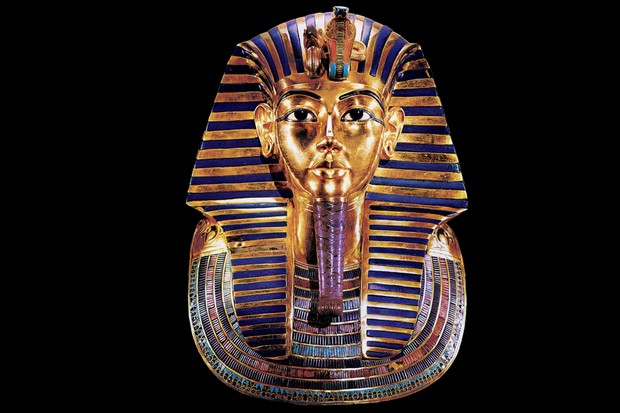
LUKE: My uncle, King Tut, has to take all of them to the afterlife with him!
Tutankhamun, commonly referred to as King Tut, ancient Egyptian pharaoh who was the last of his royal family to rule during the 18th Dynasty (ruled circa 1332-1323 BC). His tomb was discovered in 1922, sparking a renewed public interest in ancient Egypt. He was buried with over 5000 artefacts, with some of his treasures being exhibited around the world at various times.
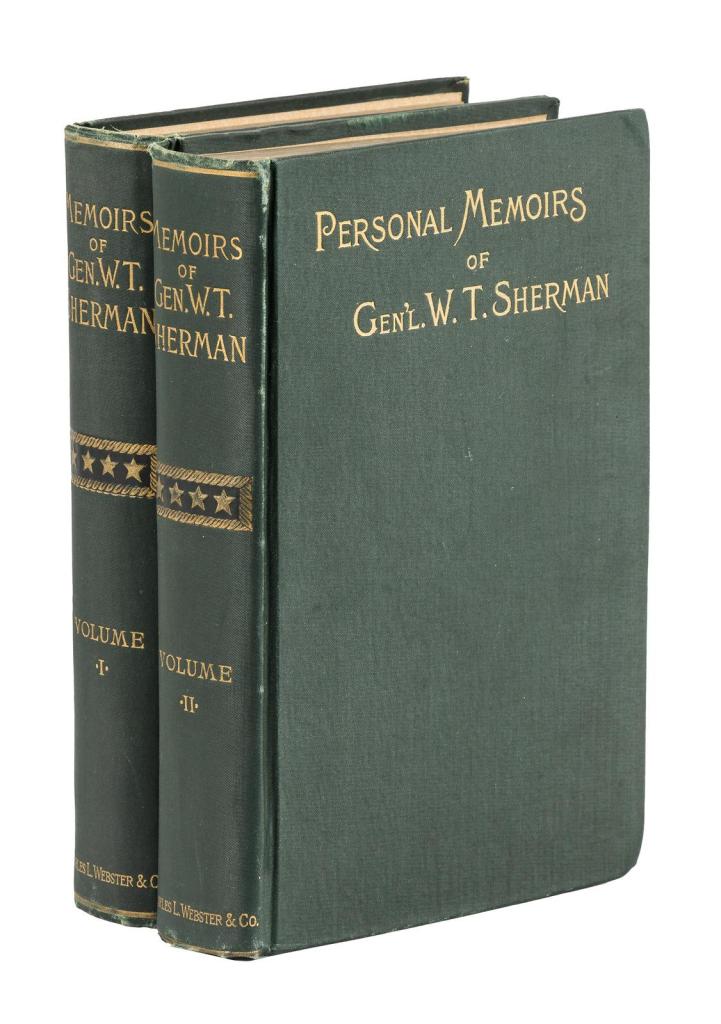
William Tecumseh Sherman (1820-1891), general in the Union Army during the American Civil War, recognised for his military strategy and criticised for his harsh scorched earth policies against the Confederate States. His memoirs were published in 1875, becoming one of the best-known first-hand accounts of the Civil War.
Football signed by Johnny Unitas
John “Johnny Unitas (1933-2002) football quarterback from 1956 to 1973, primarily playing with the Baltimore Colts. He is consistently listed as one of the greatest NFL players of all time, and was inducted into the Pro Football Hall of Fame in 1979.
Gas mask (from World War I or II?)
Pith helmet (safari helmet worn by European travellers and explorers, routinely issued to European armed forces in hot climates in both world wars)
Baseball card collection
Lou Gehrig (Henry Louis Gehrig, born Heinrich Ludwig Gehrig, 1903-1941), played with the New York Yankees from 1923 to 1939. Known as “The Iron Horse” for his durability, he still has the highest ratio of runs scored plus runs batted among Hall of Fame players, being inducted in 1939. His career was brought to a tragic end by motorneurone disease, still often called Lou Gehrig’s disease in the US.
Joe DiMaggio (born Joseph DiMaggio, 1914-1999), played for the New York Yankees from 1936-1951. Widely considered the greatest baseball player of all time, his 56-game hitting streak is a record which still stands. He was inducted into the Baseball Hall of Fame in 1955. He is well known for his marriage to Marilyn Monroe, and lifelong devotion to her.
Willie Mays (born 1931), played for the New York/San Francisco Giants (1951-1972), before finishing his career with the New York Mets (1972-1973). Regarded as one of the greatest players of all time, he was inducted into the Baseball Hall of Fame in 1979. He was awarded the Presidential Medal of Freedom in 2015.
Louie’s interests seem to be fishing, bowling, drinking, watching baseball and football, and collecting war memorabilia and sporting memorabilia. Some of the items he’s being buried with are quite valuable.
Belgium – the papier-mache from here was rejected as hack work
Oslo, Norway
Copenhagen, Denmark
Bora Bora, an island group in French Polynesia, popular honeymoon destination [pictured]
Hong Kong – acrobats
After a few words from Lorelai, Sookie suddenly understands that she’s wandered into Emilyland, and that she wants her nice simple wedding with Jackson back. A subplot which ran its course very quickly.
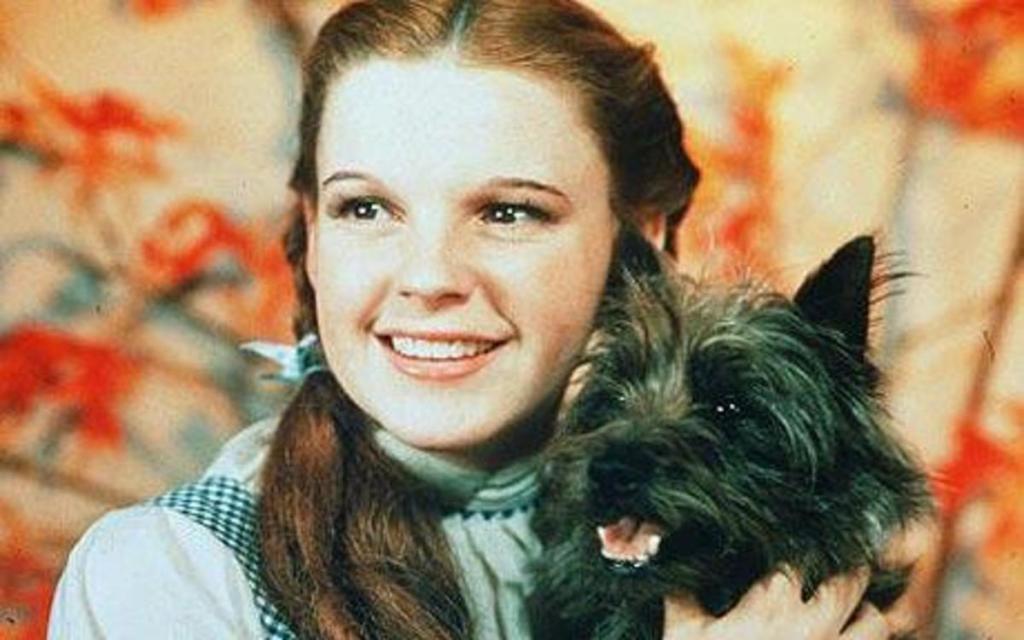
KIRK: He kicked my dog when I was a kid … Toto was always different after that.
Yet another reference toThe Wizard of Oz. Toto is the name of Dorothy’s little dog in both the book and the film. In the film, Toto was a female dog played by a brown Cairn Terrier named Terry. In the original book, Toto is only described as a small, black, scruffy male dog, but the illustrations depict what looks like a Yorkshire Terrier. It’s possible Kirk’s pet dog Toto, a female, was likewise some sort of small fluffy terrier.
Uncle Louie is made even more unpleasant by not only kicking a dog, but probably a very small dog.
The Stars Hollow Revolutionary Battle Re-Enactors tell Luke that they don’t want to attend Louie’s funeral the next day because they hated him.
Louie always had a scowl on his face, and never said anything nice. He blew smoke from his cigar into people’s faces, and then spit after each puff. He repeatedly hit on Cy’s (crank in the hat) wife, until she lost interest in her favourite soap operas. He kicked Kirk’s pet dog Toto, and after that her mind was affected, so that she couldn’t fetch any more, but just lay down and went to sleep. He never participated in town functions, and when the battle re-enactors gathered (including his own brother, William), he’d throw rock and small tools at them. Unmarried and without children, he was a loner, and only got meaner with age.
When he retired to Florida, the town threw a big party to celebrate (somehow Luke never heard about this big party). Cy made love to his wife that night as never before, and Kirk’s dog gave a happy bark and died, as she was quite elderly by that stage.
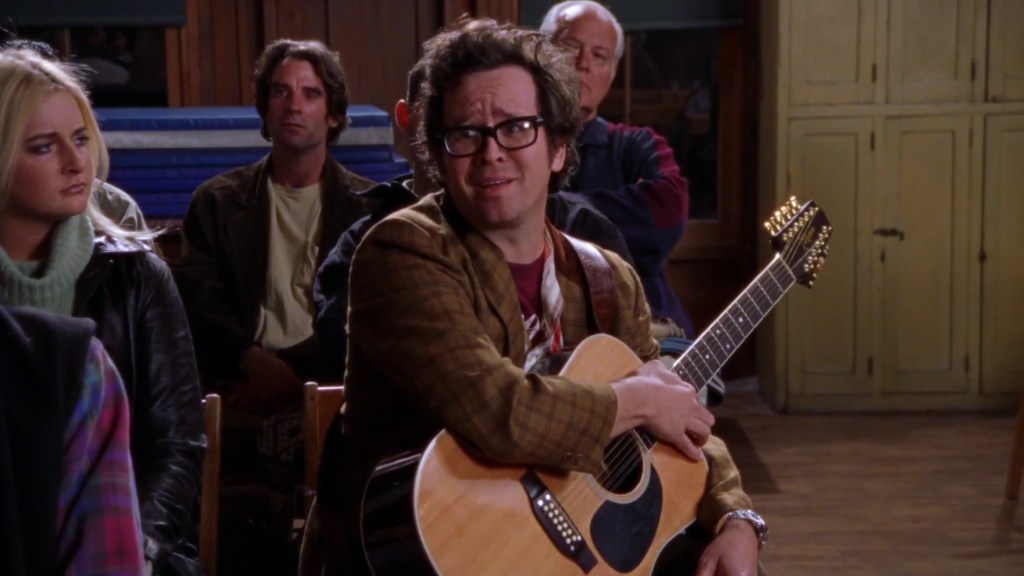
TROUBADOUR: ‘Cause you left me twistin’ for a long time before you did, Taylor, and it didn’t feel good. I even wrote a song about the experience.
LORELAI: Oh, I heard it. It’s called “Taylor Left Me Twistin’.”
The Troubadour writes songs based on his own experiences in Stars Hollow, and Lorelai and Rory have listened to this one, even offering the Troubadour encouragement, feedback, and advice as to what to add to the song. Apparently they, and perhaps others, are on friendly speaking terms with the Troubadour, even though in the show people just walk right by him. We never see him perform this song in the street, or anything else so personal, but that might happen off camera.
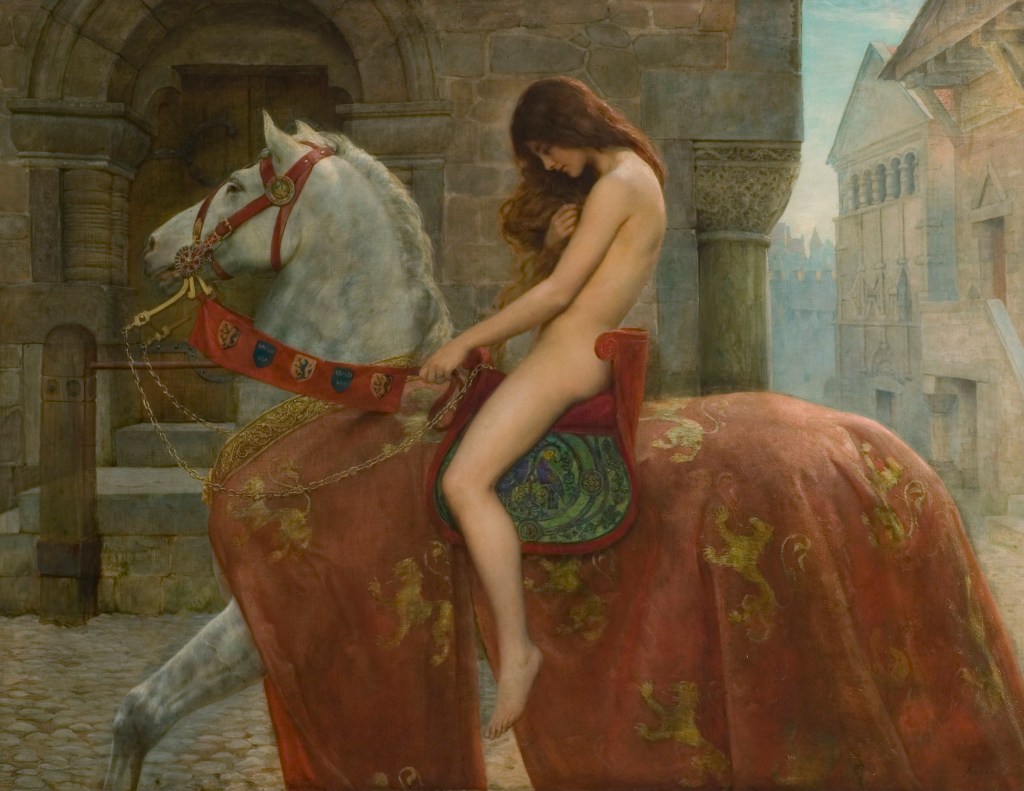
TAYLOR: Wait a second, wait a second! You there, when Lady Godiva here wanted to be town troubadour over you, I stood by your side.
Lady Godiva, in Old English Godgifu (died between 1066 and 1086) was an Anglo-Saxon noblewoman, married to Leofric, Earl of Mercia. According to legend she rode naked, covered only by her long hair, through the streets of Coventry to protest an oppressive tax her husband had imposed on his tenants. The legend dates to the 13th century and is not considered plausible by historians.
This is another long-haired character referenced by Taylor in regard to the Second Troubadour.
[Picture shows Lady Godiva, a 1897 painting by John Collier].
Charlie Rose, television interview and talk show, hosted by journalist Charles “Charlie” Rose (born 1942). Rose interviewed thinkers, writers, athletes, politicians, entertainers, business people, leaders, scientists, and fellow journalists. It was broadcast on PBS from 1991 to 2017, only coming to an end when Rose was accused of sexual harassment. The show was then replaced by one hosted by Christiane Amanpour. Transcripts of the show were made available online after broadcast, and in fact many of them still are.





 The Annotated Gilmore Girls