Straub, Richard, and Lorelai

Christopher’s father Straub (Peter Michael Goetz) could hardly be written as more hateful. He makes it clear that he sees Rory as nothing more than a terrible mistake, entirely Lorelai’s fault, which ruined his son’s life. He even suggests that as a sixteen-year-old, Rory is just about to get pregnant herself (“dangerous age for girls”). He looks down on Lorelai, and identifies her position as executive manager of an inn as a “blue collar” job. This is ridiculous, as Lorelai is in no way performing manual labour – I suspect he still thinks of her as a maid.

It is entirely satisfying when Richard throws Straub and the mousily ineffectual Francine (Cristine Rose) out of the house (with Francine, you can see where Christopher gets his weak character from, although Straub’s bullying also provides an explanation for his overly compliant wife and son). The fight between Straub and Richard explains why Rory never has any further contact with her paternal grandparents.

Lorelai thanks her father for defending her, but instead of a sweet father-daughter moment, Richard coldly tells her that he wasn’t defending her, but “the Gilmore name”. He lets Lorelai know in no uncertain terms that she brought shame to the family by getting pregnant, and that after she ran away from home Emily was confined to her bed for a month with grief – something Lorelai did not know until this moment.

Richard lets Lorelai know that he hated Christopher for getting her pregnant, but that Christopher at least was willing to marry Lorelai and work in the insurance business to support her and Rory (Christopher would agree to anything to avoid conflict, although we can feel fairly confident he would have found a way to weasel out of it at some point).

Richard continues to blame Lorelai for not marrying Christopher, her personal feelings being irrelevant to him. This seems to be further evidence that the whole plan to reunite the Gilmores and the Haydens was something cooked up by Richard and Emily, who really want Lorelai to marry someone suitable, with Rory’s father being the best candidate in their eyes.

Princeton

STRAUB: Our son was bound for Princeton. Every Hayden male attended Princeton including myself, but it all stopped with Christopher. It’s a humiliation we’ve had to live with every day, all because you seduced him into ruining his life. She had that baby and ended his future.

Princeton University is a private Ivy League university which was founded in 1746, making it one of the oldest universities in the United States. It is located in Princeton, New Jersey.

We learn from Straub that several generations of his family have attended Princeton. He specifically says the males, as Princeton only became co-educational in 1969 – if Christopher had a sister, she might have gone to Princeton.

I’m pretty sure you can still go to Princeton if you have a child with your high school girlfriend, so Straub is clutching at straws in his efforts to blame Lorelai and Rory for Christopher not being accepted into Princeton (or any other university).

Straub doesn’t make Christopher face the consequences of his actions, and blames others for any failure in his life, which is one reason why Christopher is such a weak and unreliable person. It’s notable that Christopher privately tells Lorelai it isn’t her fault her didn’t go to Princeton, but doesn’t have the guts to defend her openly, and tell his father that.

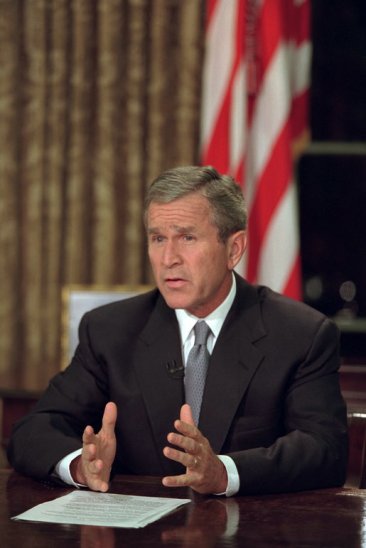
President Bush

LORELAI: I hate President Bush … He’s stupid and his face is too tiny for his head and I just want to toss him out.

Lorelai is talking about George W. Bush (born 1946), who had been elected President of the United States in November 2000, and sworn in on January 20 2001, less than two months previously from Lorelai’s perspective. He is the son of George H.W. Bush, who was US President from 1989 to 1993. Like so many famous people referenced in the show, George W. Bush has a Connecticut connection, being born in New Haven: he also attended both Yale and Harvard.

Lorelai’s perception of George W. Bush as “stupid” was one shared by many people, due to his frequent lapses of grammar, mangled sentences, and baffling statements. Polls showed that American voters saw him as having a low intelligence. Historians rate his presidency quite poorly, although his popularity has picked up since he left office in 2009.

It was rare for Gilmore Girls to stray far into politics, so this was an unusual moment which identified Lorelai as a Democrat. She was clearly desperate to get attention away from Rory, and her plan worked. Impulsive as ever, Lorelai didn’t stop to think whether her comment was going to make the evening easier. It didn’t help things.

The Bahamas

RICHARD: Well Straub, how is retirement treating you?
EMILY: Yes, do tell us about the Bahamas.
STRAUB: You can get an entire island there for the cost of a decent house here.

The Bahamas (officially the Commonwealth of The Bahamas) is a sovereign state made up of an archipelago of over 700 islands, cays, and islets in the Atlantic Ocean. Under British control for most of its modern history, it has been independent since 1973, but, like other Commonwealth nations, retains the British monarch as head of state.

The Bahamas is a popular destination for Americans to retire to: it is English-speaking, has a warm climate with beautiful beaches, and only 40 minutes by plane from Florida. Residents don’t pay any tax either, which is another drawcard, and to become a permanent resident, all you have to do is buy a property worth $500 000 or more.

It is possible to buy a very small island in The Bahamas today for as little as $500 000 – the price of a nice house in Hartford. I suspect for Straub, a “decent” house in Hartford would be around the 1 million mark in today’s money, and for a million dollars, you could get a rather nice little islet in The Bahamas.

That Straub and Francine live in The Bahamas provides a convenient excuse as to why they haven’t been any part of Rory’s life. (Emily asks them what The Bahamas is like, but in a later season we discover she and Richard spent the previous Christmas in The Bahamas, presumably so that Richard could relax after his angina attack).

Lorelai and Christopher’s Childhood Duet

CHRISTOPHER: Lucy, Schroeder, you laying on the coffee table.
LORELAI: You pretending it was a piano. God, why is that remembered?
EMILY: Because it was such a wonderful production.
LORELAI: I don’t know if it was a production, Mom. It was just one song.
CHRISTOPHER: Suppertime.
RICHARD: Did you write that? That was really very good.
LORELAI: Dad, that’s from You’re a Good Man, Charlie Brown. It’s a famous musical.

At the age of ten (around 1978), Lorelai and Christopher sang a song for at least Richard and Emily, and possibly Christopher’s parents as well.

The song was Suppertime, from the 1967 musical comedy You’re a Good Man, Charlie Brown by Clark Gesner, based on the characters from the Peanuts comic strip drawn by Charles M. Schulz. The show premiered off-Broadway in 1967, went to London’s West End in 1968, and opened on Broadway in 1971. It had a Broadway revival in 1999.

The show was adapted for television in 1973, when Lorelai and Christopher were about five. This might be where they knew of the musical from, although it’s a favourite for amateurs to perform, and they might have seen a local production, or even been in a school production. The musical was adapted for TV again in 1985.

Suppertime is a song sung by the dog Snoopy, about his excitement in being fed after waiting hopelessly for the food to arrive. It’s a strange song to choose as a duet, because Snoopy sings almost the entire song, with only a few interjections from Charlie Brown. I presume Lorelai sung Snoopy’s part, and Christopher sung Charlie Brown’s – it seems like her to hog the limelight, and like him to do only minimal work. Possibly they chose that song because they were performing it just before dinner was served.

Lorelai and Christopher recall playing the roles of Lucy and Schroeder, in the iconic pose of Lucy lying on the piano while Schroeder plays it. It isn’t clear how this fitted in with the song by Snoopy. In the musical, Lucy and Schroeder have a scene together where he plays Beethoven’s Moonlight Sonata on the piano while Lucy expresses her love for him and asks about marriage, while Schroeder remains detached. This is ironic considering what comes later.

Chuck Berry

RICHARD: I’m a Chuck Berry man myself.
LORELAI: … Chuck Berry?
RICHARD: Yes, Chuck Berry. He was all the rage when I was in school.
LORELAI: So we’re talking pre-My Ding-a-ling?

Charles “Chuck” Berry (1926-2017) was an American singer, songwriter, and musician who was one of the pioneers of rock and roll, most famous for 1950s songs such as Maybellene, Roll Over Beethoven, Rock and Roll Music, and Johnny B. Goode. Chuck Berry was one of the first musicians to be inducted into the Rock and Roll Hall of Fame when it opened in 1986, with his lyric structures, guitar riffs, and showmanship seen as laying the groundwork for modern rock and roll. He won the Grammy Lifetime Achievement Award in 1984, and is regarded as one of the greatest rock musicians of all time.

My Ding-a-ling is a novelty song that was first written written and recorded by Dave Bartholomew in 1952, and covered by Chuck Berry in 1972. The song is about a child’s toy covered in silver bells – the “ding-a-ling” – which is constantly held and played with, but the song uses double entendre as most of the lyrics would still make sense if the “ding-a-ling” was actually a penis. It was Chuck Berry’s only single to get to #1.

Richard says he became of a fan of Chuck Berry because his songs were popular when he was at school: Richard would have been aged 12-15 when Berry became famous in the 1950s. Richard being a fan of Chuck Berry continued to be a feature of the the show throughout its run.

Christopher’s Musical Abilities

CHRISTOPHER: Hey, I play guitar.
LORELAI: You know the opening lick to Smoke on the Water.
CHRISTOPHER: And I’ve since mastered the opening lick to Jumpin’ Jack Flash.

Smoke on the Water is a 1973 song by English heavy-metal pioneers Deep Purple, from their 1972 album Machine Head; it was written by the band’s guitarist, Ritchie Blackmore. The song retells the true story of when Deep Purple were in Montreux, Switzerland to record an album at the casino in 1971, when the casino caught fire. The “smoke on the water” is the image of the smoke from the fire over Lake Geneva. Smoke on the Water went gold and got to #4 in the US. It is famous for its opening riff, which is often chosen as a piece by beginner guitarists, although playing it correctly is actually fairly difficult, and most learners opt for a simpler power chord version. This may be what Christopher did as well.

Jumpin’ Jack Flash is a 1968 song by English rock band The Rolling Stones, released as a single. It was written by Mick Jagger and Keith Richards, but Bill Wyman claims it was he who wrote the famous opening riff, and remained uncredited for it. Jumpin’ Jack Flash went to #1 in the UK and #3 in the US, and is one of the band’s most popular songs, often covered by other performers and featured in films.

Martini

When Lorelai, Christopher, and Rory arrive at the elder Gilmores’ house, Richard mixes the adults a martini, which became the go-to cocktail on Gilmore Girls. (In the picture, all the adults are holding martini glasses).

A martini is a cocktail made with gin and vermouth, garnished with an olive or a twist of lemon. Some trace its origins back to the Occidental Hotel in San Francisco in 1860, who made a similar cocktail named the Martinez; others to a bartender named Martini who worked at the Knickerbocker Hotel in New York around 1911. The martini soared in popularity during the Prohibition era thanks to illegal gin, and was the predominant cocktail mid-twentieth century. They fell out of favour in the 1970s, but became popular once again in the 1990s.

“Drama king and queen of Connecticut”

(They stand outside the door of Richard and Emily’s house)
LORELAI: [sighs] I’ve gotta see my parents.
CHRISTOPHER: [sighs] I’ve gotta see my parents.
RORY: Ladies and gentlemen, the drama king and queen of Connecticut.

A “drama queen” is a melodramatic person who habitually makes a fuss over minor problems, especially one who does it as a bid for attention. It applies to both genders, but “drama king” is a specifically masculine version. It originated as slang in the gay community during the 1960s, but became mainstream by the 1970s, and was popularised during the 1990s.

Schnickelfritzes

Lorelai refers to the Haydens as “the Schnickelfritzes”. This is a variant of the slang snickelfritz, Pennsylvsania German slang given as an endearment to a child, most likely with the meaning “chatty kid, mischevious little imp”. Despite its affectionate use, Lorelai seems to refer to anyone she considers a massive pain in the rear as Schnickelfritz.

It may be a reference to Billy Wilder’s 1953 war film Stalag 17, set in German POW camp. To pass the time, the American airmen held in the camp bet on a “horse” race, where the horses are actually mice. One mouse named Schnickelfritz wins the race, even though the main characters were betting on another one. Lorelai may feel that the people she calls Schnickelfritz are similarly likely to ruin the fun and succeed where she’d prefer them to fail.

The film stars William Holden, who we later discover is one of Lorelai’s favourite actors, and on whom she has a celebrity crush. Holden won the Academy Award for Best Actor for his role as J.J. Sefton, and Stalag 17 was a commercial success, now recognised as one of the great war films of its era.