“Many moons ago”

MAX (on answering machine): Anyhow, as I sit here losing my faith in mankind, I wonder if we’re ever gonna actually go on that date we talked about many moons ago.

A “moon” is an old-fashioned way of saying “a month”, or one lunar cycle from new moon to new moon. Max is speaking poetically rather than literally – they made the date in October and it’s now November, so it’s only one moon ago, or at most, one moon and a bit.

Emily Dickinson

MAX: [on answering machine] Lorelai, it’s Max … Medina. Maaaax Medina. And once again we miss each other. It’s now 2 o’clock in the afternoon on Thursday and I’m in my office grading a paper titled Emily Dickinson: Get a Life.

Emily Dickinson (1830-1886) was an American poet. She lived most of her life in reclusive isolation, and was considered an eccentric. By the end of her life she was reluctant to even leave her bedroom. This probably explains the title of the paper on Emily Dickinson that Max is grading – which seems most unlikely as the work of a Chilton student.

Dickinson was a prolific poet, but less than a dozen of her poems were published during her lifetime, and were usually altered to fit the poetic conventions of the day. Dickinson’s work was unique for her time, with short lines, slant rhymes, and unconventional capitalisation and punctuation. They are rarely titled, and many are on the themes of death and immortality.

Her poems were first published in 1890, but it wasn’t until 1955 that the complete unedited collection was published.

USSR

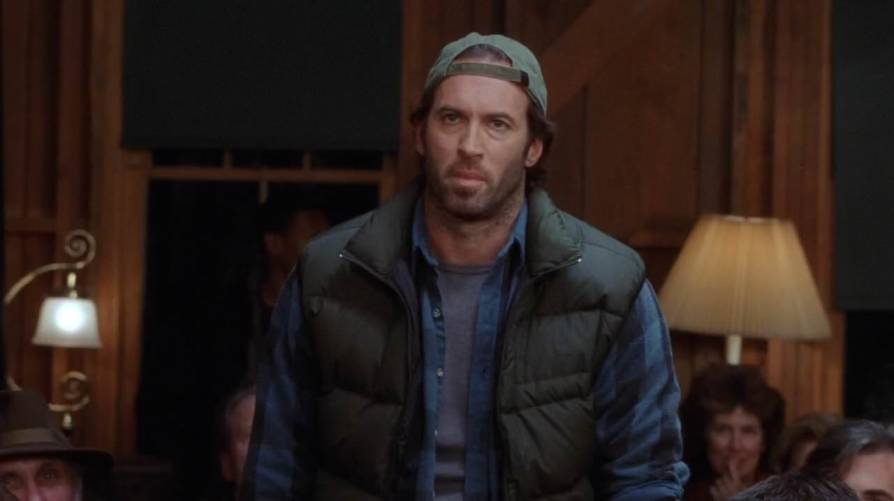
MAYOR: If you don’t like it here in America, why don’t you go stand in line for toilet paper in the USSR!
LUKE: There is no more USSR, Harry.

The Union of Soviet Socialist Republics, abbreviated to USSR, and also known as Soviet Russia, existed from 1922 to 1991. It came into being shortly after the Russian Revolution, and collapsed at the end of the Cold War. The picture shows the present day countries which were once part of the USSR.

Soviet Russia was notorious for its long queues because of the shortages caused by the Communist system, which prioritised industry over consumer goods. People would line up for hours in order to buy any commodity that was in short supply

Battle of Stars Hollow

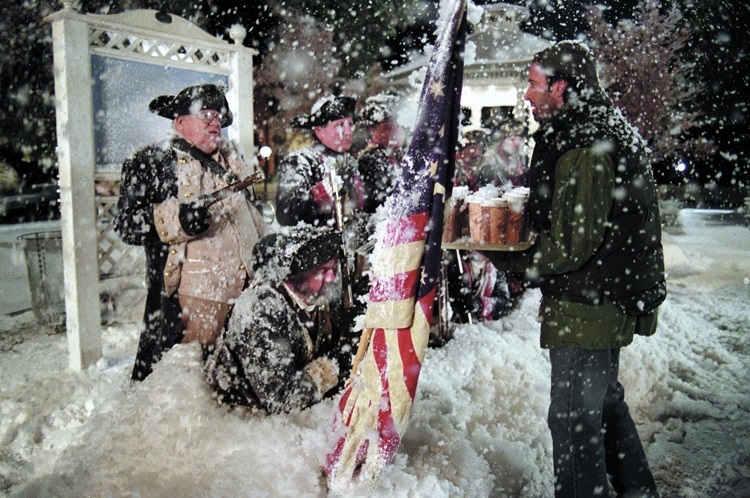
We learn in this episode that every year the town re-enacts The Battle of Stars Hollow, which took place during the Revolutionary War on either November 10 or November 17 in 1776 (depending on whether this episode is one or two weeks after the previous one). This contradicts the sign in town, which says that Stars Hollow was founded in 1779.

In the “battle” a dozen militia men from Stars Hollow waited for the redcoats in the cold, however the British never showed up. Despite this lack of anything happening, Stars Hollow is very proud of its role in the American Revolutionary War.

We also learn that Luke’s father William Danes was an enthusiastic battle re-enactor, and even owned his own musket, which he had buried with him. Although Luke doesn’t follow in his father’s footsteps, he does serve free hot drinks to the re-enactors who have to have to spend all night freezing in the cold.

In real life, there were only three battles sites in Connecticut in the American Revolutionary War, and they were all British victories. Nonetheless, Revolutionary War history is a big deal in New England. Many Connecticut towns have annual commemorations of the American Revolutionary War, just like Stars Hollow.

Mayor Harry Porter (David Huddleston)

During the town meeting we encounter the mayor of Stars Hollow, Harry Porter, who has been mayor for many years He was gradually phased out leaving Taylor Doose in sole charge of the town. Perhaps Harry entered a sort of semi-retirement or became a figurehead: he didn’t retire as nobody else was elected mayor and in fact the role of mayor apparently became more or less redundant.

Lava Lamp

TAYLOR: Well, excuse me, Andrew, but some of us have businesses to run that don’t involve peddling drug paraphernalia to kids.
ANDREW: It was a lava lamp, Taylor.
TAYLOR: There is no use for a lava lamp unless you’re on drugs.

Lava lampa are novelty decorations first invented in 1963 by a British accountant named Edward Craven-Walker. The lamp has a special wax mixture inside a glass vessel filled with translucent  liquid; as the lamp heats the wax rises, then falls as it cools in a way which suggests the flow of lava. The actual manufacture of the lamp is a trade secret, so I can’t tell you any more than that. In the US in 2000, lava lamps were made by Lava World International: elsewhere they were, and still are, made by Craven-Walker’s company Mathmos, although he died in 2000.

Taylor is right that lava lamps have been a big part of drug culture, and in the 1960s were a symbol of the counterculture and psychedelia. However you don’t have to be on drugs to own one, and they have a sort of kitschy retro chic. We later learn that Lane Kim owns at least two lava lamps, possibly bought from Andrew’s store, Stars Hollow Books.

Town Meeting

This is the first episode in which we see a town meeting, and we learn that they are held on Thursday nights (somehow Lorelai gets back from business class in time for the meetings). We also discover that they are held in Miss Patty’s dance studio rather than a town hall, and never find out why, but can assume it’s for some suitably eccentric and quirky reason.

In real life, even a much smaller town than Stars Hollow would have a town hall. Washington Depot, the original inspiration for Stars Hollow, is about a third the size and still has its own town hall. The practical reason not to have a town hall on the show is that it would mean building a new set for it that would be rarely used. A town hall would also require a much larger cast to fill it to capacity.