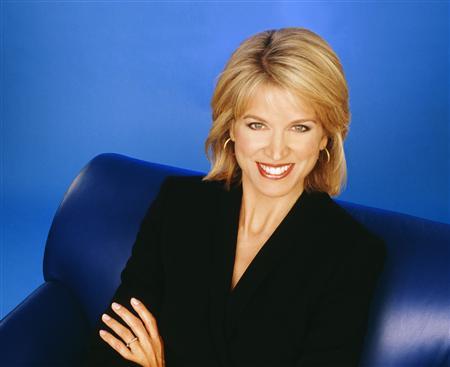
Paula Zahn (born 1956) [pictured], award-winning journalist and newscaster who has been an anchor at ABC News, CBS News, Fox News, and CNN. Although in 2002 she had already scored dozens of interviews, and covered stories like the Waco siege and the September 11 attacks, her career really off took the following year.
Jess seems to suggest that he imagines Rory being a journalist like Paula Zahn – an attractive, smart woman who starts at the bottom, probably at a local level (like Zahn did), and gradually works her way up to the major broadcasters and news services. It’s far more realistic than what Rory plans to do.
RORY: Do not give me that whole ‘I’m so misunderstood, Kurt Cobainy’ thing. You are way stronger than that and I don’t even wanna hear it. You have to go to college …
JESS: So, Courtney, what about you?
Kurt Cobain (1967-1994), singer, songwriter, and musician, frontman of the grunge rock band Nirvana, serving as the band’s lead vocalist, guitarist, and primary songwriter. Through his angst-fuelled songwriting and anti-establishment persona, Cobain’s compositions challenged the conventions of rock music. He was often heralded as a spokesman for Generation X and is considered one of the most influential musicians in the history of alternative rock.
Cobain struggled with depression, heroin addiction and the pressure of fame, and was found shot dead at the age of 27, apparently by his own hand. He was posthumously inducted into the Rock and Roll Hall of Fame, along with his fellow band members, in 2014.
Rory pretty much gives Jess the same talk that Lorelai did when he arrived in Stars Hollow – if anything, she is less sympathetic, telling him to quit the “misunderstood act”, and saying he is way too strong to be dragged down by his circumstances.
Jess is far more receptive to hearing this from Rory. He probably appreciates not being pitied, and likes the suggestion he is tough enough to survive anything. Rory may be the first person to openly tell Jess he can achieve anything he wants, and once again, she is very keen to urge a male love interest to attend college.
Note that as Rory casts Jess in the role of Kurt Cobain, he is equally quick to cast her as Kurt’s wife – an obvious suggestion that Jess considers her to be his “other half” that Rory surely cannot miss. As Kurt and Courtney were something of a doomed, destructive couple, it doesn’t feel like a good omen for Jess and Rory.
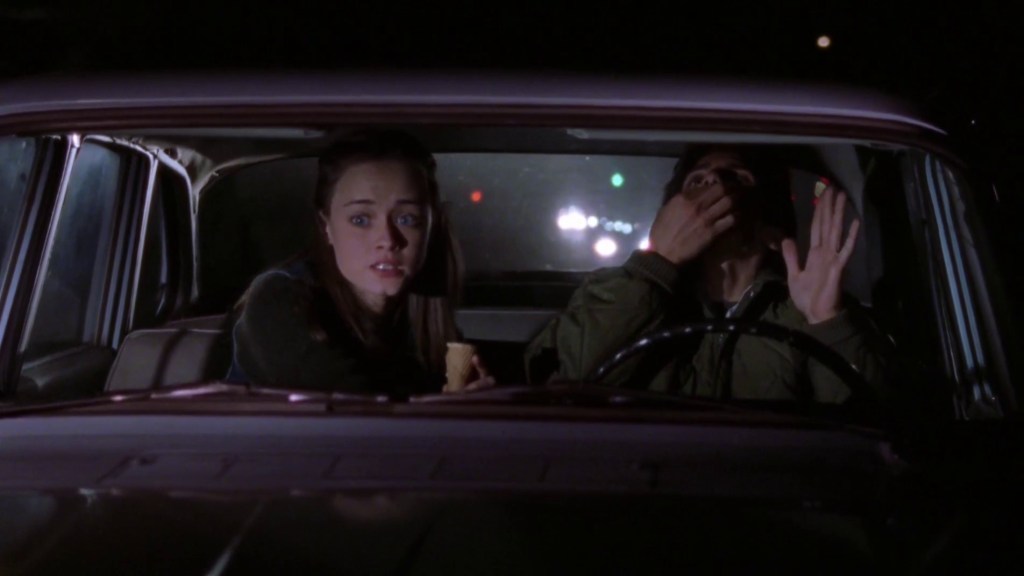
RORY: I can’t hold the wheel, you’re driving. The person who’s driving has to hold the wheel. That’s the first thing they teach you in Driver’s Ed.
Driver’s Education, a class or program, often organised by high schools, that helps give young people instruction in driving to help prepare them for their driver’s license test. The first Driver’s Education program in the US started in 1934, at a Pennsylvania high school.
Rory’s comment suggests that she took Driver’s Ed, possibly at Stars Hollow High, since she (impossibly) already has her license before she starts at Chilton.
Could they have made this any more sexual? Even the choice to buy ice cream cones seems like a deliberately erotic choice.
Out the back window, you can see a set of traffic lights, and multiple cars behind them. I think they are still supposed to be driving around Stars Hollow, which only has one traffic light, on the main square, and almost no traffic. It really doesn’t look like Stars Hollow!
I can accept this scene as believable if Jess drove to a nearby larger town to buy ice cream cones and then back to cone-less Stars Hollow, but I’m not sure this is what the show actually wants us to think. My understanding is that Jess was just circling the main square.
Othello, a tragedy by William Shakespeare, probably written in 1603, and first performed in 1604. Set during the Ottoman-Venetian War (1570-1573), the story revolves around Othello, a noble Moorish military general serving in the Venetian army who is married to Desdemona, a beautiful wealthy Venetian lady much younger than he. A malevolent junior officer named Iago stokes Othello’s jealousy until the usual calm and stoic man kills his wife in a fit of blind rage. Its themes of passion, jealousy, and race are still relevant today, and it is popular and widely performed.
The significance of Jess studying Othello with Rory is obvious, as it is all about a man who is insecure about his wife, and is too easily led to believe she is unfaithful to him. Dean’s belief in Rory is going to be severely tested by Rory spending time with Jess while he is away. It’s another suggestion from Jess that Dean will become violent over Rory’s relationship with Jess.
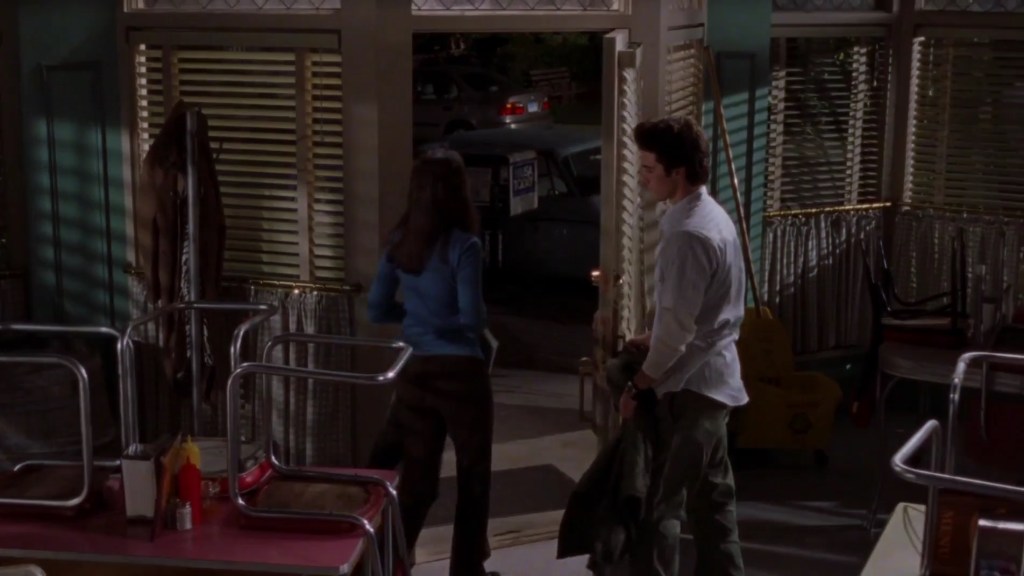
Why is Rory’s car outside the diner? They always walk to Luke’s, even at night. Perhaps Rory drove to the diner since she’s going to be tutoring Jess until late, and Lorelai doesn’t want her walking home alone at night – or with Jess as her escort. If so, it seems overly cautious, in light of how close they live to Luke’s, and how safe Stars Hollow seems to be. In retrospect, walking home with Jess would probably have been safer and less dramatic than what actually occurs.
It’s interesting that Jess recognises Rory’s car. Although we never see this onscreen, Rory is presumably in the habit of driving around Stars Hollow, often enough that Jess can identify the car as hers.
RORY: You’ve done card tricks, you’ve made coffee, you’ve tried to explain to me how on earth Coldplay could be considered an alternative band, but as of yet, no studying.
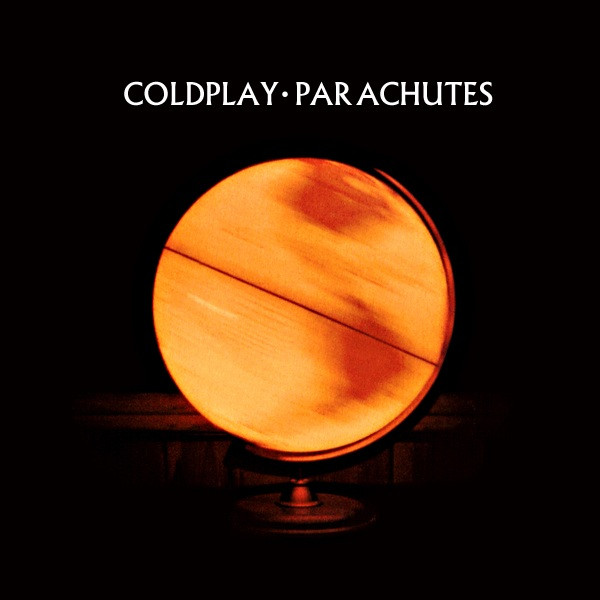
Coldplay, British rock band formed in 1996, with vocalist and pianist Christ Martin, guitarist Johnny Buckland, bassist Guy Berryman, and drummer Will Champion.
Their 2000 debut album Parachutes included their breakthrough hit “Yellow”, and it received a Brit Award for British Album of the Year and a Grammy Award for Best Alternative Music Album. This may be the source of Rory and Jess’ discussion as to how Coldplay can be considered an “alternative band”. In the US, their singles were played on college and alternative radio stations, and charted on the Alternative Music charts.
Jess writes some of the lyrics to this song by English punk rock band The Clash on a notepad for Rory, who correctly identifies it – thus passing one of Jess’ “tests” to see if she’s worthy.
“Guns of Brixton” is from the 1979 album, London Calling. It was written and sung by the band’s bassist, Paul Simonon, who grew up in Brixton in South London, and has a strong reggae influence, reflecting the culture of the area. It predates the race riots which took place in Brixton in the 1980s, but depicts the discontent of the area due to economic factors and heavy-handed policing against black youth.
The lyrics begin:
When they kick at your front door How you gonna come? With your hands on your head Or on the trigger of your gun?
When the law break in How you gonna go? Shot down on the pavement Or waiting on death row?
After this point, the phrase “guns of Brixton” becomes used so often that it would be immediately apparent which song it is, so I presume Jess showed Rory the first stanza or the first two stanzas. It looks as if he has written the first two stanzas on the notepad, but I can’t see it very clearly.
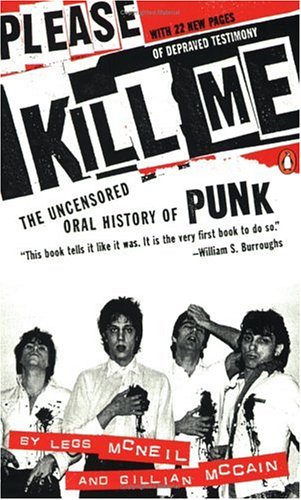
JESS: Have you ever read Please Kill Me? … Oral history of the punk movement. You’d like it – you can borrow it if you want.
Please Kill Me: The Uncensored Oral Historyof Punk by Legs McNeil and Gillian McCain, first published in 1996. It consists of interview with punk musicians, and spans the early period of punk in the US, from The Velvet Underground and The New York Dolls to Iggy Pop and The Ramones. The book became an instant hit, and is a cult classic.
Note that Jess suggests this “history” book as an alternative to reading about The Marshall Plan!
RORY: Explain to me the political ramifications of the Marshall Plan.
The Marshall Plan, officially the European Recovery Program or ERP, was an American initiative enacted in 1948 to provide foreign aid to Western Europe. The US transferred over $13 billion (equivalent to around $115 billion today) in economic recovery programs to Western European economies after the end of World War II.
The initiative was named after the US Secretary of State, George C. Marshall, and one of its main ramifications was to ensure greater geopolitical influence for the US in Western Europe. It has been argued that it marked the beginning of the Cold War, with the USSR refusing assistance, and determined to bolster its own influence in Europe. This was seen by the US as an act of hostility.
Jess’ History class is obviously studying the Post-War era.





 The Annotated Gilmore Girls