Another Confusing Timeline

As with so many episodes written by Daniel Palladino, I cannot follow the timeline of this episode very easily. It opens early in the morning, and we know it’s a school day, because Rory is dressed in her Chilton uniform. Yes, she has to get a bus to school, and they can’t go to the diner, so it makes perfect sense for them to walk a long way for a friend to cook them breakfast! They really should have just made their own breakfast, for practical reasons.

However, the next few scenes have Rory dressed in her normal clothes and Lorelai isn’t at work, so that it seems to be the weekend. That implies they had breakfast at Sookie’s on a Friday morning, but the previous episode ended on Friday night. And they can’t have skipped a week, because Rory was meant to have her cast removed in two weeks, so it would have been gone by that time.

I think just as “PS I Lo … ” has two Thursdays in a row, there are two Fridays in a row as we transition from “Help Wanted” and “Lorelai’s Graduation Day”.

The timeline issue could have been fixed by simply making their breakfast on Saturday morning, which makes sense because they always eat out for breakfast on Saturday, and they would have plenty of time to walk to Sookie’s (and Lane would have the free time to practice drumming on pots and pans). It would even make it slightly more plausible that Jackson was sitting around in his PJs and not at work.

Possibly the problem isn’t the fault of the writer this time, but of the costume department, for putting Rory in a school uniform she shouldn’t have been wearing. The only way I can make sense of this is for Rory to have run out of clean clothes and forced to wear her uniform on a weekend – or she has some school activity that Saturday, like a debate, and is already dressed for it.

“Hey, is Jackson in the house?”

LORELAI: Hey, is Jackson in the house? Let me hear you say “unh”.

JACKSON: Unh.

“Jerome is in the house” is a catchphrase from the sitcom Martin (1992-1997), starring comedian Martin Lawrence in the title role as a free-spirited radio DJ in Detroit, and also as a host of supporting characters, including his own mother Edna, an annoying neighbourhood child named Roscoe, and a stereotypical white surfer-redneck named Bob (performed in whiteface with a blond wig).

Jerome was another of Lawrence’s characters, a loudmouth, once-flashy, now aging pimp who runs an illegal casino and sports a gold tooth. His signature spiel and personal theme song was, “Ooh, I say, Jerome is in the house … I say, watch your mouth!”. The catchphrase “in the house” quickly became highly popular.

Martin won numerous awards and was one of the highest-rated shows on the Fox Network at the time. It went into syndication, and is still on cable television and streaming services.

“I can’t believe I ate the whole thing”

[Jackson moans]

LORELAI: Now say, “I can’t believe I ate the whole thing”.

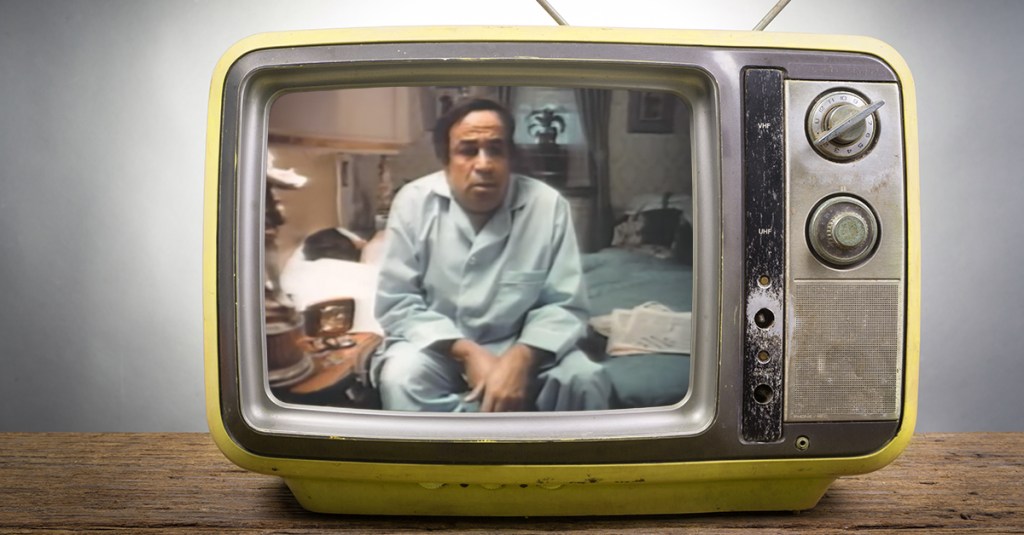
A reference to a 1970 Alka-Seltzer commercial, shown on television. It shows a newly-wed couple (played by Alice Playten and Terry Kiser) in the bedroom where the wife has served her husband a giant dumpling. The husband says, “I can’t believe I ate the whole thing!”, which becomes the commercial’s tagline. He quickly and secretly takes some Alka-Seltzer antacids so his wife won’t know how indigestible her cooking is.

The commercial was created by Howie Cohen, who was inspired by a real life incident where he ate everything he was given at a photo shoot out of politeness. When he said to his wife, “I can’t believe I ate the whole thing”, she replied, “There’s your next Alka-Seltzer commercial”.

The commercial won a CLIO Award, and its tagline quickly became a popular catchphrase.

One of Terry Kiser’s acting roles was playing comedian Vic Hitler in the television series Hill Street Blues. Vic was known as “Vic the Narcoleptic Comic”, which seems a bit similar to Jackson being “Narcoleptic Nate”. Lorelai nicknamed Dean “Narcolepsy Boy” after he fell asleep with Rory at Miss Patty’s, so it seems like an insult she likes to dish out.

“He’s not much of a morning person”

LORELAI: Hey, what’s with Narcoleptic Nate over there?

[Jackson, who is leaning against the counter with his eyes closed, moans]

SOOKIE: He’s not much of a morning person.

Slightly unbelievably, Jackson, a market gardener, isn’t much good in the mornings, and needs at least an hour of sitting around semi-comatose in his pyjamas before he wakes up. Shouldn’t he be getting up at dawn every day for work? I feel as if market gardeners are, by the nature of their profession, early risers, especially in spring. You can’t just wander in at 9.15 am with a cup of coffee, saying, “Wow traffic was really bad this morning, huh?” to the tomatoes.

Note that Jackson is wearing his pyjamas with his own photos on them, a callback to “Secrets and Loans” when they caught Jackson in his pyjamas previously, and they learned his cousin has a printing business putting photos on items.

Mystery Breakfast Spot

LORELAI: We have arrived.

RORY: Arrived where? [looks up] Aw, you are without shame.

Somehow Lorelai has led Rory all the way to Sookie’s house without Rory having the slightest idea where they are going. This is even less believable than the time Lorelai took her right to the very gates of Harvard before Rory suspected where they were. How can Rory not remember where Sookie lives?

Once again, we see that Sookie seems to live a long walk from Lorelai’s house, yet somehow it is too close to get in the car and drive to it. Rory says they are in the opposite direction to the business district, and even wonders if they are walking to the next town, suggesting that Sookie lives on the outskirts of Stars Hollow. Yet the area doesn’t look any more rural than Lorelai and Rory’s street – which makes sense, because in real life, Sookie’s house was right next to Lorelai’s!

Lorelai cannot go to the diner for breakfast, because she and Luke are still in a fight over Jess. The show doesn’t make it clear whether Lorelai arranged in advance to have breakfast at Sookie’s, or if they have turned up unannounced first thing in the morning expecting to be fed (which would not be out of character). Either way, Sookie is delighted to have extra people to cook for.

Ramble On and John Bonham

LANE: I’ve almost nailed the fill in “Ramble On”. I just have to stop hitting my face with the sticks when I pull my arms back.

RORY: John Bonham had that same problem.

“Ramble On”, 1969 song by English rock band Led Zeppelin, from their album Led Zeppelin II. The lyrics were influenced by J.R.R. Tolkien’s The Lord of the Rings, previously mentioned. It is regarded as one of of Led Zeppelin’s greatest songs.

John Bonham (1948-1980), English musician, best known as the drummer for Led Zeppelin. Esteemed for his speed, power, fast single-footed kick drumming, distinctive sound, and feel for the groove, he is regarded as one of the greatest and most influential rock drummers in history. He has influenced numerous drummers, including Dave Grohl and Neil Peart. He was posthumously inducted into the Rock and Roll Hall of Fame in 1995 as a member of Led Zeppelin.

Even though Lane is being allowed to practice on real drums twice a week, she is getting in extra practice by banging on Lorelai’s pots and pans, to show how keen she is.

Michael Landon

LANE: [runs up behind them] Hey, wait, stop!

LORELAI: Oh look, it’s Michael Landon.

Michael Landon, born Eugene Orowitz (1936-1991), actor and filmmaker best known for his roles in the television series Bonanza (1959-1973), Little House on the Prairie (1974-1982), and Highway to Heaven (1984-1989).

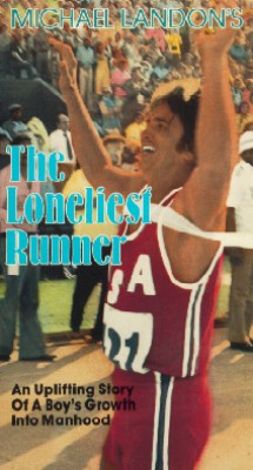
Michael Landon made an autobiographical television film in 1976, called The Loneliest Runner. The story is about a teenage boy named John Curtis, based on Landon himself, who still wets his bed. His mother publicises his problem by hanging the stained sheets from his bedroom window for all to see.

Every day, John runs home from school to take the sheets down before his friends see them. He starts running with the junior track team to channel his anger and forget the shame and hurt of his dysfunctional family life. Ten years later, he is a gold-medal winning Olympic champion, who credits his mother for his athletic success. Landon plays the adult Curtis himself.

Like John Curtis, Michael Landon wet the bed until he was 14, and his mother Peggy hung the sheets out to shame him. He had Olympic ambitions as a javelin-thrower, but a shoulder injury ended his athletic career, which propelled him into acting.

His unauthorised 19991 biography by Aileen Joyce, Michael Landon: His Triumph and Tragedy, relates that the bedwetting was brought on by the stress of having a suicidal mother. As a child, Michael Landon had to save his mother from drowning herself during a beach vacation.

Woman Who Won the Lottery

LORELAI: I don’t know, didn’t they feed lead to our jumping frog or something?

RORY: Oh yeah, right after they stoned the woman who won the lottery.

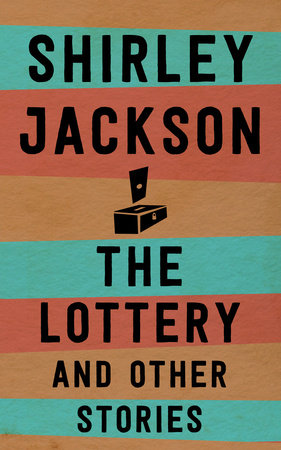
Rory references the 1948 short story, “The Lottery”, by Shirley Jackson. Set on a beautiful summer day in an idyllic New England village (based on Jackson’s own home of Bennington, Vermont), the story tells of an annual ritual known as “the lottery”, an old tradition carried into modern times, and seemingly practised to ensure a good harvest.

People draw slips of paper from a box, and a wife and mother named Tessie Hutchinson eventually “wins” by drawing the marked piece of paper. The entire village begins stoning her to death as she screams of the injustice of the lottery – an injustice that only bothers her when she is the scapegoat marked for death.

The story was first published on June 26 in The New Yorker, and proved so unsettling at the time that The New Yorker received a torrent of letters, the most mail they ever received about a story. Jackson herself received about 300 letters about the story that summer, much of it abusive or hate mail. (Some asked where they could go to watch the “the lottery” take place!).

Since then, “The Lottery” has been analysed in every possible literary and sociological way, its careful construction and symbolism noted, and its themes linked with everything from mob mentality, the military draft, and the death penalty. It is one of the most famous stories in American literature, often reprinted in anthologies and textbooks, and has been adapted for radio, television, film, graphic novel, and even (to Shirley Jackson’s bafflement) a ballet.

Apart from being a short story often read for high school English classes, this seems like a story Rory would enjoy. She has a taste for dark and “gloomy” themes, and is a fan of American Gothic. Like Tessie, Rory is from an idyllic New England town, and has been singled out for special treatment – but in her case, it’s to be loved and glorified by the town.

The story reminds us that even the most charming small towns have a dark side, and that includes Stars Hollow. Rory is no doubt thinking of Jess, vilified and forced to leave because of a minor car accident. (The name Jess even sounds a bit like Tessie).

Jumping Frog

LORELAI: We don’t patronize the next town.

RORY: Since when?

LORELAI: I don’t know, didn’t they feed lead to our jumping frog or something?

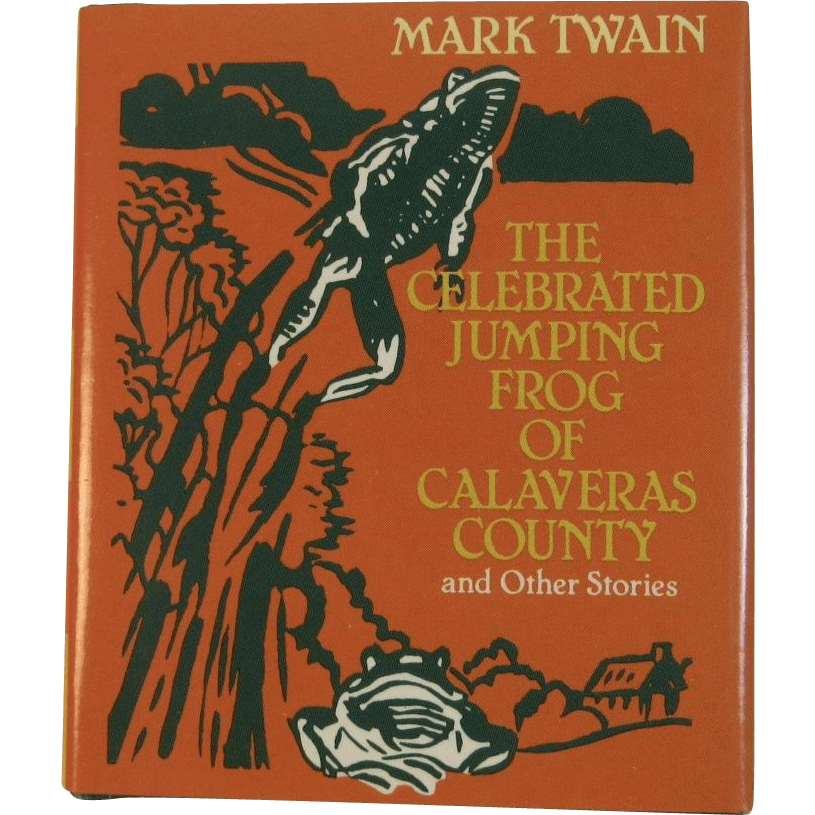
Lorelai references the 1865 short story, “The Celebrated Jumping Frog of Calaveras County” by Mark Twain. The narrator of the story relates a tall tale he heard at a bar in Angel’s Camp, then a gold-mining town, in Calaveras County in northern California.

An inveterate gambler named Jim Smiley catches a frog and spends months training it to jump. He bets a stranger that his frog can out-jump any frog the stranger can find, but when the time comes, Smiley is dismayed to find his frog has been beaten. He pays up and the stranger departs, but Smiley later discovers that the stranger has poured lead shot down the frog’s throat, making it too sluggish to jump. He chases after the cheating stranger, but is unable to catch him.

First published in The New York Saturday Press as “Jim Smiley and His Jumping Frog”, the story was an immediate success and made Twain’s name as a writer. Later that year it was published in The Californian under its current title. Twain used the story in his first book, The Celebrated Jumping Frog of Calaveras County and Other Stories, published in 1867.