Past Graduates of Harvard

LORELAI: Past graduates. Henry James … isn’t that a beer?
RORY: And a novelist. Go on.
LORELAI: John Adams. That’s a beer!
RORY: Our second president. He’s very in right now.
LORELAI: W.E.B. Du Bois, Yo-Yo Ma. Oh cool! Fred Gwynne.
RORY: Who?
LORELAI: Herman Munster. Now I’m impressed.

Henry James (1943-1916), earlier mentioned, was an American-born British author, often considered one of the greatest novelists of all time. He is best known for his novels and stories depicting interactions between Americans, English people, and Continental Europeans, such The Portrait of a Lady, and The Ambassadors. Henry James’ style closely examines the psychology of his characters in an ambiguous or contradictory way. There is no beer named Henry James that I know of. Henry James attended Harvard Law School in 1862, but soon discovered he had no interest in law, and pursued a literary career instead, so he isn’t actually a graduate.

John Adams (1735-1826) was an American statesman and Founding Father of the United States who served as the Vice-President of the US, and as the second President of the US from 1797 to 1801. Adams tended to be a rather obscure president for many years, with many Americans knowing nothing about him, until the publication of his biography John Adams by popular American historian David McCullough in May 2001. It was very favourably received, and brought about a resurgence in Adams’ reputation. Rory seems to be referring to this book by saying Adams “is very in right now”, and has almost certainly read it. There is actually a beer named John Adams. John Adams entered Harvard in 1751, graduating in 1755 with a Bachelor of Arts degree.

William Edward Burghardt “W.E.B.” Du Bois (1868-1963) was an American sociologist, historian, civil rights activist, and writer. He was one of the founders of the National Association for the Advancement of Colored People in 1909, and was the leader of the Niagara Movement who worked for equal rights for blacks. A prolific author, Du Bois’ 1903 essay collection The Souls of Black Folk was a seminal work in African-American literature, and his 1935 Black Reconstruction in America was his greatest work. The Civil Rights Act, embodying many of the reforms for which Du Bois had campaigned, was enacted the year after his death. W.E.B. Du Bois attended Harvard from 1888 to 1890, where he received his second bachelor’s degree, graduating cum laude.

Yo-Yo Ma (born 1955) is a French-born American cellist. A child prodigy, he has performed as a soloist with orchestras around the world, recorded more than 90 albums, and received 18 Grammy Awards. He has received several prestigious awards, including the Presidential Medal of Freedom in 2011. Yo-Yo Ma received his bachelor’s degree from Harvard in 1976, and in 1991 Harvard awarded him an honorary doctorate.

Frederick “Fred” Gwynne (1926-1993) was an American actor, singer, artist, and author, best-known for his roles in 1960s sitcoms such as The Munsters, where he played Herman Munster, who resembled Frankenstein’s monster. He also sang professionally, painted, and was a successful children’s author. Fred Gwynne graduated from Harvard in 1951, and was highly involved in Harvard life, including as a member of the Hasty Pudding Theatricals.


Rory and Lorelai Visit Harvard University

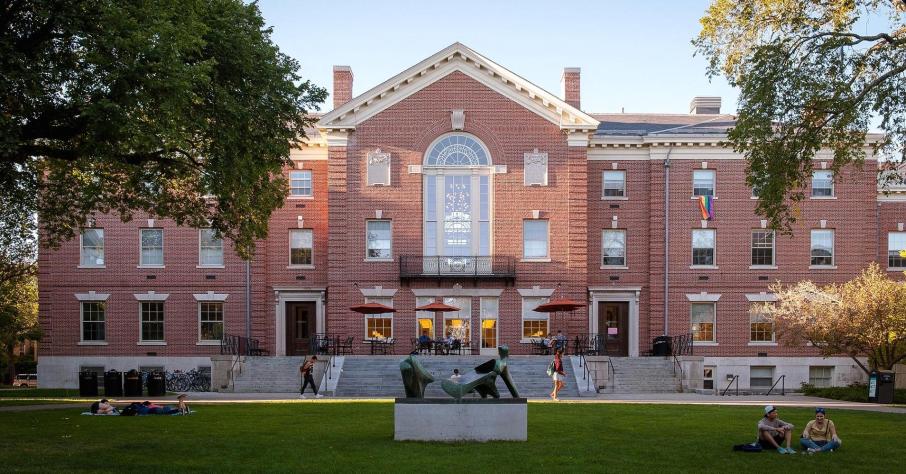
After examining the map, Lorelai surprises Rory by driving her to Harvard University, which is in the city of Cambridge in Massachusetts, part of the Boston metropolitan area. Why Rory didn’t think of it herself is really the big surprise in this scene – surely she knows where Harvard is, and wouldn’t she have been begging her mother to take her there? Apparently not, as they get all the way to the front gates before Rory seems to realise where they are.

Rory wants to get a guide to the university – Harvard offers free one-hour guided group tours of its campus, given by students. Lorelai opts for the self-guided tour: you can navigate yourself around the university with the help of a brochure. Rory already knows the foundation date of Harvard (1636) by heart.

Lorelai reads about important scientific discoveries made at Harvard. The idea for the pacemaker was first originated by John Alexander McWilliam from Aberdeen University in 1889, while the first pacemaker was devised by Mark C. Lidwill from the Royal Prince Alfred Hospital and Edgar H. Booth from the University of Sydney in 1926. The brochure is probably talking about Paul Zoll (1911-1999) from Harvard Medical School, one of many who helped develop and refine the pacemaker during the 1940s and ’50s.

The other scientific advances mentioned seem to be referring to Sheldon Glashow (born 1932), a Nobel Prize-winning physicist who is a Professor of Physics at Harvard University. In 1964, in colloboration with James Bjorken, he was the first to propose the existence of the charm quark, which helped to solve a number of problems in quantum field theory. In 1973, in colloboration with Howard Georgi, he proposed the first grand unifed theory, a model in which the interactions of electromagnetism, radioactivity, and nuclear forces are merged into one single force.

Lorelai is disturbed to see that out of 18 000 applicants to Harvard in the previous year, only 2000 were accepted. It’s a piece of news she should already know by now, and comes as a stiff reality check. Possibly for the first time, Lorelai gets an inkling that Rory’s dream of going to Harvard may be out of reach. The odds are even worse now – although Harvard still accept around 2000 students per year, nearly 40 000 applied to graduate in the year of 2022.

The scenes of Harvard were filmed at the University of California, Los Angeles campus in Westwood, which doesn’t resemble Harvard University. The front gates that Rory and Lorelai enter were made for the show.

Places on the Map

RORY: Well, I didn’t want to drive around aimlessly again today. [pulls out map]
LORELAI: I got it, I got it. So what’s near?

Concord is a town in Massachusetts, part of the Greater Boston area, with a population of around 17 000. It is important historically as the scene of the first battle in the American Revolutionary War, the Battle of Lexington and Concord in 1775. In the 19th century it became a focus for literary life as the home of Ralph Waldo Emerson, Nathaniel Hawthorne, Amos Bronson Alcott, Louisa May Alcott, and Henry David Thoreau. The Concord grape was developed here, hence Lorelai’s implication that there’s nothing to do there except eat grapes (in fact there are a plethora of interesting activities in Concord, and it’s a popular tourist destination).

Manchester is probably referring to Manchester-by-the-Sea, a small coastal town of around 5000 on Cape Ann in Massachussets. Blessed with scenic beaches, it has been a fashionable summer resort since the 19th century.

Salem is a historic coastal city in Massachusetts with a population of around 40 000. One of the most important seaports in Puritan history, its cultural identity comes from the fact it was the scene of the infamous Salem witch trials in 1692, as featured in Arthur Miller’s play The Crucible, previously discussed. Witchcraft history and culture is a major tourist drawcard to the city, and Lorelai seems quite interested in visiting it for that reason.

Boston [pictured] is the capital of, and largest city in Massachusetts; with a population of around 685 000, it is the largest city in the whole of New England, and the Greater Boston area contains more than 4.5 million people. It was founded in 1630 on the Shawmut Peninsula by Puritan settlers from England, making it one of the oldest cities in the US. It was the scene of numerous major events during the American Revolutionary War, including the Boston Massacre, Boston Tea Party, and the Battle of Bunker Hill. Historically a major port and manufacturing hub, it is also a centre of education and culture with numerous colleges and universities, and attracts many tourists. Boston has the first and oldest state school in the US (Boston Latin School, founded 1635), the first and oldest public park (Boston Common, established 1634), and the first and oldest subway system (Tremont Street Subway, built 1897).

Newton is a city in Massachussets, one of the suburban districts of Boston, with a population of around 85 000.

Needham is a town in Massachusetts, a suburb of Boston, with a population of around 28 000. The mention of Newton and Needham are clues that Lorelai is looking at the suburbs of Boston.

All these locations are around an hour’s drive from Portsmouth, making them easy day trips.

Brown

WOMAN (to Rory): We have a son just a bit older than you.
MAN: He’s not good enough for her.
WOMAN: Oh, Dave. He’s a freshman at Brown.
MAN: He majors in MTV.

Brown University is a private Ivy League university in Providence, Rhode Island. It was founded in 1764, and was the first university to accept students regardless of their religion. It became fully co-educational in 1971 when its women’s college, Pembroke, merged with the university.

Brown is well regarded in the liberal arts, and its students were rated the happiest of any at American universities. It has a reputation for being free-spirited and iconoclastic, which fits in with the son taking (what sounds like) self-directed cultural studies.

Goodnight Spoon

WOMAN: So, what are the titles [of the books you’ve published]?
LORELAI: Well, there’s um, Goodnight Spoon and um, The Horse that Wanted to Bark.

The title Goodnight Spoon is a play on the classic children’s picture book Goodnight Moon by Margaret Wise Brown, illustrated by Clement Hurd. First published in 1947, it is a rhyming poem which features a bunny whose bedroom rital includes saying goodnight to everything around him. It remains a bestseller to this day.

There are many parodies of Goodnight Moon in existence; a few years ago Rolling Stone produced one called Goodnight Spoon, a supposed children’s book written by Keith Richards. I don’t know if Gilmore Girls gave them the idea or not.

The Horse That Wanted to Bark is a parody of the many, many children’s book titles that are [Animal] Who Wanted [Something]. A few examples are The Puppy Who Wanted a Boy by Jane Thayer, The Cat Who Wanted to Go Home by Jill Tomlinson, and The Mouse Who Wanted to Marry by Doris Orgel.

Hummingbirds

LORELAI: What are you people doing?
LADAWN: We’re watching hummingbirds.
WOMAN: They’re still out there if you wanna scooch in.
MAN: They’re the darndest things. Flap their wings a hundred times a second. It’s an engineering marvel.

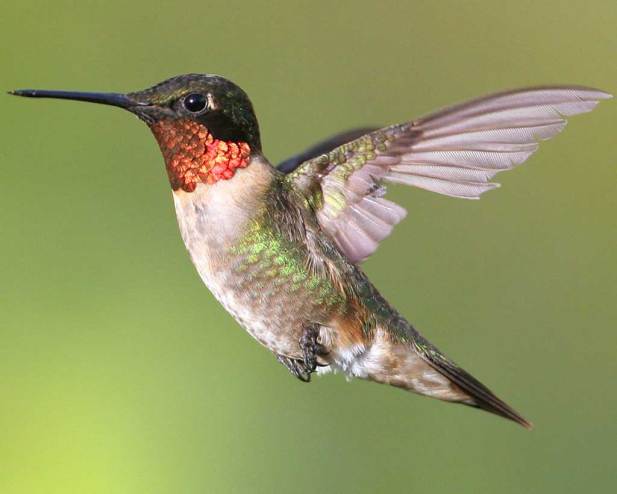
The hummingbirds the B&Bers are watching are most likely Ruby-Throated Hummingbirds (Archilochis colubris), the most common hummingbird in the eastern states of the US, and found during the summer months. Other species of hummingbird have only been rarely sighted in Connecticut. Unfortunately for this episode, Ruby-Throated Hummingbirds are solitary and aggressive towards others of its kind, so there would not be multiple hummingbirds to see all at once.

This species of hummingbird can flap its wings up to eighty times a second – quite close to a hundred times a second.

David Lynch

LORELAI: We are not gonna have this fight in a flowery bedroom with dentists singing Gypsys, Tramps and Thieves [sic] in the background. It’s too David Lynch!

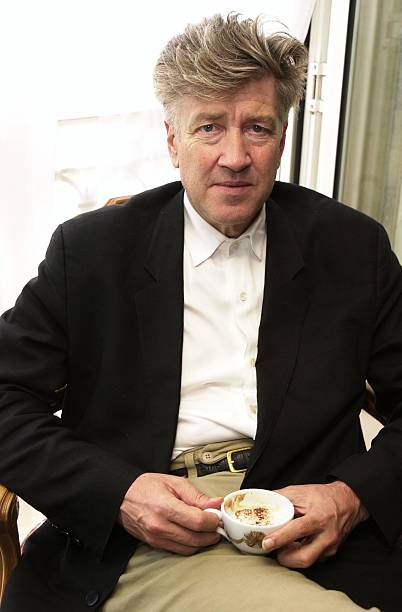
David Lynch (born 1946) is an American film maker, musician, actor, and artist. His first feature-length work was the surrealist horror film Eraserhead (1977), which became a cult classic, and he gained mainstream success with the biographical film The Elephant Man (1980), previously mentioned. The science-fiction epic Dune (1984) was a failure, while his mystery film Blue Velvet (1987) was controversial upon release, but now regarded as one of the greatest films of its era.

He is well known for his mystery horror television series Twin Peaks (1990-1991), which was a smash hit around the world, quickly gained a cult following, and caused him to be labelled the “first popular Surrealist”. He also directed Wild at Heart, earlier mentioned as a film Nicolas Cage starred in.

It becomes apparent during the show that Lorelai is a David Lynch fan.

Gypsys, Tramps & Thieves

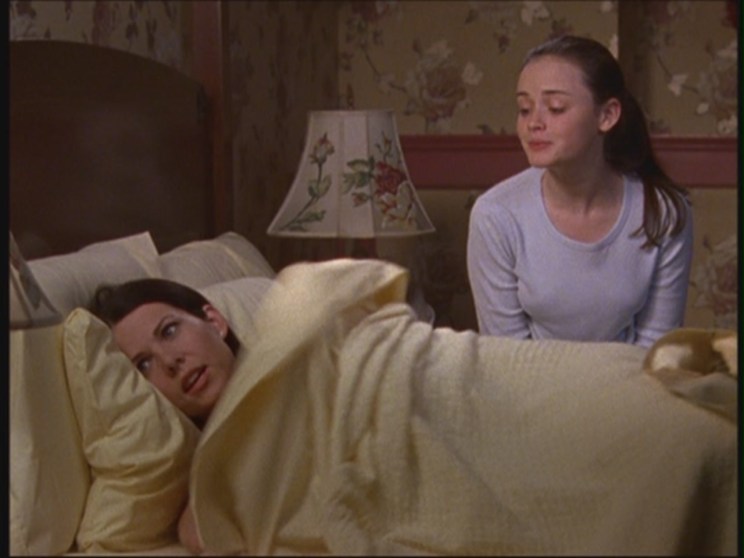
LORELAI: Rory, stop it! We are not gonna have this fight in a flowery bedroom with dentists singing Gypsys, Tramps & Thieves in the background.

Gypsys, Tramps & Thieves [sic] is a 1971 song written by Bob Stone, and performed by pop singer Cher, from her self-titled seventh album. It went to #1 in the US and Canada, becoming Cher’s first #1 single as a solo artist. It gave her a comeback after four years out of the Top Ten, and was her best-selling single to that point. So successful was the song that the album was renamed Gypsys, Tramps & Thieves [sic] after the song, and re-released.

The song is about a multi-generational family in a “travelling show” – the “gypsies, tramps and thieves” of the title, which are the insults hurled at them by the public. Like Highway to Hell, this is another song about life on the road, in line with the episode’s main event of a road trip.

“I was counting on this!”

RORY: We had plans! We made space in the closet!
LORELAI: Oh Rory, just because we moved a couple of boxes is not reason enough for me to get married!
RORY: Max was counting on this! I was counting on this!

After behaving with callous indifference towards Max and showing a deep cynicism towards his upcoming wedding with Lorelai, Rory is suddenly extremely upset that the whole thing is off. It turns out that she actually cares about Max, and was heavily invested in the relationship, despite zero evidence of that.

U2

LORELAI: I have earned the right not to be quizzed about my social life by my sixteen-year-old daughter.
RORY: I thought I was your best friend!
LORELAI: When we’re at a U2 concert, you are my best friend. But right now you are my sixteen-year-old daughter and I am telling you I do not want to have this conversation.

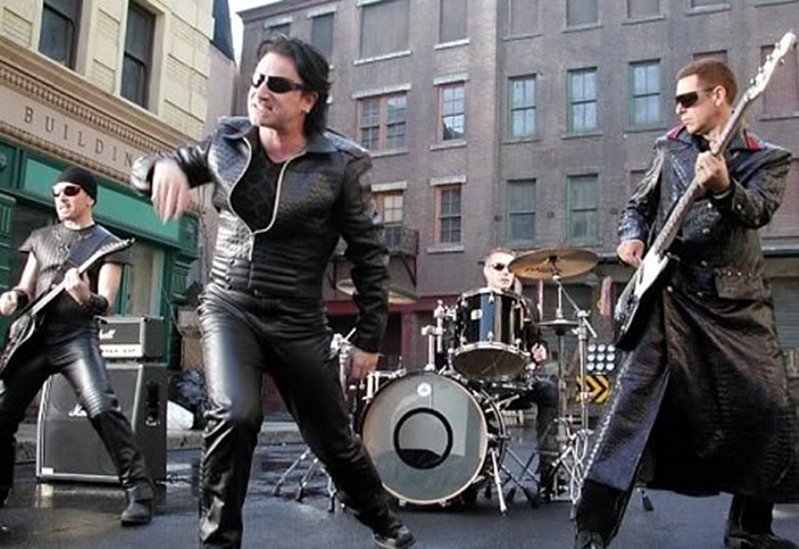
U2 are an Irish rock band, earlier mentioned. It was formed in 1976 and consists of Bono (Paul Hewson), The Edge (David Evans), Adam Clayton, and Larry Mullen Jr. Their debut album was Boy (1980), and their first #1 album in the UK was War (1983), with singles such as Sunday, Bloody Sunday and Pride (In the Name of Love) establishing their reputation as politically conscious. By the mid-1980s they were globally renowned as a live act, and their 1987 album The Joshua Tree made them international superstars; it remains their greatest commercial and critical success. Their most recent album from Lorelai’s viewpoint is All That You Can’t Leave Behind, released in 2000. One of the world’s best-selling musical acts, U2 have won 22 Grammy Awards, more than any other band, and were inducted into the Rock and Roll Hall of Fame in 2005. They are famous for their campaigns for human rights and social justice.

This establishes Lorelai as a U2 fan. U2 gave a concert in Hartford as part of their Elevation tour on June 3 2001, although in the Gilmore Girls universe it seems to have taken place around mid-May – this was the concert that Tristan offered to take Rory to on a date (with PJ Harvey as the support act). It doesn’t seem plausible that Lorelai and Rory attended the concert, although it is just possible, particularly if they went to the real-life concert rather than the fictional one in the show.

U2’s previous concert in Hartford was as part of their Zoo TV tour, and it took place on March 12 1992 – this is the only other U2 concert that Lorelai could have taken Rory to. Unfortunately, the concert would have been when Rory was eight years old, and later Lorelai says that Rory thought she “discovered” U2 when she was ten; Rory could hardly believe that after attending an elaborately staged concert by the band two years before. It is possible that Lorelai is referring to a purely hypothetical U2 concert.

Lorelai lets Rory know that the idea of them being “best friends” is something of a fiction, being entirely at Lorelai’s convenience. As long as Rory is doing exactly as Lorelai wants, they are best friends; once she deviates from that, they are back to being mother and daughter.