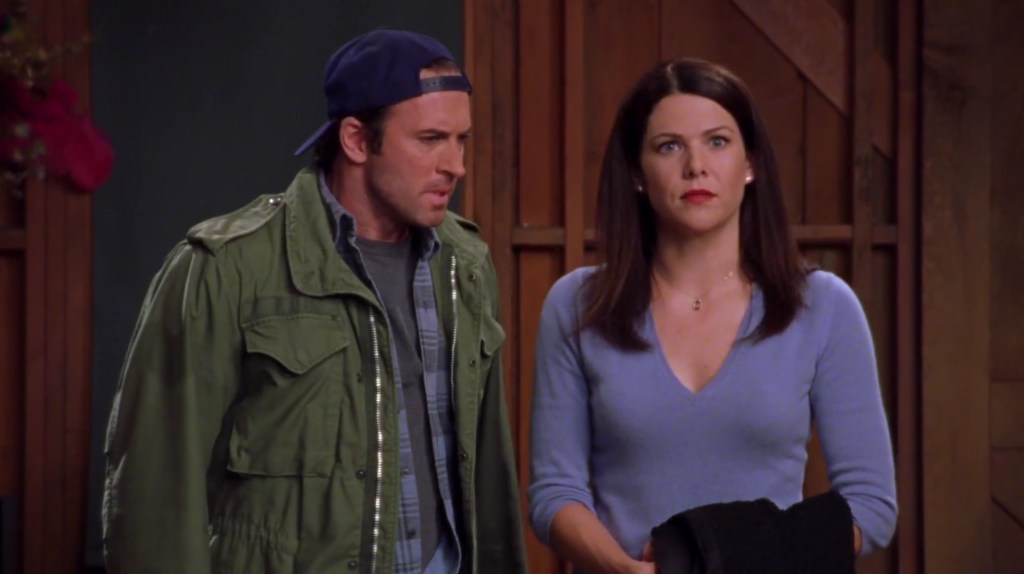
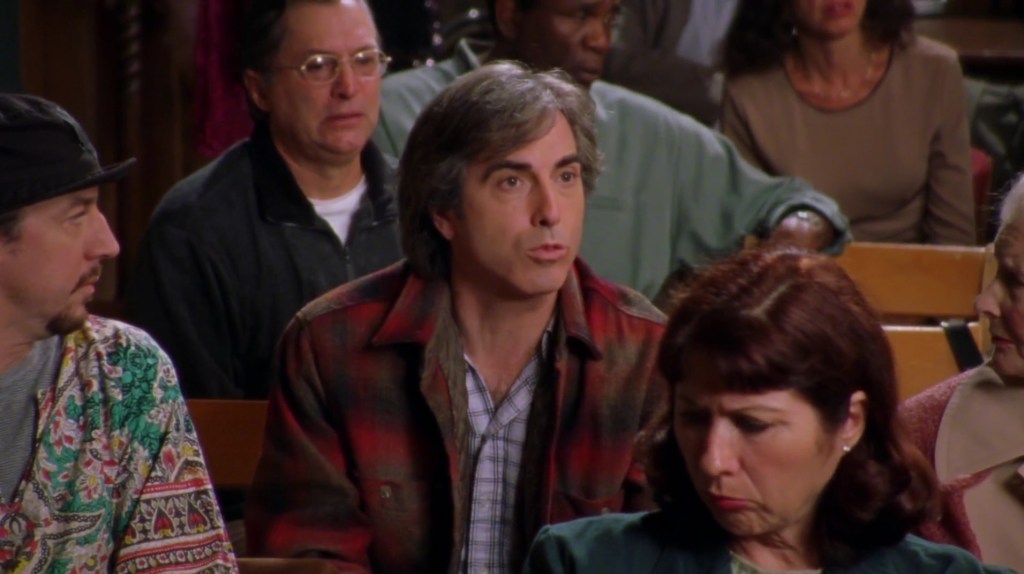
Taylor and the rest of the town don’t seem able to understand what Luke is saying (he is slightly incoherent with rage), so Lorelai “translates” for him, standing shoulder to shoulder with Luke to signify her support of him. She asks the town to let Luke handle any problems he might be having – if there is actually a problem, which Luke isn’t willing to acknowledge even exists.
She could have asked the town to be more understanding and accepting of Jess, and give him a chance, but I don’t think Luke would have appreciated that.
LUKE: Look, I’ve lived in this town my entire life, longer than most everybody here.
Luke’s is presumably only in his early thirties, and yet he’s already lived in Stars Hollow longer than most of the people at the town meeting, a sizeable proportion of whom are fairly elderly. There’s obviously many residents who have moved there from somewhere else. (Bootsy is quick to remind Luke that he’s lived there slightly longer, being five weeks older, and we know Fran Weston has been there all her life).
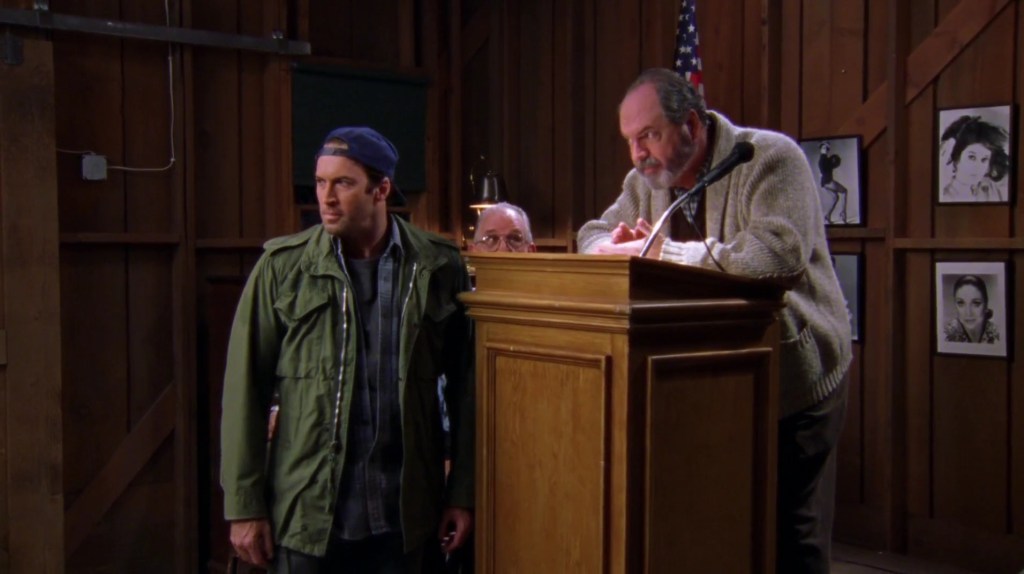
TAYLOR: The bottom line here is that there is a consensus among townspeople who are in agreement that Stars Hollow was a better place before Jess got here. LUKE: So this half of the room gets the tar, and the other half gets the feathers? TAYLOR: Well, there hasn’t been any talk of tar and feathers. Although …
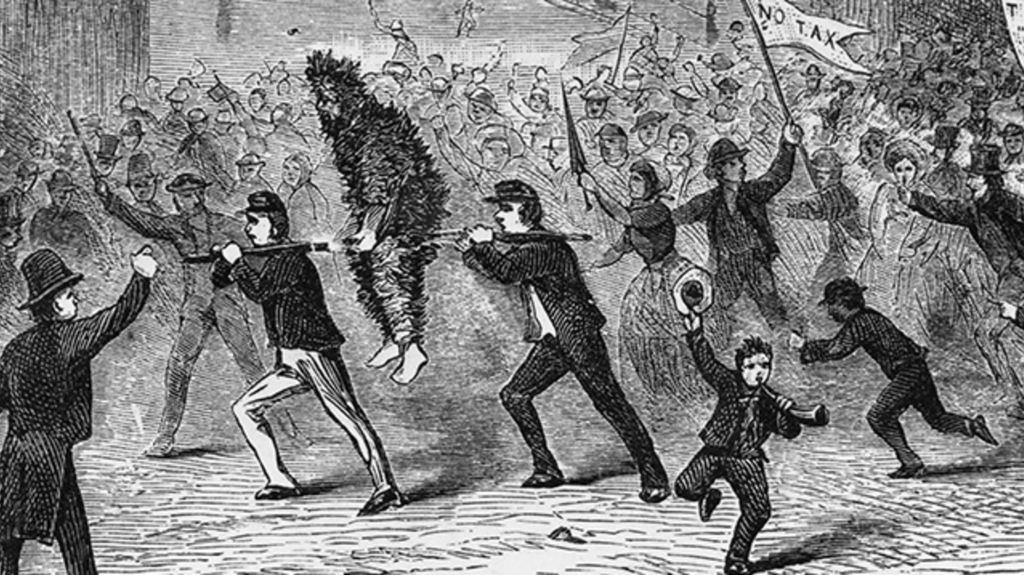
Tarring and feathering is a form of public torture and punishment handed out as unofficial justice, used in feudal England and colonial America, as well as the early American frontier, as a form of mob or vigilante vengeance. The last known example was in 2007 in Northern Ireland, against someone accused of drug-dealing.
The victim would be stripped naked or stripped to the waist, painted with hot tar, and then rolled in feathers (there were usually other punishments thrown in, such as whipping or scalping). The skin would be burned by the tar, and scraping it off later led to the skin being torn off, so it was extremely painful as well as humiliating. “Tarring and feathering” is now used as a term to denote severe public criticism.
Luke is saying the town meeting is on a par with the brutal mob justice associated with the Wild West, in agreement with Lorelai’s earlier comment. It is actually quite horrifying, because they seem to be saying Jess should be run out of town, even though he’s a high school kid who’s only guilty of petty theft and a few mild pranks.
It’s also baffling, because Jess isn’t exactly a stranger – he’s Luke’s nephew, Liz’s son, and the grandson of the respected William Danes. The town should be prepared to take him in as one of their own, and the fact that they won’t is a deeply troubling sign. Maybe there’s a good reason why Liz took off.
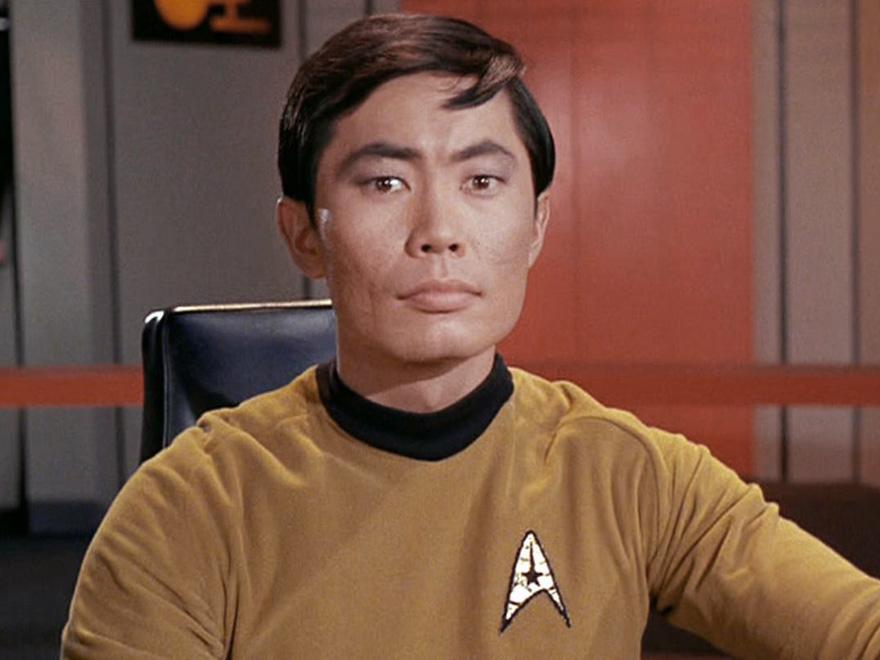
BOOTSY: This goes way beyond the Jess matter, Taylor. Luke’s been on my case since the first grade when he wrongfully accused me of sabotaging a clay imprint that he made of his hand. LORELAI: Ooh! Think hard, was he dressed like Sulu?
Lieutenant Hikaro Sulu is a character in Star Trek, played by George Takei in the original series. He is the ship’s physicist, third officer, and senior helmsman. He wears the same uniform as everyone else, so I’m not sure what Lorelai means about “dressed like Sulu”, unless she means “dressed like a Star Trek crew member”.
We now learn that as well as having an antagonistic relationship with Taylor, Luke also has a long-standing problem with Bootsy, his former classmate, going back to first grade. How many enemies does Luke really need?
Andrew from Stars Hollow Books is at the meeting, and says that his son told him about Jess setting off the fire alarms at the high school. We now discover that Andrew is the father of a boy, presumably a teenager. (He makes it sound as if he only has one son, although there may be daughters as well). He’s sitting next to Bootsy, as if they might be friends (or both in the trade of selling reading materials, so have something in common).
LORELAI: I heard [Jess] controls the weather and wrote the screenplay to Glitter.
Glitter is a 2001 romantic drama musical film directed by Vondie Curtis Hall, and starring Mariah Carey, previously discussed. The screenplay was written by Kate Lanier. The film is about a club dancer who aspires to be a professional singer, and falls in love with a nightclub DJ who helps her in her career.
The film came out on September 21, so Lorelai would have seen it in the cinema only recently. It was heavily panned by critics, with Mariah Carey’s acting efforts considered amateurish, and it failed at the box office. It has been called the worst film ever made. Even before the film was released, Mariah Carey was hospitalised with a breakdown, much later revealed to be bipolar disorder. Carey herself expressed a lot of regret over, and disappointment in, the film.
Amy Sherman-Palladino was one of the many people who hated Glitter, which is probably why it gets mentioned here as Lorelai’s joke about the “evil crimes” of Jess. Lorelai doesn’t like Jess, but even she thinks the town is going too far in their treatment of him. She has the good sense not to offer her own issues with Jess (stole beer, talked back to her, prowled around her daughter), as grist for the mill at the meeting.
Stole money from the bridge fundraising jar (money was returned)
Stole a gnome from Babette (gnome was returned)
Hooted one of Miss Patty’s dance classes (it’s not really clear if he hooted a horn or hooted in derision, either way, they’re just little girls, so kind of yuck)
Stole a hose from Fran’s front yard (was this payback for refusing to sell her inn to Rory’s mother?)
Set off all the fire alarms at the high school
Drew a chalk outline outside Doose’s Market so that Taylor lost business
The viewer might be getting the impression that Jess, although clearly a pest and a nuisance around town, is hardly committing any major acts of villainy. For some reason, the police don’t seem to be getting involved, even for petty theft, misuse of a fire alarm, or vandalism, and perhaps this lack of police action is one of the things fuelling the town’s frustration. It may also be spurring Jess on to further mischief, if he’s mostly doing this for attention or to prove he’s a “bad boy” so he’ll be sent back to his mother.
TAYLOR: When Mrs. Lanahan couldn’t buy her head of lettuce that morning for her lunch, she drove straight to Woodbury to buy lettuce from a competing market.
Woodbury is a small town in Litchfield County, Connecticut of about 9000 people, around ten miles from Waterbury, which is the nearest big town. In the Gilmore Girls universe, Woodbury is posited as the nearest town to Stars Hollow, and portrayed as something of a rival town (the Mount Pilot to Stars Hollow’s Mayberry).
In real life, Woodbury is about ten miles from Washington Depot, as if to underline that this is the inspiration for Stars Hollow, even though it contradicts other information, such as being half an hour’s drive from Hartford. However, if we placed Stars Hollow the same distance away in the other direction, roughly where Waterbury is, this would make it half an hour’s drive to Hartford, and also put it on the I-84and the bus route from New York to Hartford.
So this is a bit of geographic information that actually makes quite a bit of sense (of course often contradicted by various geographic impossibilities!).
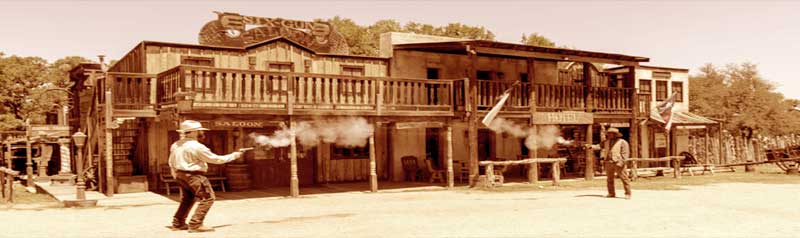
TAYLOR: You weren’t invited because we are dealing with the Jess situation. LUKE: The Jess situation? LORELAI: Uh oh. If this was the Wild West, we’d be pushing the horse aside and diving into the water trough right about now.
A trope in Western films, especially in comedy or parody versions – during a gun battle, those who are unarmed or incapable of fighting will dive into a nearby water trough to escape injury or death. Lorelai sees Taylor and Luke as the gunslingers, while they are the innocent bystanders.
LORELAI: Aha! LUKE: Geez! Don’t sneak up on me like that. LORELAI: Yeah boy, I was lucky you had your phasers on stun, huh?
Phasers are the standard weapon (and tool) of choice in the Star Trek universe, apparently giving off some kind of “beam” of pulsed energy. They can be set to stun, rather than kill, so that an opponent or threat is simply shocked, rather than vaporised.




 The Annotated Gilmore Girls