Billy Graham

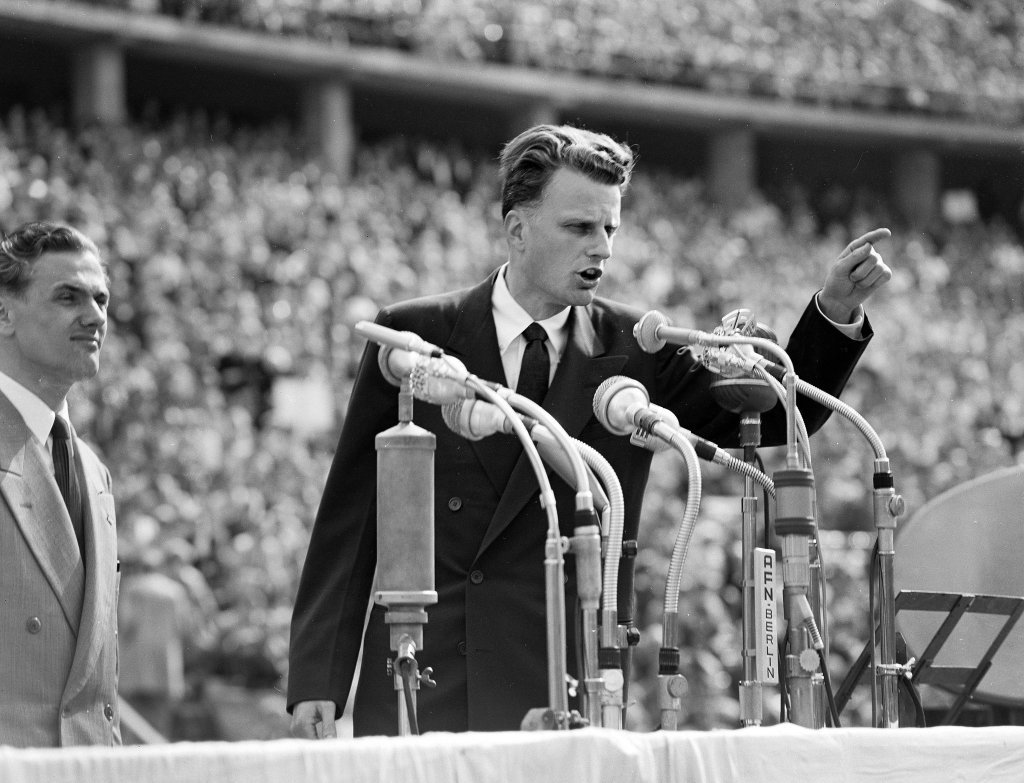
LORELAI: The Bible said all that, huh? Did it, did it mention me by name? I’m just . . . okay, I’m just kidding. So, um, judging by your Billy Graham impression, I am guessing that you didn’t send me an ice cream maker, so maybe you could just give me Aunt Clarissa’s phone number?

William “Billy” Graham (1918-2018) was a prominent American evangelist and ordained Southern Baptist who became well-known internationally in the 1940s. He held large outdoor rallies and his sermons were broadcast on television from 1947 to 2005, with an entire lifetime audience of over two billion, meaning he preached the Gospel to more people than anyone in history. He repudiated racial segregation, and invited Martin Luther King Jr to preach alongside him at a joint rally in 1957. He became the spiritual adviser for every US president from Harry S. Truman to Barack Obama.
On the Town

RORY: How did [Tristan] fall in with those guys [Duncan and Bowman]?
MADELINE: The new year started and there they were, all three of them, side by side.
LOUISE: And practically dressing the same.
MADELINE: It’s very On the Town.

On the Town, a 1949 musical film directed by Gene Kelly and Stanley Donen, based on the 1944 Broadway musical with music by Leonard Bernstein and Roger Eden. It stars Gene Kelly, Frank Sinatra and Jules Munshin as three sailors with a day’s leave in New York City, and their romantic escapades. An immediate succeess, it won the Oscar for Best Music and is regarded as one of the greatest musicals.

Like the three sailors, Tristan and his new pals all dress the same – although as there’s a school uniform, doesn’t everyone dress the same anyway?

Butch Cassidy and the Sun-dunce Kid

RORY: Tristan got suspended again? … What did he do? …
MADELINE: Took apart Mr. McCaffey’s car and put it back together in the science building hallway …
LOUISE: Yeah, well he didn’t do it by himself. Duncan and Bowman were there too …
PARIS: Hey, anyone stupid enough to hang out with Butch Cassidy and the Sun-dunce kid deserves whatever they get.

Paris references the 1969 Western film Butch Cassidy and the Sundance Kid, directed by George Roy Hill and written by William Goldman. The film is about the real life early twentieth century train and bank robber Robert Parker, better known by his alias, “Butch Cassidy” (played by Paul Newman), and his accomplice Harry Longabaugh, “The Sundance Kid” (played by Robert Redford).

Although the film became #1 at the box office for 1969, initial reviews were mixed. Over time, critics have warmed to it, and it is now considered a classic. Butch Cassidy and the Sundance Kid won four Academy Awards, including Best Original Screenplay.

Sock Hops and Clambakes

PARIS: I’d really like to get an ‘A’ on this assignment, and in order to do that I’m afraid you’re gonna have to discuss your sock hops and your clambakes some other time, okay?

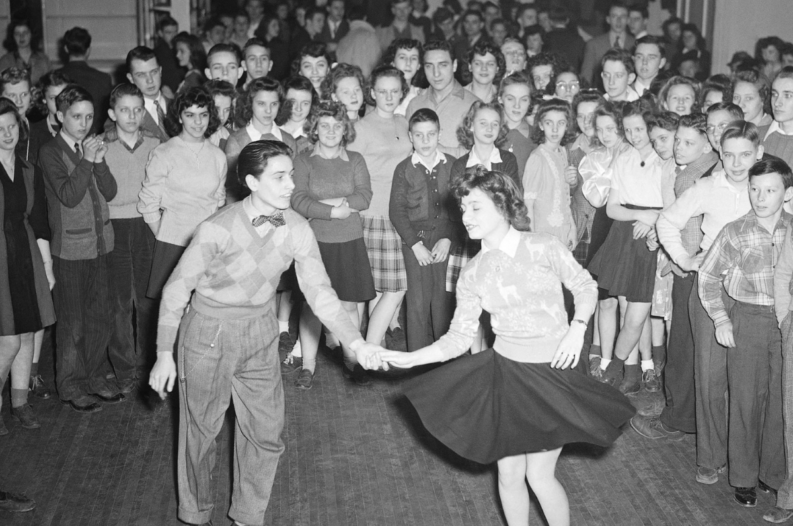
A sock hop [pictured] was an informal sponsored dance event for teenagers in the 1940s and ’50s, commonly held at high school gyms and cafeterias, and often as a fundraiser. The name comes from the fact that dancers were asked to remove their shoes so as not to damage the varnished floor of gymnasiums. The name was dropped once sneakers became common, so shoes could be worn. What we’d call a “school dance” today.

A clambake is a traditional method of cooking shellfish, such as lobsters, clams, and mussels, by steaming them over seaweed in a pit oven. Vegetables such as potatoes, onion, carrot and corn can be added. Usually held as festive occasions along the New England coast.

Chang and Eng

PARIS (to Rory): Why don’t they just sew our sides together and rename us Chang and Eng?

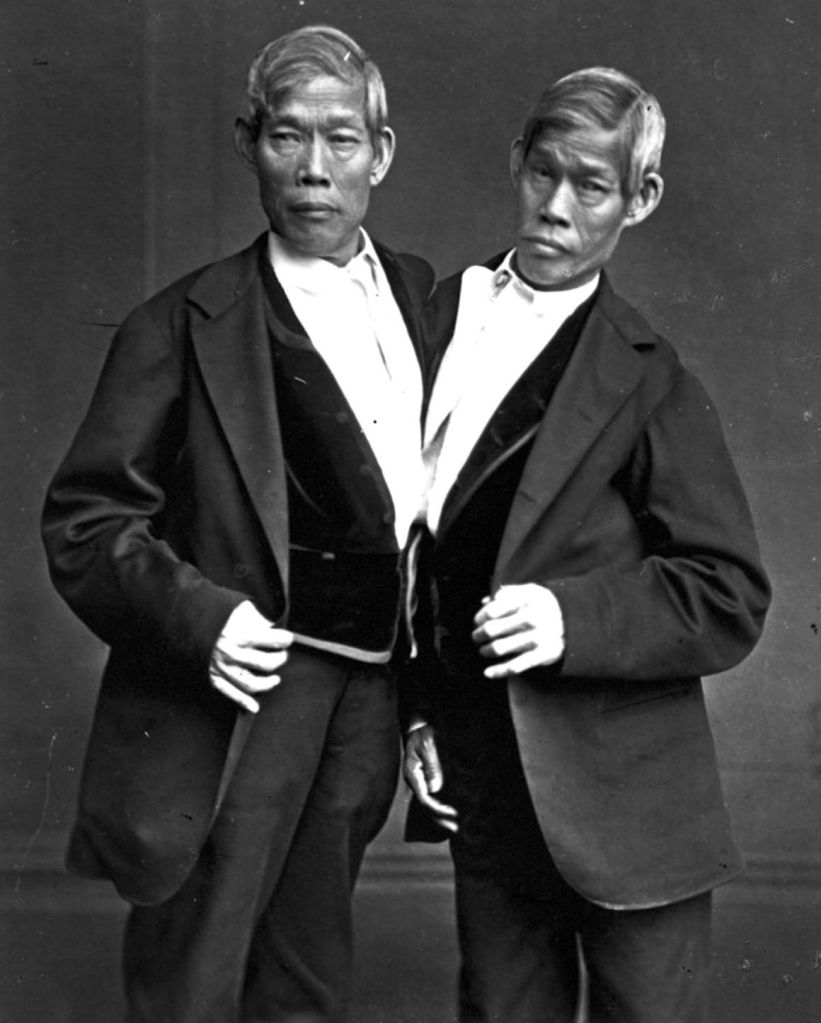
Chang and Eng Bunker (1811-1879), Siamese-American conjoined twins of Chinese ancestry, previously mentioned. Born in modern-day Thailand (then called Siam), they were brought to the US in 1829, and became wealthy by exhibiting themselves in “freak shows”. After ten years, they retired from touring, became American citizens, bought slaves, married two sisters, and fathered twenty-one children between them. For many years, conjoined twins were called “Siamese twins” because of Chang and Eng’s birthplace.

Richard III, The Sonny and Cher Show

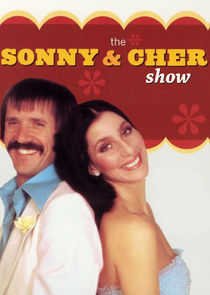
PROFESSOR ANDERSON: Last year, we did Richard III. One group did their scene as the Mafiosi. Another set theirs during the Roman Empire. And my favorite, the climactic last scene was set during the final days of The Sonny and Cher Show. Just remember, whatever interpretation you choose should highlight the themes you see in the scene. And if the love of the Bard’s language still doesn’t inspire you, remember this will be fifty percent of your final grade.

Richard III is a historical tragedy by William Shakespeare, probably written around 1593. It is one of the longest of his plays, and is often abridged for performances. It is about King Richard III of England, depicted in the play as an ugly hunchback and an absolute villain. The final scene is set at the Battle of Bosworth, when Richard’s supporters desert him; he is killed by the Earl of Richmond, who claims the throne as Henry VII.

The Sonny and Cher Show was a 1976-77 television variety show with music and comic sketches, which followed on from The Sonny & Cher Comedy Hour (1971-74), The Sonny Comedy Revue (1974), and Cher (1975). Sonny and Cher got divorced, hence the separate shows, but with the bitterness of their divorce behind them, they came back with another show made together, although slightly more subdued in tone. Variety shows were on their way out, and the final few episodes were quickly aired in a late-night Monday evening time slot – this would have been the “final days” of the show. In the last episode, Tina Turner was the guest star.

The Shakespeare Project

PROFESSOR ANDERSON: Believe it or not, Shakespeare probably never intended his plays to be read by students sitting at desks more concerned with getting As than with the fate of Macbeth. His plays were meant to be experienced, lived. So with that in mind, together with my third period Shakespeare, you’ll be split up into five groups and each group will assume responsibility for one act of Romeo and Juliet, which will be performed a week from Sunday. You will nominate the director, you will cast the scene, rehearse the scene, and interpret the scene in your own individual manner.

This is the main plot of this episode, revolving around the group project that Rory’s class is doing for English Literature (?). Her new teacher is Professor Anderson, according to the credits, so she no longer has Mr Medina, like at the start of this year. I’m not sure if he’s just conveniently faded out of the picture (like Mr Remmy did), or if Professor Anderson is teaching English instead.

Professor Anderson references Macbeth, previously discussed, a callback to it last being mentioned when Rory had to do a project outside class with Paris, Madeline and Louise. The project is focused on Romeo and Juliet, previously mentioned, a play which has become a touchstone for Gilmore Girls.

Saint Peter

LORELAI: Okay, clearly this is shaping up to be one of those moments that Saint Peter’s gonna show on the big video screen when I die, and I for one do not wanna see the three of us staggering around with cider ice cream slathered all over our faces while my soul hangs in the balance, so until I can find out who sent this, no one goes near it.

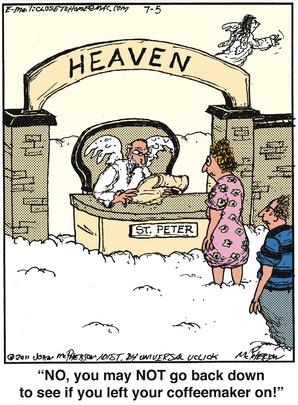
Saint Peter was one of the Twelve Apostles, and a major leader of the early Christian church – by tradition, the first bishop of Rome, or first pope. The Gospel of Matthew speaks of Jesus giving Peter the keys to the kingdom of Heaven. In modern depictions, particularly cartoons and jokes, he is literally the keeper of the gates of Heaven, and responsible for deciding who is allowed in and who isn’t.

Emily Post and Martha Stewart

LORELAI: Okay, once again, I bring up the fact that this is a wedding present, and as I am not getting married, neither God’s law nor Emily Post allows me to keep this …
SOOKIE:
[Martha Stewart] said that if it arrives after ten weeks …
RORY: Eight.
SOOKIE: …eight weeks, that you don’t have to return it.

Emily Post and Martha Stewart, both previously discussed. The program that Sookie watched was Martha Stewart Living.

There is, of course, no such “wriggle room” rule in etiquette (Sookie and Rory invented it because they want the ice cream maker). If your wedding is cancelled, you return all the gifts, no matter how late they arrive (unless the sender specifically tells you to keep it, which does sometimes happen).

However, if a gift arrives with no name attached to it, then there is little you can do, because it’s considered even ruder to ring around and ask people if they sent such-and-such (it seems like you’re criticising them for not sending it, and assume they are too dim-witted to attach a name to it). You could try to find out the sender by calling the company who delivered it, but after that there’s not much you can do. If conscience smites you, you can always donate it to charity, or sell it and donate the money.

Lorelai must surely suspect her mother of sending it, yet she’s the one person that Lorelai doesn’t ask, as if she doesn’t want to know.

Sookie says it is more than ten weeks since the wedding was cancelled, and Rory corrects her to more than eight weeks. In fact, it is just over twelve weeks since Lorelai and Max’s wedding was meant to take place.