[the referee drops the puck to start the game] KIRK: And the puck is down as the first quarter begins. Period, sorry. First period begins, my bad.
American football games are divided into four quarters of 15 minutes each. Hockey has three periods, lasting 20 minutes each, with two intermissions of 15 minutes.
KIRK: People of Stars Hollow, are you ready to rumble?
A variation of the catchphrase, “Let’s get ready to rumble” used at boxing matches and professional wrestling matches. It was created and trademarked by ring announcer Michael Buffer, who has made $400 million from licensing the phrase. The show perhaps uses a different form of it to avoid having to pay a fee.
As will become apparent, Kirk muddles up all his sports while working as the announcer at the hockey game.
The national anthem of the US, which is sung by Miss Patty and Babette at the hockey game.
The lyrics come from the “Defence of Fort M’Henry”, a 1814 poem by lawyer Francis Scott Key after witnessing the bombardment of Fort McHenry by British ships of the Royal Navy during the Battle of Baltimore in the War of 1812. Key was inspired by the large US flag, with 15 stars and 15 stripes, known as the Star-Spangled Banner, flying above the fort during the US victory.
The poem was set to the tune of a popular British song by John Stafford Smith, called “To Anacreon in Heaven”, which was already popular in the US. “The Star-Spangled Banner” soon became a well-known US patriotic song, famously known for being very difficult to sing. Although the poem has four stanzas, only the first is commonly sung today.
“The Star-Spangled Banner” was first recognised for official use by the US Navy in 1889. In 1931 it became the official national anthem of the US.
LORELAI: It’ll be fun. There’ll be cheerleaders and clowns, people doing the wave. RORY: You have no idea what a hockey game is, do you?
The wave (known as the Mexican wave or the stadium wave outside North America) is an audience participation move where successive groups of spectators briefly stand, yell, and raise their arms. Immediately upon stretching to full height, the spectator returns to the usual seated position.
The result is a wave of standing spectators that travels through the crowd, even though individual spectators never move away from their seats.
It first appeared at a hockey game in Denver in 1979, a move claimed to be invented, then perfected, by professional cheerleader Krazy George Henderson. It began to be adopted internationally after broadcast coverage of the 1986 FIFA World Cup in Mexico, leading to the act being known as a “Mexican wave” in some countries.
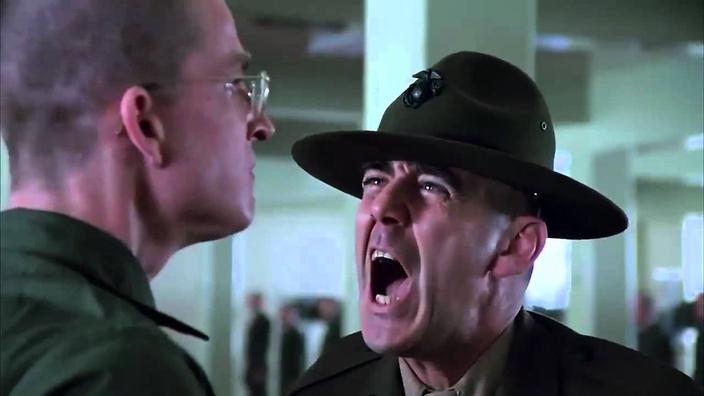
ZACH: Dude, remember the drill instructor in Full Metal Jacket? BRIAN: Totally.
Full Metal Jacket, 1987 war drama film directed, produced, and co-written by Stanley Kubrick. It is based on the 1979 semi-autobiographical novel, The Short-Timers, by Marine Corps veteran Gustav Hasford, who was also one of the screenwriters, and stars Matthew Modine, Lee Ermey, Vincent D’Onofrio and Adam Baldwin.
The storyline follows a platoon of US Marines through their training who struggle under their abusive drill instructor Gunnery Sergeant Hartman (Lee Ermey). It was the last of Stanley Kubrick’s films to be released during his lifetime, and received critical acclaim, as well as being a commercial success. It is regarded as one of the most exciting films ever made.
Zach and Brian liken Mrs Kim to Gunnery Sergeant Hartman for her level of scariness.
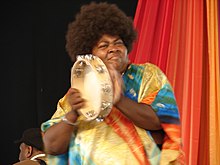
MRS. KIM: Where’s your tambourine? DAVE: We don’t have one. MRS. KIM: Next time bring one.
Tambourine, a small, typically handheld, percussion instrument, with pairs of metal jingles, which are called zills. In use since ancient times, they have a long history being used for religious music, a tradition which goes back at least since the Old Testament.
The monthly meeting included a luncheon, but this DAR luncheon is presumably something separate from, and far more elaborate than, the monthly meeting luncheons. Lorelai books the DAR luncheon for the 15th March, which was a Saturday in 2003. (There may be some joke here about the Ides of March – the 15th of March – the day on which Julius Caesar was assassinated).
MAN 2: I was in France during the Big One. MICHEL: Oh, that’s nice. So – MAN 2: Nice? It was a war. What’s nice about that?
The Big One, an informal name for World War II.
This Doose relative is played by veteran actor Bob Larkin. He was born in 1929, so when World War II broke out, he was only ten years old. His character is apparently meant to be about ten years older than the actor’s real age.





 The Annotated Gilmore Girls