[Lane takes off her Dead Kennedys shirt; underneath is a shirt that says Trust God]
DAVE: Trust God – is that a band?
LANE: No. My life.
Right from the start Dave knows that Lane is a Christian, and that she has to hide her love of rock music from her family. She makes no attempt to laugh off the shirt or pretend that it’s a band name, or some kind of ironic joke. Whatever Dave feels about Lane, he will have to accept who she is if they are to have a chance together.
In the US, a junior college is a two-year post-secondary school whose main purpose is to provide academic, vocational and professional education. The highest certificate offered by such schools is usually an Associate degree, although junior college students may continue their education at a four-year university or college, by transferring some or all of their credits earned.
Dean might be planning to attend Goodwin College, a junior college in East Hartford that used to be a school of business. They have student housing available so that Dean would be able to live on campus.
There are three junior colleges in Boston – Bay State College, Fisher College, and Labouré College of Healthcare, which provides training for nurses and is probably not for Dean. Bay State and Fisher are mostly for business and administration degrees. Both Bay State and Fisher do have halls of residence for students to stay in, so Dean isn’t correct about that.
RORY: Christiane Amanpour spends half of her life standing in foxholes in third world countries, and she has a husband and a kid. And she was on C-SPAN last week getting some award, so if she and her husband can make it work, we can.
DEAN: So we’ll have access to the CNN jet?
Christiane Amanpour, previously discussed as Rory’s idol. From 1998 to 2018 she was married to James Rubin (born 1960), former Assistant Secretary of State and spokesman for the US State Department during the Clinton administration, and was an informal adviser to Hillary Clinton. Their son Darius Rubin was born in 2000, so aged two years old at this time. Because of Amanpour’s career, her husband James did spend a lot of time home alone with the baby, keeping in touch with his wife by telephone.
In real life, Amanpour received two awards in 2002. The Goldsmith Career Award for Excellence in Journalism was presented to her at Harvard in March, and the Edward R. Murrow Award for Distinguished Achievement in Broadcast Journalism was presented to her at Washington State University in May. Neither of those were “last week” from Rory’s perspective, although it’s possible she only saw the broadcast of one of them on C-SPAN the week before.
Christiane Amanpour worked for CNN from 1983 to 2010, so throughout the run of Gilmore Girls. As chief foreign correspondent, she reported on crises from many of the world’s hotspots, and in 2002 had filed reports from the Gaza Strip, famously interviewing Yasser Arafat in his compound by phone.
[Picture shows Christiane Amanpour, her husband James, and son Darius in London, 2003]
DEAN: So you’ll come home, do homework all weekend, then leave.
RORY: No, I can do my homework during the week or on the train coming home to see you, who I will spend my weekends with not doing homework. Plus, we can talk during the week on the phone constantly. Trust me, it’ll feel like I never left.
In real life, it’s a three and a half hour train trip from Boston to Hartford, requiring a change at New Haven. Then Rory would need someone (Dean?) to pick her up from the Hartford station for a thirty minute drive home to Stars Hollow. It sounds very tedious to do regularly – of course, she has to go back again every Sunday, so that’s eight hours of travel every weekend! That does give her free time to study though, I guess.
As it happens, Rory doesn’t go to Harvard in the end, and she has a car by then anyway, so this impractical plan never gets put into operation. It does sound as if she hasn’t thought about it very hard though.
[Picture shows South Station in Boston, from where Rory would need to catch a train. It’s a 15 minute bus ride from Harvard, so add a bit more time on for that].
DEAN: When you leave for Harvard . . . do we break up?
Rory acts as if Dean is being unreasonable to ask this question, but it doesn’t really seem so. After all, Zach and Liza broke up when they left Hartford to attend different universities. A lot of young couples break up when one or both go away to college, being realistic enough to know that long-distance relationships don’t usually work out for teenagers.
It does seem a bit premature to bring it up already – Rory hasn’t even applied to Harvard yet, let alone been accepted. It also comes out of the blue, as the pair of them were kissing, holding hands, and smiling together just seconds previously.
It feels as if Dean is either trying to ruin their last year together, or is pushing Rory for some kind of commitment. He must be feeling pessimistic about their future together, and probably rightly so, when they are headed in very different directions. I do sense a jealousy and possessiveness from Dean in regard to Rory’s education, as if it is taking her away from him.
British slang meaning “to kiss and fondle in a sexual way”, the equivalent of the American slang, “making out”. In fact, Rory and Dean have a very chaste kiss in front of Lorelai, they don’t actually do any real snogging.
LANE: No, don’t apologize, I love you . . . for that, for being that way. I love it.
Lane tells Dave she loves him within a few minutes of meeting (not like Rory, who took months of dating before she could say it to her boyfriend). Rory and Lorelai can see at once that Lane and Dave are a perfect match, meaning that Lane is about to get her own romantic subplot.
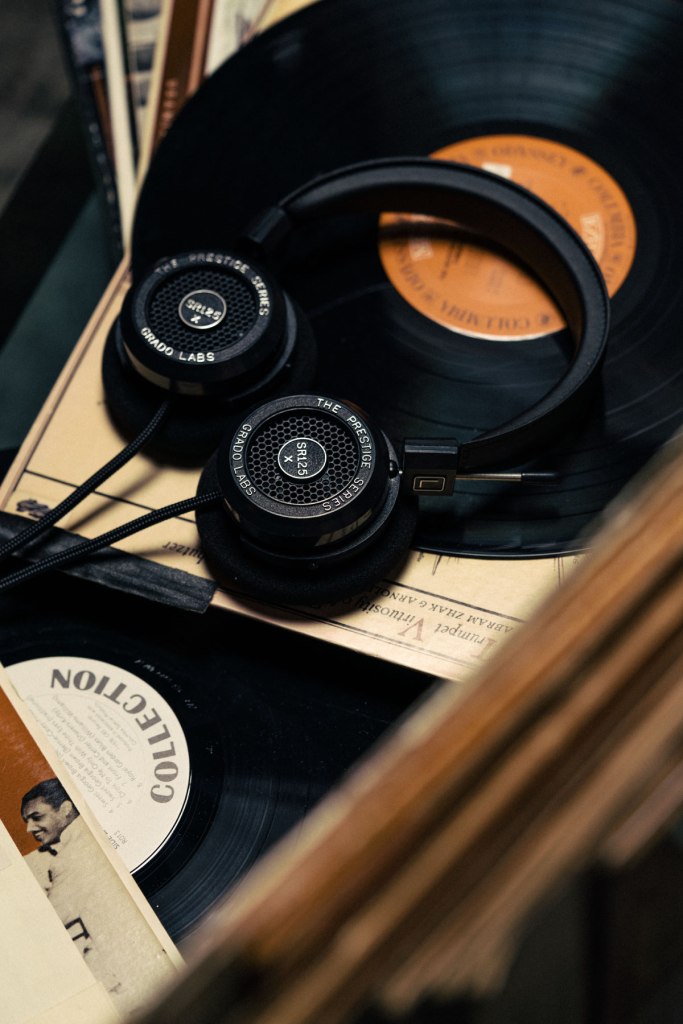
DAVE: Well, this is a headphone amp and it just boosts the volume and makes the clarity off the hook, and then these are Grado 125s, which is just really, killer, killer portable sound.
A headphone amplifier, or headphone amp, is a low-powered amplifier that raises the low-voltage signal from an audio device so that it can be converted into sound waves by the speakers inside headphones. It works like the amps used to power full-sized speakers at a lower scale.
Grado 125s [pictured] are headphones made for the home market by Grado Labs in Brooklyn. They are stylish, reasonably priced, and good quality, but apparently not very comfortable to wear.
DAVE: I can play you a song we demo’d a couple weeks ago using a drum machine.
A demo (short for demonstration) is a song or group of songs recorded by a band that can be handed on to record labels, producers, or other artists. Bands also record demos for their own use and reference.
A drum machine [pictured] is an electronic musical instrument that creates percussion sounds, drum beats, and patterns. Drum machines may imitate drum kits or other percussion instruments, or produce unique sounds, such as synthesised electronic tones. A drum machine often has pre-programmed beats and patterns for popular genres and styles, such as pop music, rock music, and dance music. They have been commonly in use since 1980.
Dave’s band obviously used a drum machine on their demo because they didn’t have a drummer – now they do.
DAVE: We do a lot of cool covers – uh, the Clash, the Kinks, et cetera.
The Clash, English rock band formed in 1976, previously mentioned. Billed as “The Only Band That Really Matters”, they were key players in the original wave of British punk rock, contributed to the post-punk and new-wave movements, and used elements of a range of genres, including reggae, funk, and rockabilly. Their classic line-up was Joe Strummer (lead vocals, rhythm guitar), Mick Jones (lead guitar, vocals), Paul Simonon (bass), and Nicky “Topper” Headon (drums). The Clash achieved critical and commercial in the UK with their first two albums The Clash (1977) and Give Them Enough Rope (1978). Their third album, London Calling, gained them success in the US; released in 1979 in the UK, it was released in 1980 in the US and was named the best album of the 1980s by Rolling Stone. Combat Rock (1982) was even more successful in the US. The band broke up in 1986. The Clash were inducted into the Rock and Roll Hall of Fame in 2003, shortly after the death of Joe Strummer. They are regarded as one of the best bands of all time.
The Kinks [pictured], English rock band formed in 1963 by brothers Ray and Dave Davies. Regarded as one of the most influential bands of the 1960s, they emerged during the period of British R&B and Merseybeat, and were briefly part of the British Invasion of the US, until they were banned from touring in America in 1965 because of their rowdy on-stage behaviour. Their 1964 single “You Really Got Me”, became an international hit, going to #1 in the UK and Top 10 in the US. The Kinks have had numerous hit singles in both the UK and US, and among numerous honours received the Ivor Novello Award for “Outstanding Service to British Music”. The original members of The Kinks were inducted into the Rock and Roll Hall of Fame in 1990, and the UK Music Hall of Fame in 2005.









 The Annotated Gilmore Girls