There’s the Rub

The title for this episode comes from the phrase, “there’s the rub”, to mean that there is a problem or contradiction which is difficult or impossible to resolve. It’s also a pun, because Lorelai and Emily are going to a spa to receive massages, or to be “rubbed”.

The phrase is believed to have originated from the sport of lawn bowls, played since ancient times, and known in England since at least the 13th century. A ball (known as a bowl) is rolled toward a smaller stationary ball, called a jack. The object is to roll one’s bowls so that they come to rest nearer to the jack than those of an opponent. A rub is a flaw in the playing surface that interferes with the ball’s trajectory.

The saying was popularised by William Shakespeare’s Hamlet. In the soliloquy scene, as Hamlet is contemplating suicide, he says, “To sleep; perchance to dream: ay, there’s the rub: for in that sleep of death, what dreams may come?”.

What a Wonderful World

This is the song which plays at the end of the show, when Luke interrupts Jess to knock a hole in his apartment wall. The song has been used before in the show, but the original version by Louis Armstrong, previously discussed.

This version is sung by Joey Ramone, former lead singer of punk band The Ramones, from his debut album as a solo artist, Don’t Worry About Me. It was released in February 2002, not long before this episode aired. (The music video for “What a Wonderful World” was directed by Debbie Harry from Blondie).

It was released posthumously, Joey Ramone having died in April 2001. The album peaked at #21 in the US, and was warmly reviewed.

Notice that this episode ends with an allusion to Mayberry, an idyllic fictional town, “It’s a Small World”, and “What a Wonderful World”, to impress on us the perfection of this little world they have created for us.

Notes of a Dirty Old Man

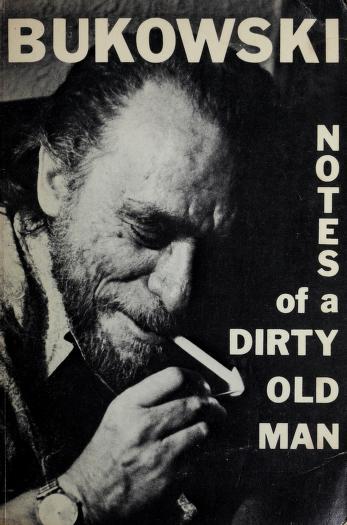
This is the book that Jess is reading on his bed when Luke comes in.

Notes of a Dirty Old Man is a 1969 book by Charles Bukowski, a collection of his newspaper columns for the underground Los Angeles newspaper, Open City. His articles showcased his trademark crude humour and attempts to provide a truthful viewpoint of events in his life. He writes openly about his alcoholism and hook-ups with prostitutes and married women.

Some of the quotes from the book sound like things that Jess could probably relate to:

  • The people walk with such an indifference I begin to hate them, but then again I’ve never really been fond of anything.
  • Is it possible to love a human being? Of course, especially if you don’t know them too well.
  • The people will always betray you. Never trust the people.

This kind of nihilistic self-hatred and detachment from others is heady stuff for a teenage boy who’s been kicked around, and I can imagine Jess reading this as a kind of wisdom needed to survive in the world.

Like Rory, Jess has a strong interest in journalism – but a very different type of journalism. Did he recommend this book to Rory? It seems likely. And likely that she would read it, too.

“Does Jess ever talk to you about Rory?”

After losing her temper with Jess and letting him know she doesn’t trust him one bit around her daughter, Lorelai tries to find out from Luke if there is anything going on between Jess and Rory. Luke says that Jess doesn’t confide in him, but he thinks it would be great if they got together, because Rory would be good for Jess.

Lorelai is much more concerned about whether Jess would be good for Rory, and she now knows that Luke may be her friend, but he is not her ally when it comes to keeping Jess and Rory apart. This is no doubt painful to learn, and it also means that her distrust and resentment towards Jess begins to spread to Luke. Again, this will lead to a major break between Lorelai and Luke later down the track.

Jess was brought in by the writers to drive a wedge between Lorelai and Luke and keep them apart, and their plan is working.

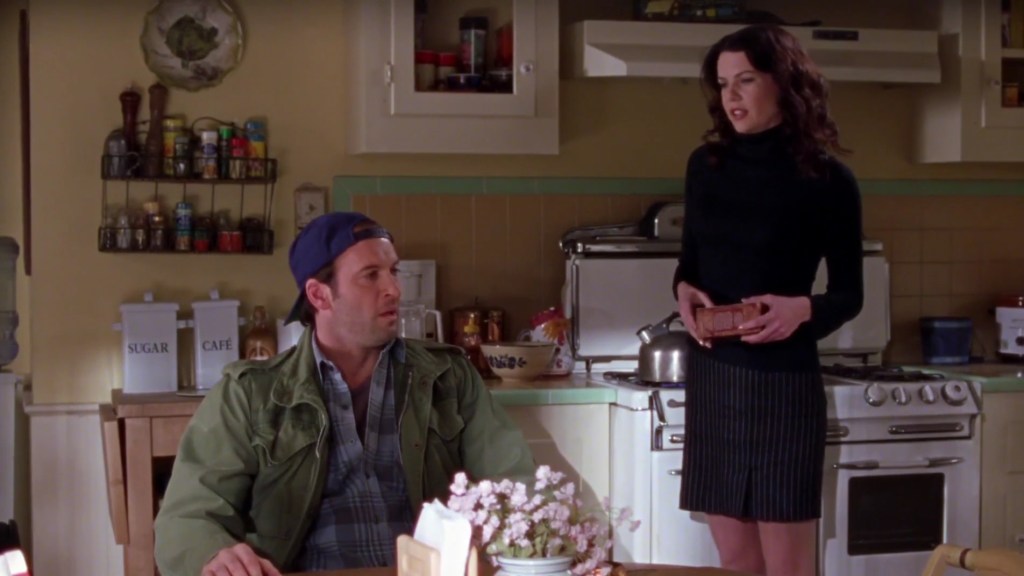
(Note that the canisters behind Luke read SUGAR CAFE!).

Taylorville

LUKE: He’s systematically buying up the town. He’s gonna turn it into Taylorville where everyone’ll wear cardigans and have the same grass height.

A possible allusion to The Andy Griffith Show, previously discussed. It is set in the small town of Mayberry (one of the models for Stars Hollow). One episode of The Andy Griffith Show explained that Mayberry was almost named Taylortown in honour of Colonel Taylor, an early settler. Andy Griffith’s character himself is named Andy Taylor.

There is a real-life Taylorville in Illinois, a city of around 11 000 people. (In the US, the designation of “city” does not seem to be dependent on achieving a minimum population size; Taylorville is barely bigger than “small town” Stars Hollow).

“Two weeks”

JESS: If it’s the most precious thing she owns, why did it take her two weeks to figure out it was gone, huh? You might wanna re-evaluate how madly in love she is. I wouldn’t start calling him ‘son’ yet.

Jess makes a devastatingly accurate comeback to Lorelai. The fact that Rory didn’t notice the bracelet was missing for some time, even needing Dean to point it out for her, is a very clear indication that her interest in Dean has waned. Something that Jess can take cold comfort in.

It is actually three weeks since the Bid-on-a-Basket Fundraiser, not two, even though it was two episodes ago.

Santa Claus

JESS: Actually, I came down the chimney and pulled a Santa Claus.

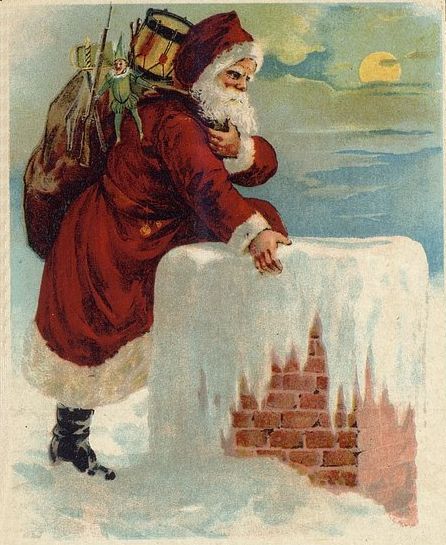
Jess refers to Santa Claus delivering gifts by coming down the chimney, a common tradition in many European countries. It probably pre-dates Christianity, as in Germanic legend, the Norse god Odin was said to bring gifts down the chimney at Yuletide, and in folklore elves and fairies brought gifts down the chimney to leave on the hearth. The fireside and hearth has been held sacred since ancient times, probably since humans began using fire.

Santa Claus coming down the chimney became part of American tradition upon the publication of the 1823 poem, A Visit from St. Nicholas, by Clement Clarke Moore, which begins, “’Twas the night before Christmas …”. Enormously popular, it had a massive effect on Christmas traditions in the US, many of which can be dated to the publication of the poem.

Jess is quick to counter Lorelai’s suggestion that he broke into their house to steal the bracelet by instead aligning himself with a benevolent figure who actually brings gifts, rather than steals them. Jess does the right thing in returning the bracelet as soon as he can, but gets nothing but grief for it.

EDIT: Edited to change a Jeff to a Jess, thank you to Carol Stamm for help in my battle with autocorrect. Otherwise we’d all be reading about Laurel Gilmore and her daughter Dory, in the little town of Tars Hello.

Mission: Impossible

LORELAI: What, did you break into our house, you got all dressed in black and pulled a Mission: Impossible?

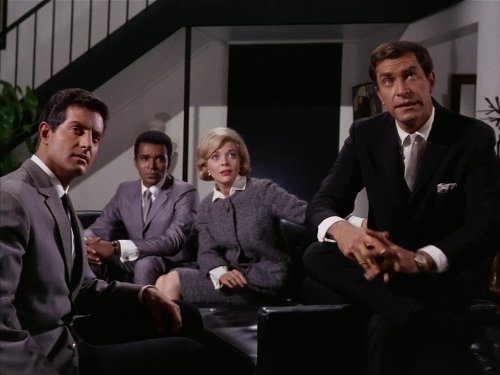
Mission: Impossible, award-winning television series about the exploits of a small team of government agents known as the Impossible Missions Force, used for covert missions against hostile Iron Curtain governments, third world dictators, evil organisations, and, later, crime lords.

Each episode opened with a montage of clips from that episode accompanied by the theme music, and the first scene showed the lead characters receiving instructions from a voice on a recording, beginning, “Your mission, should you choose to accept it …”. The recording invariably self-destructed when complete.

Financed and filmed by Desilu Productions, owned by Desi Arnez and Lucille Ball, it originally aired from 1966 to 1973, and was revived in 1988. It also inspired a series of action-adventure films starring Tom Cruise, the first one released in 1996.