“He was my Burton and I was his Taylor”

EMILY: I must say, I admire your composure. The week before my wedding, I was a wreck.
MISS PATTY: So was I, before all of mine.
SOOKIE: How many was that?
MISS PATTY: Well, uh, there was St John, John, Sergio, St John. Three men, four times.
SOOKIE: Do you regret any of them?
MISS PATTY: Well, St John was a let down the second time, but he was my Burton and I was his Taylor. Just wish I could’ve found a little Mike Todd there in the middle.

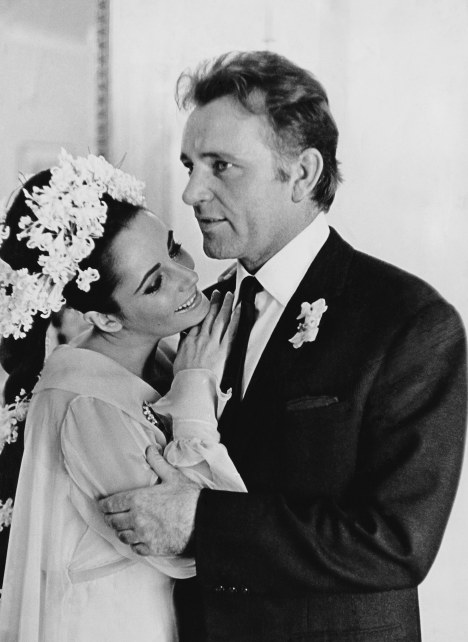
Miss Patty is referring to actress Elizabeth Taylor, previously discussed, and her multiple marriages. She married actor Richard Burton in 1964 [pictured], then for a second time in 1975.

Elizabeth Taylor married theatre and film producer Mike Todd in 1957, a third marriage for each of them. Famously, he was her only husband never to be divorced; he was killed in a plane crash in 1958 – Taylor had meant to fly with him, but he told her to stay home as she had a cold. Although they had a tempestuous relationshop, in later life Elizabeth Taylor always claimed that she was happiest with Mike Todd than any other of her husbands.

We learn a little of Miss Patty’s personal life here, that she has been married several times, including a remarriage to her first husband, St. John. She seems to be divorced, as the marriage was a “let down”, and probably for several years at least, from the tone of Sookie’s questions.

Ba Zing!

MICHEL: It is a weekend, and on the weekend I like to move, and the ladies, they like it too.
LORELAI: Especially when you move out of town. Ba zing!

Lorelai’s comeback to Michel’s statement mimics the one-line quip beloved of classic stage comedians to their “straight man”, even providing her own ba zing in imitation of the cymbal being hit to mark the punch line. Another indication that Michel was originally meant to be heterosexual.

Amy Sherman-Palladino’s father, Don Sherman, was a stand-up comedian in the 1960s, and there are numerous references to classic stage comedy in Gilmore Girls.

Tony Manero

MICHEL: So, is there no dancing here? I was hoping there’d be dancing.
SOOKIE: You need to strut, Tony Manero?

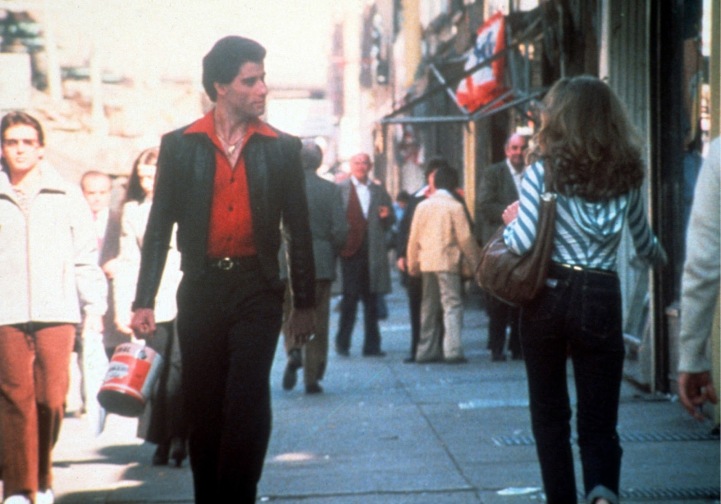
Anthony “Tony” Manero (John Travolta) is the protagonist of the 1977 musical drama film Saturday Night Fever, directed by John Badham, and based on a 1976 New York magazine article by British journalist Nik Cohn, Tribal Rites of the New Saturday Night. In the 1990s, Cohn admitted he’d faked the article on New York disco culture, basing the main character on a man he had briefly seen in a doorway, and an English mod he’d known in the 1960s.

The film revolves around Tony, a young working-class Italian-American man who spends his weekends drinking and dancing at a local disco in Brooklyn. While in the disco, he is the champion of the dance floor, and this helps him cope with a dead-end job, family squabbles, racial tension in his community, and a general restlessness, while he dreams of a better life.

The film begins with an iconic scene where Tony is strutting down the streets of his neighbourhood with The Bee Gees song Stayin’ Alive playing. Both scene and song are referenced in the film’s less-regarded 1983 sequel, Staying Alive.

Saturday Night Fever was a massive box-office success, and the #4 film of 1977. It received excellent reviews, and critics named it as one of the best films of 1977. It helped to popularise disco music, and made John Travolta a household name. The soundtrack, featuring songs by The Bee Gees, is one of the best-selling movie soundtracks of all time.

“Gay Icon” Waitresses at the Queen Victoria

The waitresses at the Queen Victoria are in drag as popular gay icons. Joan Crawford serves Emily, they walk past Marilyn Monroe on their way to the table, and Mae West takes Lorelai’s order.

Joan Crawford, born Lucille LeSueur (1904-1977), and previously mentioned. Beginning her career as a dancer and chorus girl on Broadway, Crawford signed her first film contract in 1925. She usually played hard-working young women who found romance and success, making her films popular fodder in the Depression era, so that she became one of the highest-paid actresses in Hollywood. Her career foundered, but she made a comeback in 1945 in Mildred Pierce, for which she won a Best Actress Academy Award. She continued acting through the 1940s and ’50s, gaining huge box-office success with the 1962 horror film Whatever Happened to Baby Jane? Crawford has been described as the “ultimate gay icon” for her sex appeal, bitchiness, and complex personal life.

Marilyn Monroe, born Norma Jeane Mortensen (1926-1962), and previously mentioned. Famous for playing comedic “blonde bombshells”, she was one of the biggest sex symbols of the 1950s. After beginning as a pin-up model, she had small parts in films before signing with Fox in 1951. By 1953 she was one of the most marketable Hollywood stars, with leading roles in Niagara, Gentlemen Prefer Blondes, and How to Marry a Millionaire in this year alone. One of her biggest successes of her career was The Seven Year Itch, a 1955 comedy where she wears the iconic white dress that the waitress models. Critically acclaimed in Bus Stop (1956), she gained both critical and commercial success with Some Like It Hot, a 1959 comedy involving cross-dressing. That was a big boost to her as a gay icon, as well as her sex appeal, vulnerability, and tragic demise.

Mary “Mae” West (1893-1980) [pictured] was an an actress and sex symbol whose career in entertainment spanned seven decades. Starting out in vaudeville and the theatres of New York, she moved to Hollywood to become a comedian, actress, and writer, with appearances in film, television, and radio. She is considered one of the greatest female stars of classic American cinema. She was often controversial, having problems with efforts to censor her – she usually found a way for this to bring her greater publicity, such as a brief stint in gaol for writing a play named Sex, which made her a media darling as a “bad girl”. The characters she played in films tended to be sexually secure and liberated women, and by 1935 she was the highest paid woman in Hollywood. West reportedly got her image, style, and famous walk by copying female impersonators, and she could be seen as a “female drag queen”. Brassy, busty, and ballsy, ultra-womanly yet somehow androgynous, with risque wisecracks and impeccable comic timing, Mae West was a lifelong supporter of gay rights, and a natural fit as a gay icon.

Cocktails

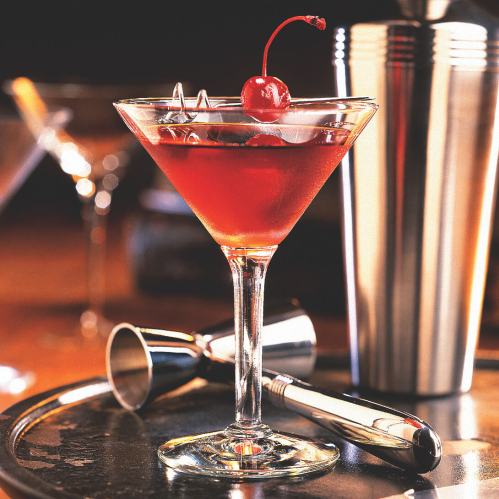
Emily is already drinking a Manhattan [pictured]; a cocktail made from whiskey, vermouth, and bitters, usually served in a cocktail glasss with a Maraschino cherry. It seems to date from the mid-19th century, and to have originated in bars around the Manhattan area. There are many variations on the drink. Because Emily praises her Manhattan for not being too sweet, it may be a Dry Manhattan made with dry vermouth, or a Perfect Manhattan, made with a mixture of dry and sweet vermouth.

Lorelai orders a Rum and Coke; it is not certain who for, but because she orders it first and without asking, it may be for Sookie. Rum and coke is a mixture of rum and cola with a dash of lime juice served with ice. It originated in Cuba, where it is called a Libre Cuba (“Free Cuba”), and dates to the early 20th century after Cuba won its independence in the Spanish-American War of 1898.

Lorelai orders a Margarita without salt, possibly for Miss Patty. A margarita is a mixture of tequila, Cointreau, and lime juice, traditionally served in a special cocktail glass that looks like a champagne glass. Originating in Mexico (its name is Spanish for “Daisy”), it became popular in the 1930s, when Prohibition gave Americans a reason to go over the border into Mexico to get a drink.

Lorelai orders a Martini with an olive, previously discussed. I feel that the martini may be for Michel – as he didn’t tell Lorelai what he wanted, she may have chosen the standard cocktail at the elder Gilmore residence for him.

Lorelai orders a Shirley Temple, previously discussed. This now seems to be Rory’s go-to mocktail, which she drinks with ice. Note that even as a supposed 18 year old, Rory is unable to drink alcohol in a bar, as the drinking age is 21 in the US. As Rory is the only person not drinking, I presume she is the designated driver.

Lorelai orders herself a giant Long Island Iced Tea. This drink is a mixture of vodka, tequila, rum, triple sec, gin, and a splash of cola, which gives it the amber tea-colour it gets its name from, often decorated with a lemon and a straw. It has a very high alcohol content, due to the small amount of mixer in it.

Emily at the Queen Victoria

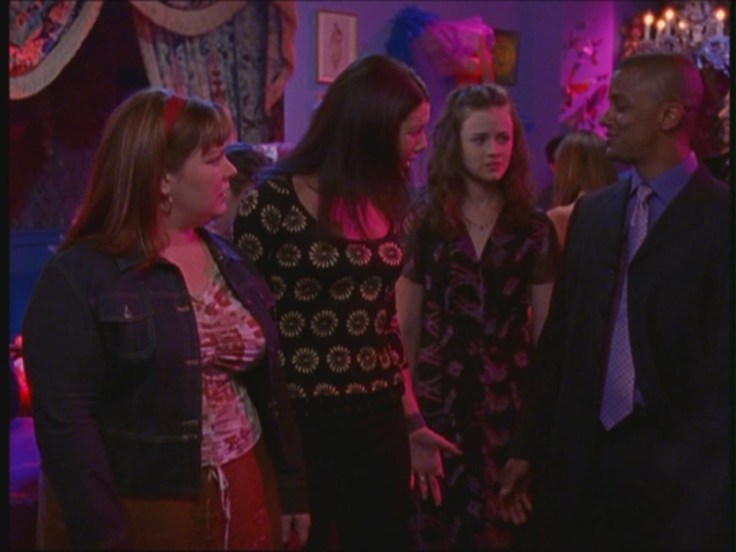
When Lorelai looks around the club for a table, she is appalled to see her mother has already saved them one. Lorelai didn’t invite Michel to her bachelorette party – Sookie invited him – and now Michel has invited Lorelai’s mother, who he adores, because he “thought it would be a kick”.

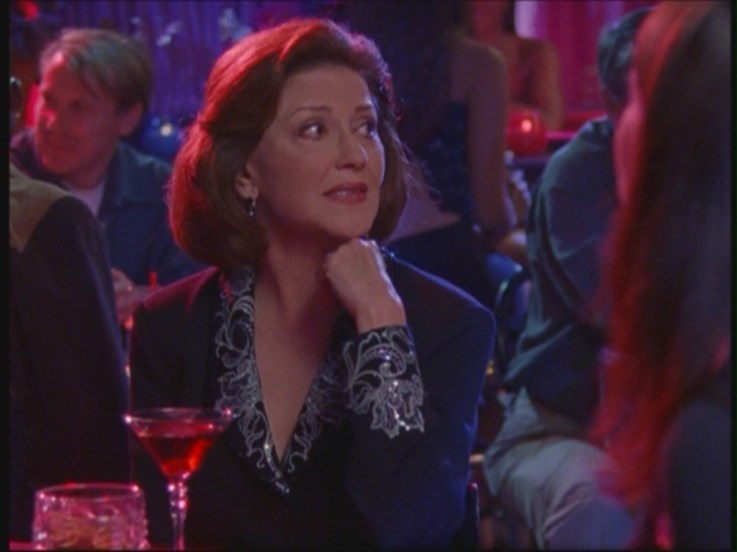
Emily, apart from giving Lorelai a brief lecture about being late to her own bachelorette party, seems to be very happy to be allowed to join in the fun for a change. Although she looks slightly uncomfortable at first, she is unfazed by the drag club, and able to adjust to almost any social environment through sheer force of will.

Emily does question Rory’s appearance at a bar that is 18 and over, but isn’t angry or upset about it. This seems really unbelievable, except that we know Emily firmly believes that you don’t get into arguments or explanations at social events. Her own rules of etiquette seem to insist that she go along with it, however implausibly.

Queen Victoria

MICHEL: This is a drag club.
SOOKIE: It’s called the Queen Victoria. What did you expect, tea and crumpets?

Victoria, born Alexandrina Victoria (1819-1901) was Queen of the United Kingdom of Great Britain and Ireland from 1837 until her death. She became a national icon, and is identified with standards of strict morality that we still refer to as “Victorian”. Hr reign of more than 63 years was longer than any other of her predecessors, and is known as the Victorian Era, a period of industrial, scientific and cultural change in the UK, coupled with a great expansion of the British Empire.

Michel seems put out that he has been taken to a drag club, perhaps another signal that he was originally not presented as a gay character. Sookie mentions tea and crumpets as a favourite afternoon snack of the Victorian era (and still popular today).

The Queen Victoria is a fictional drag club. In real life there is a gay bar in Hartford where you can see drag shows, but it is not actually a drag club per se. The sign outside the Queen Victoria identifies it as a “bar and grill” (unless that is the place next door) and in real life, Hartford has a couple of bars and cafes that have regular drag shows.

Get Happy

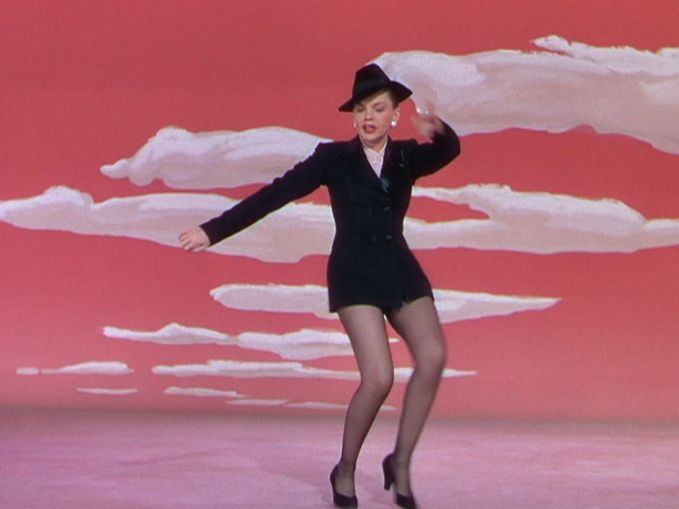
When the company enters the bar for Lorelai’s bachelorette party, a drag queen dressed as Judy Garland is lip-synching on stage to this song.

Get Happy is a song written by Harold Arlen, with lyrics by Ted Koehler; the lyrics mimic gospel and evangelical songs. It was first performed by Ruth Etting in the 1930 Broadway show Nine-Fifteen Revue, and although the musical was a disastrous flop, Get Happy was successful and recorded several times, including by both Benny Goodman and Charlie Parker.

Judy Garland sang the song in the 1950 musical film Summer Stock, her last movie for MGM. In a let’s-put-on-a-show plotline, Garland performs the number wearing a tuxedo jacket, fedora, and stockings and high heels in the movie’s most iconic scene, often copied by other singers and dancers.

Judy Garland had been a gay icon since The Wizard of Oz became popular TV viewing, so having this song playing as they enter is a stereotypical way to signal it’s a gay club.