Xuxa

LORELAI: Hey, whatever happened to Xuxa?

Xuxa – pronounced SHOO-sha – is the stage name of Maria da Graça Meneghel (born 1963), a Brazilian television host, singer, dancer, model, and businesswoman. She began modelling as a teenager, and became known in the US during the 1980s as a Playboy model.

Xuxa became a highly successful children’s television entertainer in Brazil in 1986, and by 1991 she was on the Forbes Rich List – the first Brazilian to join the list. Her albums were best-sellers through Latin America, Europe, and North America, and in 1993 she hosted an English-language version of her show called Xuxa on US television. Although the show was sold around the world, the taping was gruelling, and Xuxa withdrew due to stress-related illness.

Because she disappeared from US television in the mid-1990s, Lorelai wonders what happened to her. However, Xuxa has continued her career, and is still very successful; she is the richest t female entertainer in Brazil with a fortune of over one billion, and the second-highest selling female Brazilian singer. Twice winner of the Latin Grammy Award for Best Children’s Album, she is known as “The Queen of Children”.

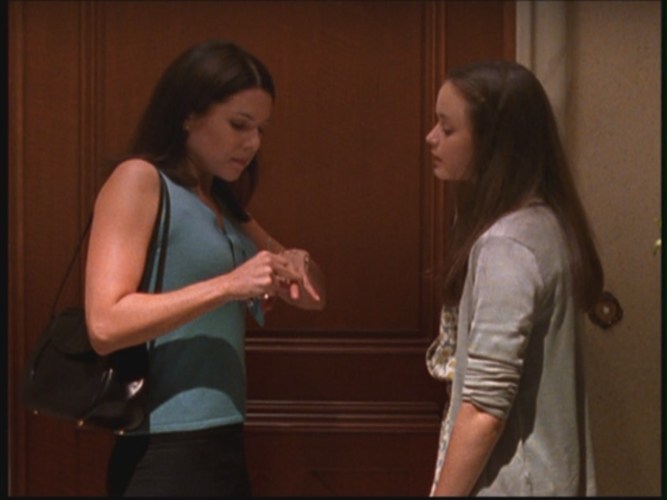
Party Games

LORELAI: Shouldn’t we wait for Dad?
EMILY: Don’t worry about him.
LORELAI: He’s the one with the early plane. We don’t have to go anywhere tomorrow. We can stay all night. Have a party, do some Jell-O shots, play light as a feather, stiff as a board.

Jello-O shots (jelly shots) are made from flavoured gelatine powder, some water to dissolve it, then alcohol added, usually rum or vodka, and set into little jellies served in shot glasses or little plastic cups. The alcohol is contained within the jelly mixture, so that the body absorbs it more slowly, making it easy to consume a lot of alcohol before the effects are felt. Alcoholic gelatines have been enjoyed since the 19th century, but became more common during the 1950s.

Light as a Feather, Stiff as a Board is a game often played at girls’ slumber parties. It is a levitation trick, where one girl pretends to be dead while the others chant “light as a feather, stiff as a board”, and lift the girl using just one or two fingertips. At the end of all the chanting and rituals, the girl will seem lighter, or even weightless. The game works through equal distribution of weight, making it easy for a group of people to lift a child. Variants of the game have been played since at least the 17th century, and it always seems to have been a girl’s game (perhaps partly because girls tend to be lighter and easier to lift to begin with).

“If you don’t tell them in two weeks”

LORELAI: I will tell them when I’m ready to tell them. You have to accept that because I’m the mother and you’re the daughter, and in some cultures, that means you have to do what I say.
RORY: If you don’t tell them in two weeks, I will.

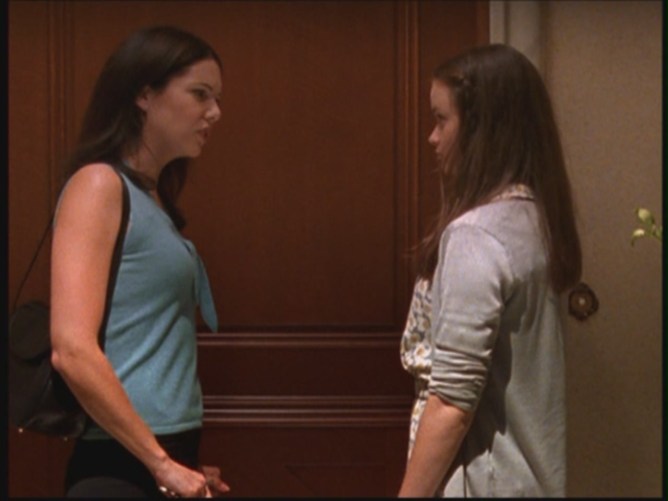
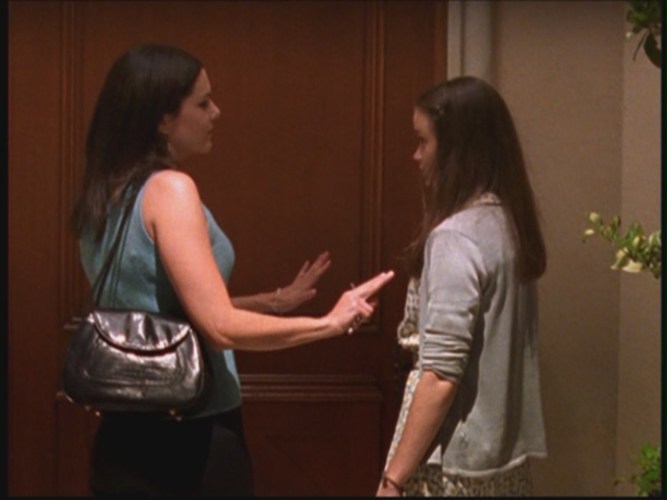
For years, Lorelai has been running she and Rory’s lives by making all the decisions for both of them (in fact, she’s been shown to be quite controlling, like Emily). Now Rory is a few months off seventeen, she is starting to make her own opinions heard, especially when it comes to her grandparents. These are the first rumblings of what will eventually be a major rift between mother and daughter.

Rory says she will wait two weeks before telling Richard and Emily, meaning she’s quite happy for them to miss Max and Lorelai’s engagement party. Maybe she’s in no hurry for them to meet Dean again.

“Soon”

RORY: When are you going to tell them [Richard and Emily, about the engagement]?
LORELAI: Soon.
RORY: When’s “soon”?
LORELAI: When the big hand hits the “S” and the little hand hits the “OON.”

A play on helping small children tell the time by showing them where the hour hand and minute hand on a clock are.

“Keeps your halo shiny”

RORY: I will be assisting, I will be helping out those less fortunate than myself, I will be getting college credit and this is the end of this particular conversation.
LORELAI: You’re right. It’s a good thing. Nice, keeps your halo shiny.

As becomes increasingly clear during this episode, Rory is volunteering purely for college credit, and doesn’t really care about the less fortunate. She’s not quite as angelic as Lorelai thinks.

“Light bulb burned out”

LORELAI: “Mom, tomorrow I’m going to build a house.”
RORY: Help build a house.
LORELAI: Did you tell them that there’s a light bulb in your closet that burned out in ’97 that you still haven’t changed?

The light bulb in Rory’s closet burned out when she was twelve or thirteen, possibly of an age where Lorelai could have changed the light bulb for her (mind you, that was the year Lorelai broke her leg, so she may not have been too mobile when it happened). Or what about Luke – he did tons of work on Lorelai’s house a few episodes ago while he was avoiding Rachel, couldn’t he at least have replaced a light bulb?

Henry and Lane

Henry tells Rory that he tried to call Lane once, and Mrs Kim answered, frightening him so much that he never phoned again. This doesn’t quite tally with what Lane told Rory: that Henry rang once and got the answering machine, leaving a message that she listened to again and again before eventually breaking the machine. Perhaps Henry only counts the call where someone answered the phone (which Lane doesn’t know about since her mother took the call).

It is now nearly three months since Henry and Lane first met at Madeline’s party. That’s a long time for Henry to remain interested without doing anything, and he’s taken ages to talk to Rory about the situation. Perhaps he is as unused to dealings with the opposite sex as Lane – certainly they both seem to have made a bit of a mess of this situation.

Rory hasn’t been a real help either; she lives in the same town as Lane and goes to school with Henry, so couldn’t she at least have passed notes and letters between the two of them, or driven Lane into Hartford to see Henry? (Maybe even organised a Trigonometry tutoring class that Lane and Henry could have both joined!)

To be fair, Rory didn’t rely on Lane to fix her relationship problems with Dean, but Rory has a bit more experience with boys, much more freedom, and a generally far easier life than Lane.

Rory’s Summer School Classes

RORY: Oh, Henry, hi. Nice to see you.
HENRY: You too. What classes are you taking?
RORY: Shakespeare, physics, obscure Russian poetry.

Rory got a D for her first English Literature assignment, so it makes sense for her to enrol in two Literature classes to improve her grades further. One is the ubiquitous William Shakespeare, while the other is “obscure Russian poetry”, which doesn’t sound like a real subject. Possibly Rory is being facetious, and the subject is actually Nineteenth Century Russian Poets, or Modern Russian Poetry, or something like that. It may seem obscure to Rory, but probably isn’t – Chilton seems to cover the classics rather than anything left-of-field.

Rory has also enrolled in Physics, quite possibly towards credit in the next academic year, as she didn’t study Physics at Chilton in her sophomore year (Biology and Chemistry were her science subjects).

Henry is taking Trigonometry at summer school – just like Lane, this is his worst subject (an aversion of the stereotype that people of Asian heritage are gifted in mathematical subjects). Rory offers to help Henry with Trig, but we never see if she actually does so. It seems plausible enough since they’re both at summer school and Rory has experience in helping Lane with the subject.


Thelma and Louise

RORY: Are you seriously going to be mad about the fact that you thought I was going out with Tristan, even though I wasn’t, for the rest of your life?
PARIS: I have great commitment.
RORY: And you don’t see how stupid that is?
PARIS: I’m sorry if you thought we had some kind of deep Thelma and Louise thing going here, but we didn’t.

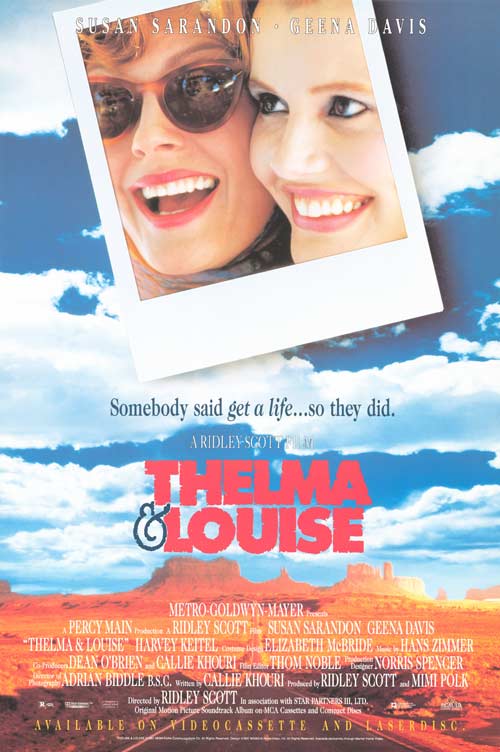
Thelma and Louise is a 1991 road film directed by Ridley Scott, written by Callie Khouri, and starring Geena Davis and Susan Sarandon in the title roles. The story is about two best friends who embark on a road trip and end up running from the law, with every disaster they face bringing them closer together until the bitter end.

Thelma and Louise was a commercial success and gained overwhelming praise from critics; Callie Khouri won the Academy Award for Screenplay Written Directly for the Screen. Influential on other films and artistic works, the film is now regarded as a classic and a high point of woman-centred films.