
Rebuilding Together


MADELINE: There’s a Rebuilding Together thing going on tomorrow. You know, they fix up homes for the needy. It’s a total easy outdoor denim gig that looks really great on your college transcript.

In real life, Rebuilding Together is a non-profit organisation founded in 1988 which provides free home repairs and renovations for low-income homeowners. However, in the Gilmore Girls universe it seems to operate more like Habitat for Humanity, a Christian-based organisation founded in 1976 which builds simple, affordable housing with volunteer labour for people in need. In real life, both Rebuilding Together and Habitat for Humanity have branches in Hartford, and ongoing volunteering projects.

Madeline here makes a little bid for independence – even after being reminded that she is not meant to be talking to Rory, she invites her to join them on a volunteer project. It’s the closest she gets to protesting Rory’s treatment.
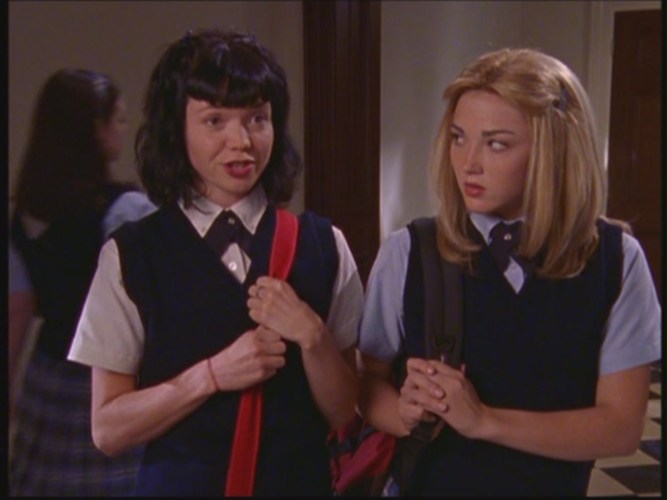
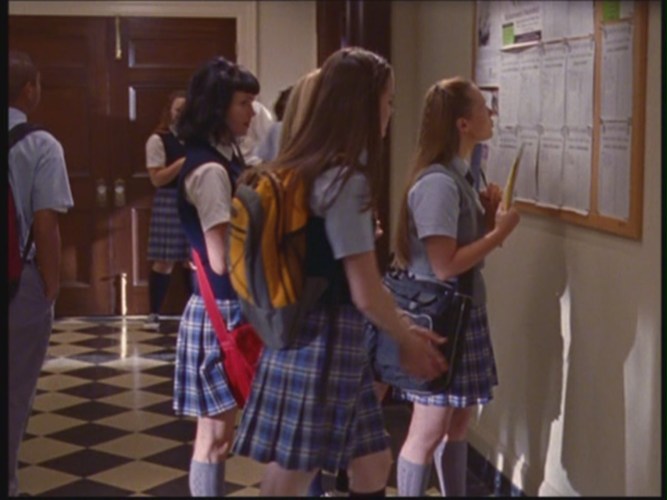
“You’re not talking to me”

RORY: Uh, you’re not talking to me.
MADELINE: I’m not?
LOUISE: Tristan.
PARIS: PJ Harvey.
MADELINE: Oh yeah.

This conversation is a nice reminder of the events of last season which caused Paris to (once again) hate Rory, and force Louise and Madeline to join her in solidarity. It is typical of Madeline that she can never remember why she is supposed to hate Rory – partly it’s ditziness, but also a genuine liking for Rory; Madeline is noticeably always pleased to see her. And Paris’ reasons for hating Rory are so silly that’s it’s no wonder Madeline can’t remember them.

Summer School

MADELINE: You doing the summer school thing too?
RORY: Uh, yeah.

In North America, schools and universities can offer academic programs which take place during the summer vacation. In high school, students may enrol in classes for credit which can improve their grade point average or be included on their academic record. Summer school can either make up for credits lost through absence or failure, accelerate progress, or lighten the course load for the year.

Summer school usually lasts for 3-5 weeks, although Louise complains about spending “the summer” at Chilton; she’s probably exaggerating. You don’t normally have to wear a school uniform to summer school, so Chilton is very unusual in expecting this. In fact, most schools make money by attracting students from outside their school, especially international students, so a uniform would actually by impractical.

Rory missed the first few weeks of the academic year at Chilton, and at first struggled to keep up, so it makes sense for her to enrol in summer school.

A.J. Benza

LOUISE: Princess Grace didn’t go to college.
PARIS: Thank you for the history lesson, A.J. Benza.

Alfred Joseph “A.J.” Benza (born 1962) is an American gossip columnist and television host. He began as a gossip columnist on the New York Daily News, and in the mid-1990s began appearing on The Gossip Show on E! Entertainment Television, leading to appearances on several chat shows. From 1998 to 2001 he was the host of Mysteries and Scandals on the E! Network.

Princess Grace

PARIS: You have to go to college.
LOUISE: Princess Grace didn’t go to college.

Princess Grace, born Grace Kelly (1929-1982) was an American actress who began her career on television and starred in several Alfred Hitchcock films, such as Dial M for Murder (1953), Rear Window (1953), and To Catch a Thief (1955). She also starred in the classic western High Noon (1952) and the musical High Society (1956), winning a Best Actress at the Academy Awards for The Country Girl (1954).

She retired from acting to marry Prince Rainier III of Monaco in 1956, becoming Princess Grace of Monaco, and having three children. As a princess, she founded children’s charity AMADE, formed the Princess Grace Foundation for artisans in Monaco, and became known as a fashion icon, being inducted into the Best Dressed Hall of Fame in 1960.

Louise is correct – Princess Grace, who came from a wealthy family and attended prestigious private schools, was rejected by Bennington College in 1947, due to her low scores in Mathematics. However, she graduated from the American Academy of Dramatic Arts in New York, the oldest acting school in the English-speaking world, so she did have a distinguished tertiary education.

Vassar

MADELINE: If I don’t improve my French grades, I can kiss Vassar goodbye.

Vassar College is a private, liberal arts college in the town of Poughkeepsie, New York. Founded as a women’s college in 1861 by philanthropist Matthew Vassar, it became co-educational in 1969. It is one of the Seven Sisters, seven elite liberal arts colleges in the northeast of the United States that were originally founded for women. Vassar offers B.A. Degrees in more than fifty subjects and a flexible curriculum, and is one of the the top liberal arts colleges in the United States. It has a reputation for being cool and hipster, which might be what attracts Madeline to the idea of going there.

Apparently Madeline never did improve her French grades, as she did not go on to attend Vassar College.

“Happy happy, joy joy”

LOUISE: Ooh, spending the summer at Chilton. Happy happy, joy joy.

Louise is referencing The Ren & Stimpy Show, an animated television show which aired from 1991 to 1995 on Nicktoons, Nickelodeon’s cartoon channel. The show follows the adventures of a short-tempered chihuahua named Ren, and a dim-witted cat named Stimpy, and is notable for its absurdist tone, dark humour, adult jokes, violence, and slapstick. The show received widespread critical acclaim after its run and gained a cult following, becoming highly influential on the development of animated shows.

Happy Happy, Joy Joy is a song used throughout the show, in different contexts, with music by Christopher Reccardi and lyrics by Charlie Brisette and John Kricfalusi. It is one of the best-known songs from the show, and a favourite tag line for Ren & Stimpy fans.


“He’s playing softball”

RORY: Let’s go …Wedding dress shopping …
LORELAI: Uh, you need to see Dean.
RORY: He’s playing softball.

We know from Christopher Returns that Dean plays softball on Saturday mornings, so this looks to be the very next day after the previous episode, and the fight that Rory had with her grandfather. Rory doesn’t seem to be upset any more, so perhaps her grandfather rang her almost immediately after she got home to apologise, as Emily told him to.

Bustle

LORELAI: I tried on three different [wedding] dresses, one of which gave me a rash. And I gotta say, has anyone missed the bustle? ‘Cause I haven’t.

A bustle is a type of framework intended to support drapery at the back of a woman’s dress, which could either jut out at the back, have numerous heavy folds, or support a train. It was a fashion popular in the 19th century, but still in use for formal gowns and wedding dresses.

Taffeta and Cotillion

RORY: Why don’t you go to a wedding dress place and try a real veil on?
LORELAI: No way.
RORY: Why?
LORELAI: Too much taffeta, it gives me cotillion flashbacks.

Taffeta is a smooth plain-woven fabric made from silk. It is considered a luxurious fabric suitable for ball gowns and wedding dresses.

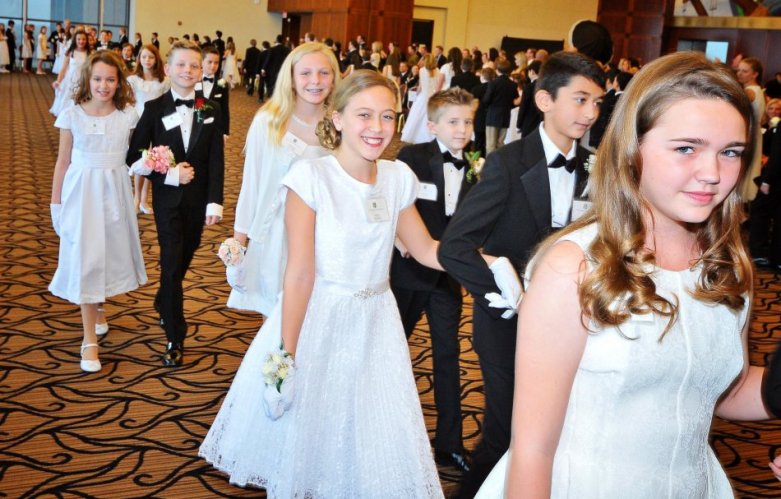
In American usage, a cotillion is a formal ball, often for presenting debutantes to society. However, Lorelai is most likely talking about cotillions as a class for younger girls, perhaps aged 10 to 13, to prepare them for their future debut in society. Such classes teach social etiquette, followed by a formal party where they put what they’ve learned into practice. We later learn that Emily teaches these classes, and probably taught Lorelai when she was younger.