EMILY: Don’t back down Lorelai. You took a stand and you are completely in the right here. You absolutely must keep her from that boy. If you need to change her curfew, lock her up, throw away the key, whatever it takes to make sure she doesn’t go astray – you do it. Her judgment cannot be trusted here. She’s a young girl and knows nothing. You are her eyes and her ears and her brain for as long as it takes to make sure she doesn’t make any ridiculous choices in her life.
To Lorelai’s horror, when Emily learns about the problem between Lorelai and Rory, she completely takes her daughter’s side, saying that Rory is a young girl with no experience of the world, and it is Lorelai’s job to make all major decisions for her, until she is old and wise enough to choose for herself. Lorelai has to listen to Emily agree with her that Rory needs to be kept away from Jess, and to realise (again) that she isn’t as different from the controlling Emily as she thought.
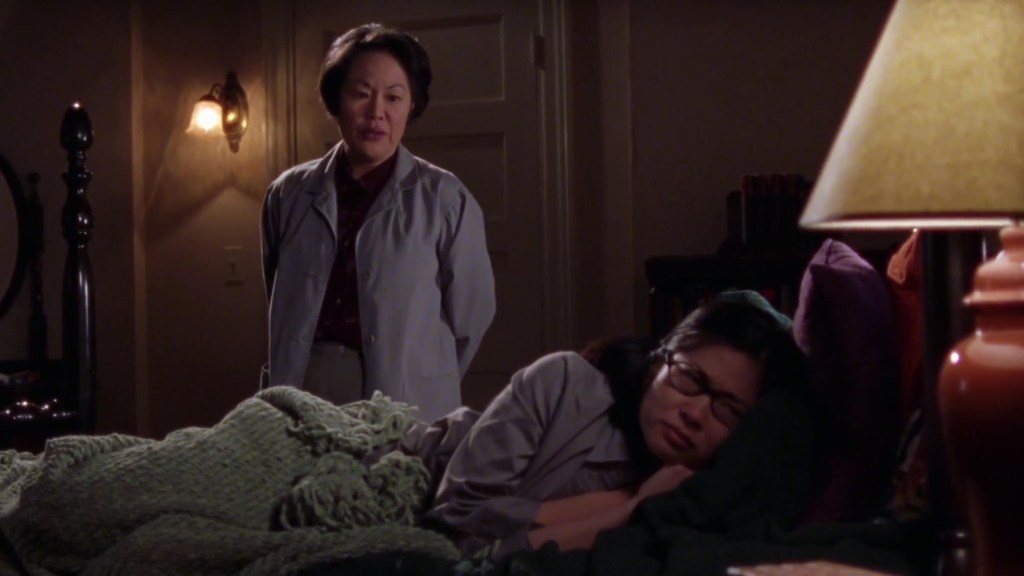
MRS. KIM: You see, this is exactly why I make these rules. You’re too young, too vulnerable. American boys have different values, they don’t understand respect, you get hurt. I do all of this so you don’t get hurt and now here you are hurt. I don’t like this, I don’t like this at all. Who is he, this boy who hurt you?
We can see that no matter how flawed Mrs Kim might be as a parent, and how wrong-headed her restrictions are of Lane, she does love Lane deeply and wants to protect her. She thinks that Lane is unhappy about Henry because she disobeyed Mrs Kim’s rules to keep her safe, while Lane knows she’s unhappy over Henry because her parents set so many rules that she was unable to form a real relationship, even with a boy they would have approved of.
EMILY: A cigar club. Can you imagine a more disgusting organization to join? Your grandfather now pays money to sit in an enclosed room with a bunch of other men and blow smoke in each other’s faces. Twice a week he comes home smelling like a flophouse.
This is Richard’s first attempt to reinvent himself after retirement by joining a cigar club, where men gather to buy and smoke cigars together.
In real life, there are many places in Hartford which have cigar bars and lounges. The upmarket Hartford Club [pictured] has a cigar room for guests, and this seems like the sort of place Richard would feel comfortable.
This explains Richard’s absence for Friday Night Dinner, now the writers can’t use his job as an excuse. It does seem a little strange that Lorelai and Rory can never miss Friday Night Dinner except for emergencies or extraordinary circumstances, but Richard can miss it just to smoke a cigar!
A flophouse is American English for a dosshouse: a cheap hotel, hostel, or boarding house designed to house poverty-stricken homeless people. It seems unlikely they would actually smell of expensive cigars.
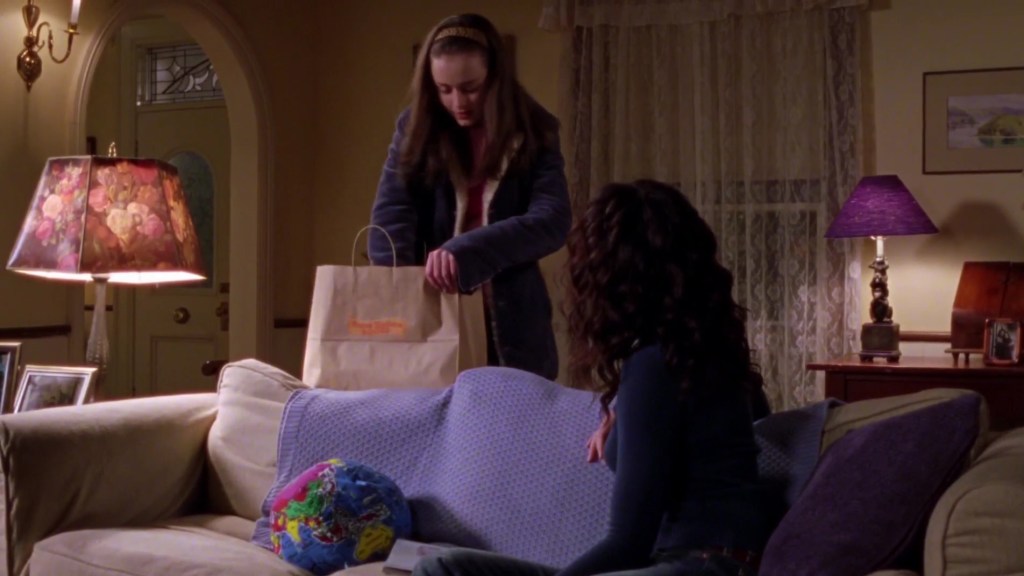
LORELAI: Oh, hey. Where’ve you been? I thought Taylor auctioned you off to the highest bidder. RORY: No, I just went to get some pizza and I, uh, wandered around the bookstore for a little while. Here. [hands her a book]
After the fundraiser, Jess took Rory out for pizza, as her picnic was inedible – a clear parallel to Luke bringing Lorelai diner food to replace her inadequate basket. They then wandered around Stars Hollow Books together. No doubt tongues were wagging in town over that.
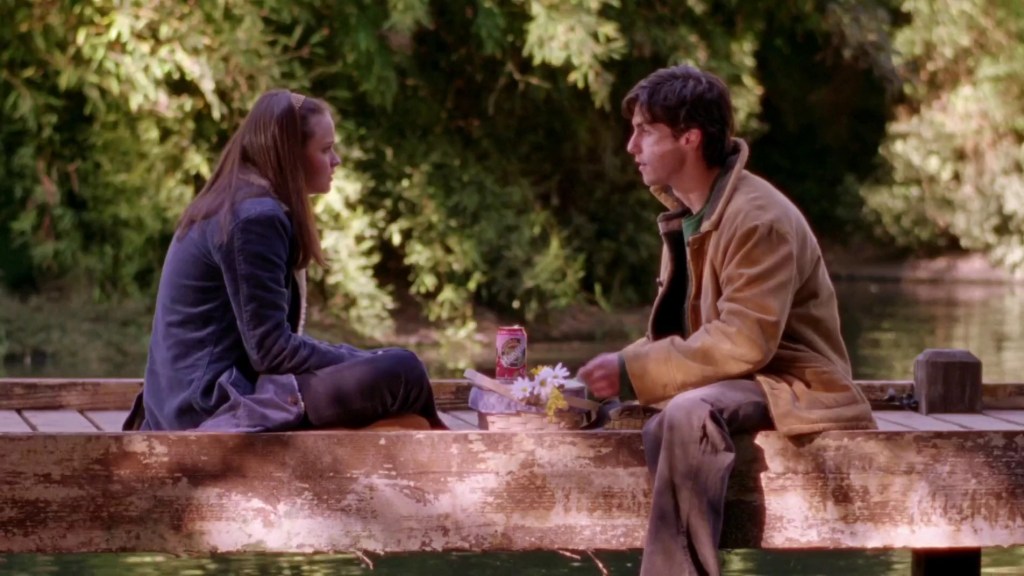
Rory said it’s “tradition” to eat a picnic with the person who buys your basket, but sitting together on a secluded bridge for an hour, going for pizza, and then book shopping seems to be going above and beyond tradition. As Dean finds shopping for books boring and only goes with Rory so he can watch her, Rory would have enjoyed doing it with someone who shares her passion for reading.
Note that Lorelai makes the same joke about Rory being “auctioned off” that she made to Emily in regard to school dances.
It is unclear why Jess keeps Rory’s bracelet, but most likely just the sentimental pleasure of having something of Rory’s he can hold and touch. He probably intended to give it back at some point, the same way he returned her book. He may have also thought the handing back ceremony would be a flirtatiously teasing one – “Oh, you were looking for this? Another one of my magic tricks“.
RORY: An hour ago you were totally screwing with Dean and now you’re totally nice to me. JESS: You see, it’s the screwing with Dean – that’s an important step to getting here so that I can be nice to you. RORY: So it was a plan … The whole bidding on my basket, it was a plan.
Of course it was a plan! Nobody believed it was anything other than deliberate. Just ask Dean.
JESS: Okay, tomorrow I will try again, and you will . . . RORY: Give the painful Ernest Hemingway another chance. Yes, I promise. JESS: You know, Ernest only has lovely things to say about you.
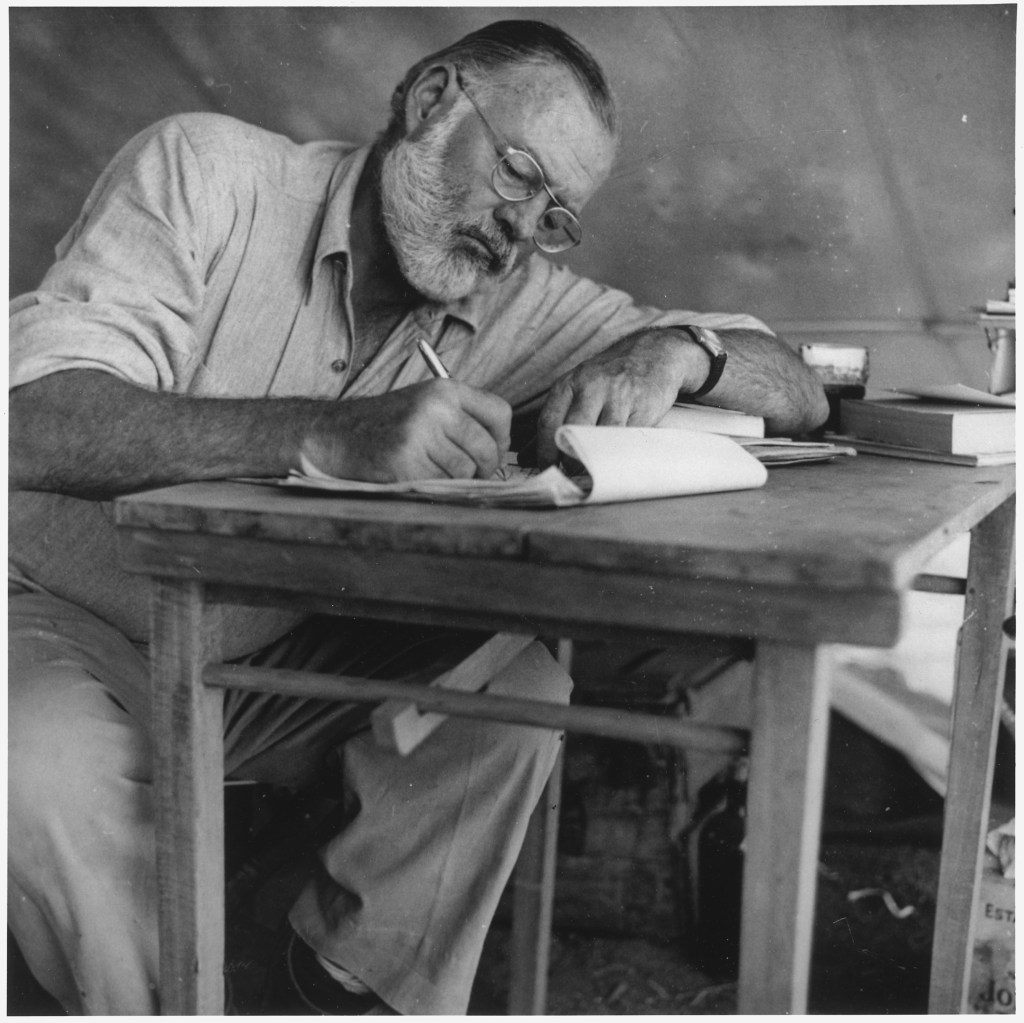
Ernest Hemingway (1899-1961), author, journalist, and sportsman. He is famous for his economical and understated style, which had a profound influence on 20th century fiction, while his public image and adventurous lifestyle brought many admirers. He produced most of his work during the 1920s to the 1950s, and was awarded the 1954 Nobel Prize for Literature. Many of his works are considered classics of American literature.
Hemingway’s hard, lean prose style and strongly masculinist ethos (to the point where it sometimes seems misogynistic) seem at odds with the more diffuse, subtle writing that Rory seems to appreciate. The irony is that Hemingway was a journalist, which helped to hone his spare writing style.
I’m not sure exactly what Jess means by “Ernest only has lovely things to say about you”, but in his works, brunettes are usually good, while blondes are bad (hm, rather like Gilmore Girls). Hemingway married four times times, three times to fellow journalists, as Rory plans to be.
RORY: Really? Try it. The Fountainhead is classic. JESS: Yeah, but Ayn Rand is a political nut. RORY: Yeah, but nobody could write a forty page monologue the way that she could.
The Fountainhead, 1943 novel by Russian-American author Ayn Rand, and her first literary success. The novel is about a ruggedly individualistic architect named Howard Roark, who battles against conventional standards and refuses to compromise his ideals. Rand said that Roark was the embodiment of her ideal man, and the novel reflects her views that the individual is more valuable than the collective.
Twelve publishers rejected the manuscript before Bobbs-Merrill took a chance on it, and contemporary reviews were mixed. However, it gained a following by word of mouth, and eventually became a bestseller. It has had a lasting influence, especially among architects, business people, conservatives, and libertarians. It was adapted into film in 1949, and turned into a stage play in 2014.
We here learn that Rory attempted to read The Fountainhead when she was ten, without success, but tried again when she was fifteen and liked it. Jess is taken aback by her recommending a text beloved of right-wing libertarians and “political nuts”, but Rory says she enjoys it as a piece of literature. The Fountainhead is absolutely full of characters having lengthy monologues where they clearly explain their philosophies, plans, and ideals.
The character of Howard Roark (allegedly based on architect Frank Lloyd-Wright) is a brooding man of few words, rather like Jess. Could Rory be recommending the book to Jess for that reason, to let him know that she likes a book where the protagonist is like Jess? A literary flirtation, like Jess annotating her copy of Howl?
Jess’ later career has a few things in common with Roark – neither of them graduate because they can’t be fettered by a conventional curriculum, both believe themselves to be misunderstood, both would prefer to take any paying job rather than compromise their creative integrity, and both become successful in their chosen fields.
More eye-raising is the character of Dominique, Roark’s love interest, and said to be his perfect match. Their first sexual encounter is so rough that Dominique describes it as a “rape”, and yet comes back for more, again and again. It’s a risque (or even plain risky) thing for a teenage girl to recommend to a boy she likes, and if this is a flirtation-by-literature, Rory seems to have suggested that Jess make things physical, even without her explicit consent.
LORELAI: Well, last year Roy Wilkins bought it and I got my sprinklers fixed for half price … And this year my rain gutters are completely clogged, and I thought if I could get the Collins kid to bite, I’d get that taken care of.
We learn that the previous year, in 2001, a man named Roy Wilkins bought Lorelai’s basket at the fundraiser, and she was charming enough to him that he fixed her sprinklers and only charged half price for it. This year, she was hoping that “the Collins kid” might buy her and be inveigled into cleaning her gutters for cheap or free.
It sounds as if since becoming a homeowner, Lorelai has been using the Bid-on-a-Basket Fundraiser as a way to get free or cheap home repairs or home maintenance done. Hmm, you know who is really good at handyman stuff? Luke! And now she’s having a picnic with him.
LUKE: You’re Miss Flexibility over here? LORELAI: Hey, I can be flexible. LUKE: Please. LORELAI: I can. As long as everything is exactly the way I want it, I’m totally flexible.
A keen piece of self-insight from Lorelai.
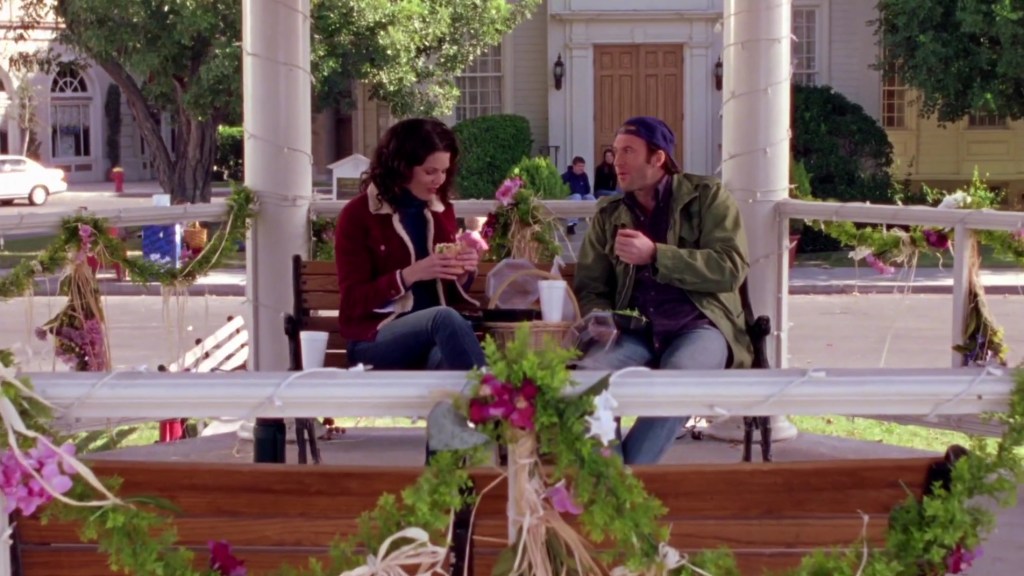
Lorelai and Luke eat their picnic in the gazebo, because Luke can’t stand sitting on the ground to eat (he enjoys hiking and camping – does he sit around the campfire on a deck chair???). He seems to have picked the most romantic spot possible, because it is still decorated with wreaths of flowers.





 The Annotated Gilmore Girls