“I’ll think about it tomorrow – at Tara”

LORELAI: I won’t think about it tonight. I’ll think about it tomorrow – at Tara.

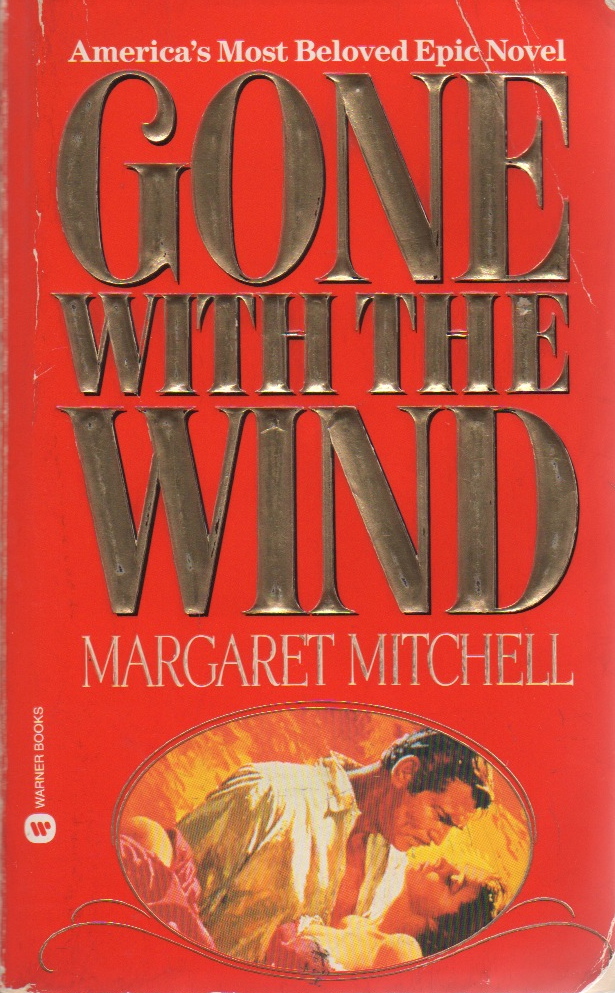
Lorelai slightly misquotes from the 1936 novel Gone with the Wind, by Margaret Mitchell, previously mentioned. Set in the American South at the time of the Civil War and subsequent Reconstruction, the novel’s protagonist is a beautiful, wilful Southern belle named Katie Scarlett O’Hara who is willing to do anything to claw her way out of poverty and save her plantation, named Tara, even while her heart is breaking over her numerous relationship disasters. It takes her too long to discover that the scandalous Rhett Butler is the only man who ever truly loved her.

The full quote is: “I’ll think of it tomorrow, at Tara. I can stand it then. Tomorrow, I’ll think of some way to get him [Rhett] back. After all, tomorrow is another day.” They are the last lines of the novel.

Gone with the Wind was a runaway success, a bestseller before the first reviews of it were even published. Margaret Mitchell won the Pulitzer Prize and the National Book Award, and it was turned into a box-office smash film in 1939, starring Vivien Leigh as Scarlett O’Hara (the film slightly alters the quote from the book). It is the second favourite book of American readers, only beaten by the Bible. It is considered controversial because of its derogatory depiction of African-Americans and romanticisation of white supremacists.

Scarlett O’Hara seems like a forerunner of Lorelai Gilmore – a beautiful, headstrong brunette with a powerful will to survive, and a tendency to mess up all her chances at romantic happiness. Lorelai wanted to give her house a name, like a Southern plantation, and is as deeply attached to it as Scarlett is to Tara. As in Gilmore Girls, blondes tend to be the antagonists in Gone with the Wind. One of the girls at Chilton even suggested to Rory that Lorelai was a Southern belle name. It’s not hard to imagine a teenaged Lorelai reading this novel and identifying with the feisty, rebellious Scarlett.

Xerox

JACKSON: I have a cousin who owns a Xerox company that specializes in taking pictures and making them into things – calendars, coffee mugs, collector plates, and pajamas.

Xerox is a corporation selling print and digital document products and series, headquartered in Connecticut, and incorporated in New York. They are best known for making photocopiers – so much so that Xerox is often used to mean any photocopier (like Kleenex and tissues), and “xerox” can be used as a verb, meaning “to photocopy”.

Jackson’s cousin owns a photocopying service which puts photos onto gift items. Jackson has a large family, and we learn a lot about them during the course of the show. We also learn that Jackson was on the wrestling team when he was in high school.

Lorelai’s Contributions to Stars Hollow

Made all the donkey outfits for the 2001 Christmas Festival – we never saw this, but presumably it’s the same festival that the Christmas pageant is a part of. Seems like a lot of people dressed up as donkeys for the festival, in typical quirky Stars Hollow fashion.

Organised the Save the Historic Oak Tree campaign. Apparently Stars Hollow has a historic oak tree, which we haven’t seen, and Lorelai saved it.

Played the role of Tevye in Fiddler on the Roof for the Stars Hollow Community Theater. Tevye is the father and patriarch in the musical, so Lorelai must have been great to beat any male competitors for the role (unless she was the only candidate, or they were doing a gender-flipped version). Either way, she obviously gave a standout performance. A reminder that Lorelai has to be both mother and father, as a single parent.

I don’t know why Sookie and Rory think any of these things will help Lorelai get a loan – do either of them know how banks work? They don’t give you loans based on how nice and community-minded you are.

“You will take them again and do better”

PARIS: Louise, what did you get?
LOUISE: Highlights, just around my face.
PARIS: You will take them again and do better.

Although Paris is correct that you can retake the PSAT, you can only do it once every twelve months. So Louise would need to wait until October 2002 to retake it – by which time, she would have taken the actual SAT, making it redundant. If you want to take your PSATs more than once, you need to start at least a year in advance. I feel as if Paris would know this.

Note that Louise’s results are apparently lower than Madeline’s, and it is actually she who is worse academically than her best friend. Louise seemed to be the brighter one in Season 1, but Paris berates her by saying, “You don’t study, you don’t apply yourself”, as if she knows Louise is capable of doing better, but is simply lazy.

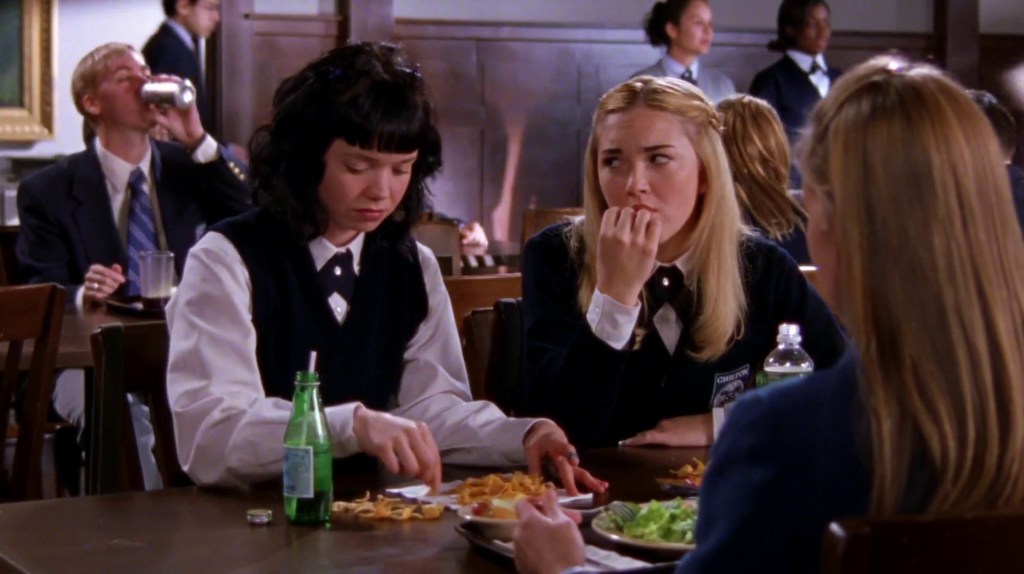
Fritos

These are the chips that Louise and Madeline are eating in the school dining hall for lunch, counting each one to make sure they don’t go over their (obviously tiny) calorie limit. Fritos are a brand of corn chips created in Texas in 1932 by Charles Elmer Doolin and since 1961 produced by the Frito-Lay division of PepsiCo.

Que Sera, Sera (Whatever Will be, Will Be)

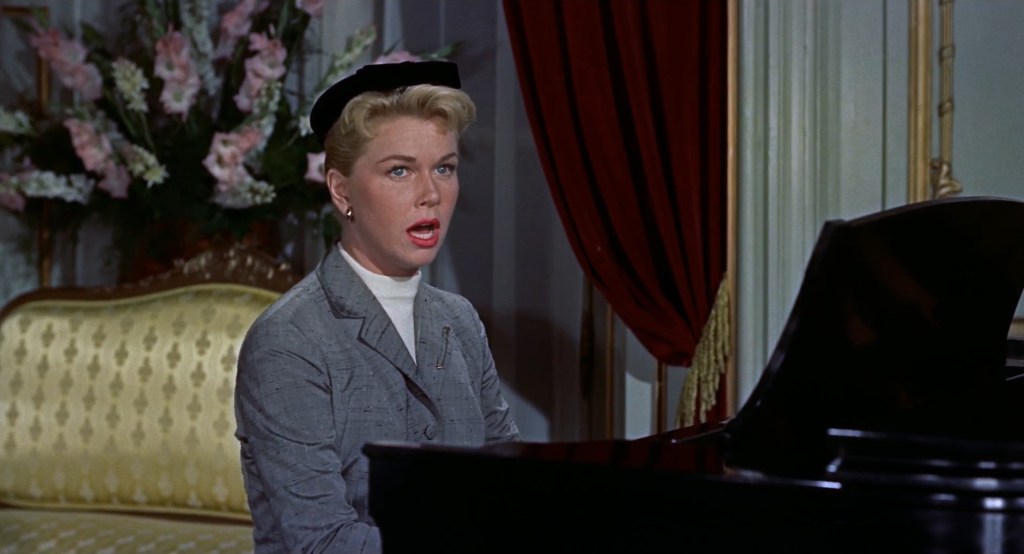
This song plays as Lorelai wakes up happy, gets coffee, goes outside, and falls through the porch. It was written by Jay Livingston and Ray Evans, published in 1955. It was introduced in the 1956 Alfred Hitchcock film, The Man Who Knew Too Much, sung by Doris Day. Her rendition went to #2 in the US and #1 in the UK, and the film received the Academy Award for Best Song. It became Doris Day’s signature song, and is regarded as one of the best songs in cinema history.

The song popularised the phrase que sera sera to indicate a sort of cheery fatalism, although the phrase itself was used as a heraldic motto as early as the 16th century. It is an English mistranslation of “what will be, will be” from the Spanish; in Spanish it would be lo que será, será. No such similar phrase is known of in Spanish or Italian, it has always been an English saying.

In The Man Who Knew Too Much, Doris Day sings the song in the hopes that her kidnapped son will hear it. The song’s message of hope is often used in film and television juxtaposed against disastrous events to create a moment of black comedy, of which we see a very mild version in Gilmore Girls. The joke is that Lorelai has no idea what is coming.

(It might seem unusual to go out on your porch in the your pyjamas early in the morning in the depths of winter to drink your coffee, but Lorelai has that special relationship with snow. And they’re actually in California).

Magenta, Janet, and Dr Frank-n-Furter

LORELAI: I am Magenta, Rory usually opts for Janet, and I … was thinking that you could put on some fishnet stockings, a leather teddy, some platform boots, and go with us as Dr. Frank-N-Furter.

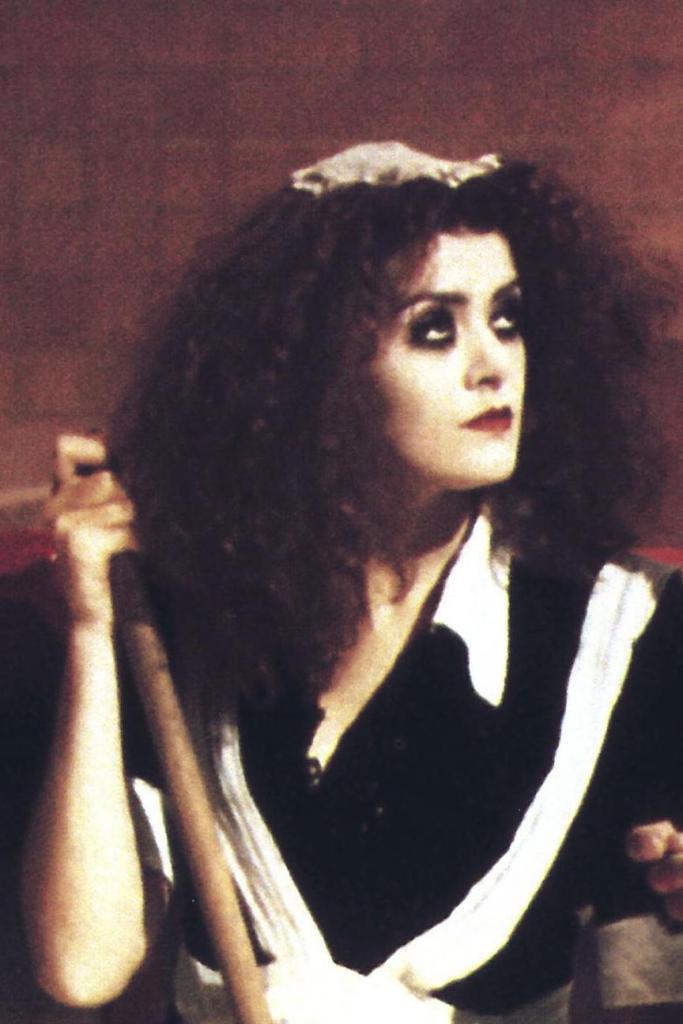
Magenta (played by Patricia Quinn) [pictured] is the maid at the castle in The Rocky Horror Picture Show. A popular choice for dress-ups, she has wild frizzy reddish-brown hair, heavy Goth make-up, and a maid’s uniform. Apart from referencing Lorelai starting at the inn as a maid (she possibly still has her old uniform to wear as a costume), she really would look great as Magenta.

Janet Weiss (played by Susan Sarandon) is the innocent young woman who comes to the castle. She has a girl-next-door look with pink dress, white cardigan, and white handbag. Rory would make a convincing Janet as the seemingly wholesome girl with a deeply repressed sexual side just waiting to be unleashed. Note that Janet is unfaithful to her fiance, Brad – the show keeps linking Rory with infidelity.

Dr Frank-n-Furter (played by Tim Curry), previously discussed, and described by Lorelai.

Human Behaviour

This is the song which plays out to the end of the episode. It’s a 1993 song by Björk, the lead single from her first solo album, Debut. It reflects on the mysteries of human behaviour, apparently from an animal’s point of view, although the lyrics can also be understood as from a small child’s viewpoint.

If you ever get close to a human and human behaviour
Be ready, be ready to get confused and me and my here after
There’s definitely, definitely, definitely no logic to human behaviour
But yet so, yet so irresistible and me and my fear can
And there is no map uncertain

The song was praised by critics, and was an underground smash hit, peaking at #2 on the US dance charts, and reaching #36 in the UK. It went to #1 in Björk’s home country of Iceland.

It’s a fitting tribute to Björk, whose effigy plays a central role in this episode, and we learn that both Lorelai and Rory are fans of hers. It also underlines that Rory doesn’t really understand Jess’ behaviour, and her own behaviour is going to become increasingly unclear to those around her – and herself, too.