“I need to find a retarded kid”

DEAN: Well, Rory, it’s summer. I mean, summer’s the time to hang out and kick back.
RORY: I can’t hang out or kick back. I need to find a retarded kid and teach him how to play softball. Oh God, listen to me. I am horrible. I am under qualified and horrible.

This is the girl that Lorelai calls “the sweetest kid in the world”. Either Lorelai has rose-coloured glasses when it comes to her only child, or Rory has already been corrupted by her zeal to get into Harvard. Maybe both.

Paris and Volunteering

PARIS: When you apply to an Ivy League school, you need more than good grades and test scores to get you in. Every person who applies to Harvard has a perfect GPA and great test scores. It’s the extras that put you over the top. The clubs, charities, volunteering. You know.
RORY: Oh yeah, I know.

Paris explains to Rory what she should already know – to get into a top university like Harvard, you need something to set you apart from all the other excellent candidates.

Paris has been volunteering since she was about nine, and began by handing out cookies at the local children’s hospital (possibly the Connecticut Children’s Medical Center in Hartford). By the age of ten she was running a study group for teenagers, probably through Chilton. She has also been a counsellor for a children’s summer camp, organised a literacy program for seniors, worked at a suicide prevention hotline (a truly terrifying thought), and a residential centre for runaways and homeless youth.

She has also adopted dolphins (you just send money to an organisation like The Oceanic Society), taught American Sign Language (perhaps through the American School for the Deaf in Hartford), and trained guide dogs (volunteers raise puppies and give them socialisation and basic training before handing them back so they can be trained as guide dogs; Paris may have done this through Guiding Eyes in Hartford.) We know Paris likes dogs, because her dog Skippy is said to have had a litter of puppies on Lorelai’s mini-dress that she borrowed: weirdly (or perhaps lazily by the writers) her dog has the same name as Rory’s unfortunate hamster.

Paris has done an insane amount of volunteering for a 16-17 year old girl, but in fact choosing this as a good method of getting into Harvard is almost certainly wrong. Colleges don’t seem to be really be that impressed by you doing huge amounts of random volunteer work (probably because anyone with half a brain and no life can rack up hours of unpaid work fairly easily).

What they really want to see is how your extracurricular activities demonstrate the kind of person you are, and the unique skills and interests that you have. For example, Paris wants to work in medical research, so the children’s hospital was a great start, but she didn’t stick with it. It would have been better to continue volunteering with just one or two organisations, and demonstrate that she had gained a leadership role and given real help to the community – maybe even won an award of some kind. Paris’ volunteering CV looks as if she’s desperately taken any role offered (and sending money to dolphins doesn’t look impressive to anyone).

Furthermore, it depends on the university how highly they rank volunteer work when assessing applications. It doesn’t seem to be extremely important for Harvard, which makes Paris’ efforts even more pointless.
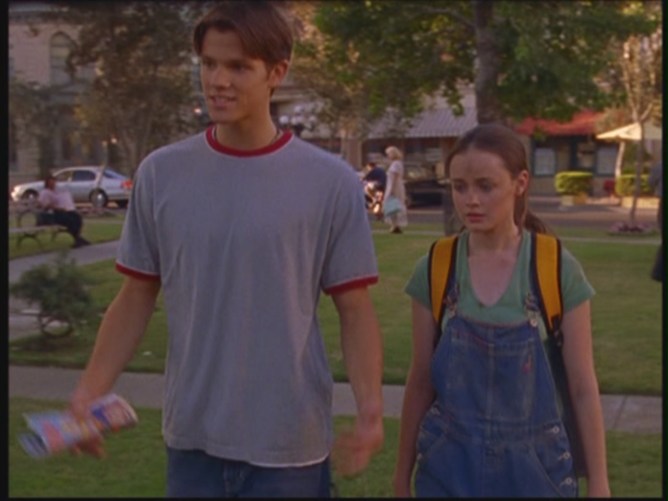
“Keeps your halo shiny”

RORY: I will be assisting, I will be helping out those less fortunate than myself, I will be getting college credit and this is the end of this particular conversation.
LORELAI: You’re right. It’s a good thing. Nice, keeps your halo shiny.

As becomes increasingly clear during this episode, Rory is volunteering purely for college credit, and doesn’t really care about the less fortunate. She’s not quite as angelic as Lorelai thinks.

Rebuilding Together


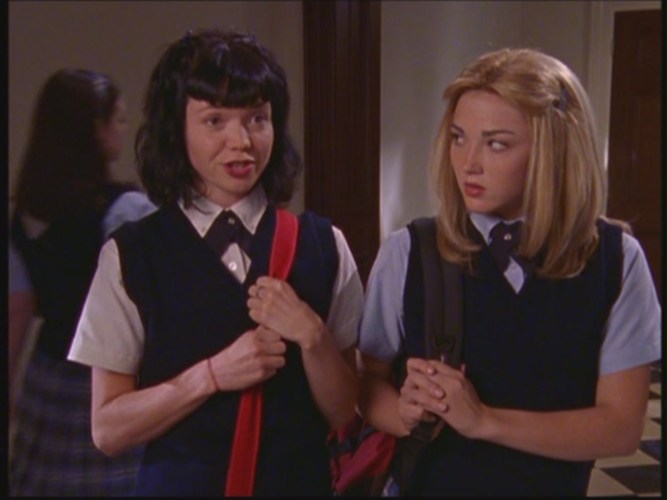
MADELINE: There’s a Rebuilding Together thing going on tomorrow. You know, they fix up homes for the needy. It’s a total easy outdoor denim gig that looks really great on your college transcript.

In real life, Rebuilding Together is a non-profit organisation founded in 1988 which provides free home repairs and renovations for low-income homeowners. However, in the Gilmore Girls universe it seems to operate more like Habitat for Humanity, a Christian-based organisation founded in 1976 which builds simple, affordable housing with volunteer labour for people in need. In real life, both Rebuilding Together and Habitat for Humanity have branches in Hartford, and ongoing volunteering projects.

Madeline here makes a little bid for independence – even after being reminded that she is not meant to be talking to Rory, she invites her to join them on a volunteer project. It’s the closest she gets to protesting Rory’s treatment.

“You’re not talking to me”

RORY: Uh, you’re not talking to me.
MADELINE: I’m not?
LOUISE: Tristan.
PARIS: PJ Harvey.
MADELINE: Oh yeah.

This conversation is a nice reminder of the events of last season which caused Paris to (once again) hate Rory, and force Louise and Madeline to join her in solidarity. It is typical of Madeline that she can never remember why she is supposed to hate Rory – partly it’s ditziness, but also a genuine liking for Rory; Madeline is noticeably always pleased to see her. And Paris’ reasons for hating Rory are so silly that’s it’s no wonder Madeline can’t remember them.

Taffeta and Cotillion

RORY: Why don’t you go to a wedding dress place and try a real veil on?
LORELAI: No way.
RORY: Why?
LORELAI: Too much taffeta, it gives me cotillion flashbacks.

Taffeta is a smooth plain-woven fabric made from silk. It is considered a luxurious fabric suitable for ball gowns and wedding dresses.

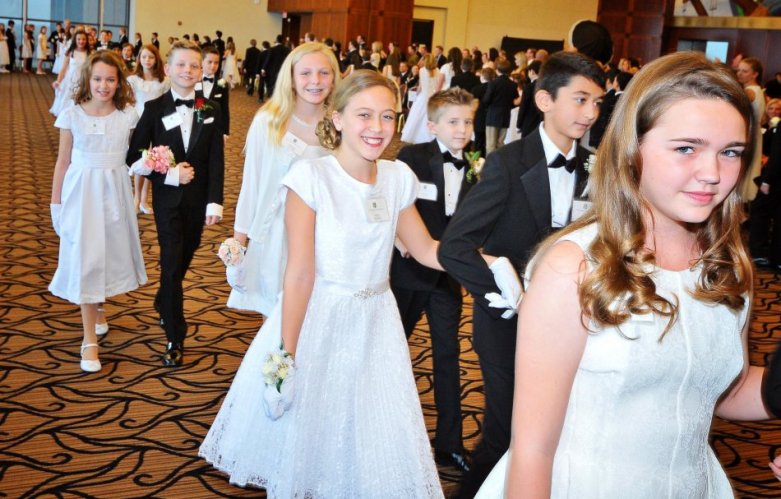
In American usage, a cotillion is a formal ball, often for presenting debutantes to society. However, Lorelai is most likely talking about cotillions as a class for younger girls, perhaps aged 10 to 13, to prepare them for their future debut in society. Such classes teach social etiquette, followed by a formal party where they put what they’ve learned into practice. We later learn that Emily teaches these classes, and probably taught Lorelai when she was younger.

Rory’s Fight With Richard

Rory has tended to think of her grandmother as the more difficult and exacting grandparent, while her grandfather can be counted on to dote on her. Moreover, her grandmother had a meltdown after Rory and Dean stayed out late together.

However, at the special dinner it is Emily who makes an effort to be civil with Dean (we already know from Rory’s Birthday Parties that she thinks social occasions are not suitable times to get into arguments), while Richard basically attacks Dean.

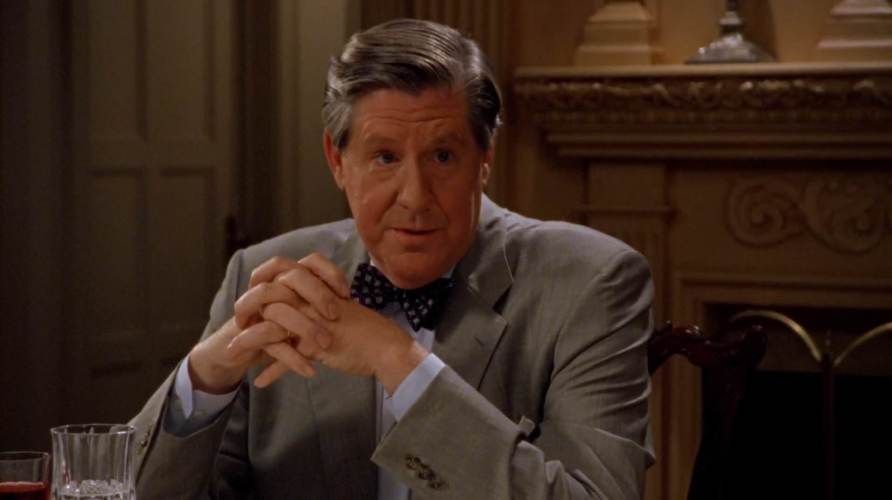
Richard is furious that his precious beautiful granddaughter, so smart and ambitious, bound for an Ivy League university and a glittering career, should have a boyfriend like Dean – an average student who doesn’t know where he’s going to college, and hasn’t thought about what job he might do later.

Richard comes down hard on Rory for choosing Dean as her boyfriend, telling her that as a Gilmore, she has a responsibility to uphold the family name. We know from his fight with Lorelai in Christopher Returns that the Gilmore name is very important to Richard, and that he has immense family pride. He warns Rory that Dean can only hold her back in life.

Richard is incredibly rude and snobbish in this episode, revealing how elitist he is. There must surely be some jealousy as well, knowing that he is not the most important male in Rory’s life.

Rory is justifiably angry with him, and defends Dean as well as she can – as she can’t exactly counter Richard’s arguments, all she can say is that Dean is incredible and special to her, and that he shouldn’t be treated that way as a guest before storming out.

Rory will later find herself in the same position as Dean when a future boyfriend’s parents don’t believe she is good enough for their son.

Everyone is Interested in Lorelai and Luke

Once word (instantly) gets around town that Lorelai has had a marriage proposal, all the townspeople are inordinately interested in seeing how Luke takes the news.

This is taken to exaggerated levels when a line of people, most of whom we have never seen before, form a line and begin following Lorelai to the diner. They then proceed to press their faces against the diner’s windows so they can watch Luke hear the news. They won’t be able to hear anything from the street, but apparently they don’t care.

For normal people, only friends and family (maybe) are interested in your wedding news; for Lorelai and Luke, they are the celebrities of Stars Hollow that even strangers find completely fascinating.

Rory tells Lorelai that “everyone knows” that Luke “has a thing for Lorelai”, which means that Rory knows too, and still discouraged Lorelai from seeking out a relationship with him.

“Why don’t you want to think about this?”

RORY: Why don’t you want to think about this?
LORELAI: Because I haven’t made my mind up about the yes or no part, so I don’t want to start fantasizing about dresses and flowers or doves and tulle until I do, so please change the subject.

The fact that Lorelai needs to think about whether to say yes or no is a sure sign that she doesn’t really want to marry Max. If she did, she would be jumping at the chance, or at least coming up with ways to justify saying yes.

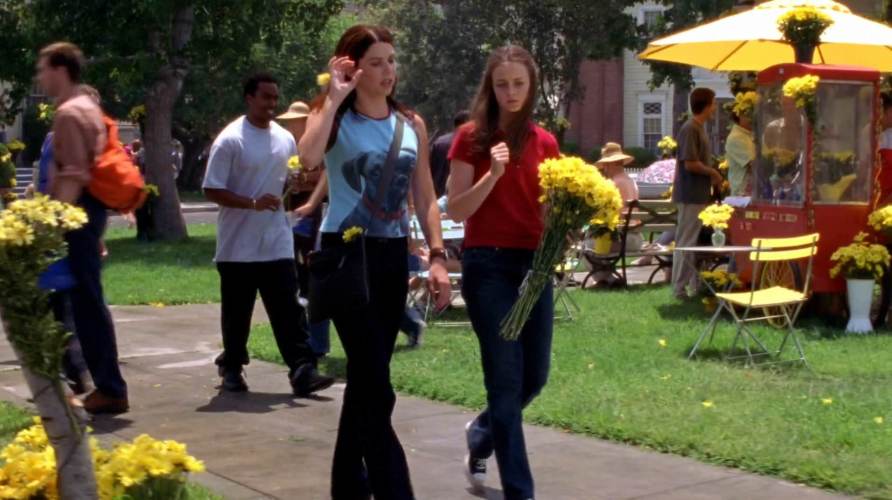
(You can see in the background that Lorelai has donated her yellow daisies to the entire town, and they even seem to have set up a little red wagon in the town square from which to either sell or give away the flowers to passers-by. It’s a typically big-hearted gesture by Lorelai which serves to make her more of a star and the centre of attention. It’s also practical, as she could hardly take all the daisies home).

Secrets of the Flesh: A Life of Colette

When Tristan grabs Rory’s books from her in a pathetic attempt to hold them hostage until she agrees to go the concert with him, this is one of the books we can see in the pile.

Colette, born Sidonie-Gabrielle Colette (1873-1954) was a novelist, short-story writer, journalist, actress and mime. Her works, which are often about married life and female sexuality, were semi-autobiographical, and highly critical of conventional roles for women. Colette is regarded as one of France’s great women writers, with one of her best known works the novella Gigi (1944), which was adapted into a film and a musical.

Judith Thurman is a journalist who became a staff writer for The New Yorker in 2000, and writes about fashion, literature, and culture. Her Colette biography was first published in 1999 and reprinted in 2000; it won The Los Angeles Times Book Award and the Salon Book Award in the biography category of each.

Thurman also wrote an award-winning biography of Isak Dinesen in 1983, which was used as the basis for the film Out of Africa, previously discussed.

It is not surprising that Rory would want to read a biography of an unconventional female writer, written by someone who is doing what Rory would love to do – we know she is a fan of The New Yorker. Reading a biography of Colette suggests that she has already read novels by Colette, and as we know she loves Isak Dinesen, she has probably read the earlier biography by Judith Thurman as well.