“I just got the job”

PARIS: I just got the job [of school newspaper editor].
RORY: Oh. Congratulations.
PARIS: Thank you. And don’t worry, you’ll have some role. How’s covering the new parking lot landscaping sound?

Paris is not kidding – writing up the new parking lot is the first assignment that she sets Rory when school resumes the next semester.

To me it seems unbelievable that a junior would be given the job of editor over seniors, who would already have a year of experience under their belt. However, it’s not impossible The Franklin is a school newspaper specifically for juniors to work on, and Paris can be very forceful when she wants something. Rory certainly didn’t seem to make much effort to get chosen as editor, which she should have done as an aspiring journalist.

Rachel Leaves

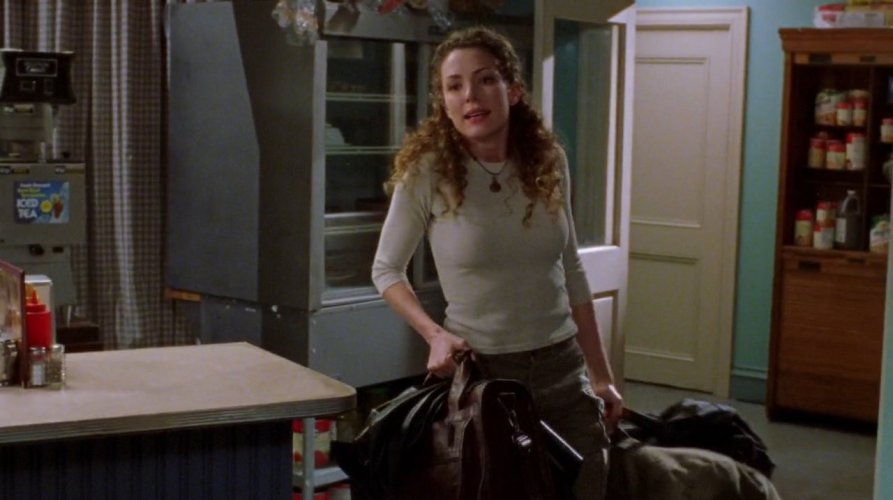
(Rachel picks up her luggage and walks out from behind the counter.)
LUKE: So you’re leaving, huh?
RACHEL: Yeah.

After waltzing into town on a whim in March, Rachel is now out of there after putting in a full seven weeks or so as Luke’s live-in girlfriend and diner assistant. (You can see that she is taking the leather camera case that Luke bought her and Lorelai chose). It’s amazing how little we actually learn about her (not even her surname, or how she came to Stars Hollow in the first place to become Luke’s girlfriend).

Rachel was never a real character, just a plot device. She came to Stars Hollow to remind Lorelai about the Dragonfly, an old inn that now becomes part of Lorelai and Sookie’s goals for the future. She also arrived to help Luke understand that he has feelings for Lorelai, and that he is definitely over Rachel, who he had long held a torch for (in fact, he more or less admitted to Lorelai that he has been in love with a fantasy all these years).

Amazingly, one thing Rachel didn’t come to do was to help Rory with her journalism career. It’s almost unbelievable that Rory got to meet a real-life photojournalist, and one who is also young, cool, and travels the world for her job, covering important political stories, just as Rory longs to do, and not once do we see Rory ask her for advice, or any interaction between them at all, apart from Rachel bringing them food and drinks in the diner.

This would have been the most incredible opportunity for Rory to talk to a freelance journalist, ask about the perks and downsides of the job, managing the day-to-day aspects of such work, the difficulties of travelling to distant and even dangerous locales, the need for being independent and organised, or even the publications that Rachel has sold stories to. It shows a lack of keenness for her future career that is truly disappointing.

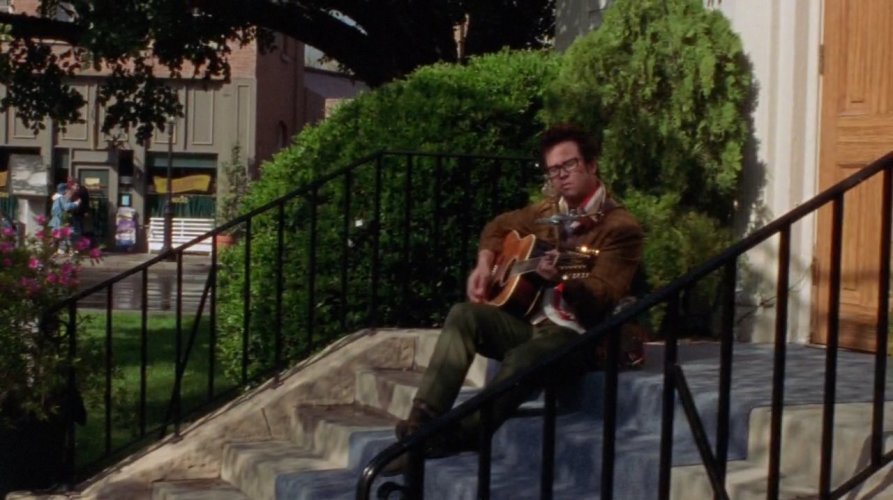
Sad Lonely Guys (Natural Loners)

LORELAI: Lee Harvey Oswald.
LUKE: John Muir.
LORELAI: The Unabomber.
LUKE: Henry David Thoreau.

Lorelai and Luke disagree about the romantic ideal of the male loner, with Lorelai seeing them as sad, lonely misanthropes, and Luke as mystical hermits of the wilderness. Luke sees himself as the latter, while Lorelai is worried he could be the former.

Lee Harvey Oswald (1939-1963) was an American ex-Marine and Marxist defector to the Soviet Union, described as quiet and withdrawn. According to four federal investigations, he assassinated President John F. Kennedy in 1963; there is a strong public belief that he didn’t act alone. Oswald was murdered by nightclub owner Jack Ruby while he was being transferred from the city gaol to the county gaol, and never stood trial or gave testimony.

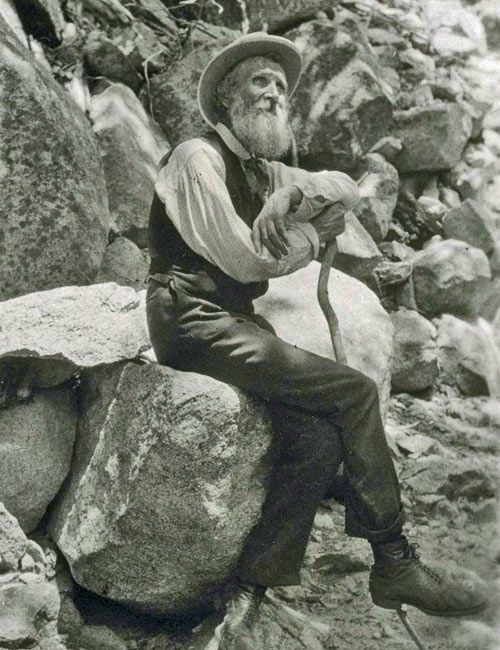
John Muir (1838-1914) [pictured] was a Scottish-American naturalist, author, environmental philosopher, glaciologist, and early advocate for the preservation of wilderness in the United States. His essays and books about nature have inspired millions, and his activism helped preserve Yosemite National Park, Sequoia National Park, and other wilderness areas. He co-founded The Sierra Club, a prominent conservation organisation, and he has many things named in his honour, including the John Muir Trail in the Sierra Nevada, and the John Muir Way in Scotland. He is known as “Father of the National Parks”, and has been described as a patron saint of the environmental movement. As a young man, Muir spent many years hiking alone in the wilderness, but in middle age he married and had children, although still needing to spend time in the wilderness to refresh his spirit.

Ted Kaczynski, known as the Unabomber, and previously discussed.

Henry David Thoreau (1817-1862) was an American author, poet, naturalist, and philosopher whose writings are early examples of environmentalism, and who advocated hiking, canoeing, and the preservation of wilderness (although when he actually went deep into the wilds, he came back with a new appreciation for civilisation). Thoreau is best known for his book Walden, or, Life in the Woods, which describes living a simple life in natural surrounds. It is based on a period of over two years that Thoreau spent living in a wooden cabin near Walden Pond among woods near Concord, Massachusetts. The book is both a memoir, and a spiritual quest to discover a better way to live. It tells of how Thoreau managed to enjoy his solitude in the woods, but also the companions that he met, and the friends who came to visit him, and how he enjoyed that too.

That Luke selects Muir and Thoreau as his models of loners, one who married and had a family, and the other who enjoyed friendship and companionship, suggests that he does not wish to be completely alone or isolated in life.

Honey, Don’t Think

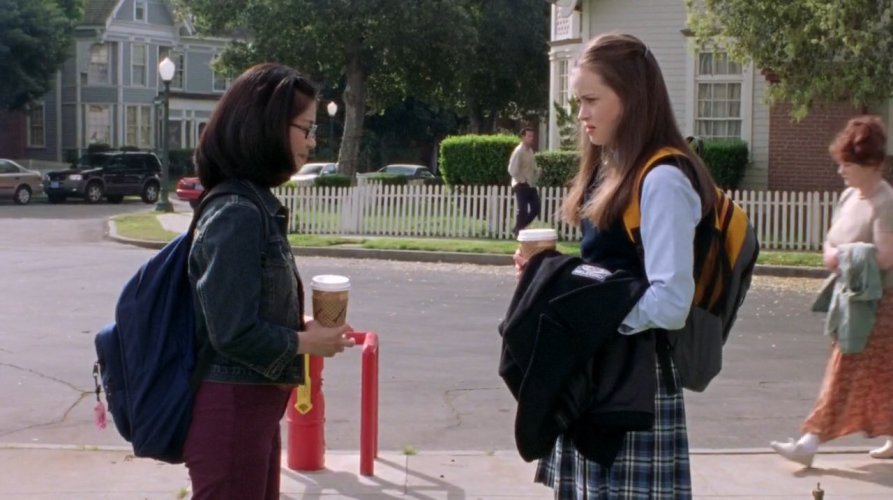
After Rory has tried to find Dean in Doose’s Market, and failed, she and Lane walk away while the town Troubadour sings this song. It’s from Grant Lee Buffalo’s 1994 album Mighty Joe Moon, earlier mentioned. The song seems to be advising Rory not to think about it too long before talking to Dean.

On Rory and Lane’s walk away from the market, we learn that it is around 4.30 pm by the town clock, which seems too early for Rory to already be back from school (she gets out at 4.05 pm, and has a 40 minute bus ride home). Viewers will also notice that Rory’s little box of French fries is empty, so Lane must have eaten them all while she was waiting for Rory, in line with her lust for junk food that her mother won’t allow.

“Mr. Cosell”

EMILY: She [Rory] got home from school, but she just went right upstairs. Now she didn’t want a snack, but I had Rosa make her one anyway. I haven’t checked to see if she’s eaten it. She had a decent breakfast this morning, but she did seem a little tired, and when I went into her bathroom the aspirin bottle was out, so I assume she had a headache. Now, I don’t know if it was last night or …
LORELAI: Excuse me, Mr. Cosell. I appreciate the play-by-play but I just want to talk to my daughter now.

Howard Cosell, born Howard Cohen (1918-1995) was an American sports journalist who entered sports broadcasting in the 1950s, and in the 1970s became the commentator for Monday Night Football on ABC. He completely changed the style of sportscasting towards one of context and analysis, similar to hard news journalism, and is regarded as the greatest American sports commentator of all time. Lorelai compares Emily’s blow-by-blow account of Rory’s activities to Cosell’s in depth analysis of a football game.

Emily’s speech shows her hyper-controlling style of micromanagement. Rory has only been home from school for around an hour, but has had her every move and mood scrutinised, been given a snack after saying she didn’t want one, and had her bathroom searched after leaving it. It’s a telling insight into what Lorelai’s childhood must have been like, and into what Rory’s would have been like if Lorelai had remained living with her parents after becoming a mother.

Emily allows no autonomy, choice, or privacy, and keeps people under surveillance as if they are in prison (remember Lorelai, an adult, could not even say she was going to the toilet without being followed?). It’s really hard to blame Lorelai for fleeing her childhood home because of these circumstances, fearing that Rory would have to endure the same childhood she did.

“Running around trying to protect me”

RORY: I’ll get over it.
LANE: Well, you’re not over it yet.
RORY: Maybe I’d get over it a little quicker if everyone weren’t so busy running around trying to protect me from all the bad scary things in the world.

During her fight with Lane, Rory puts her finger on the great tragedy of her life. Everyone does everything they can to protect her, to mollycoddle her, and to reassure her she’s wonderful, without ever thinking that this could stunt her emotional growth.

Throughout the series, Rory will demonstrate again and again that she could have done with a little toughening up, as she tends to fall apart the second she’s faced with reality.

Out of Africa

LORELAI: Okay, last week we were talking about Meryl Streep and the whole accent thing, and Rachel said that she loved Out of Africa, but she’d never read the book, remember?
LUKE: Nope.
LORELAI: Okay, so I was like, “Are you crazy? Isak Dinesen is amazing, I love her.” Which is kind of crap because I’d never read the book either, but Rory told me it was amazing, so I felt pretty confident in my recommendation of Out of Africa.

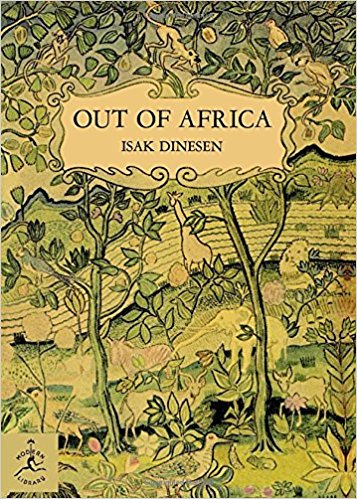
Out of Africa is a 1937 memoir by Isak Dinesen, the pen name of Danish author Karen Blixen. It describes the seventeen years that Blixen spent in Kenya, then called British East Africa. It is a meditation on her life on her coffee plantation, and some of the people she encountered there.

The book is non-chronological in structure, and is notable for its melancholic, poetic style that is above all a tribute to the Africa she knew, and a world that had changed irretrievably. That she helped change it did not seem to make a strong impression on her, although her notes on the African people are understanding and accepting, and they admired her as wise and trustworthy.

It seems appropriate that Rory would enjoy Out of Africa. We know that she admires women writers, books on travel, memoir and autobiography, and works with a certain lyrical sadness to them – she likes things that make her feel “gloomy”.

Out of Africa was adapted into film in 1985, directed by Sydney Pollack, and starring Meryl Streep and Robert Redford in the lead roles. The film has several differences from the book, and focuses on Karen Blixen’s love affair with a hunter named Denys Finch Hatton (an Englishman, although Robert Redford plays him with an American accent). Meryl Streep spent a lot of time listening to tapes of Karen Blixen speaking, and chose an old-fashioned, aristocratic accent for her character, which Sydney Pollack thought excessive; Streep is well known for her mastery of different accents.

Out of Africa was the #5 film of 1985 and won seven Academy Awards, including Best Picture, and Best Director. Despite this, it received mixed reviews from critics.

The fact that Luke can’t remember a word of a conversation with Rachel doesn’t seem very promising for their relationship. As Out of Africa is in part about a doomed love affair, it is possible that Rachel may read something into the gift that Luke has “chosen” for her.

Lane and Dean

When she was with Rory, Lane told her that she had to meet her science partner to work on an assignment; now we learn that Dean is her science partner. They are studying spores, moulds, and fungi, which suggests a Biology class.

It is notable that Lane is able to work with Dean, and is reasonably polite and even friendly with him. She doesn’t treat Dean badly because he broke up with Rory, as others have done, or seem to have any problem with him.

From her observations of both, she may have decided it is quite likely that Rory and Dean will eventually get back together and she prudently doesn’t want to be the person who made an enemy of her best friend’s boyfriend. (She even raises the possibility with Dean, suggesting it is something she has thought about).

Another possibility is that Rory has told her, or at least hinted to her, that it isn’t entirely Dean’s fault that they broke up, and that he didn’t dump her on a whim, or do anything horribly cruel to her. Lane does seem to understand that Dean is not a monster, and perhaps knows that Rory has trouble with commitment.

Rory walks in on Lane and Dean studying together, and having a conversation about her behind her back. She didn’t know that it was Dean who was Lane’s science partner, and doesn’t cope well when she finds out this way.

“I have asthma”

KIRK: Okay, did somebody put the “Kick me” sign on my back again?
(Lorelai and Rory are laughing.)
KIRK: It wasn’t funny last week, and it’s not funny now! I have asthma.

Asthma is a common long-term inflammatory disease of the airways of the lungs. Symptoms include coughing, wheezing, and shortness of breath, and episodes may occur several times a day, or a few times a week. There is no cure, but symptoms can be reduced by avoiding allergens and irritants (such as tobacco smoke), and using an inhaler with corticosteroids in it.

This is the first time in the show that we learn something about Kirk’s private life. It also shows us that Kirk is the town joke, and something of a whipping boy, so that Lorelai and Rory have no problems making fun of him in public.

“You look tired”

LORELAI: You look tired.
RORY: I just haven’t been sleeping very well lately.
LORELAI: How come?
RORY: Just have a lot on my mind.

It’s a few weeks since Rory and Dean ended their relationship, and she seemed to be coping pretty well. But perhaps that was just because she had a few distractions, such as a surprise visit from her great-grandmother, a group project to work on, spending an afternoon with her grandmother, and getting her own bedroom at her grandparents’ house.

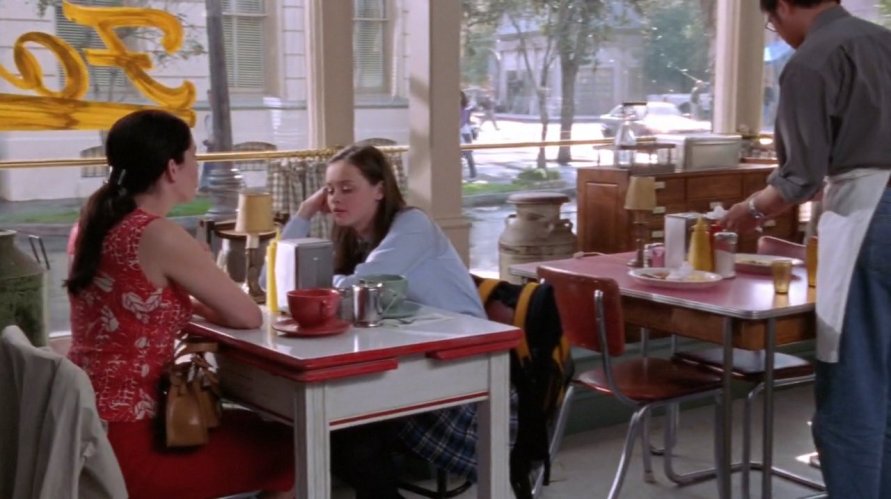
Now that it’s back to normal life with nothing much happening, Rory is having trouble sleeping. When she sees Dean walk past the diner as she and Lorelai play a “who would you marry?” game with passers-by, Rory looks miserable.