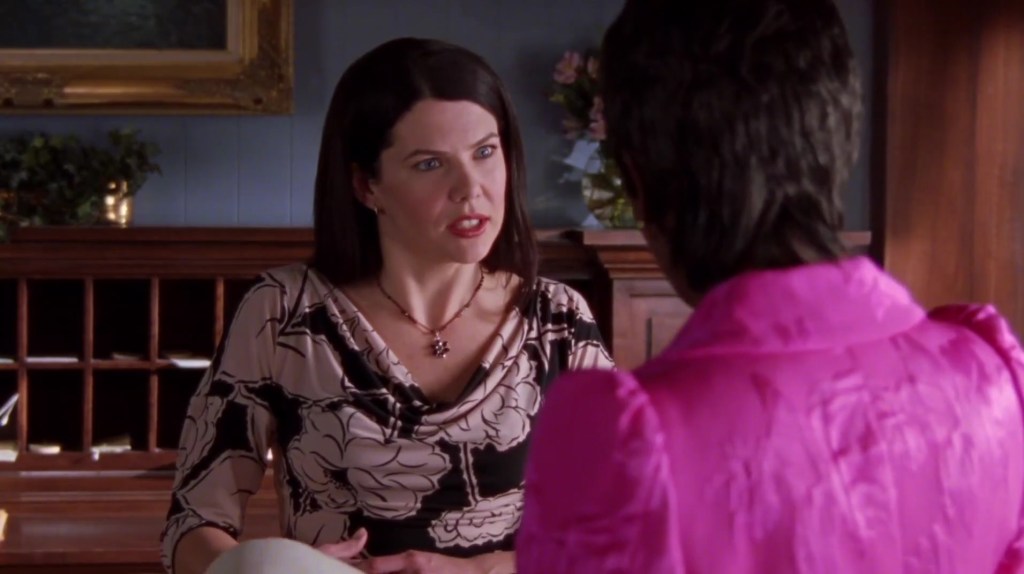
“Michel ate pasta?”

GISELLE: I am. I will miss him so much when I go home, but thank goodness, he will have an extra five pounds to remember me by after eating all my pasta today, that dirty thieving boy.

LORELAI: Michel ate pasta?

GISELLE: Well, yes. Michel loves pasta, he eats it all the time.

LORELAI: Not around us. Here it’s all no-carb, low-cal, let me see if I can eat less than the lab rats do.

Michel and his mother Giselle are having a wonderful time together treating themselves to luxurious meals, and there must surely be some malice involved when Lorelai decides to “out” Michel as a fad dieter to his mother (it feels like a subtitute for a different kind of “outing”, and just as much of a betrayal).

When Michel and his mother leave together laughing and joking over coffee, Lorelai looks utterly disgusted by them, and mutters, “That is so wrong”. It seems that it’s wrong for any other mother to befriend her child and joke with them while pigging out and drinking coffee!

Jehovah’s Coffee Girl

LUKE: Not everybody likes it that strong.

LORELAI: Well, then I shall convert them. I am the Jehovah’s coffee girl.

Jehovah’s Witnesses is a non-mainstream Christian denomination which emerged from the Bible Study Movement founded in the 1870s by Charles Taze Russell; after his death, a breakaway group headed by Joseph Franklin Rutherford took control and chose the name Jehovah’s Witnesses in 1931.

Jehovah’s Witnesses are probably best known for their door-to-door preaching, distributing evangelical literature. Lorelai sees herself as similarly working to convert people to strong coffee.

Cathy Coffee, Mrs Folger, and Juan Valdez

LORELAI: We’re running out of coffee … I got it.

LUKE: Do you know how?

LORELAI: Do I . . . ugh . . . I am Cathy Coffee, mister, the bastard offspring of Mrs. Folger and Juan Valdez.

Cathy Coffee

I think a fictional coffee mascot that Lorelai has invented and is now personifying.

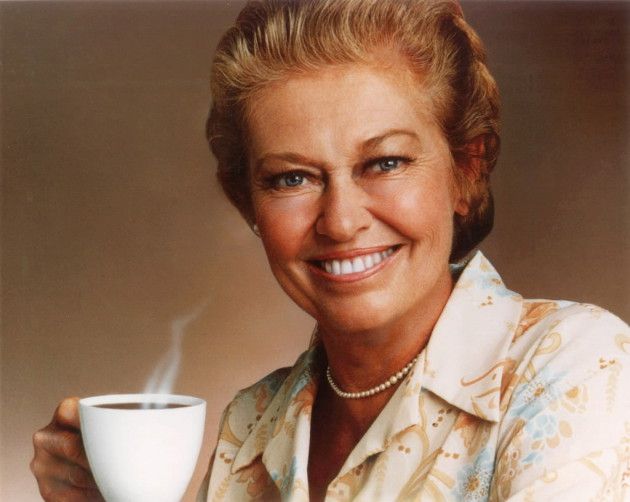
Mrs Folger [pictured]

Mrs Olson, or “The Folgers Coffee Woman” was in a string of television commercials for Folgers Coffee during the 1960s and ’70s. Mrs Olson was a Swedish neighbour who always recommended a cup of Folgers Coffee to other people in the commercial. She was played by an actress named Virginia Christina, born Virginia Ricketts (1920-1996).

Juan Valdez

A fictional character who has appeared in advertisements for the National Federation of Coffee Growers in Colombia since 1958. He is an icon for both coffee and Colombia. He was portrayed by a Cuban actor named José F. Duval until 1969, then by Colombian actor Carlos Sánchez. Since 2006, Juan Valdez has been portrayed by Carlos Castañeda, a coffee grower from a small town in Colombia.

“A big, pretty dish of lovin’ with a spoon”

LORELAI: A big, pretty dish of lovin’ with a spoon made especially for you.

This sounds like a reference to the rock band The Lovin’ Spoonful, founded in Greenwich Village in 1965 by singer John Sebastian and guitarist Zal Yanovsky. Their hits include Do You Believe in Magic? (1965), Summer in the City (1966), and Daydream (1966). The band broke up in 1969, but have had a few revivals and reunions over the years. An influence on British bands such as The Beatles and The Kinks, they were inducted into the Rock and Roll Hall of Fame in 2000, and into the Vocal Group Hall of Fame in 2006.

The band’s name is taken from a line in the song Coffee Blues, by blues singer Mississippi John Hurt, a tribute to Maxwell House Coffee. There is a link in blues songs between a “spoonful” of something and sex (sometimes drugs); it has been conjectured that the “lovin’ spoonful” in the song refers to the amount of ejaculate in a typical male orgasm.

This connection between coffee, sex, and love seems very apt for Lorelai! It’s as if the coffee Luke makes for her is a metaphor for something else that’s hot and wet.

Lemon Coke

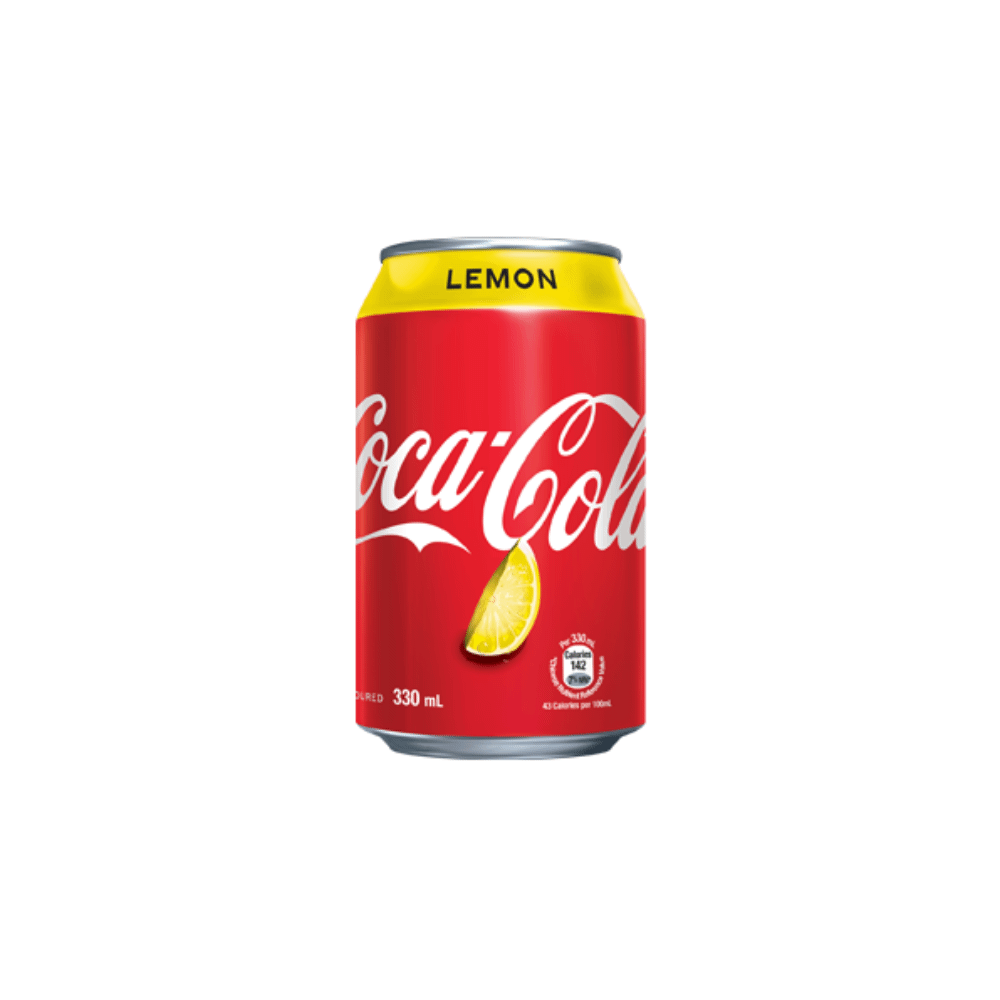
LORELAI: Sorry, it’s just. . .so excited about the ducks that, uh . . . do you want something to drink? You have good timing ‘cause we shopped yesterday, and in addition to a case of Maybelline Fresh Lash Mascara, I also bought some of that new, uh, freaky Coke with the lemon in it. It’s very addictive.

Coca-Cola with Lemon is a brand owned by the Coca-Cola company, introduced in 2001.

“Hooch is hooch”

RICHARD: Uh, you wanna narrow that [drink order] down for me?
LORELAI: Hooch is hooch, Dad.

Hooch is old-fashioned American slang for hard liquor, which became common during the 1920s and the Prohibition era. It originated in the 19th century, and comes from the Hoochino Indians of Alaska. One small tribe, who called themselves the Hutsnuwu, had a reputation of brewing their own illicit alcohol which was extremely potent (presumably the information on making spirits was taught to them by Europeans, but nobody knows for sure).

Florida People and Anita Bryant

RICHARD: Oh, I always start my breakfast off with half a grapefruit.
LORELAI: Hm, do the Florida people know about you? Because Anita Bryant left this huge gap that has yet to be filled.

Anita Bryant (born 1940), previously mentioned. Singer who had a string of hits in the late 1950s and early 1960s, and was Miss Oklahoma 1958.

In 1969, she was chosen as the ambassador for the Florida Citrus Commission, with commercials featuring her singing Come to the Florida Sunshine Tree, and saying the tagline, “Breakfast without orange juice is like a day without sunshine”.

In 1977 she became a controversial figure as an anti-gay rights activist, leading a coalition of conservative Christians who wished anti-discrimination legislation to be repealed. They were successful, but earned the ire of gay-rights activists, who organised a ban against orange juice. She became an object of ridicule, and after her divorce in 1980, the Florida Citrus Commission allowed her contract to lapse. This is the “huge gap” that Lorelai suggests Richard might like to fill. It also seems to be another comment about censorship.

“One grub too many”

SOOKIE: You just had one grub too many. Just drink lots of water to rehydrate.
JACKSON: I will.

I think Sookie is referring to mezcal, a Mexican spirit distilled from the agave plant, similar to tequila, and extremely intoxicating. Some brands include an edible mezcal “worm”, an insect larva which is the caterpillar of a moth, or occasionally the larva of a weevil, both of which naturally infest agave plants. The manufacturers added it in the 1950s as a marketing ploy. I think this is the “grub” Sookie means.