Audiovisual Club

RORY: I mean, Harvard is hard to get into, and I don’t know why I even spend my time thinking about anything else.
LORELAI: Because you have a pulse, and you are not the president of the Audiovisual Club.

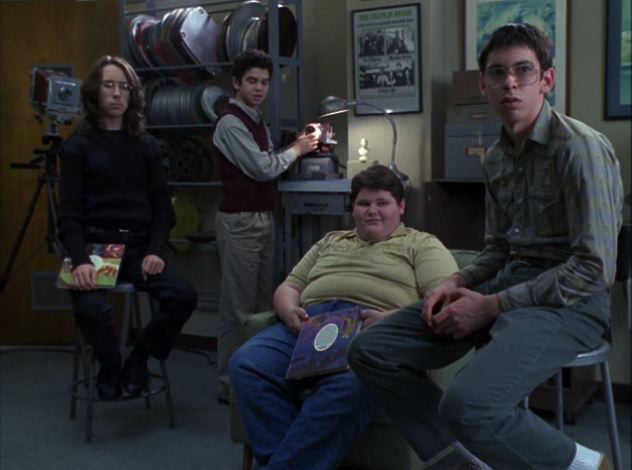
An Audiovisual Club was one in American high schools where children learned how to become proficient in using microphones, film, slide projectors, VCRs, and other audiovisual devices, often becoming assistants to library and teaching staff when they needed that equipment.

They’ve become more or less obsolete since the 1980s, or evolved into IT Clubs or Media Clubs, but the stereotype remains of an Audiovisual Club being made up of extremely geeky students who belong to the A.V. Club, often as a way of hiding from bullies. They feature in TV series set in the 1980s, such as Freaks and Geeks [pictured] and Stranger Things.

Lorelai is remembering back to her own school days in the 1980s. Rory is perhaps too diplomatic or too depressed to tell her mother that her school doesn’t have an A.V. Club.

Princeton

STRAUB: Our son was bound for Princeton. Every Hayden male attended Princeton including myself, but it all stopped with Christopher. It’s a humiliation we’ve had to live with every day, all because you seduced him into ruining his life. She had that baby and ended his future.

Princeton University is a private Ivy League university which was founded in 1746, making it one of the oldest universities in the United States. It is located in Princeton, New Jersey.

We learn from Straub that several generations of his family have attended Princeton. He specifically says the males, as Princeton only became co-educational in 1969 – if Christopher had a sister, she might have gone to Princeton.

I’m pretty sure you can still go to Princeton if you have a child with your high school girlfriend, so Straub is clutching at straws in his efforts to blame Lorelai and Rory for Christopher not being accepted into Princeton (or any other university).

Straub doesn’t make Christopher face the consequences of his actions, and blames others for any failure in his life, which is one reason why Christopher is such a weak and unreliable person. It’s notable that Christopher privately tells Lorelai it isn’t her fault her didn’t go to Princeton, but doesn’t have the guts to defend her openly, and tell his father that.

Lane’s School Results

RORY: Hey how’s it going?
LANE: Very well. I have discovered that in addition to my lameness in geometry I also will not become a biologist, French translator, or Civil War buff.

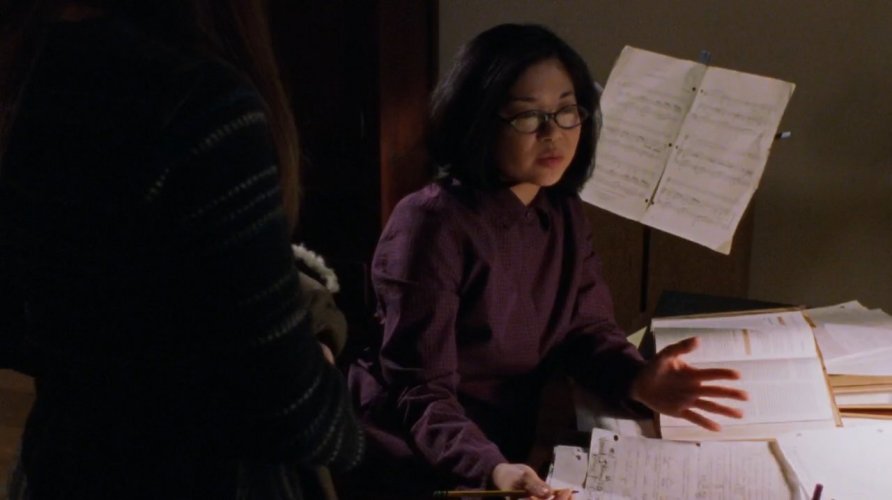
Apparently Lane didn’t get great results in her mid-term exams – at least not in Geometry, Biology, French, and American History. A reminder that Lane has a school life too with homework and exams, and that unlike Rory she isn’t an academic whiz-kid.

You can see that Lane has a sheet of music up, so she is apparently teaching herself to read music, as well as familiarising herself with multiple genres of popular music. This helps explain her lacklustre school results – she is bright, focused, and hard working, but is simply far more interested in music than school. If only her parents had sent her to a music school, she would have aced everything, but only Rory gets educational opportunities and a chance to shine at what she’s good at.

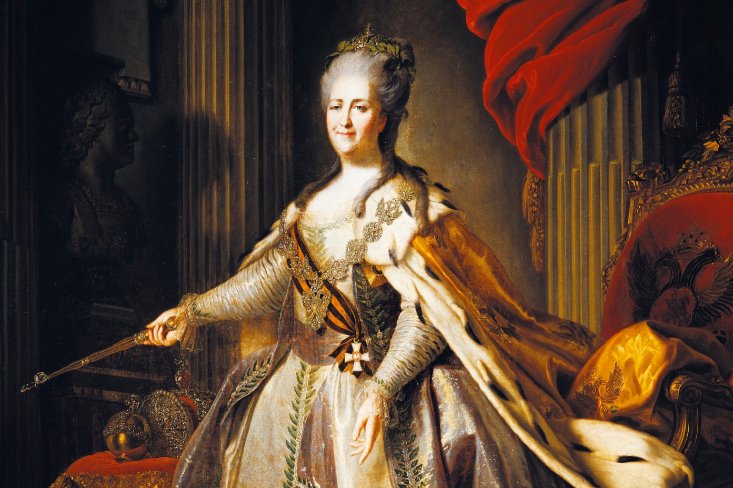
Catherine the Great

While Lorelai is mending her Chilton school sweater, Rory studies for a History test (her midterm exam?), reading through index cards on Catherine the Great.

Catherine II (1729-1796), also known as Catherine the Great, was Empress of Russia from 1762 to 1796, the country’s longest-ruling female leader. Under her reign, Russia grew larger and stronger, and was recognised as one of the great powers of Europe, while the period of her rule is considered the Golden Age of the Russian Empire and the Russian nobility. As patron of the arts, she presided over the Russian Enlightenment, and decreed the first state-funded institute of higher learning for women.

As Rory’s notes say, she was born Princess Sophie Friederike Auguste von Anhalt-Zerbst-Dornburg in Prussia. Although Lorelai jokes that everyone called her Kitten, her nickname was Figchen, a short form of her middle name Friederike. She received the name Yekaterina (Catherine) in 1744 on converting to the Russian Orthodox faith in preparation for her marriage.

Catherine married her second cousin Peter von Holstein-Gottorp, Duke of Holstein-Gottorp (that’s in north-west Germany) in 1745 – not 1754 as Rory says. Their marriage was indeed unhappy, and Catherine detested Peter at first sight. He had a difficult personality, and both of them were unfaithful to each other, with Catherine taking many lovers during her lifetime.

Peter became Peter III, Emperor of Russia in 1762, but six months later was deposed and possibly assassinated as the result of a conspiracy led by his wife Catherine, who succeeded him to the throne.

In an episode focused on women’s roles, this is a reminder of one of history’s most powerful female leaders.

“Not in the budget”

RICHARD: It costs a fortune to travel first class in Europe. We only do it every two years
EMILY: In the fall.
RICHARD: It’s just not in the budget this year.

Richard and Emily didn’t go to Europe the previous fall, so they would normally have gone this fall, except that it’s not in the budget. Most likely that’s because they are paying for Rory’s schooling – a year’s tuition at Chilton would be enough money for two first-class vacations in Europe. (Of course the idea they could have a cheaper holiday is one they can’t get their heads around, and they wouldn’t enjoy it anyway).

Richard and Emily are extremely tactful about this shortfall of money, even after Lorelai and Rory keep cluelessly pushing them on the issue. Think how easy it would have been for them to snap (or even state calmly), “We’re not going to Paris because we need the money for Rory’s education!”. It’s to their credit they never make Rory feel like a financial burden, and are quick to reassure her if someone else tries to imply that she is.

Walmart

While Rory and Lane are talking and listening to music, Lorelai comes in to complain that she has to study for a big test on “the Walmart phenomenon” to be held on Friday (it’s a new semester at college, and her classes have changed from Tuesday and Thursday to Friday and some other day: somehow going to night school on Fridays will not clash with Friday night dinners).

Walmart is a multinational retail company which operates a chain of hypermarkets, discount department stores, and grocery stores, founded in 1962. It is the world’s largest company by revenue, and the largest employer in the world.

When looking at the “Walmart phenomenon”, a business studies class might examine the profitability of the company and the methods by which they keep prices low, but also how that could impact on the wider community. For example, foreign product sourcing could hurt the US economy, low prices might force smaller stores out of business, and low wages mean that workers often need welfare payments as well to survive, placing further pressure on the economy.

New Poems of Emily Dickinson

This is the book that Rory is reading in the school cafeteria just before she confront Paris about the the gossip she has been spreading about Lorelai and Max.

New Poems of Emily Dickinson, edited by William H. Shurr and others, presents 500 new poems that were found embedded in Emily Dickinson’s correspondence. The book was first published in 1993, and republished in 1999.

This isn’t the textbook that the English Literature class used to study Emily Dickinson, and that assignment is over anyway. It shows that Rory continues to follow up and expand on things she learns at school for her own interest and satisfaction – one sign of an excellent student.

Ditch Day

LORELAI: Mr. Medina’s class, huh?
RORY: The fancy book owner himself.
LORELAI: How does first annual mother/daughter ditch day sound?

Ditch day (also called skip day) is a tradition in some American schools where the majority of the senior class “ditch” or skip school on one particular day. It’s usually in the spring, at the end of the school semester.