Jimmy Buffet

LORELAI: Oh my God … You like Jimmy Buffett? He’s so mellow.

LUKE: I’ve just been to a few shows, that’s all.

LORELAI: A few shows? Oh my God, you’re a Buffett Head.

James “Jimmy” Buffett (1946), singer-songwriter, musician, author, actor, and businessman. He began his musical career as a country singer in Nashville in the late 1960s, bringing out his first album, Down to Earth, in 1970.

After busking for tourists in New Orleans, Louisiana, he went on a busking expedition to Key West, Florida, in 1971, he moved there permanently, and began establishing the easy-going beach-bum persona for which he is known. His style of music is called “tropical rock”.

During the 1980s, Buffett made far more money from his extensive touring than from albums, and became known as a popular concert draw. He is one of the world’s richest musicians, with a net worth of over $900 million. Jimmy Buffett and his Coral Reefer Band gave concerts at the Meadows Music Theater in Hartford almost every year in the late 1990s, giving Luke ample opportunities to see him live.

Jimmy Buffett fans are actually called “Parrot Heads”, not “Buffett Heads” – it’s after the parrot hats all his fans seem to wear. Lorelai appears to recall that the the word head is in there, but not the details. She may have misheard or misremembered the term.

At this point, the viewer, like Luke, thinks that Lorelai says, “Oh my God” because of the Jimmy Buffett shirt. In fact, we later learn she says it because she’s seen Jess’ girlfriend Shane in the closet, and quickly covers for it by immediately gabbling about Jimmy Buffett as a distraction. She certainly gives Jess some hard looks, though, as he continues to confirm, or appear to confirm, all her worst fears about him.

Junior College

RORY: Or hey, you can go to college in Boston.

DEAN: I’m going to junior college.

RORY: Boston has junior colleges.

DEAN: But not dorm rooms.

In the US, a junior college is a two-year post-secondary school whose main purpose is to provide academic, vocational and professional education. The highest certificate offered by such schools is usually an Associate degree, although junior college students may continue their education at a four-year university or college, by transferring some or all of their credits earned.

Dean might be planning to attend Goodwin College, a junior college in East Hartford that used to be a school of business. They have student housing available so that Dean would be able to live on campus.

There are three junior colleges in Boston – Bay State College, Fisher College, and Labouré College of Healthcare, which provides training for nurses and is probably not for Dean. Bay State and Fisher are mostly for business and administration degrees. Both Bay State and Fisher do have halls of residence for students to stay in, so Dean isn’t correct about that.

Falstaff

DARREN: In which play does Falstaff appear?

JACK: That would be plays … Henry the Fourth, Part One and Two, and The Merry Wives of Windsor.

DARREN: So that was a different Falstaff than Henry the Fifth?

Sir John Falstaff is a comic character created by William Shakespeare. A fat, vain, and boastful knight, he spends most of his time drinking with petty criminals, living on stolen or borrowed money. He is best known from Henry IV, Part 1, where he is the companion of Prince Hal. Although Falstaff is a drunken, corrupt lowlife, he has charisma and a zest for life that the prince enjoys. In Henry IV, Part 2, Prince Hal is on his path to kingship, and ultimately rejects Falstaff as a companion. They meet briefly only twice in the play, and Falstaff is ageing and unwell.

Darren is incorrect that Falstaff appears in Henry V – he dies offstage, but another character memorably describes his death.

Sir John Falstaff appears in the comedy, The Merry Wives of Windsor. He is vaguely recognisable as the same character, but there is otherwise no connection to the earlier plays, and it has been argued that it isn’t the same Sir John Falstaff. Although nominally set during the reign of either Henry IV or Henry V, everything in the play suggests that it actually takes place in Shakespeare’s own time, around the late 1500s. Tradition has it that the play was written at the request of Queen Elizabeth I, who asked Shakespeare to write a play where Falstaff falls in love.

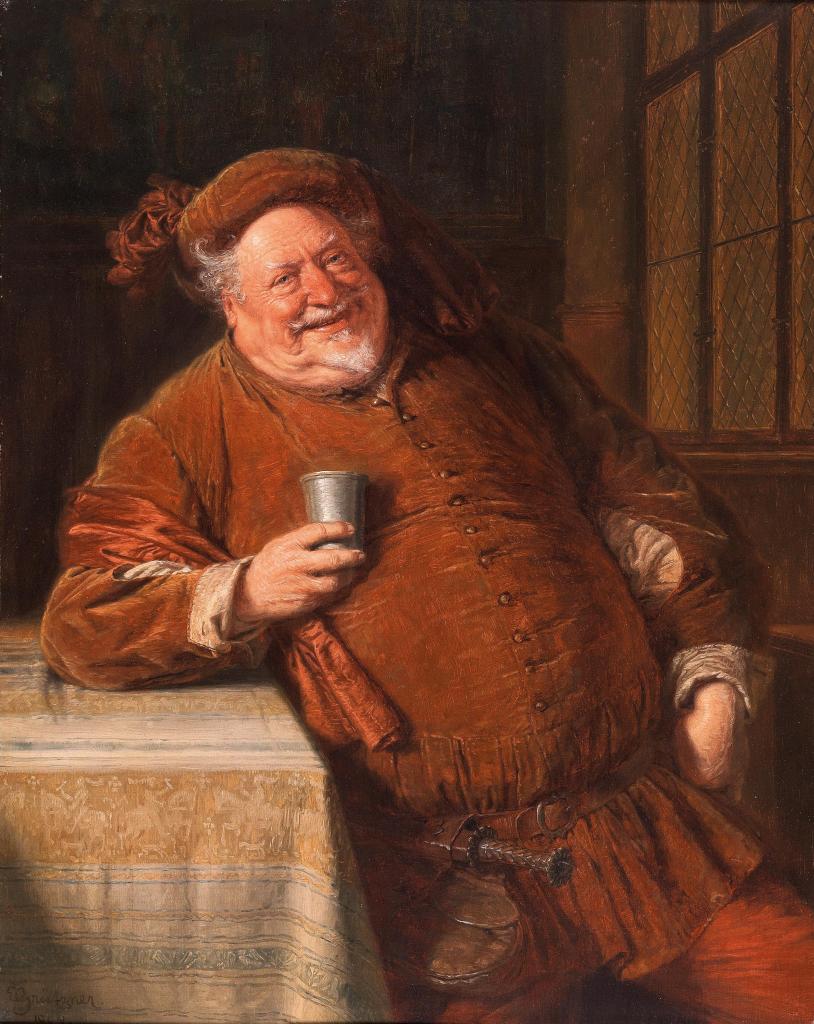
[Painting shown is Falstaff II by Eduard von Grützner, 1904]

Alumni Dinner

LORELAI: [Headmaster Charleston]suggested setting up a meeting with a Harvard graduate, like a dinner or something. He even gave me the number of someone he knows.

RORY: An alumni dinner?

An “alumni dinner” is actually a dinner given for alumni of a university, not by an alumnus. Harvard holds several alumni dinners each year.

Headmaster Charleston seems to be talking about meetings for prospective students which are set up by institutions such as the Harvard Club – there is a Harvard Club for Southern Connecticut in Wallingford. My understanding is that these are official events, which at least a couple dozen of the best and brightest from each area attend at the same time – not just one student being given a phone number by their school principal, which seems incredibly sketchy.

After meeting with prospective applicants, the alumni association involved (such as the Harvard Club) will then meet with an admissions officer from the university, and put in a good word for the students they think would make great “Harvard material” (or whatever university it is). It sounds like privileged kids getting even more help to be accepted into university, but these associations are apparently very keen to increase diversity, and may advocate strongly for bright, successful students from a variety of backgrounds.

It almost seems as if Headmaster Charleston considers Rory to be one of these “non-traditional” Harvard applicants, who might benefit from some kind of assistance. I’m not sure Rory is actually that non-traditional, but in any case, I’m pretty sure the situation in this episode doesn’t happen in real life – and if it does, it shouldn’t!

Somehow we’ve gone from Rory being special and having the brains and hard work and tenacity to get into Harvard to Rory needing to be shuffled in the backdoor through some shady deal with a Harvard alumnus.

Lane’s Bands in a Line from Progressive Rock

LANE: [on phone] I mean, I contend that you can draw a straight line from Yes to Jethro Tull to The Jam to Nirvana, bing bang boom . . . Who are the Jam? [to Rory and Lorelai] That’s disturbing.

Yes: English progressive rock band formed in 1968 by lead singer and frontman Jon Anderson, bassist Chris Squire, guitarist Peter Banks, keyboardist Tony Kaye and drummer Bill Bruford. It has had numerous lineup changes since then. Yes have explored several musical styles over the years and are regarded as progressive rock pioneers. They had a move towards more commercial, pop-oriented rock, and had their highest-selling album in 1983, 90125, with its #1 single, “Owner of a Lonely Heart”. Yes are one of the most successful, influential, and longest-lasting progressive rock bands, selling tens of millions of records, winning a Grammy, and being inducted into the Rock and Roll Hall of Fame in 2017.

Jethro Tull: British rock band formed in 1967, and forging a signature progressive rock sound. The group’s bandleader, founder, primary composer and only constant member is Ian Anderson (no relation to Jon Anderson), a multi-instrumentalist who mainly plays flute and acoustic guitar, and is also the lead vocalist. Their first commercial success was Stand Up (1969), which went to #1 in the UK, while Thick as a Brick (1972) is regarded as a classic. They have sold 60 million albums, won a Grammy, and are one of the most commercially successful and eccentric progressive rock bands of all time.

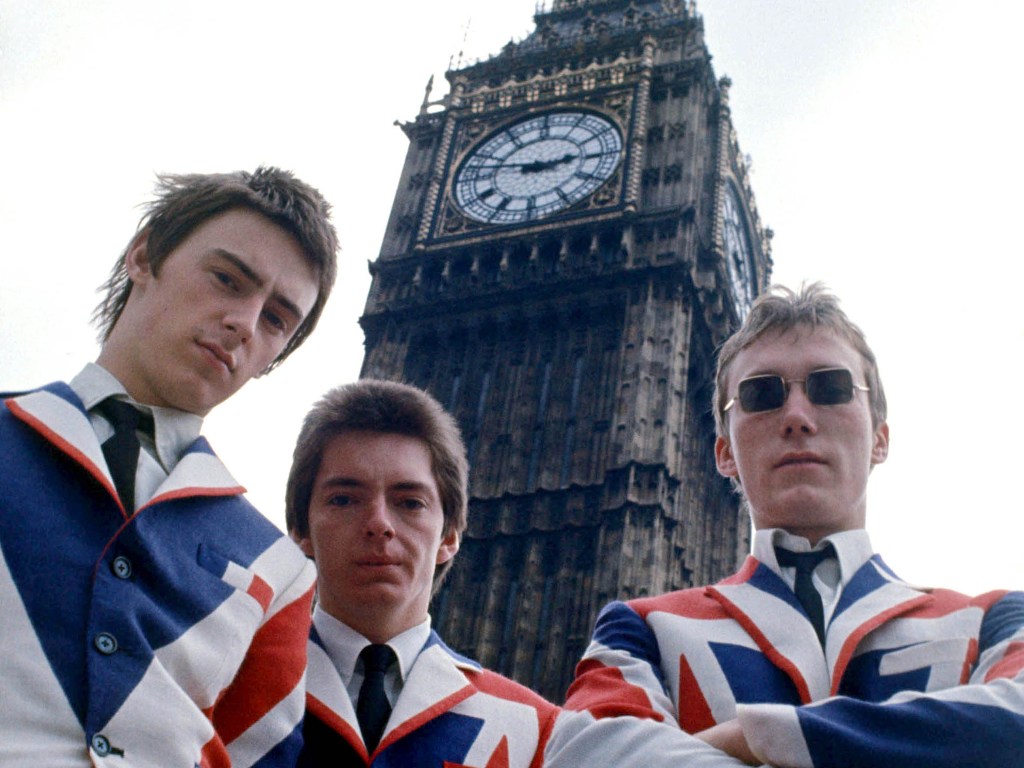
The Jam [pictured]: English mod revival and punk rock band which formed in 1972, led by Paul Weller on bass and lead vocals, and broke up in 1982. While The Jam shared the angry social protest and fast tempo of punk, they wore tailored suits and were influenced by 1960s bands such as The Who and The Kinks, as well as Motown, and were at the forefront of the Mod Revival movement in the UK. They released six studio albums, and had eighteen consecutive Top 40 singles in the UK, of which “Going Underground”, “Start!”, Town Like Malice”, and “Beat Surrender” all went to #1. The guy on the phone hasn’t heard of The Jam, because they broke up twenty years earlier, and were not well known in the US – their biggest hit there was “Town Like Malice”, which got to #31.

Nirvana: Rock band founded in 1987 in Aberdeen, Washington, by lead singer and guitarist Kurt Cobain, previously discussed, and bassist Krist Novoselic; Dave Grohl, previously mentioned, was recruited as drummer in 1990. They established themselves as part of the Seattle grunge scene and found unexpected mainstream success with “Smells Like Teen Spirit”, the first single from their landmark second album Nevermind (1991). Nirvana’s success popularised alternative rock, and they were often referenced as the figurehead band of Generation X. Their music maintains a popular following and continues to influence modern rock culture. Nirvana is one of the best-selling bands in the world, had five #1 hits, received a Grammy Award, and were inducted into the Rock and Roll Hall of Fame in 2014.

You can’t actually draw a straight line from Yes to Jethro Tull to The Jam to Nirvana (the difficulty of drawing one from Yes to Jethro Tull seems quite enough, when Jethro Tull came first!). However, they’d all fit into some sort of Venn diagram with psychedelic rock, so Lane’s bold assertion is incorrect, but not completely crazy.

The Beatles at Shea Stadium

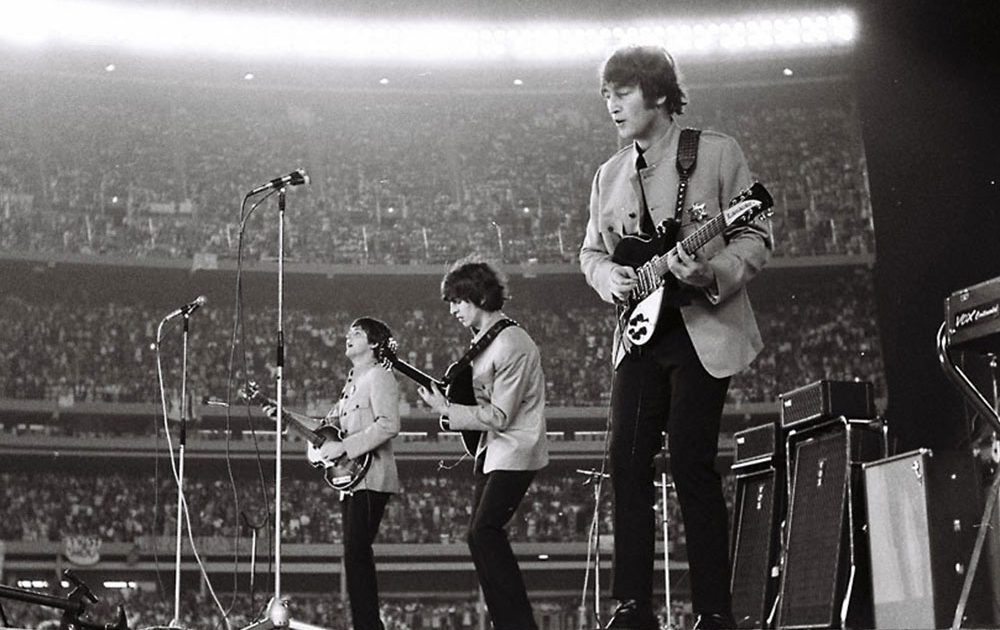
PARIS: I was working with the losers in the AV club to project it on a giant video screen. And all Mr. Hunter said was, “Paris, this isn’t The Beatles at Shea Stadium.” Nice anachronism, huh? Like they had video screens in ’63. His references are as topical as his suits.

The Beatles at Shea Stadium, previously discussed.

The Beatles actually performed there in 1965, not 1963. They must have realised that they made a mistake, because on Netflix, there is re-recorded audio correcting the error to 1965 instead.

“Putting her on an iceberg”

RORY: Are you sure the first thing you wanna do in office is to get a ninety-three year old woman sacked?

PARIS: Hey, at least I’m not putting her on an iceberg and shoving her off to sea …

Paris refers to a stereotype of Eskimo culture where the elderly were put on an ice floe to die when they became a burden. Although some Eskimos did practice senilicide (the killing of the elderly), it was rare, usually only practised during famines, and there is no record of anyone being put out on the ice to die – simple abandonment was probably the most common method. In many cases, it may have been what we might refer to as assisted suicide. It is no longer practised in Eskimo culture, and hasn’t been for a very long time.

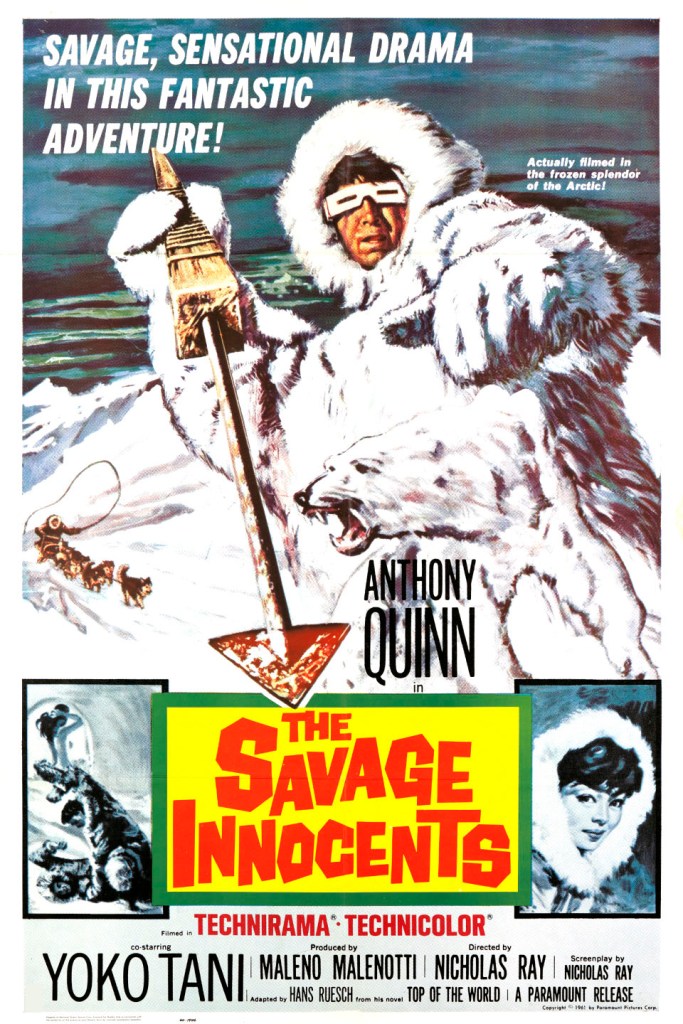
The idea of elderly Eskimos being pushed out to sea on ice floes might have come from the 1960 adventure film, The Savage Innocents, directed and co-written by Nicholas Ray, and based on the 1950 novel Top of the World by Swiss author Hans Ruesch. The film stars Anthony Quinn as an Inuit hunter – which is believed to be the inspiration for Bob Dylan’s 1967 song, “Quinn the Eskimo (The Mighty Quinn)”, successfully recorded by British band Manfred Mann in 1968.

In the film, the hunter’s mother-in-law is put on the ice to die, but is rescued soon after. In another scene, the hunter’s wife walks across the ice to commit suicide; a piece of ice breaks off and she briefly floats on the ice floe before drowning herself. The two scenes together may have suggested the popular idea of the elderly being set adrift on the ice to die.

Although Paris is made to seem a monster by getting rid of the librarian, she is ninety-three years old, and is in intensive care during this episode! Surely it is time for her to retire, on health grounds? I don’t feel as if Paris is being that unreasonable here.

Ottoman and Napoleon Complex

RORY: Hello living room.

LORELAI: Hello Rory, we missed you. Not the ottoman, of course, but everyone knows he’s a snob. Napoleon complex, he only really likes the magazine rack.

An ottoman is a small padded seat without a back or arms that can be used as a table, stool, or footstool. They are also known as tuffets, hassocks, or pouffes. The name comes from the Ottoman Empire from where it originated, the seat introduced to Europe in the 18th century.

A Napoleon complex is an imaginary syndrome attributed to people of short stature, where the short person (usually a man), overcompensates for their size by being too aggressive or domineering. In psychology, it is regarded as a derogatory social stereotype and a piece of mysandry. It comes from the idea put about by the British in the 19th century that Napoleon Bonaparte’s short temper was caused by him being of short size. In fact, Napoleon was 5 foot 7, average height for his era.

Presumably the ottoman only likes the magazine rack because it’s the one thing smaller than it is!

“I have lost. Mr Nixon has won”

PARIS: How’s this sound for a template? I have done my best. I have lost. Mr. Nixon has won. The democratic process has worked its will, so now let’s get on with the urgent task of uniting this country … Hubert Humphrey’s concession speech. Now, other than the part about Nixon, parts of it really seem to apply here.

Paris refers to Hubert Humphrey’s concession speech on 6 November 1968, acknowledging that Richard Nixon had been successful in his bid to become President of the United States by a narrow margin. It ended: “I have done my best. I have lost. Mr. Nixon has won. The democratic process has worked its will. Now let us get on with the urgent task of uniting this country”.

Paris says that Hubert Humphrey probably wasn’t considered very fun either, but this is one of a myriad of things that Paris gets completely wrong. Hubert Humphrey was known for his positive outlook and zest for life, a free spirit who loved every minute of being alive and wanted to make the world a happier place. Even when conceding defeat, he spoke about how much fun the campaign had been. It’s probably one of America’s tragedies that they failed to elect him as President.

Pup ‘N’ Taco

EMILY: I hope Raul’s getting enough shots of Lorelai. I don’t want the whole damn ceremony and none of her.

RICHARD: Oh, no, I disagree. I hope he gets every inspired word articulated by the East Coast Marketing Director of Pup ‘N’ Taco.

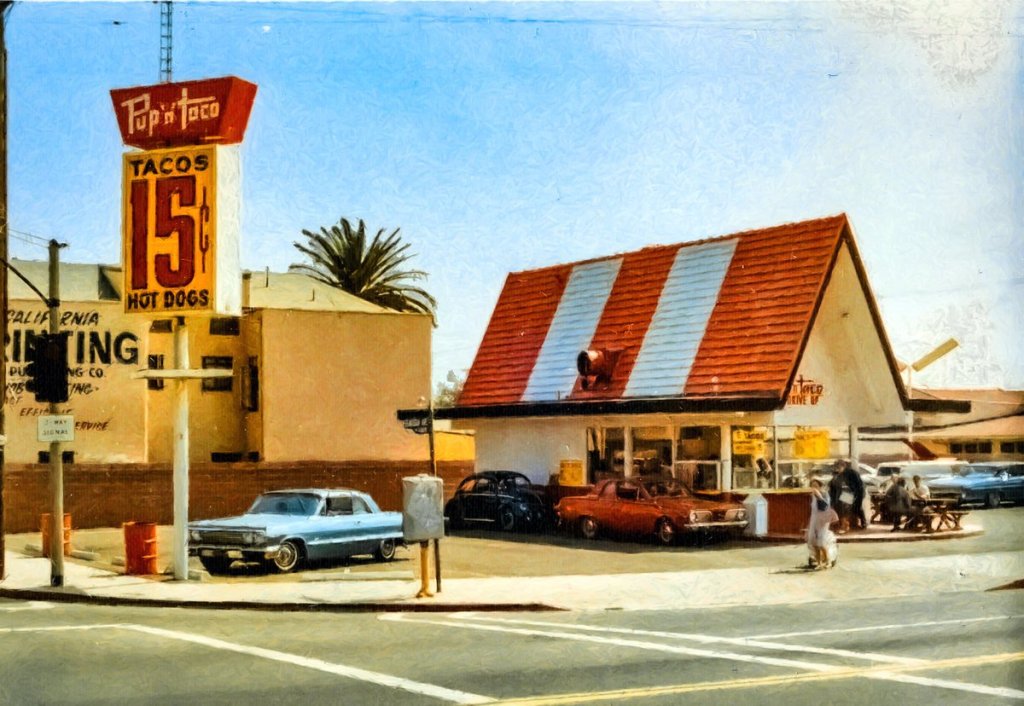
Pup ‘N’ Taco, a chain of fast-food restaurants in Southern California, originally headquartered in Long Beach, L.A. It was founded in 1956 by Russell Wendell as a drive-in restaurant selling tacos, hot dogs, and pastrami sandwiches. The first officially named Pup ‘N’ Taco opened in Pasadena in 1965. The business was bought out by Taco Bell in 1984, effectively ending the chain.

Not only did Pup ‘N’ Taco never have an East Coast Marketing Director (they were Californian), but they didn’t even exist in 2002! I presume Richard has no idea who he’s been listening to, and only knows the name Pup ‘N’ Taco because Johnny Carson used to make a lot of jokes about it on The Tonight Show in the 1970s and ’80s.